
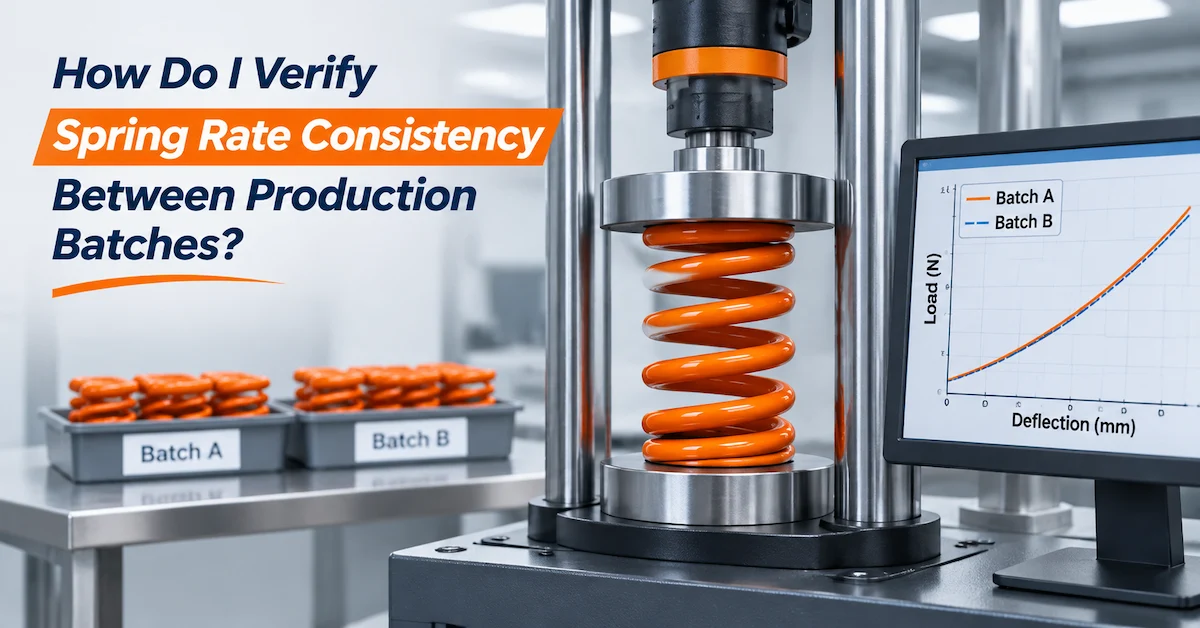
Verify spring rate consistency by comparing load-deflection results from defined load points under the same fixture, conditioning, temperature, measurement direction, speed, and calculation method. Do not compare one free-height measurement from one batch with a load-deflection result from another. A useful batch review combines an agreed test method, traceable samples, repeat measurements, lot-level statistics, visual and dimensional checks, and a documented response for outliers.
The buyer's goal is not to prove that every spring has an identical curve. Manufacturing variation exists, and the acceptable range depends on the vehicle, spring design, installed condition, load window, and production risk. The goal is to show that the variation is understood, within the project limits, and stable enough that a later batch will support the same suspension configuration.
This guide is for OEM buyers, suspension brands, distributors, quality engineers, and vehicle developers checking a suspension spring manufacturer's performance between batches. It focuses on production acceptance rather than general spring selection. The same method can be used for loose springs, replacement springs, or springs assembled into a shock absorber, but the test condition must match the product being accepted.
Start by defining what “same spring rate” means
Spring rate is the change in force divided by the change in deflection over a defined region. For a linear spring, a simplified calculation is k = (F2 - F1) / (x2 - x1). That formula is easy to write and easy to misuse. The result changes when the load points, seating condition, direction, speed, temperature, fixture alignment, or spring history changes.
Before comparing batches, the buyer and supplier should agree whether acceptance is based on a nominal rate, a load at one or more installed heights, a complete load-deflection curve, or a combination. For progressive, dual-rate, or preloaded assemblies, one number cannot describe the whole operating range.
| Definition choice | What it measures | When it is useful |
|---|---|---|
| Free height | Unloaded spring length after a defined rest condition. | Dimensional identity and a quick screen; not a substitute for rate. |
| Load at height | Force required to reach specified installed heights. | Vehicle ride-height, sag, and load-support checks. |
| Two-point rate | Slope between two agreed force or displacement points. | Linear or approximately linear working regions. |
| Multi-point curve | Force response across several positions or loads. | Progressive springs, dual-rate designs, and broader operating windows. |
| Complete assembly response | Spring plus seats, preload, damper, and hardware in an installed condition. | Final vehicle or shock-assembly acceptance; requires strict fixture control. |
Separate spring rate from preload
Preload changes the force present at a given installed height, but it does not normally change the rate of a linear spring. A buyer who compares assembled force without recording preload can misdiagnose a setting difference as a spring-rate difference. The test record should state spring length, compressed position, installed preload, seat condition, and whether the spring is bare or inside a shock assembly.
State the measurement direction and seating condition
A spring may settle during the first compression cycles. The first measurement can therefore differ from a later measurement even when the part is acceptable. Define whether the spring is preconditioned, how many seating cycles are applied, whether the test is compression-only, and whether the force is recorded on loading, unloading, or both.
Use the same unit system and rounding rule
Rate is frequently reported in N/mm, N/m, kgf/mm, or lb/in. Convert units before comparison and retain the raw force and displacement values. A rounded label can hide meaningful differences, especially when a buyer is comparing a narrow tolerance band. The purchase specification should identify the reporting unit, decimal resolution, and rounding method.
Write a batch comparison test method before the shipment arrives
Testing becomes difficult to defend when the method is created after an outlier appears. Issue the method with the purchase specification or quality agreement. It should be detailed enough that the buyer, supplier, and independent laboratory would obtain comparable results from the same spring.
| Method element | Decision to document | Why it matters |
|---|---|---|
| Sample identity | Part number, spring revision, batch, cavity or line where relevant, and sample number. | Prevents results from being detached from the actual lot. |
| Conditioning | Storage, temperature equalization, rest time, cleaning, and pre-cycles. | Reduces history and environment effects. |
| Fixture | Seats, alignment, guide, diameter clearance, and support surface. | Side load or poor seating can change apparent force. |
| Machine settings | Displacement rate, force range, travel range, sampling frequency, and return behavior. | Allows repeatable measurements and meaningful trend review. |
| Load points | Heights or forces used for rate and installed-load calculations. | Defines the region that matters to the vehicle. |
| Acceptance | Nominal, tolerance, outlier rule, retest rule, and lot disposition. | Prevents subjective pass or fail decisions. |
Control the fixture and support surfaces
The spring must be seated in a way that resembles the approved assembly or the specified laboratory condition. If the upper and lower seats are not parallel, the spring can bow or contact the fixture differently between tests. A fixture that is too small can constrain the spring; one that is too large can allow unstable movement. The method should describe the seat geometry and any guide used.
Control temperature and conditioning
Temperature affects materials, lubricant, and measurement equipment. The effect may be small or significant depending on the design and test range, but it should not be ignored when a batch comparison is used for a close acceptance decision. Record room or part temperature as required by the project, and allow samples to stabilize before testing.
Control the load points that reflect vehicle use
Do not choose convenient load points that are unrelated to the installed height. Use the vehicle's relevant static and operating positions where those are known. If the spring operates between two installed heights, the batch comparison should include those points or a curve that covers them. If the design has a preload collar, state whether the spring is tested at zero preload or in the installed setting.
Choose a sampling plan that can show both average and spread
A single spring can show that one sample is acceptable. It cannot show how the batch behaves. A useful sampling plan gives the buyer enough information to see average rate, within-batch spread, between-batch drift, and unusual outliers. The exact quantity depends on risk, volume, customer requirements, and the consequences of a mismatch.
| Sampling approach | What it can show | Limitation |
|---|---|---|
| One sample per batch | A quick signal that the lot is not obviously wrong. | Cannot estimate spread or identify a mixed lot. |
| Random samples across a lot | Average, spread, and potential lot-level variation. | Requires a defensible selection method and adequate quantity. |
| Start, middle, and end of production | Possible time or process drift during a run. | May miss variation if the lot is mixed or the process changes by machine. |
| Samples by line, cavity, or material batch | Source-related differences and traceability signals. | Needs supplier records and a clear lot definition. |
| 100% functional test | Strong containment for a high-risk characteristic when feasible. | Higher cost and still depends on a valid, calibrated method. |
Ask the supplier to explain what constitutes a production batch. It may be a shift, a heat or wire batch, a furnace load, a machine run, a packaging lot, or a purchase-order quantity. If the definition changes from one order to the next, trend analysis becomes unreliable.
Randomize the sample selection
Do not select only the cleanest or easiest-to-reach cartons. Use a documented method that covers the lot. If springs are packed in rows, layers, or bundles, select from more than one location. Record the carton, pallet, production date, and supplier batch so a failed result can be contained without guessing which units are affected.
Link the spring to the complete assembly identity
A spring may look identical while the assembly uses a different seat, spacer, collar, or damper setting. If the customer is accepting a complete shock absorber, record the complete BOM and the spring's own identity. Test the bare spring for material behavior and the assembled unit for installed response when both are important to the application.
Measure rate consistently and keep the raw data
The report should contain more than a pass or fail column. Retain raw force and displacement points, calculated rate, machine identity, fixture identity, calibration status, operator, date, temperature, conditioning, sample number, and batch. Raw data allows the buyer to distinguish a calculation error from a real process shift.
Run repeat measurements on selected samples
Repeatability is the variation observed when the same spring is tested again under the same conditions. If repeat results vary more than the buyer's acceptance band, the method is not ready for a batch decision. Possible causes include seating, alignment, displacement zero, machine resolution, spring settling, or operator handling.
Calculate the rate from the same points
For a two-point comparison, use the same force or displacement points for every sample. Do not calculate one spring between 10 and 30 mm and another between 20 and 40 mm because the resulting slopes may describe different parts of the curve. For a progressive spring, report the curve or several defined slopes instead of one average that hides the transition.
Check the force at installed heights
Rate consistency and installed-force consistency are related but not identical. A free-height shift, seat difference, or preload change can move the entire load-deflection curve. Record force at the heights that matter to ride height and sag. This is especially important when the spring is used with a threaded collar or when the vehicle carries different payloads.
Review hysteresis or loading history when relevant
Some springs show a difference between loading and unloading because of friction, seating, fixture contact, or test history. If the application or specification cares about this behavior, define whether the acceptance result uses the loading curve, unloading curve, or a specified cycle. Do not mix curves without documenting the reason.
Use statistics to see drift, not to hide nonconforming parts
Lot average and standard deviation are useful summaries, but they do not replace engineering judgment. A batch can have an acceptable average while containing a harmful outlier or two mixed populations. Review individual results, the distribution, the time sequence, and the relationship to the specification.
| Review signal | What it may indicate | Next question |
|---|---|---|
| Average shifted from the approved baseline | Spring process, material, tooling, heat treatment, or measurement change. | Did the source, process, or revision change? |
| Spread increased | Less stable process, mixed inputs, fixture issue, or inconsistent conditioning. | Are results linked to line, time, or material lot? |
| One isolated outlier | Part defect, test error, damage, or selection anomaly. | Can the sample be retested under the same method? |
| Two distinct clusters | Mixed spring identity, machine setting, or production source. | Is the lot definition too broad or are parts mixed? |
| Trend during the run | Temperature, tooling wear, operator, material, or machine drift. | Where did the shift begin and what was changed? |
Use control charts when the program is mature enough
A control chart can show whether the process is stable over time, but it must use a stable characteristic, consistent sampling, and a clear reaction plan. Control limits describe process behavior; specification limits describe customer acceptance. They are not interchangeable. A process can be statistically stable and still consistently outside the required performance range.
Use capability indices only with a suitable process
Cp, Cpk, or similar indices can help compare process spread with a tolerance band when the data is representative and the process is stable. They should not be calculated from a mixed lot, a changing method, or a handful of selected samples and then presented as proof of quality. Keep the underlying data available and state the assumptions.
Investigate outliers before accepting or rejecting the lot
An outlier should trigger a controlled investigation, not an automatic retest until the result disappears. The first step is containment: identify the affected sample and hold the associated material or shipment when the risk justifies it. Then determine whether the result is caused by measurement, part condition, or process variation.
- Check the sample identity, label, batch, production date, and location in the lot.
- Review machine calibration, fixture condition, zero setting, operator record, and raw force-displacement data.
- Inspect free height, coil contact, seat marks, surface damage, finish, and visible deformation.
- Retest under the original method with a second qualified measurement or witness where needed.
- Expand sampling only when the reaction plan defines how the additional results affect disposition.
- Decide whether the lot is accepted, accepted with documented deviation, reworked, sorted, rejected, or released after corrective action.
Do not replace the original result with a retest result. Keep both records and explain why the final decision was made. If the test method was wrong, correct the method and assess whether previous lots need review. If the spring is truly out of specification, the supplier should identify affected quantity and root cause rather than treating the unit as a harmless exception.
Distinguish an outlier from a different approved configuration
Some apparent outliers are actually a different spring rate, position, market version, or vehicle load class that entered the shipment without clear identification. Compare the spring ends, wire, dimensions, label, BOM, and package. A traceability problem can look like a manufacturing problem until the identities are separated.
Check dimensions and appearance together with rate
Spring rate is a functional characteristic, but it should be reviewed with the dimensions and condition that make the result meaningful. Free length, outside diameter, wire diameter, end shape, seat contact, coating, and corrosion condition can affect installation or indicate a process change. A rate result alone cannot confirm interchangeability.
| Companion check | Why it matters to batch acceptance | Typical record |
|---|---|---|
| Free height | A shift can change installed preload or ride height even when the calculated slope is similar. | Measured height, rest condition, and tolerance. |
| Outside and wire diameter | Can reveal tool, material, or forming changes that influence fit or fatigue risk. | Measurement method and sampling result. |
| End shape and seat contact | Improper seating can change load path and create apparent rate variation. | Visual check, seat images, and dimensional result. |
| Surface and finish | Damage, coating variation, or corrosion can affect installation and service risk. | Appearance standard, defect record, and lot identity. |
| Assembly identity | Confirms that the tested spring is paired with the correct damper, seat, and hardware. | BOM, label, batch, and assembly record. |
When the spring is part of a shock absorber assembly, decide whether the acceptance gate applies to the loose spring, the assembled shock, or both. The loose spring test isolates spring behavior. The assembly test checks installed load, preload, seating, and product identity. Neither should be assumed to replace the other when both risks matter.
Verify supplier controls before you rely on a batch report
A polished inspection report is useful only when it reflects a controlled process. Ask the supplier how spring identity is maintained from raw material and forming through heat treatment, surface treatment, inspection, packing, and shipment. The buyer does not need every internal work instruction, but should understand where variation can enter and how it is detected.
| Supplier control | Buyer verification question | Evidence to request |
|---|---|---|
| Material and process identity | Can the spring lot be linked to the material and production route? | Lot record, traveler, or traceability reference as applicable. |
| Forming and heat treatment | Are key settings or batch conditions recorded and reviewed? | Process record or controlled inspection summary. |
| Rate test | Is the same method used across batches and shifts? | Test method, machine identity, calibration status, and raw data. |
| Nonconforming product | How are failed or suspect springs contained and identified? | Reaction procedure and sample nonconformance record where available. |
| Change control | Will material, tooling, line, process, or supplier changes be notified? | Approved change route and revalidation trigger. |
| Packaging and labels | Can different rates and revisions be separated in the warehouse? | Label, carton, batch, and part-number example. |
The public BEDO suspension spring range is a useful product-category reference, but a new OEM or aftermarket program still needs a project-specific spring identity, load-deflection method, tolerance, and lot-control plan. Public product copy should not be used as a substitute for the approved purchase specification.
Set an acceptance rule that supports purchasing decisions
The acceptance rule should answer three questions: what is measured, what limits apply, and what happens when a result is outside the limits. Avoid a vague statement such as “spring rate must be consistent.” State the characteristic, condition, tolerance, sampling, retest, and disposition.
| Acceptance field | Example of a clear definition | What must remain project-specific |
|---|---|---|
| Characteristic | Force at specified heights plus rate between specified points. | Heights, forces, curve region, and whether the spring is bare or assembled. |
| Test condition | Defined fixture, pre-cycle, speed, temperature, and measurement direction. | Values appropriate to the approved spring and application. |
| Sample rule | Random samples from a defined batch with additional checks on reaction. | Quantity, frequency, risk class, and customer requirements. |
| Disposition | Accept, hold, sort, rework, reject, or accept by written deviation. | Authority, escalation time, and revalidation requirement. |
| Record retention | Raw data, summary, batch, revision, equipment, operator, and decision. | Retention period and systems used by buyer and supplier. |
Do not copy a tolerance from another spring
The correct tolerance depends on the vehicle and the risk of a rate mismatch. A small change may be acceptable for one application and unacceptable for another if it changes ride height, sag, bottoming margin, or handling. Set the limit from the approved design and validation evidence rather than from a generic industry number.
Define the link to vehicle validation
If a batch is within the spring-rate limit but the vehicle ride height or handling changes, the team should investigate the complete system. Tire pressure, payload, damper setting, installation height, bushing friction, and measurement condition can also affect the vehicle result. Batch acceptance should protect the vehicle requirement without claiming that spring rate explains every field symptom.
How to read a supplier's batch report
Before approving a report, check whether another engineer could reproduce the conclusion from the document. A credible report shows the lot, revision, method, samples, raw or traceable data, calculation, limits, and decision. It also states any deviation instead of hiding it in a general comment.
- Confirm that the part number, spring revision, and assembly identity match the purchase order.
- Confirm that the batch definition and production date are stated.
- Check that load points, displacement direction, speed, temperature, fixture, and preconditioning are shown.
- Check that the report includes individual results, not only an average.
- Review the highest and lowest values and their physical sample identities.
- Check whether the calculated rate uses the same points for every sample.
- Confirm that failed or retested samples remain visible in the record.
- Confirm that the disposition is signed by the responsible quality or engineering function.
If important fields are missing, ask for clarification before accepting the shipment. A missing field does not automatically mean the springs are bad, but it does mean that the report cannot support a strong comparison until the test basis is known.
Frequently asked questions
What is the most reliable way to compare spring rate between batches?
Use the same load-deflection method, fixture, conditioning, temperature, measurement direction, load points, calculation, and sampling rule for every batch. Keep the individual results and compare both average and spread.
Is one spring enough to verify a production batch?
One spring can identify an obvious mismatch, but it cannot show lot variation or a mixed population. The appropriate sample size depends on application risk, volume, customer requirements, and the agreed quality plan.
Should I compare free length or spring rate?
Both may be needed. Free length checks dimensional identity and can affect preload; spring rate checks load-deflection behavior. Neither alone proves that an assembled shock absorber will deliver the approved vehicle result.
Does preload change spring rate?
Preload changes the force present at a given installed position but does not normally change the rate of a linear spring. Record preload and installed height so the two effects are not confused.
How should a buyer handle one outlier?
Contain the sample or affected lot as appropriate, verify identity and measurement method, inspect the spring, retest under the original method, and follow the agreed reaction plan. Keep the original result and document the final disposition.
Can a batch average pass while the springs are still inconsistent?
Yes. An average can hide a wide spread, an outlier, or two different populations. Review individual results, standard deviation or other spread measures, time order, and the relationship to the specification.
Should the spring be tested alone or inside the shock absorber?
Test the loose spring when you need to isolate spring behavior. Test the complete shock when installed load, preload, seating, hardware, and product identity are part of the acceptance risk. Some programs need both.
Can BEDO provide a universal spring-rate tolerance?
No universal tolerance is appropriate for every vehicle or spring. BEDO can review the application, load cases, spring definition, test points, sampling, and acceptance requirements for a project-specific production plan through the official contact page.
Conclusion
Spring rate consistency between production batches should be verified with a controlled comparison, not by looking at labels or measuring one unloaded spring. Define the characteristic, load points, fixture, conditioning, temperature, speed, sampling, calculation, acceptance limits, and outlier response before the shipment arrives. Then keep the raw data and connect every result to the exact spring revision and production batch.
For a production program, review the suspension spring category, align the test method with the approved vehicle requirement, and ask the supplier to confirm the records and reaction plan before repeat orders are released.