
Can a Shock Absorber Drawing Be Created From a Physical Sample?
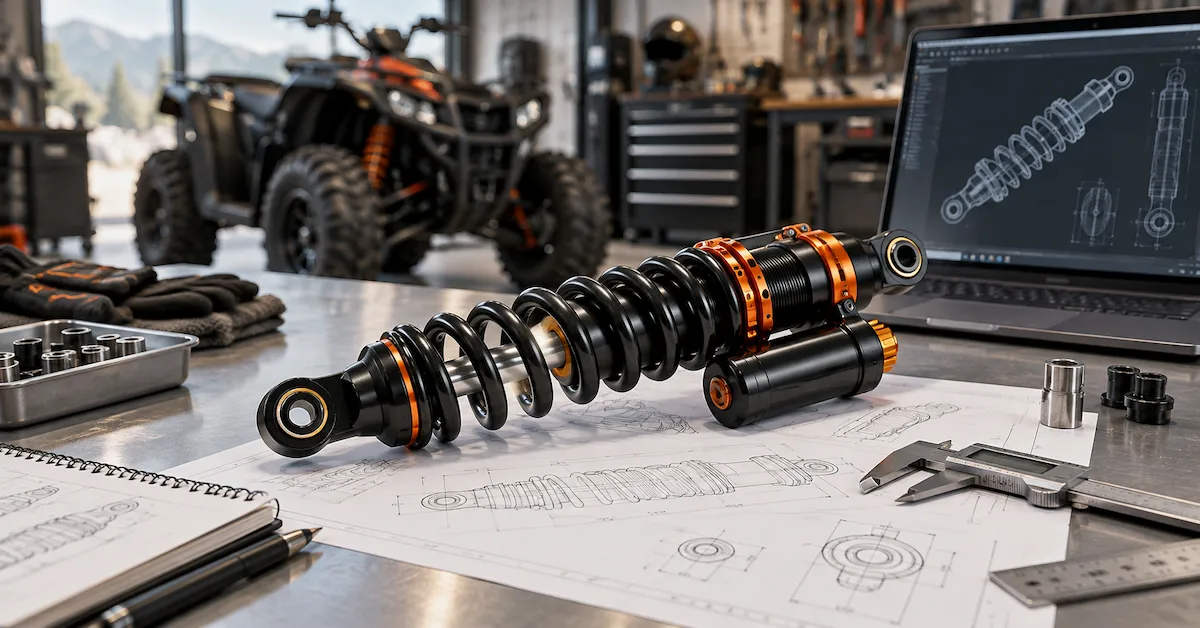
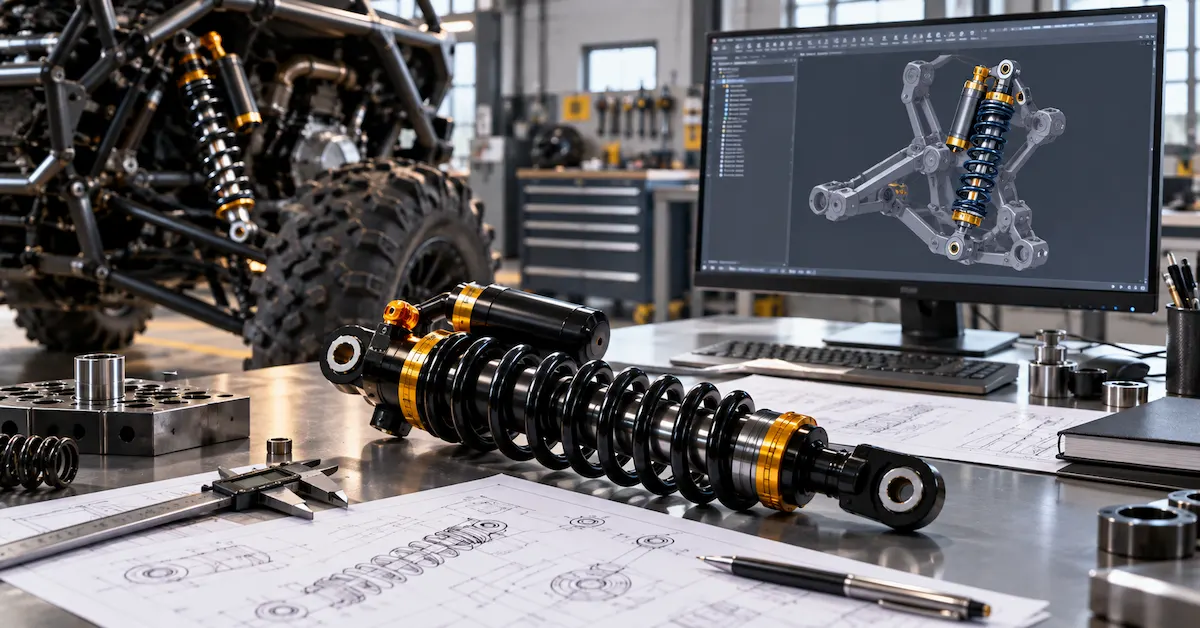
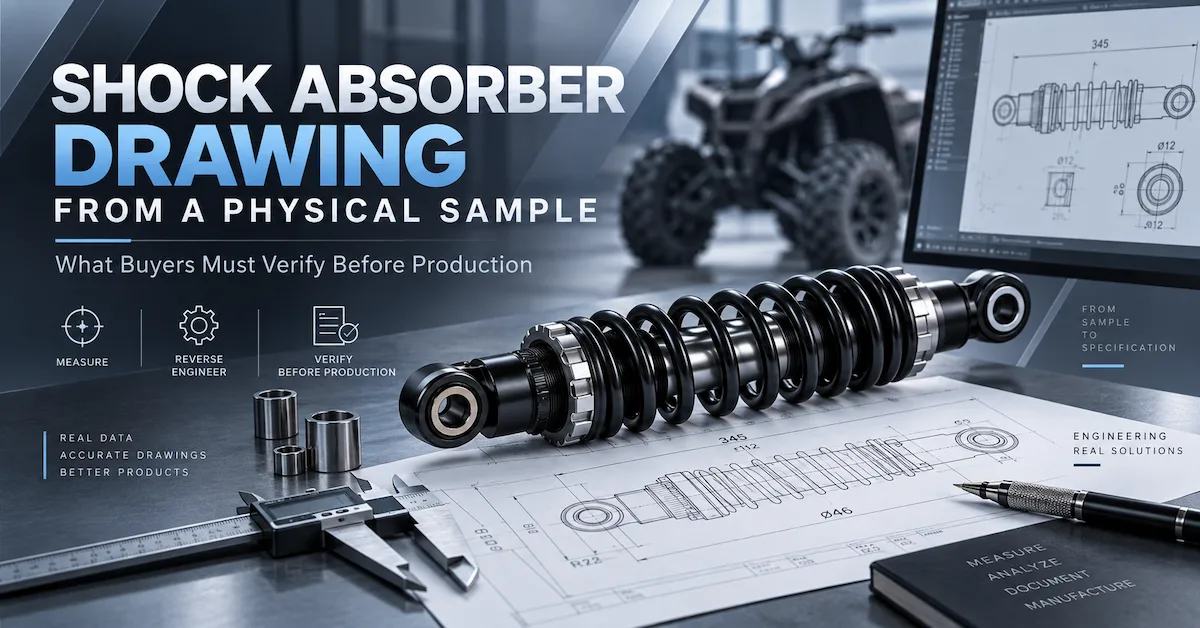
Yes. A shock absorber drawing from a physical sample can be created by measuring the part’s accessible dimensions, mounting interfaces, spring envelope, body structure, reservoir arrangement, and other visible features. This is a practical development route when an OEM buyer, aftermarket brand, distributor, or specialty vehicle manufacturer owns a reference shock but no longer has the original CAD files or production drawing. BEDO’s shock absorber drawing guidance confirms that a physical sample can be used as a starting point for dimensional analysis and drawing development, while its prototype support includes sample analysis and drawing review. BEDO shock absorber drawing service
However, measuring a sample does not automatically recover every element of the original engineering specification. A physical part can reveal geometry, but it may not reveal the original valve design, oil specification, gas pressure, exact material properties, manufacturing tolerances, or the design assumptions behind spring and damping choices. BEDO’s prototype guide specifically notes that sample-based development can measure length, stroke, mounting points, body dimensions, rod diameter, and spring dimensions, while internal specifications still require additional engineering input.
When Is Sample-to-Drawing Development the Right Approach?
This route is particularly useful when the buyer has a successful existing product but lacks original documentation, when an old supplier is no longer available, when a replacement product is being localized, or when an aftermarket brand wants to use a proven physical reference as the starting point for a new OEM program. It can also be useful when the original part needs improvement rather than exact reproduction—for example, a different spring rate, revised damping, another finish, private-label identification, or adaptation to a modified vehicle.
BEDO’s sample-based shock absorber customization guide describes this route for ATV, UTV, motorcycle, electric motorcycle, snowmobile, and other off-road projects, including dimensional analysis, mounting review, and subsequent customization.
Sample-to-drawing development is less suitable when the buyer expects a factory to infer an entirely new suspension requirement from one worn component. If the target vehicle, load, geometry, or performance objective has changed significantly, the physical sample should be treated as reference data, not as the final engineering specification.
What Can a Manufacturer Measure From the Physical Sample?
The first step is to separate features that can be directly measured from characteristics that require engineering validation.
| Sample feature | Can normally be measured? | Typical use in drawing |
|---|---|---|
| Extended length | Yes | Defines overall installed extension reference |
| Compressed length | Often, with correct procedure | Defines compression limit |
| Effective stroke | Usually measurable | Defines damper movement |
| Upper mount | Yes | Hole, width, sleeve, bushing details |
| Lower mount | Yes | Same for lower interface |
| Rod diameter | Yes | External dimensional reference |
| Body diameter | Yes | Packaging and clearance |
| Spring outer diameter | Yes | Installation envelope |
| Spring free length | Yes | Spring reference |
| Reservoir size | Yes | Packaging reference |
| Reservoir hose length | Yes | Routing reference |
| Adjuster position | Yes | External layout |
| Surface appearance | Yes | Visual reference only |
| Internal valve design | Not reliably from external measurement | Requires deeper engineering analysis |
| Oil specification | Not from dimensions | Requires known specification or engineering selection |
| Gas pressure | Not from external geometry | Must be defined/tested |
| Material grade | Not reliably from appearance | Requires documentation or material analysis |
| Original damping curve | Not from dimensions | Requires testing |
| Original spring rate | Not from appearance alone | Requires spring measurement/testing |
A professional drawing should distinguish between measured dimensions, buyer-defined requirements, and engineering values still to be confirmed.
Do Not Use a Worn Sample as an Unquestioned Master
Before measuring the shock, inspect it. A used sample can contain changes that were never part of the original design.
Common problems include worn bushings, deformed sleeves, corrosion, bent mounting eyes, damaged threads, leaking seals, rod damage, spring settling, missing spacers, or previous repair work. If these conditions are measured without documentation, the manufacturer may reproduce wear instead of reproducing the intended product.
Create a sample inspection record before reverse measurement. Photograph all sides, assign the part a sample ID, identify its source vehicle, and record known damage. BEDO’s sample-based development process treats sample analysis as an engineering input rather than a simple copying exercise. Shock absorber customization from sample
Define Measurement References Before Building the Drawing
One of the easiest ways to create an incorrect shock drawing is to use dimensions without defined reference points. For example, “overall length 450 mm” may refer to mounting-center distance, overall component envelope, end-to-end length, or another reference.
For each major dimension, the drawing should identify:
- where measurement begins;
- where measurement ends;
- whether the part is fully extended or compressed;
- which mounting center or surface is used;
- whether bushings and sleeves are installed;
- what tolerance applies after engineering review.
BEDO’s shock absorber measurement guide treats extended length, compressed length, stroke, mounting-hole diameter, mounting width, spring dimensions, and vehicle application as separate inputs. That is a useful approach when converting a physical sample into controlled drawing data.
Mounting Geometry Deserves More Detail Than One Bolt Size
For an OEM drawing, the mounting interface should describe more than the bolt-hole diameter. Record the upper and lower mounts independently.
Useful dimensions can include:
- mounting-hole diameter;
- sleeve inner diameter;
- sleeve outer diameter;
- mounting width;
- bushing width;
- eye diameter;
- clevis spacing where applicable;
- thread or pin details where applicable;
- mount orientation;
- angular relationship between upper and lower mounts.
Two shocks can have the same length and stroke yet still fail to interchange because one mounting width or bushing arrangement differs.
This is why a shock absorber drawing from a physical sample should capture installation geometry with enough detail to support both prototype manufacture and vehicle fitment inspection.
Should the Drawing Include the Spring?
Yes, if the spring is part of the complete shock assembly, but geometric spring data and performance spring data should be distinguished.
Geometric information may include:
- free length;
- outer or inner diameter;
- wire diameter where relevant;
- number of coils;
- seat interface;
- installed position.
Performance information may include:
- spring rate;
- load-deflection curve;
- preload;
- intended operating range.
A sample can provide the physical spring for testing, but the spring color or dimensions alone do not establish the correct rate. If the new vehicle load or application differs from the reference, the original spring may no longer be appropriate.
BEDO’s prototype-development service includes spring development as a separate engineering task, which is important because the factory should not simply assume that every measured spring characteristic must remain unchanged.
Can Damping Be Recovered From the Physical Sample?
External measurement cannot reproduce the original damping specification by itself.
Damping depends on internal factors such as valve architecture, piston design, hydraulic fluid, gas pressure, seals, flow passages, and other internal components. The existing shock can be tested to establish a performance baseline if its condition is suitable, but a worn sample may no longer behave as it did when new.
A better development process is:
Sample Measurement → Existing Performance Test Where Appropriate → Vehicle Requirement → Proposed Damping Target → Prototype → Test → Revision
If the buyer wants an exact replacement behavior, the manufacturer needs reliable baseline test data. If the goal is improved performance, then the existing shock should be treated as a benchmark rather than a specification that must be duplicated.
BEDO’s prototype shock absorber supplier guide explicitly distinguishes dimensional sample analysis from spring and damping validation.
Send Vehicle Data Alongside the Physical Sample
A physical sample answers “what does this component look like?” Vehicle information answers “what must the new component do?”
A useful development package should include:
| Vehicle data | Why the manufacturer needs it |
|---|---|
| Make/model/year | Defines intended application |
| Front/rear position | Establishes suspension location |
| Vehicle weight | Supports spring/damping review |
| Rider weight | Helps define normal operating load |
| Cargo | Relevant to utility applications |
| Permanent accessories | Changes baseline load |
| Tire/wheel configuration | Can change unsprung mass and clearance |
| Suspension modifications | May change geometry |
| Terrain | Defines use case |
| Current problem | Defines engineering target |
| Target performance | Distinguishes copy from improvement |
BEDO’s custom development requirements guide specifically states that photos, basic dimensions, and vehicle model alone are often insufficient; vehicle specifications, suspension geometry, load, environment, performance expectations, testing requirements, and production goals improve the development process. Custom shock absorber development requirements
Sample Copying and Engineering Development Are Different Projects
A buyer should clarify which route is required.
| Development route | Objective | Typical engineering work |
|---|---|---|
| Dimensional reproduction | Recreate external geometry | Measurement and drawing |
| Replacement development | Reproduce fit and suitable function | Drawing + application review + validation |
| Performance improvement | Change ride or control characteristics | Spring/damping development + testing |
| Heavy-duty development | Support defined higher operating load | Load analysis + spring/damping review |
| Modified-vehicle development | Adapt to tires/accessories/geometry changes | New fitment and performance review |
| Private-label product | Technical product plus brand configuration | Product approval + branding/packaging |
| New OEM platform | Develop product around new vehicle | Vehicle geometry + engineering + prototype |
BEDO’s shock customization content makes the same distinction between simply reproducing a shock and developing an engineered product.
Create a Preliminary Drawing Before Prototype Production
The first drawing created from a physical sample should usually be treated as a preliminary engineering document, not an automatically approved mass-production drawing.
A useful status may be:
Preliminary – Based on Reference Sample – Pending Engineering Validation
The engineering team can then review:
- critical dimensions;
- missing tolerances;
- mounting compatibility;
- spring requirement;
- materials;
- surface treatment;
- damping requirements;
- manufacturing feasibility;
- inspection points.
BEDO’s drawing-based development guidance describes the route as Customer Drawing → Engineering Review → Prototype → Testing → Approval → Production, emphasizing that manufacturing should not jump directly from a drawing to volume production without validation. Custom suspension parts manufacturing from drawings
What Should the Shock Absorber Drawing Contain?
The exact drawing depends on the product, but a controlled OEM drawing commonly needs enough information to manufacture and inspect the assembly.
| Drawing section | Information to consider |
|---|---|
| Product identification | Buyer SKU, supplier model, drawing number |
| Revision | Current revision and change history |
| Overall dimensions | Extended/compressed references and envelopes |
| Stroke | Required usable movement |
| Upper mount | Geometry and dimensions |
| Lower mount | Geometry and dimensions |
| Body | Relevant diameter and length |
| Rod | Relevant external dimension |
| Spring | Envelope and approved specification reference |
| Reservoir | Position and envelope where applicable |
| Hose | Length/orientation where applicable |
| Adjusters | Location and baseline reference where applicable |
| Materials | Only verified or approved requirements |
| Surface finish | Defined where required |
| Tolerances | Manufacturing-critical dimensions |
| Notes | Assembly/inspection references |
| Approval | Buyer and engineering status |
The drawing should not contain guessed material grades, unverified tolerances, or invented damping information simply because the buyer wants the document to look complete.
Use 3D CAD When Packaging Is Complex
A 2D drawing is useful for controlled manufacturing dimensions, while 3D CAD is especially valuable for checking installation space.
Consider creating CAD when the project includes:
- a piggyback reservoir;
- a remote reservoir;
- limited chassis clearance;
- larger tires;
- modified control arms;
- long travel;
- non-standard mounting angles;
- interference concerns.
The manufacturer may create the component model from measured geometry, then compare it against relevant vehicle interfaces supplied by the buyer.
If the buyer provides vehicle CAD, use only the relevant assemblies and hard points where possible. This reduces unnecessary transfer of confidential vehicle data.
Do Not Assume the Physical Sample Reveals Material Specifications
A factory may be able to identify general construction features visually, but appearance alone should not be used to declare exact alloy grades, heat treatments, hardness, seal compounds, or surface-treatment specifications.
If the original material specification is unknown, options include:
- retain material as an engineering item to be proposed;
- perform appropriate material analysis where justified;
- select an alternative material based on the new project requirements;
- validate the resulting prototype.
The drawing should clearly state whether a material is measured/verified, buyer-specified, or supplier-proposed.
This transparency is more valuable than filling the drawing with technical-looking but unsupported specifications.
Reverse Engineering Should Not Preserve Sample Defects
A physical sample may contain a weakness that the buyer specifically wants to solve.
For example:
- inadequate corrosion protection;
- premature seal leakage;
- insufficient spring support;
- weak bushing durability;
- interference in the target vehicle;
- damping unsuitable for cargo;
- inappropriate reservoir placement.
If the factory copies every detail, it may reproduce the same problem.
BEDO’s sample-based customization guidance specifically frames sample development as either reproduction or improvement depending on the buyer’s objective.
Before drawing approval, create a simple table:
| Sample feature | Keep | Modify | Engineering review |
|---|---|---|---|
| Mounting dimensions | ✓ | ||
| Spring rate | ✓ | ||
| Damping | ✓ | ||
| Color | ✓ | ||
| Reservoir position | ✓ | ||
| Logo | ✓ | ||
| Surface treatment | ✓ |
This prevents “copy the sample” from becoming an ambiguous engineering instruction.
Build Prototype Acceptance Around the Drawing Revision
Once the preliminary drawing is reviewed, manufacture the prototype against a defined revision.
The prototype record should include:
- drawing revision;
- product code;
- sample ID;
- spring specification;
- damping configuration;
- mounting hardware;
- finish;
- test configuration.
BEDO’s suspension sample-development process describes prototypes as an engineering-verification stage for fitment, suspension travel, spring characteristics, damping performance, structural reliability, and manufacturing feasibility. BEDO suspension sample development
If the prototype changes after testing, revise the drawing instead of allowing the factory to make undocumented shop-floor changes.
Verify the Prototype on the Actual Application
A dimensionally correct prototype can still fail in the vehicle.
Check:
- installation;
- mounting alignment;
- full compression;
- full extension;
- tire clearance;
- spring clearance;
- body clearance;
- reservoir clearance;
- ride height;
- sag;
- damping;
- rebound recovery;
- abnormal noise;
- leakage.
For a new performance target, test the intended rider, load, and terrain conditions.
For a replacement product, compare the new component against the approved fitment and required operating behavior rather than simply confirming that the bolts can be installed.
Use a Pilot Batch Before Freezing Large-Volume Production
A prototype proves whether the design can work. A pilot batch helps prove whether the factory can reproduce it consistently.
Before volume release, compare pilot units against:
- approved drawing;
- retained prototype;
- spring specification;
- damping requirements;
- mount dimensions;
- finish;
- identification;
- packaging.
BEDO’s prototype support connects engineering, prototype manufacturing, testing, revision, and production preparation rather than treating the prototype as an isolated sample.
The final drawing should therefore become part of the production-control package, not just an engineering file that disappears after sample approval.
Consider Ownership and Permission Before Copying a Reference Part
If the physical sample belongs to another manufacturer or contains protected design features, buyers should confirm that they have the appropriate rights or authorization for the intended development and production. A supplier’s ability to measure a component does not determine whether a buyer has the legal right to reproduce it.
For private-label projects, also clarify ownership of newly created drawings, buyer-supplied CAD, prototype data, and any newly developed design before large-scale production begins.
This is especially important when a project moves from “replacement reference” to a proprietary product intended for long-term commercial sale.
What Does a Sample-to-Drawing Project Cost?
There is no universal cost because the scope can range from simple dimensional documentation to a full engineering-development program.
Cost may depend on:
- sample condition;
- drawing complexity;
- level of disassembly;
- CAD work;
- material verification;
- spring development;
- damping testing;
- new components;
- prototype quantity;
- testing requirements;
- tooling or fixtures;
- revision cycles.
Ask the supplier to separate drawing or engineering work from prototype cost and recurring production price. A project that requires only a replacement drawing should not be quoted the same way as a project requiring new damping, new spring, vehicle testing, and private-label production.
BEDO’s prototype guidance similarly treats engineering, sample review, prototype development, testing, and production preparation as different parts of the process rather than one generic manufacturing step.
What Should You Send BEDO with the Physical Sample?
If you want BEDO to develop a shock absorber drawing from a physical sample, send more than the part itself.
Prepare:
- vehicle make/model/year or project code;
- installation position;
- sample identification;
- photos;
- known sample damage;
- current dimensions if available;
- vehicle/rider/cargo loads;
- tire and accessory modifications;
- terrain;
- current suspension problem;
- desired changes;
- spring requirement if known;
- damping requirement if known;
- target finish;
- branding requirement;
- prototype quantity;
- expected production volume.
BEDO supports sample analysis, drawing review, prototype manufacturing, spring development, damping adjustment, testing validation, small-batch production, and OEM manufacturing as part of its prototype development scope.
For a project review, send the sample and supporting information through BEDO Contact Us.
Frequently Asked Questions
1. Can a complete shock absorber drawing be made from one physical sample?
A sample can provide many external and measurable dimensions, but it may not reveal every internal material, valve, fluid, pressure, tolerance, or original design requirement. Additional engineering information may still be necessary.
2. Can BEDO create a drawing if I have no CAD files?
BEDO describes sample analysis and drawing review as part of its prototype-development support, so an existing physical sample can be used as a starting point when original CAD is unavailable.
3. What dimensions should be measured first?
Common priorities include extended and compressed lengths, stroke, upper/lower mounting details, body dimensions, spring dimensions, rod diameter, and reservoir arrangement where applicable.
4. Can the original spring rate be determined from the physical spring?
The physical spring can be measured and tested, but spring rate should be treated as a performance specification rather than inferred from appearance or color alone.
5. Can the original damping curve be reconstructed from dimensions?
No. Dimensional measurement alone cannot establish the original damping curve. Relevant performance testing and engineering analysis are required.
6. Should a worn sample be copied exactly?
No. Document wear and damage first. Decide which dimensions represent the intended design and which conditions should be corrected before drawing approval.
7. Can the drawing be changed for a heavier ATV or different rider load?
Yes, but this becomes an engineering-customization project rather than simple sample reproduction. Vehicle load, geometry, spring, damping, and intended terrain should be reviewed.
8. Do I need a prototype after the drawing is completed?
For custom or newly reconstructed products, prototype validation is an important risk-control step because a drawing cannot by itself prove fitment and dynamic performance.
9. Can the physical sample also be used for private-label development?
Yes, provided the buyer has the appropriate rights and the technical configuration is approved. Color, logo, labels, and packaging should be controlled separately from the suspension engineering specification.
10. What is the safest path from sample to production?
Use the sequence Sample Inspection → Measurement → Preliminary Drawing → Vehicle/Performance Requirements → Engineering Review → Prototype → Testing → Drawing Revision → Approval → Pilot Batch → Production.
Conclusion
Yes, a shock absorber drawing from a physical sample can be created when the original drawing or CAD data is missing, and it can provide a practical starting point for replacement, OEM, aftermarket, or private-label development. The sample can establish measurable geometry such as length, stroke, mounting interfaces, body dimensions, spring envelope, and reservoir arrangement, but it should not be treated as a complete source of internal materials, damping, fluid, pressure, tolerances, or original design intent. The most reliable development process combines sample measurement with vehicle information, load, terrain, performance requirements, engineering review, prototype testing, and controlled drawing revisions. BEDO supports sample analysis, drawing review, prototype development, spring and damping work, and subsequent OEM manufacturing. To start a shock absorber drawing from a physical sample project, use BEDO Contact Us and provide the reference shock together with your vehicle information, required changes, load conditions, prototype needs, and expected production volume.