
What Is the Difference Between Replacement and Performance ATV Suspension?
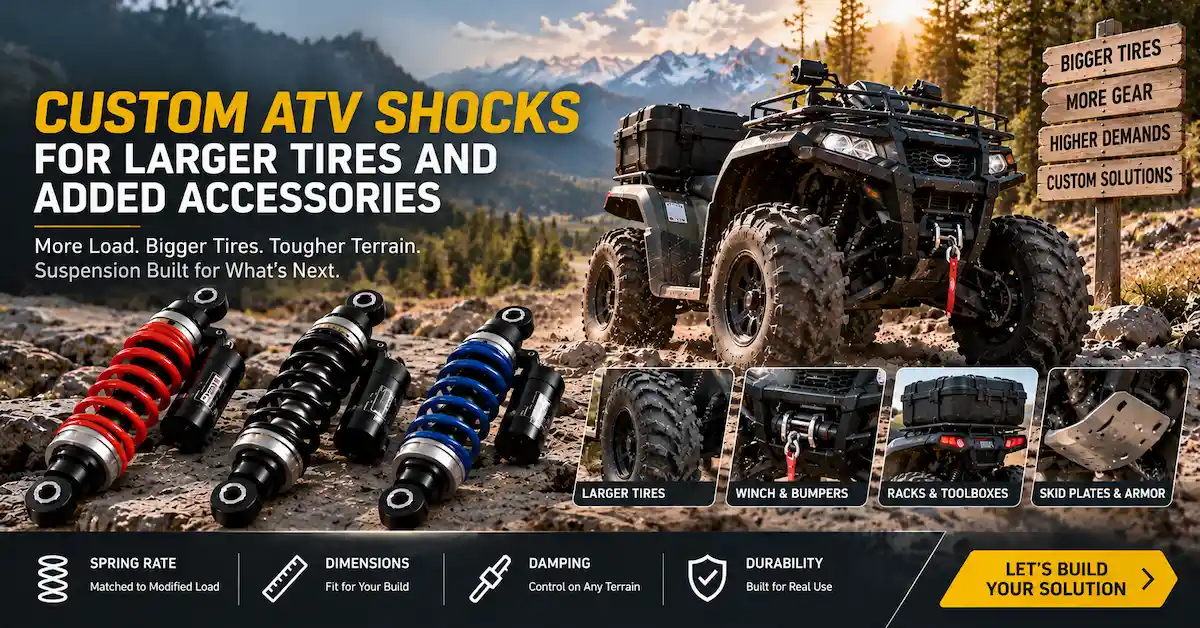
The core difference in replacement vs performance ATV suspension is the intended engineering target. Replacement suspension is normally selected to restore the fit, support, and basic operating behavior required for an existing ATV application. Performance suspension deliberately changes or refines suspension behavior for a defined purpose such as rough-terrain control, additional load support, different rider requirements, repeated high-energy impacts, or a modified vehicle. BEDO’s aftermarket ATV suspension guide separates standard replacement, heavy-duty replacement, comfort upgrade, performance upgrade, and modified-vehicle projects because they should not automatically share one specification. For a B2B buyer, the first question should therefore be “Are we restoring the intended function or developing a different performance target?” before discussing spring color, reservoirs, adjusters, or price.
Replacement vs Performance ATV Suspension: Quick Comparison
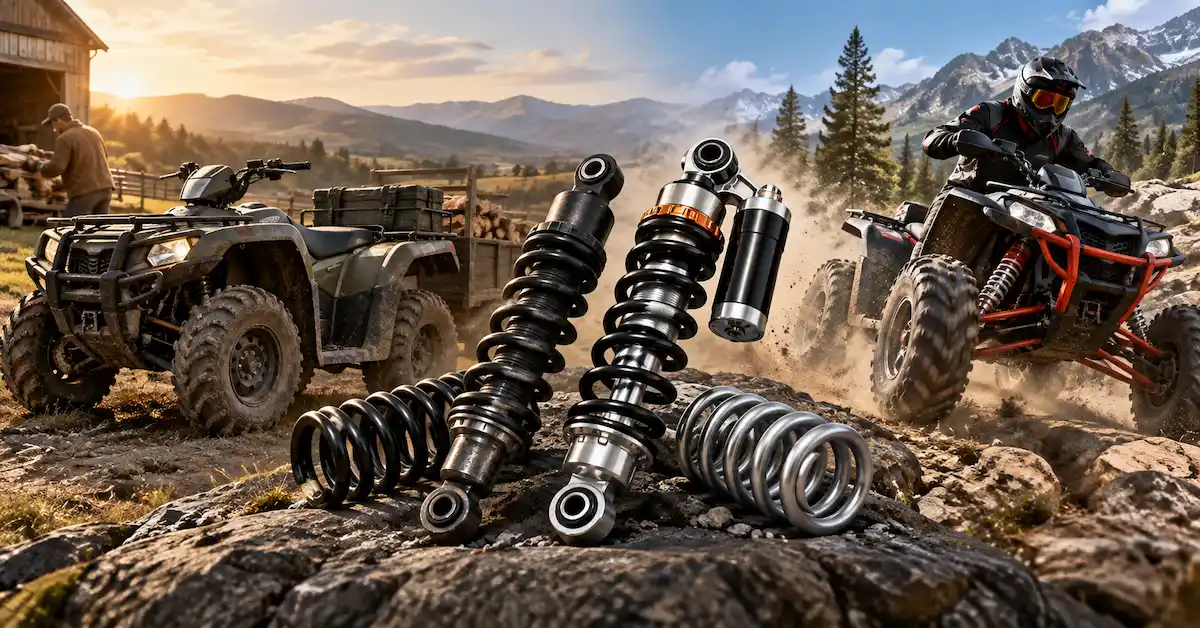
Replacement does not mean low quality, and performance does not simply mean expensive or adjustable. A well-developed fixed-damping replacement shock may be the correct product for a standard ATV, while a poorly matched adjustable shock can create worse vehicle behavior despite having more features. BEDO’s performance guidance similarly states that performance is not defined only by a larger body, sporty appearance, or adjuster knob; the shock still needs to match vehicle weight, geometry, spring rate, damping, terrain, and intended use.
| Evaluation area | Replacement ATV suspension | Performance ATV suspension |
|---|---|---|
| Primary objective | Restore intended operation | Change or optimize defined suspension behavior |
| Fitment priority | Match verified application and mounting requirements | Match application while also supporting performance target |
| Spring strategy | Reproduce or appropriately match required vehicle support | May be developed around rider, cargo, terrain,or modified setup |
| Damping strategy | Consistent specification suitable for intended standard use | Application-specific compression/rebound tuning may receive greater emphasis |
| Adjustability | Not automatically required | May be useful, but only when application justifies it |
| Reservoir | Not inherently required | May be considered for suitable duty and architecture |
| Vehicle modification | Usually stock or clearly defined replacement application | Frequently relevant to altered load, tires, geometry,or terrain target |
| Prototype testing | Important when specifications or fitment are uncertain | Strongly recommended for a new performance specification |
| Product-line risk | Incorrect fitment or inconsistent replacement behavior | Incorrect tuning, excessive complexity, misleading performance claims |
| Best suited to | Repair, replacement, broad aftermarket coverage | Upgrade ranges, specialist applications, differentiated private-label products |
Who Should Choose Replacement ATV Suspension?
Replacement suspension is usually appropriate for repair-parts distributors, wholesalers, service networks, fleet maintenance programs, and aftermarket brands whose principal promise is straightforward vehicle compatibility and dependable repeat supply.The buyer is generally not trying to transform the ATV’s suspension characteristics; the objective is to replace worn, damaged, leaking, or otherwise unsuitable components with a controlled product for a specified vehicle application. In this situation, accurate model/year coverage, mounting dimensions, compressed and extended positions, spring specification, damping consistency, installation hardware, packaging, and repeat-order traceability may create more commercial value than additional external adjustment features. A replacement product is also often a better first SKU for a broad distributor catalog because service staff and end users usually need a clear compatibility statement rather than a tuning project.
Who Should Choose Performance ATV Suspension?
Performance ATV suspension becomes relevant when the buyer can describe what needs to change. Typical projects include recreational trail products that require different suspension response, utility vehicles carrying additional equipment, larger-tire builds, long-travel developments, specialist terrain packages, rider-weight-specific versions, and premium private-label suspension lines. BEDO’s performance shock absorber guide emphasizes vehicle weight, suspension geometry, travel, spring rate, damping, temperature, terrain, and intended use as performance-development inputs. A buyer who simply asks for “30% harder shocks” has not yet provided a complete performance specification; engineering needs a measurable problem and operating condition before deciding whether spring rate, preload, damping, stroke, reservoir architecture, or another characteristic should change.
Start With the Vehicle Application Before Choosing Either Product Type
Whether buying replacement or performance suspension, define the vehicle first. Provide the ATV model, year, variant, installation position, wheel and tire configuration, rider range, permanent accessories, typical cargo, intended terrain, and relevant modifications. The major difference is how the information is used: for replacement, the data primarily verifies that the proposed shock reproduces the required application; for performance development, the same data becomes the baseline from which a new target is defined. BEDO’s custom ATV shock absorber development guidance distinguishes dimensional changes from performance development and stresses that installation requirements, spring behavior, damping, and vehicle use must be reviewed together.
| Buyer input | Replacement project | Performance project |
|---|---|---|
| Vehicle model/year | Confirms application | Defines development platform |
| Existing shock | Provides replacement reference | Provides baseline for comparison |
| Mounting dimensions | Must fit correctly | Must fit unless geometry is intentionally changed |
| Rider/load data | Confirms intended operating range | Helps define spring and damping target |
| Terrain | Checks suitability | Becomes a key tuning condition |
| Current problem | Wear, leakage, damage, incorrect fitment | Bottoming, harshness, poor recovery, inadequate load support, etc. |
| Modification data | Confirms whether standard replacement still applies | Often fundamental to development |
| Performance goal | Usually restore suitable function | Must be clearly defined and validated |
Fitment Requirements Do Not Disappear When You Buy Performance Shocks
Performance claims cannot compensate for incorrect mounting. Before evaluating damping or adjustability, confirm extended and compressed dimensions, effective stroke, upper and lower mounting-hole diameters, mounting widths, sleeves or bushings, shock orientation, body and spring clearance, and surrounding vehicle movement. BEDO’s existing rear ATV/UTV products illustrate why visual similarity is inadequate. AU_HSA_01 and AU_HSA_03 both publish a 130 mm effective stroke and 10 mm upper/lower mounting holes, yet their total lengths, body diameters, and mounting widths differ. A buyer should therefore use catalog specifications for preliminary screening and request a dimensioned drawing for final application confirmation.
| Published specification | AU_HSA_01 | AU_HSA_03 |
|---|---|---|
| Position | Rear | Rear |
| Total length | 465 mm | 445 mm |
| Effective stroke | 130 mm | 130 mm |
| Cylinder outer diameter | 38 mm | 42 mm |
| Upper/lower mounting hole | 10 / 10 mm | 10 / 10 mm |
| Upper/lower mounting width | 32 / 32 mm | 30 / 35 mm |
| Published damping adjustment | None | None |
| Damping architecture | Internal gas chamber, oil-gas separation | Internal gas chamber, oil-gas separation |
These models should not be labeled “replacement” and “performance” solely for the purpose of comparison. Their published pages describe both as fixed-damping rear ATV/UTV shocks and do not establish a universal vehicle-specific replacement or performance classification. The table instead demonstrates the purchasing principle behind replacement vs performance ATV suspension: physical compatibility must be established before performance positioning is considered.
Spring Selection Changes When the Objective Changes
For a standard replacement program, the spring should provide the support required by the approved vehicle and customer range without introducing an unintended change in suspension behavior. A performance project may deliberately use another spring specification because the load, terrain, rider group, or handling objective is different. Spring rate describes the force required for a unit of spring compression and should be recorded with a complete unit such as N/mm or lb/in. BEDO’s ATV spring-rate guide also links spring selection with ride height, sag, damping balance, load, and terrain. Do not position the stiffest spring as the performance choice: excessive stiffness can reduce compliance and usable suspension movement just as an overly soft spring can create excessive sag or bottoming.
Performance Damping Should Solve a Defined Problem
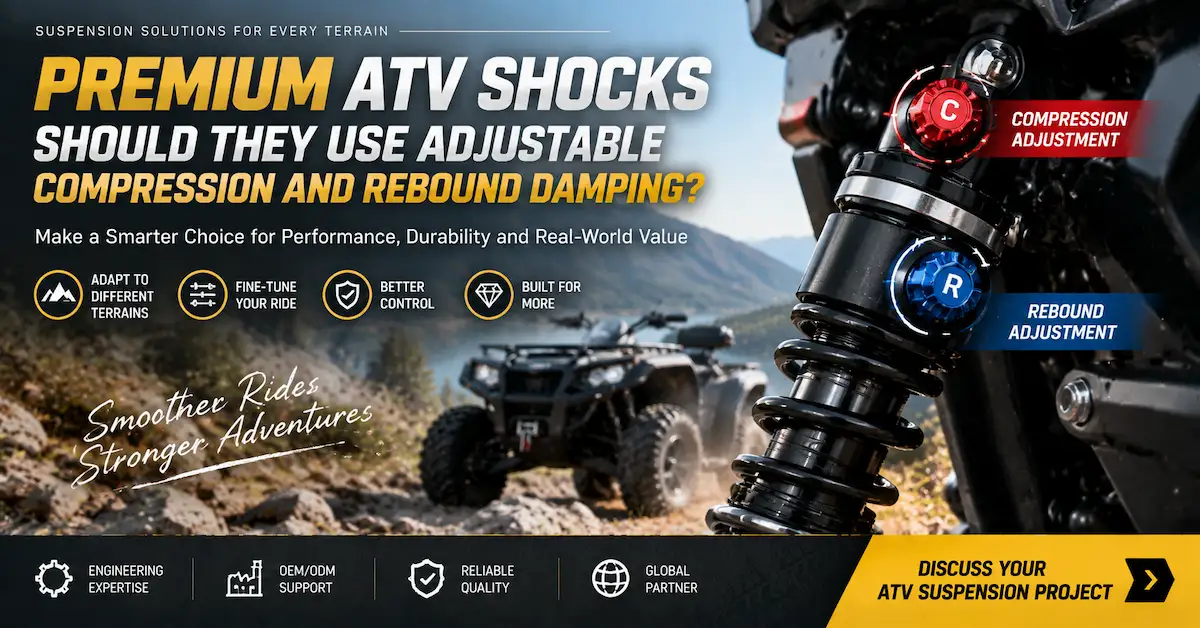
A replacement shock usually needs a stable damping specification appropriate to the intended standard application. Performance suspension may require more detailed compression and rebound development.Compression damping controls the suspension as the shock compresses; rebound damping controls extension after the bump. If the buyer is trying to reduce repeated bouncing, improve recovery between trail impacts, support a changed spring, or control movement under another load condition, the supplier can evaluate damping around that objective. However, “more damping” is not a meaningful universal performance target. BEDO’s aftermarket content makes the same distinction: spring and damper perform different jobs, and the damping should match the vehicle, spring, load, and terrain rather than simply produce the highest possible resistance.
Adjustable Does Not Automatically Mean Performance
An adjustable shock may offer preload adjustment, rebound control, compression adjustment, or other functions depending on its design. These features can add value when the ATV regularly encounters different loads or terrains, or when a performance-oriented customer expects tuning flexibility. They also increase setup complexity and the risk of incorrect adjustment. A fixed-damping shock can still have a project-specific internal specification and may be preferable for a vehicle that requires consistent behavior without operator intervention. BEDO’s adjustable off-road shock guide emphasizes that adjustment cannot correct an inappropriate spring or basic fitment problem. For B2B buyers, the specification should therefore state exactly what is adjustable, why the customer needs it, and what usable range has been validated.
A Reservoir Is a Design Feature, Not a Performance Label
External or remote reservoirs are often associated with performance suspension, but their presence should not be used as the definition of a performance product. Reservoir architecture may support hydraulic volume, heat-management requirements, packaging, or additional damping-control designs, depending on the shock. If the vehicle does not require those characteristics, the additional components can create cost and packaging complexity without solving a meaningful customer problem. Likewise, a visually simple fixed shock can be appropriate for a well-defined application. The product strategy should therefore move from use case to engineering architecture, not from appearance to marketing claim.
Replacement Products and Performance Products Need Different Validation Questions
For replacement suspension, validation asks: Does this product fit the intended vehicle and consistently provide the specified replacement function? For performance suspension, it asks an additional question: Does the modified specification achieve the declared performance target under the stated conditions? Both require traceable samples and controlled specifications, but performance development generally requires a clearer before/after baseline. If the goal is improved cargo support, test representative load cases; if the goal is trail control, reproduce relevant repeated terrain; if the goal is rider-specific tuning, validate the proposed rider/load range. BEDO’s small-batch OEM/ODM suspension program supports sample validation before buyers move into larger production, which is particularly useful where a new performance specification still needs real-vehicle confirmation.
Quality Control Must Preserve the Approved Version
A replacement range and a performance range can both fail commercially if repeat production drifts away from the approved sample. Establish controlled drawings, spring specifications, damping requirements, component references, product codes, inspection criteria, labels, and packaging. Where damping is a critical performance differentiator, define the applicable test method and acceptable limits. Where adjustable features are used, confirm adjuster function and the approved baseline setting. Current quality-system documentation can support supplier qualification, but it should not replace product-specific evidence. For performance products in particular, a buyer should be able to connect the marketing claim to a tested configuration instead of relying on phrases such as “racing grade,” “high performance,” or “extreme duty.”
Manufacturing Complexity Should Follow Real Product Value
Performance suspension may require additional development work, different components, more testing, or more complex assembly than a straightforward replacement product, but this is not automatically true for every SKU. A highly controlled replacement shock produced across a large application range can also demand substantial fitment, inventory, and quality management.During supplier review, ask which processes and controlled characteristics actually differ between the proposed products. BEDO’s company profile states that it manufactures shock absorbers and springs and provides customization, design support, and small-batch ordering; buyers can use those capabilities as a starting point for defining whether an existing product or a deeper performance-development program is appropriate. Review BEDO’s manufacturing and customization capabilities.
Replacement and Performance Suspension Have Different Commercial Risks
For a replacement range, one of the largest risks is incorrect vehicle coverage. A wrong application record can cause installation problems, returns, support costs, and damaged distributor credibility even when the component itself is well manufactured. Performance products introduce an additional risk: the product may fit correctly but fail to deliver the behavior promised in the listing. This can happen when a generic shock is marketed as a premium upgrade without documented spring, damping, load, or terrain validation. The safest approach is to keep technical claims narrow and traceable. If your performance shock was developed for a particular rider range or utility-load configuration, publish that boundary rather than calling it ideal for “all ATVs.”
Cost Comparison Should Reflect the Development Scope
When comparing replacement vs performance ATV suspension, do not compare only the final shock price. For replacement products, include application verification, samples, required documentation, packaging, inventory breadth, and repeat-order quantities. For performance products, include engineering, prototypes, spring or valving development, vehicle testing, additional components, adjustment hardware where applicable, and technical support material. BEDO’s performance guidance shows why a customized suspension product may involve more than one physical component change, while its small-batch manufacturing model allows buyers to validate a new SKU before committing to high inventory. Ask suppliers to separate one-time development expenses from recurring product cost rather than hiding both inside an unexplained unit quotation.
MOQ and Lead Time Should Be Confirmed Per Product Strategy
A broad replacement line may contain many SKUs with modest quantities per application, while a performance range may contain fewer products with more configuration options. These different inventory structures affect purchasing.Request minimum quantities by model, spring version, damping specification, finish, and packaging where applicable, and distinguish prototype, pilot, first-production, and reorder quantities. Do the same with timing: separate engineering review and sample validation from normal production lead time. BEDO supports small-batch suspension development, but exact MOQ, project capacity, and delivery timing still need confirmation for each configuration rather than being inferred from a general company capability.
Private-Label Buyers Should Separate Marketing Positioning from Engineering Approval
A private-label brand may want both a mainstream replacement range and a premium performance range. This can be a strong product architecture if the technical distinction is genuine. Replacement SKUs can emphasize verified fitment, consistency, serviceability, and application coverage. Performance SKUs can emphasize specific validated differences such as spring/load matching, damping development, suitable adjustability, or another application-specific feature. BEDO’s premium ATV suspension guide similarly distinguishes standard replacement products from premium application-specific development and notes that premium does not require every available feature.Keep logo, color, carton, and catalog tier separate from the engineering specification so a visual “Pro” version is not marketed as technically superior without corresponding evidence.
How Should Buyers Decide Which Product Strategy to Develop?
A practical decision process starts with the customer complaint or use case. If the original unit is worn and the customer wants the ATV restored to its intended operation, start with a replacement project. If the customer wants a different load capability, terrain response, tuning range, suspension geometry, or handling characteristic, define a performance-development project. If the vehicle itself has been modified with larger tires, lift components, accessories, or additional equipment, do not automatically place the product in either category until the new geometry and load requirements are reviewed. BEDO’s custom shock absorber development approach allows buyers to start from existing products, drawings, CAD, samples, or vehicle requirements and determine which elements actually require modification.
Frequently Asked Questions
1.Is replacement ATV suspension the same as OEM suspension?
Not necessarily. OEM refers to the suspension supplied or developed for original vehicle production, while aftermarket replacement products are sold later to replace existing components. A replacement product may aim to reproduce relevant application requirements without being the original component.
2. Is performance ATV suspension always stiffer than replacement suspension?
No. Performance means the suspension is developed around a defined performance objective. Excessive spring or damping stiffness can reduce compliance and control, so the correct specification depends on vehicle, load, terrain, and intended use.
3. Do performance ATV shocks always need damping adjustment?
No. A correctly developed fixed-damping shock can be appropriate for a defined performance application. Adjustable damping is valuable only when the application needs tuning flexibility and the usable settings have been properly developed.
4. Is a reservoir shock automatically better than a standard replacement shock?
No.Reservoir architecture should solve a hydraulic, thermal, packaging, or tuning requirement. Its appearance alone does not prove better vehicle performance.
5. Can an original ATV shock sample be used to develop a replacement product?
Yes. A physical sample can provide dimensional and construction references, but vehicle/application information should also be supplied so fitment and intended behavior can be properly evaluated. BEDO supports sample-based shock absorber customization.
6. Can the same sample be used to develop a performance version?
It can serve as a baseline, but the buyer must also define what performance should change. Rider or cargo load, terrain, spring requirements, damping targets, vehicle modifications, and validation conditions may all need review.
7. Should a distributor stock replacement or performance suspension first?
That depends on its customer base.Repair-focused channels may prioritize broad replacement coverage, while specialist off-road, modification, or premium aftermarket channels may benefit from performance products. Many brands can support both as clearly separated product families.
8. Does performance suspension increase an ATV’s permitted payload?
Do not use a shock upgrade as permission to exceed the vehicle manufacturer’s published payload, rack, tire, towing, passenger, or structural limits. Suspension development should remain within the relevant vehicle-level operating requirements.
9. Can BEDO customize a replacement shock into a performance version?
BEDO supports changes involving shock dimensions, spring requirements, damping, appearance, and OEM development. Whether an existing shock is a suitable starting platform depends on the target vehicle and performance objective and should be reviewed before development.
10.What should I send BEDO before asking for a quotation?
Provide the ATV make, model, year, installation position, existing shock or drawing, mounting dimensions, rider and cargo conditions, terrain, vehicle modifications, current problem, target product positioning, sample requirement, and expected order quantity. State clearly whether the goal is replacement or a performance change.
Conclusion
The most important distinction in replacement vs performance ATV suspension is the product objective. Replacement suspension should restore the required fit and suitable operating behavior for a defined vehicle application, while performance suspension deliberately develops the spring, damping, adjustment, travel, or other characteristics around a measurable target. Performance does not automatically mean stiffer springs, external reservoirs, more adjustment knobs, or a higher price, and replacement does not mean technically basic or low quality. For distributors and private-label brands, keeping these two strategies clearly separated improves product positioning, supplier communication, validation, and catalog accuracy. BEDO manufactures shock absorbers and suspension springs and supports customized and small-batch projects; to evaluate either strategy, contact BEDO with your target vehicle, existing sample or drawings, intended use, load conditions, current suspension issue, desired product positioning, and purchasing plan so the correct replacement or performance development route can be reviewed before sample and production approval.