
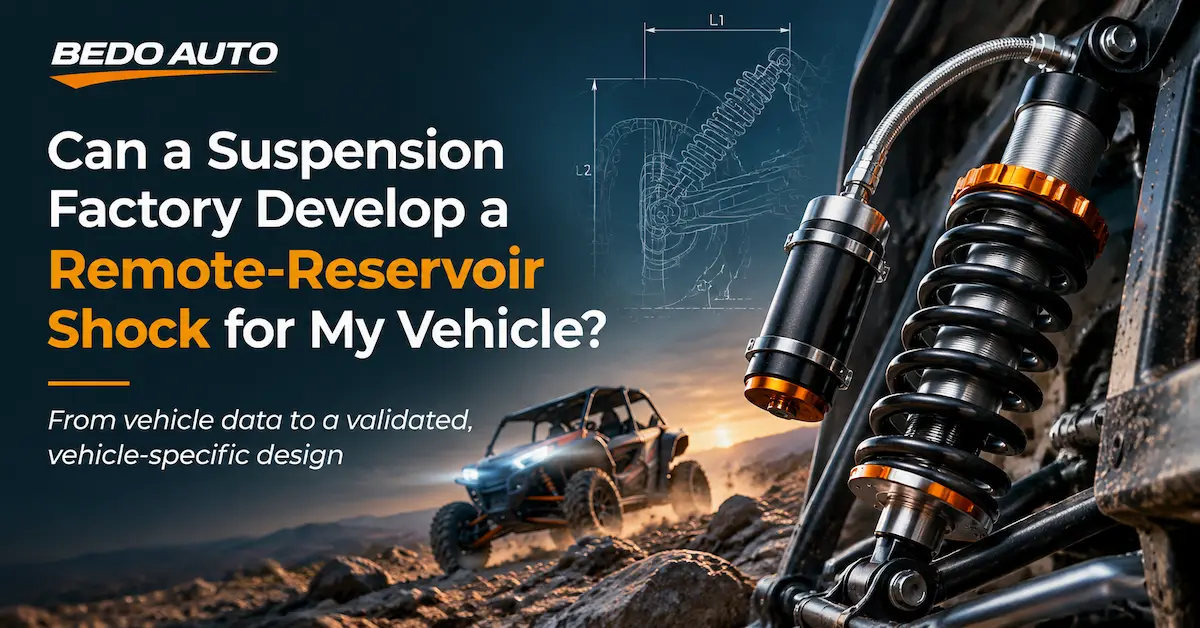
A capable suspension factory can develop a remote-reservoir shock for a specific vehicle, but the job is a vehicle engineering project rather than a request for a longer or more attractive shock absorber. The supplier must first confirm the suspension geometry, reservoir space, mounting interfaces, spring and damping targets, operating environment, and validation responsibility. The remote reservoir is useful only when its added packaging and tuning capability solve a defined problem such as repeated high-temperature damping, limited shock-body space, additional oil volume, or an adjustable compression circuit.
The buyer should expect a feasibility review, a data request, a proposed architecture, prototype samples, bench and vehicle testing, a controlled design revision, and a production plan. A supplier who quotes from a product photograph alone may be able to supply a similar-looking part, but has not yet demonstrated that the part will work on the intended vehicle.
This guide is for OEM engineers, aftermarket suspension brands, vehicle developers, distributors, and fleet buyers considering a custom remote-reservoir shock. It answers the practical question behind the search: what can a suspension factory actually develop, what information must the buyer provide, and how can the buyer tell whether the quoted shock is a real vehicle-specific solution or only a catalog adaptation?
What a remote reservoir changes in the development brief
A remote reservoir separates part of the gas and oil volume from the main damper body. Depending on the architecture, it can provide packaging flexibility, additional fluid volume, a place for a floating piston or bladder, and a path to adjustable compression damping. Those benefits are not automatic. The reservoir introduces another component, hose or passage, bracket, mounting orientation, heat exposure, sealing interface, and service consideration.
For this reason, the first engineering question is not “does the factory make reservoir shocks?” It is “what vehicle behavior or packaging constraint requires a reservoir?” A vehicle that runs short, low-energy cycles on a smooth surface may not gain enough from the additional hardware to justify it. A vehicle that repeatedly works through rough terrain, carries a changing load, or has a hot and crowded damper location may have a stronger case. The answer depends on the duty cycle and the available envelope.
| Development driver | What the reservoir may help with | What still must be proven |
|---|---|---|
| Repeated high-energy impacts | More fluid volume and a platform for a different thermal or damping layout. | Temperature behavior, force response, durability, leakage, and vehicle control. |
| Limited main-body space | Separates part of the volume or adjustment hardware from the shock body. | Reservoir clearance, bracket strength, hose routing, and full-stroke movement. |
| Need for compression adjustment | May allow an external adjustment mechanism or separate circuit. | Adjustment repeatability, setting identification, access, and baseline definition. |
| Changing terrain or load | Can support a wider tuning strategy when the vehicle needs more than one setup. | Useful adjustment range, rider or operator procedure, and safe default setting. |
| Product differentiation | Creates a different product architecture for a performance line. | Real measured benefit, service plan, cost, packaging, and supply consistency. |
Do not confuse a reservoir with a higher spring rate
The spring supports vehicle load and establishes much of the static ride height. The damper controls motion by resisting compression and rebound. A remote reservoir does not, by itself, support a heavier vehicle or correct an incorrect spring rate. If the vehicle sags under cargo, the factory must review spring rate, preload, installed length, motion ratio, and axle load before changing the reservoir architecture.
Do not confuse adjustability with correct tuning
An adjuster gives the user a way to change a response. It does not guarantee that the available range contains the correct response for the vehicle. The supplier should define the adjustment direction, baseline, number of useful settings, test speed, temperature condition, and the vehicle symptom that each change is intended to address. “Multi-level adjustable” is not a substitute for a damping target.
Which vehicles and buyers are a realistic fit?
A vehicle-specific remote-reservoir shock is most realistic when the buyer can describe the platform, the production or aftermarket objective, and the conditions in which the shock will operate. That can include an ATV, UTV, off-road utility vehicle, buggy, motorcycle, electric vehicle, specialty mobility platform, or another powersports application. The label matters less than the measurable suspension condition.
For an OEM or new-vehicle developer, the main task is integrating the damper with the complete chassis: hard points, spring, bump stop, tire, wheel travel, steering or control-arm movement, body clearance, and intended load states. For an aftermarket brand, the main task may be preserving an existing interface while creating a new performance level. For a distributor, the critical question may be whether the product can be identified, packaged, supported, and repeated across a defined vehicle application.
| Buyer type | Primary decision | Evidence to request from the factory |
|---|---|---|
| Vehicle OEM or platform developer | Can the shock be integrated and validated across the vehicle load and motion envelope? | Interface review, proposed specification, prototype plan, bench data, vehicle validation, and revision control. |
| Aftermarket suspension brand | Can the new shock deliver a defined upgrade without unsafe fitment or unclear tuning? | Application limits, installation dimensions, spring and damping options, baseline setting, and test scope. |
| Fleet or utility operator | Will the shock remain controllable and serviceable through the real duty cycle? | Load states, terrain assumptions, environmental review, inspection method, and service instructions. |
| Distributor or private-label buyer | Can the product be sold as a repeatable application rather than a one-off prototype? | Approved BOM, label and package definition, sample identity, quality records, and change notification. |
A supplier should be able to say which of these decisions it can own and which must remain with the vehicle developer. That boundary is important. The factory can design and manufacture a shock absorber, but the vehicle owner remains responsible for the complete vehicle integration, legal use, and final operating limits unless the project contract says otherwise.
What data should be sent before asking for a quotation?
The fastest route to a useful quotation is a controlled technical package. The package does not need to contain every CAD feature on day one, but it must identify the load path and the constraints that can make a reservoir shock infeasible. A product name or a single eye-to-eye dimension is not enough.
| Input group | Minimum information | Why the factory needs it |
|---|---|---|
| Vehicle identity | Platform, model or generation, front or rear position, stock or modified condition, and intended market. | Prevents the same name from hiding different mounts or geometry. |
| Mass and load | Curb or ready-to-run mass, front and rear axle loads, occupants, cargo, battery, accessories, and towing or attachment state. | Sets spring support, static sag, damping demand, and test states. |
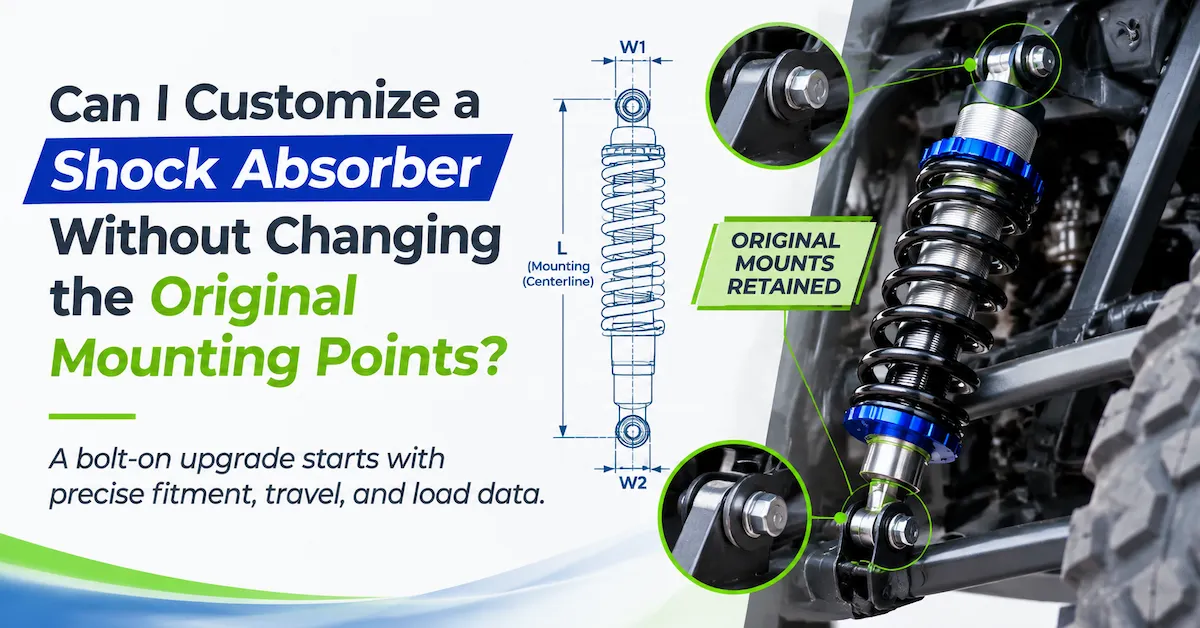
| Geometry | Extended and compressed lengths, shock stroke, wheel travel, motion ratio, mounting width, hole or thread, and articulation. | Defines the hard limits and load transfer into the damper. |
| Reservoir envelope | Available diameter, length, orientation, hose or passage path, bracket location, and service access. | Determines whether the reservoir can move safely through the vehicle stroke. |
| Performance objective | Ride-height target, sag, compression and rebound behavior, adjustment need, comfort or control priority, and speed range. | Turns “better performance” into a testable requirement. |
| Environment | Dust, mud, water, salt, temperature, cleaning, storage, and use frequency. | Influences sealing, finish, protection, and validation conditions. |
| Commercial stage | Prototype quantity, pilot expectation, annual demand estimate, branding, package, and required records. | Separates a development quote from a repeat-production quote. |
Provide the suspension position, not just the vehicle name
Front and rear shocks on the same vehicle may have different motion ratios, load distributions, clearance limits, and tuning targets. State the position and side where relevant. Include the stock shock or a drawing with reference datums. If the vehicle is modified with larger tires, a lift, a new control arm, a winch, a rack, or a battery change, identify those modifications.
Describe the load states rather than one maximum number
At minimum, define ready-to-run, normal operating load, and maximum planned load. Add accessory and passenger conditions that materially change axle distribution. For each state, record where the mass sits. A rear rack load, a front-mounted tool, and a low central battery can have the same mass but different effects on each shock.
Mark the reservoir packaging envelope in the CAD assembly
A reservoir must be checked at full bump, full droop, steering lock, articulation, and body movement. Mark nearby exhaust, motor, battery, drive shaft, tire, control arm, frame, and protective plate surfaces. A static side view can miss a rotating or flexing component. If the final vehicle CAD is incomplete, supply photographs and measured clearance points and label them as provisional.
How a suspension factory should assess feasibility
A disciplined feasibility review usually has four outputs: a confirmed input list, an open-question list, a proposed architecture, and a development scope. The buyer should ask for all four. A quote that contains only a unit price and a delivery promise leaves the most important engineering assumptions hidden.
Gate one: interface and packaging review
The factory checks whether the mounting interfaces, shock length, usable stroke, spring seat, body diameter, and reservoir envelope can coexist with the vehicle. It should identify any condition that needs a bracket, hose, spacer, orientation change, or vehicle-side modification. The result should say whether the requested “bolt-on” condition is confirmed, conditional, or not feasible with the available data.
Gate two: spring and damper target review
The factory translates axle load, motion ratio, wheel travel, ride height, and duty cycle into a spring and damping proposal. The proposal should distinguish calculated starting values from values that require vehicle tuning. It should also state whether the shock is fixed damping, externally adjustable, or adjustable only within a defined service setting.
Gate three: prototype and test scope
The supplier and buyer agree what the first prototype must prove. A dimensional sample may prove mounting and clearance. A tuned sample may prove spring and damping direction. A production-intent pilot may prove repeatability and packaging. These are different samples and should not be described with the same approval language.
| Feasibility output | Buyer should see | Decision it supports |
|---|---|---|
| Assumption register | Missing data, assumed loads, provisional dimensions, and unresolved vehicle conditions. | Whether the quote is comparable and what the buyer must confirm. |
| Architecture proposal | Shock body, reservoir type, connection, mounting approach, spring arrangement, and adjustment concept. | Whether the proposed hardware answers the reason for choosing a reservoir. |
| Risk register | Clearance, heat, hose, sealing, adjustment access, service, and validation risks. | Whether the project needs a vehicle change or extra test work. |
| Development plan | Sample stages, test inputs, approval gates, documents, and change route. | Whether the project can move from sample to repeat supply. |
| Commercial scope | Prototype content, tooling or fixture assumptions, pilot definition, packaging, and quote exclusions. | Whether the price covers the actual engineering requirement. |
How should the reservoir, hose, and bracket be validated?
Remote-reservoir failures are often packaging failures rather than failures of the damper body. A reservoir can contact the frame at full bump, a hose can be exposed to abrasion, a bracket can transmit vibration into a thin panel, or a user can be unable to reach the adjuster after installation. These issues should be checked on the vehicle, not inferred from the product render.
Check movement through the complete stroke
Test full droop, design ride height, full bump, and intermediate positions. Repeat the inspection under steering, articulation, and the relevant load states. Use clearance measurements or witness marks where the space is tight. Record whether the reservoir is supported by the intended bracket and whether the hose bends within the supplier's defined condition.
Check heat and environmental exposure
Identify nearby heat sources and the temperature conditions the shock will see. A reservoir placed near an exhaust, motor, inverter, battery, or enclosed body panel may have a different fluid and seal condition from a shock in open airflow. The factory should state what it can test and what must be confirmed on the vehicle.
Check service and adjustment access
Adjustment is only useful if the user can reach it, identify its position, and return to a known baseline. The installation instructions should show the direction of change, the reference setting, the number or type of detents if applicable, and any warning against forcing the adjuster. Service access should be checked with the vehicle in the condition in which it is actually maintained.
What tests are needed before approving production?
Testing should be linked to the risk being controlled. Dimensional inspection checks the released geometry. A force-versus-velocity or other damper test checks the response at defined conditions. Spring load-deflection testing checks support and installed load. Leakage and pressure-retention checks address containment. Vehicle testing checks the interaction that a bench cannot reproduce. Durability testing checks the agreed duty cycle or a justified substitute; it should not be described as universal proof of every use.
| Test or inspection | Question answered | Record that should be retained |
|---|---|---|
| Dimensional and interface inspection | Does the sample match the approved mounting and packaging definition? | Drawing revision, datums, measured dimensions, hardware, and photos. |
| Spring load-deflection test | Does the spring support the intended load states at the approved heights? | Fixture, conditioning, load points, raw data, rate calculation, and sample identity. |
| Damper bench test | Does compression and rebound response match the defined setting and condition? | Speed, temperature, setting, curve, machine, calibration, and revision. |
| Leakage or retention inspection | Does the assembly maintain its intended containment under the specified check? | Method, condition, sample, result, and reaction for a failure. |
| Vehicle validation | Does the complete vehicle remain controlled, clear, and usable in the planned duty cycle? | Vehicle state, load, route, settings, observations, measurements, and approval. |
| Pilot-batch inspection | Can production-intent parts and methods reproduce the approved configuration? | Lot identity, inspection plan, nonconformances, packaging, and release decision. |
Separate prototype tuning from production acceptance
During tuning, engineers may change spring preload, shims, oil, gas pressure, adjuster setting, hose routing, or bracket position. That is part of development. Before production acceptance, the final configuration must be identified in the BOM, drawing, setting record, and test report. Otherwise, the factory may reproduce a nominally similar shock with a different internal or external condition.
Use an evidence package, not a verbal “works well” statement
The evidence package should connect each result to the sample and revision. It should show what was tested, where, under which load and temperature, with what setting, and against which acceptance requirement. The package does not need to contain confidential process details, but it must be sufficient for the buyer to understand the decision and the boundaries of the approval.
What should be agreed before a repeat order?
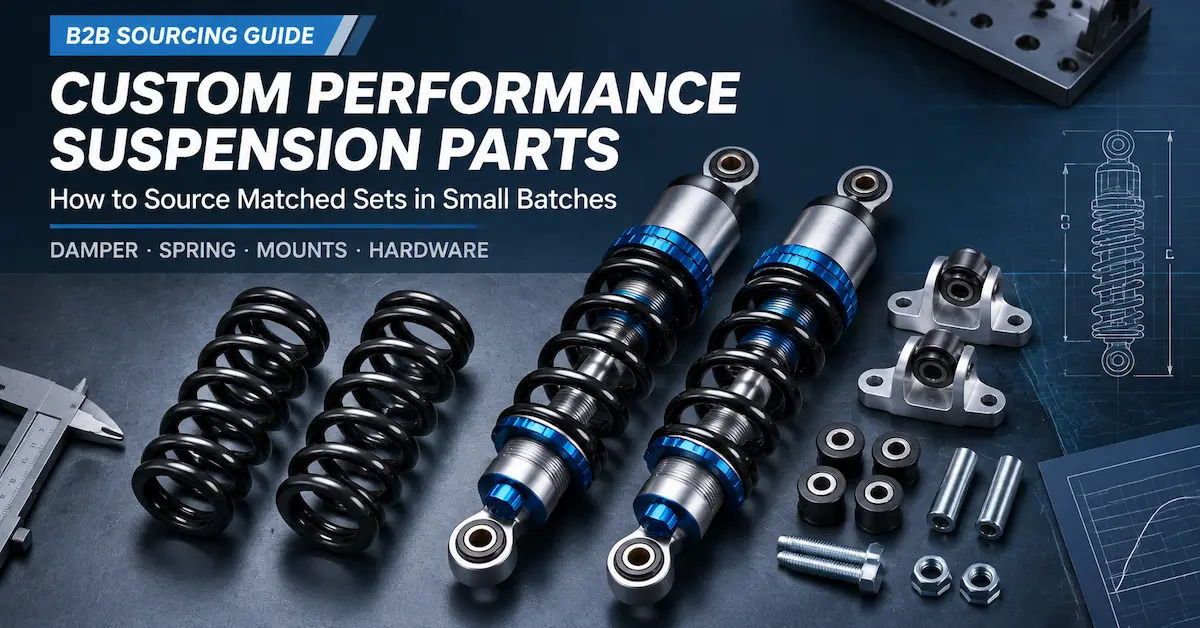
After the vehicle approves a prototype, the buyer and factory should convert the development record into a repeatable product definition. This includes the released drawing, 3D model where relevant, BOM, spring identity, damping setting, reservoir and hose parts, bracket, hardware, finish, label, package, inspection plan, and change-control route.
Ask how a later order will be identified. A part number should not hide several spring rates or damping settings. If the same body is sold for different vehicle loads, the application, spring, setting, and package should make the distinction visible. A private-label product also needs a controlled label and a way to trace the production batch without confusing a marketing name with an engineering revision.
Evidence boundary: a public product catalog can show that a supplier offers shock absorbers and related suspension components. It does not, by itself, prove that one remote-reservoir design is approved for your vehicle, meets a universal durability target, carries a specific certification, or includes a fixed MOQ or lead time. Request project-specific evidence before converting a prototype quote into a production commitment.
Define change triggers
Changes to the spring, damper setting, reservoir, hose, bracket, seal, coating, supplier, material, or assembly process can alter performance or fitment. The quality agreement should identify which changes require notification, drawing approval, sample inspection, bench retest, vehicle retest, or a new pilot. This is especially important when the first sample was tuned by hand.
Define the purchasing handoff
Purchasing needs a package that can be quoted and reordered without asking the original engineer to reconstruct the project from email. Include the approved part number, revision, application, critical dimensions, spring and damping identity, package, quantity assumptions, required inspection records, and delivery conditions that the buyer actually needs. A clean handoff reduces the risk that the cheapest interpretation of the design becomes the production interpretation.
How to compare two factories for the same reservoir-shock project
Price is only one comparison field. Ask each supplier to respond to the same technical package and return the same categories of output. This makes it easier to see whether a low quote excludes vehicle validation, assumes the reservoir fits without checking, or treats the prototype as the final product.
| Comparison area | Strong response | Warning sign |
|---|---|---|
| Input review | Lists missing dimensions, load states, packaging risks, and assumptions before quoting. | Quotes from a photo, model name, or eye-to-eye length only. |
| Architecture | Explains why the reservoir, connection, bracket, and adjustment are suited to the vehicle. | Uses “race” or “heavy duty” as the only technical justification. |
| Performance | Defines spring and damping targets, bench conditions, and vehicle approval gates. | Promises comfort or control without a test condition. |
| Production | Controls BOM, revision, setting, inspection, traceability, and change notification. | Assumes the approved prototype can be copied by appearance. |
| Commercial scope | Separates development, prototype, pilot, package, and repeat-order assumptions. | Leaves sample content, records, or exclusions unclear. |
A buyer should also ask who owns the final vehicle validation and what happens if the first architecture does not meet the target. A responsible supplier can describe a controlled redesign or retune path. That is more useful than an unconditional promise that the first sample will be perfect.
FAQ: custom remote-reservoir shock development
Can a suspension factory build a remote-reservoir shock from my existing CAD?
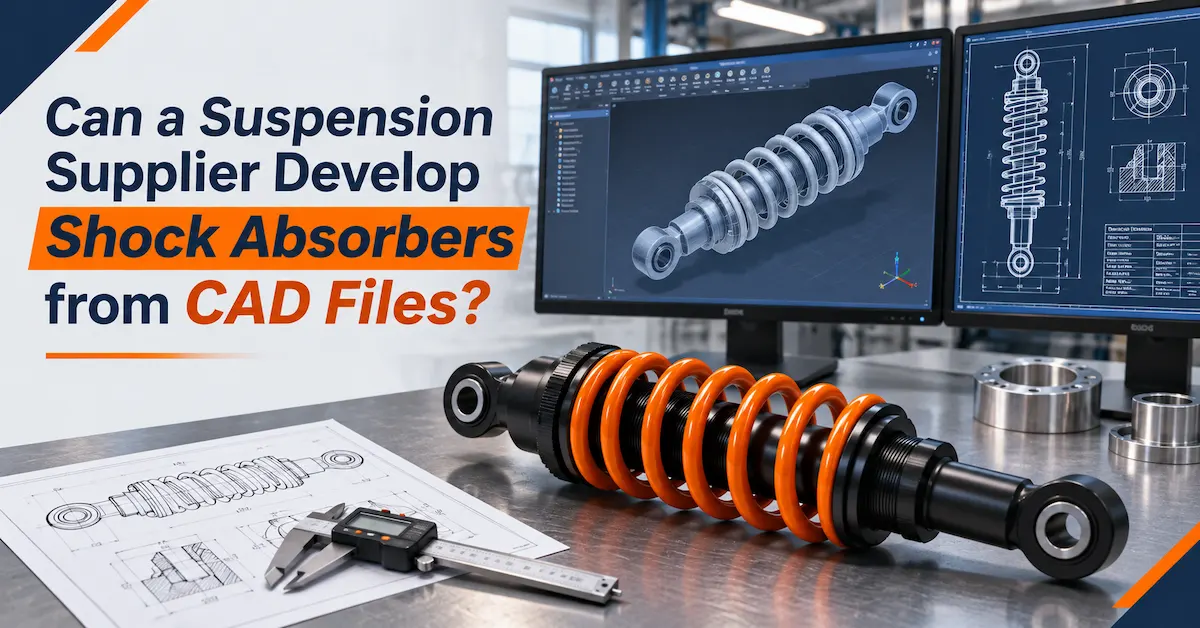
Usually, CAD can start the review, but the factory still needs vehicle loads, suspension position, movement conditions, reservoir envelope, spring and damping objectives, and environmental information. A model that shows only the mounting points cannot define the complete shock specification.
Do I need to change the vehicle frame to add a reservoir?
Not necessarily. The answer depends on the available envelope, mounting location, bracket strategy, hose or passage routing, and movement through full bump and droop. If the reservoir cannot be packaged without interference, a vehicle-side bracket or a different shock architecture may be required.
Is a remote reservoir always better than a standard shock?
No. It is better only when its packaging, volume, adjustment, or tuning capability addresses a real requirement. For a simple duty cycle, the extra parts may add cost and service complexity without a measurable benefit.
Can the reservoir shock keep the original spring?
It can if the spring rate, installed length, seat, retention, preload range, and load states remain appropriate. The reservoir changes damper architecture, not the need to verify spring support. The complete spring and damper combination must be checked.
What should the first sample prove?
Define the first sample's purpose. It may prove dimensions and clearance, or it may be a tuned sample intended to prove vehicle response. A production approval needs additional evidence for configuration identity, functional performance, pilot repeatability, and change control.
What should I send for a remote-reservoir shock RFQ?
Send the vehicle and suspension position, drawings or CAD, mounting dimensions, extended and compressed conditions, stroke, motion ratio if known, axle loads, payload states, reservoir envelope, terrain, speed, temperature, adjustment objective, prototype quantity, and required records. Mark confirmed data separately from estimates.
Conclusion
A suspension factory can develop a remote-reservoir shock for a specific vehicle when the project is defined around the vehicle's load path, movement, packaging, and performance objective. The reservoir should have a reason to exist, and that reason should become a measurable requirement. The buyer should provide controlled geometry and load data, review the supplier's assumptions, validate the reservoir and bracket through full vehicle movement, separate tuning from production acceptance, and freeze the complete configuration before repeat orders.
For a serious OEM, aftermarket, or fleet project, the next useful step is a technical review of the vehicle data and packaging envelope. Contact BEDO Auto for a vehicle-specific shock absorber discussion with the drawings, load states, photos, and intended production stage so the development scope can be assessed before a quotation is treated as an approval.