
What Are Performance Shock Absorbers?
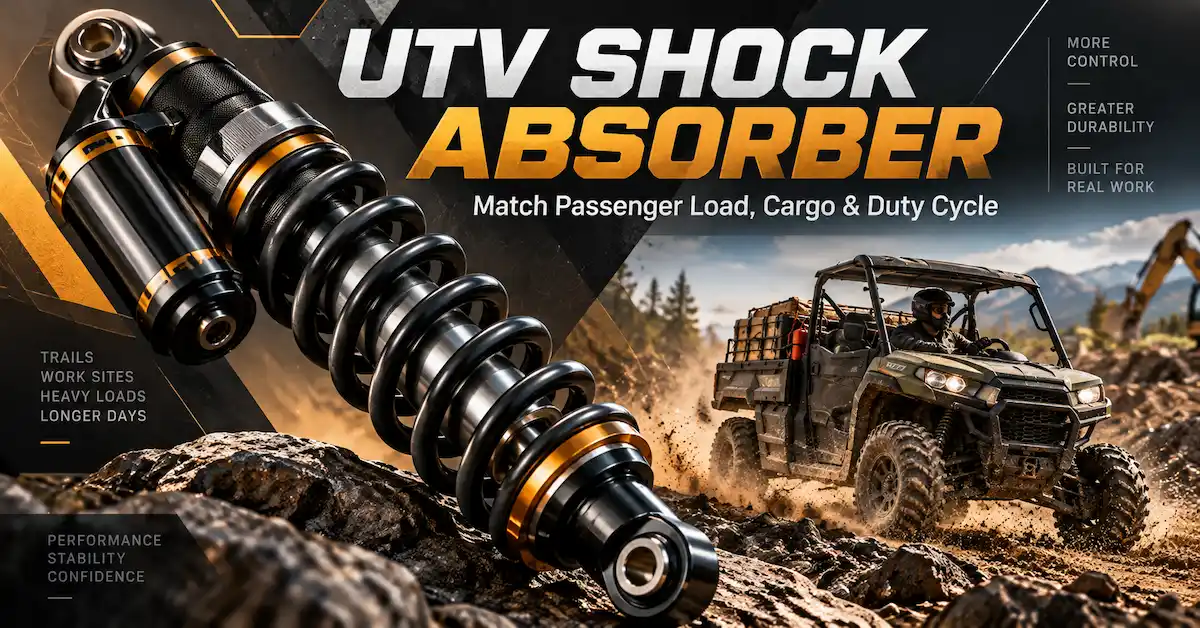
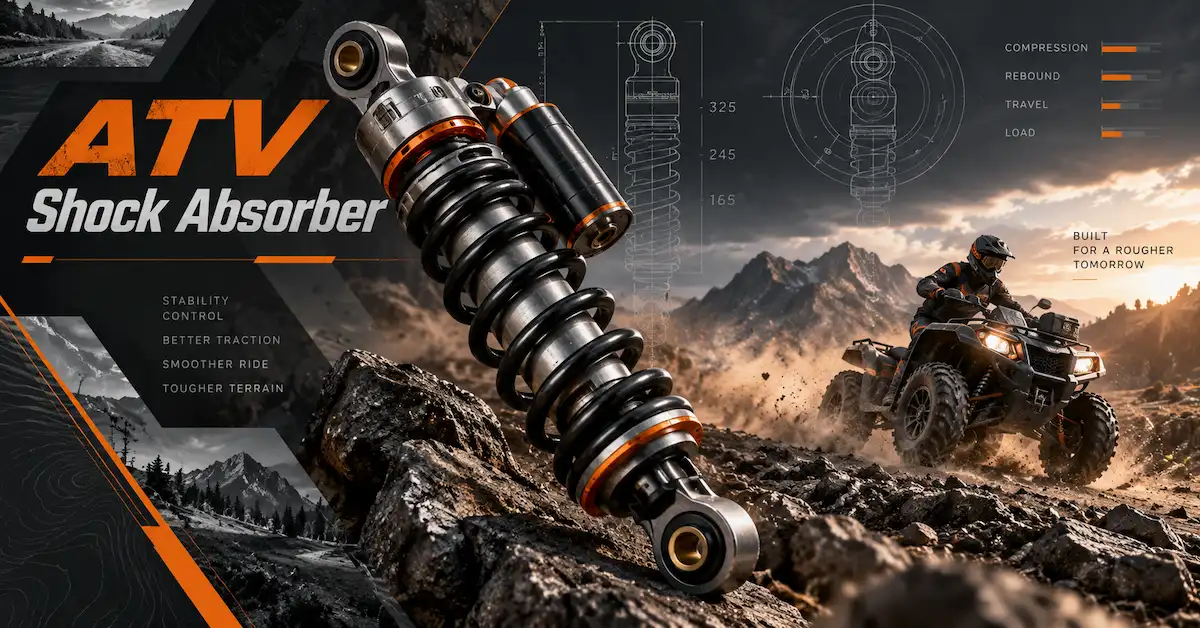
Performance Shock Absorbers are shock absorbers selected or developed to provide better suspension control for a defined vehicle, load, terrain, and driving objective.
The word “performance” should not mean simply:
- a harder spring;
- a larger shock body;
- an external reservoir;
- more adjustment knobs;
- a more aggressive appearance.
A shock absorber only performs well when its core parameters work together with the vehicle.
Those parameters include:
- fitment;
- stroke;
- spring rate;
- preload;
- compression damping;
- rebound damping;
- suspension geometry;
- vehicle load;
- operating terrain;
- durability requirements.
For an ATV or UTV buyer, the most useful question is therefore not:
Which shock looks the most performance-oriented?
The better question is:
Which shock specification best controls this vehicle under its real operating conditions?
Buyers can review BEDO's current shock absorber and suspension product range before comparing standard, OEM, or custom performance options.
Who Actually Needs Performance Shock Absorbers?
Not every ATV or UTV requires a performance suspension upgrade.
A standard shock may be appropriate when:
- the vehicle remains in factory configuration;
- payload is predictable;
- terrain is moderate;
- original ride and handling are acceptable;
- fitment and durability are the main requirements.
Performance-oriented suspension becomes more relevant when the buyer needs to solve a specific limitation.
Heavy-Duty Utility Buyers
Typical problems include:
- excessive rear sag;
- frequent bottoming;
- unstable response under cargo;
- reduced ride height;
- poor control with tools or accessories.
Recreational ATV and UTV Buyers
They may prioritize:
- faster suspension recovery;
- better terrain compliance;
- controlled body movement;
- more predictable handling;
- improved response over repeated bumps.
Aftermarket Suspension Brands
Their objective is often product differentiation.
They may need:
- custom spring rates;
- different damping targets;
- adjustable configurations;
- unique finishes;
- private labeling;
- vehicle-specific fitment.
Vehicle Modification Companies
Modified vehicles may use:
- larger tires;
- heavier bumpers;
- winches;
- lift kits;
- cargo systems;
- different wheel offsets.
These changes can alter suspension demands enough to justify a new shock setup.
OEM Vehicle Manufacturers
For new ATV or UTV platforms, the shock absorber may need to be developed around:
- vehicle weight;
- suspension geometry;
- wheel travel;
- target ride height;
- passenger load;
- cargo;
- terrain;
- performance positioning.
Performance Does Not Mean “Stiffer”
One of the most common suspension mistakes is treating stiffness as performance.
A shock can feel firm and still be poorly matched.
A stiff setup may create:
- reduced compliance;
- poor traction over small bumps;
- harsh ride quality;
- insufficient suspension movement.
A soft setup may create:
- excessive sag;
- poor load support;
- bottoming;
- uncontrolled chassis movement.
The correct setup balances spring support and damping control.
Spring Rate: The Foundation of Load Support
The spring primarily supports the vehicle and its load.
Spring rate influences:
- ride height;
- sag;
- load carrying;
- available compression travel;
- how easily the suspension moves.
If spring rate is too low, the vehicle may sit too low and use too much of its travel before encountering a bump.
If spring rate is too high, the ATV or UTV may become unnecessarily harsh.
What Should Buyers Consider?
Spring selection should account for:
- vehicle curb weight;
- front/rear weight distribution;
- rider weight;
- passenger count;
- cargo;
- accessories;
- intended terrain;
- suspension geometry.
A utility UTV carrying two passengers and tools should not automatically use the same spring setup as a lightly loaded recreational vehicle.
Compression Damping: Control During Suspension Compression
Compression damping controls how quickly the suspension compresses.
It affects vehicle response during:
- bumps;
- rocks;
- braking;
- hard terrain inputs;
- jump landings;
- rapid load transfer.
Too little compression control may allow the suspension to use travel too quickly.
Too much compression damping may make the suspension feel harsh and prevent it from absorbing terrain efficiently.
Performance tuning should therefore match the compression characteristics to the application.
Rebound Damping: Control After the Impact
Rebound damping controls how quickly the suspension extends after it has compressed.
If rebound damping is too low, the suspension may:
- bounce;
- extend too rapidly;
- create unstable chassis movement.
If rebound damping is too high, the suspension may:
- recover too slowly;
- fail to reset between consecutive bumps;
- reduce wheel compliance over repeated terrain.
BEDO's guide to compression and rebound damping testing explains why these two directions should be evaluated separately.
Spring Rate and Damping Must Work Together
A performance shock absorber cannot compensate indefinitely for the wrong spring.
Consider a heavily loaded UTV.
If the spring rate is too low, increasing compression damping may reduce movement temporarily, but the suspension may still sit too low under static load.
Likewise, installing a stronger spring without revisiting rebound damping may create poor suspension recovery.
A more complete tuning sequence is:
Load → Spring Rate → Ride Height/Sag → Compression → Rebound → Vehicle Testing
This sequence helps buyers separate load-support problems from motion-control problems.
Shock Stroke Is Not the Same as Wheel Travel
This distinction is critical for modified and high-performance vehicles.
Shock stroke describes damper shaft movement.
Wheel travel describes wheel movement.
The relationship depends on:
- suspension arm geometry;
- shock mounting location;
- motion ratio;
- mounting angle.
Increasing shock stroke does not automatically produce the same increase in wheel travel.
Changing shock length or stroke without reviewing suspension geometry can also affect:
- ball-joint articulation;
- CV joint angles;
- tire clearance;
- suspension-arm travel;
- chassis clearance.
BEDO discusses this relationship in its UTV wheel travel and shock stroke guide.
Fitment Still Comes Before Performance
A premium damping setup is useless if the shock does not fit correctly.
Before comparing performance characteristics, confirm:
| Fitment Item | Why It Matters |
|---|---|
| Extended length | Controls maximum extension |
| Compressed length | Controls full-bump fitment |
| Stroke | Defines available shock movement |
| Upper mount | Must match vehicle interface |
| Lower mount | Must match vehicle interface |
| Hole diameter | Must fit mounting hardware |
| Mounting width | Prevents incorrect installation |
| Body clearance | Prevents interference |
| Spring clearance | Avoids contact during motion |
| Reservoir position | Must fit available packaging space |
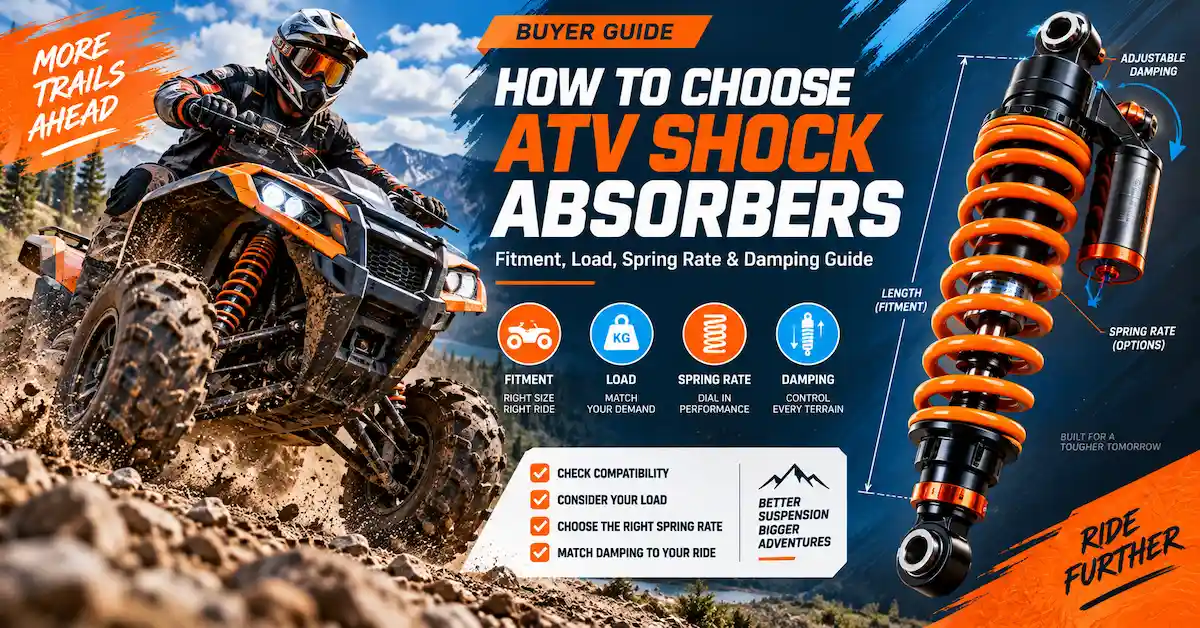
For ATV applications, BEDO's ATV shock absorber fitment guide provides additional guidance on measuring and verifying compatibility before ordering.
Fixed vs Adjustable Performance Shock Absorbers
Adjustability can be valuable, but it is not automatically superior.
| Shock Type | Main Strength | Limitation | Best For |
|---|---|---|---|
| Fixed damping | Simple and repeatable | Limited user tuning | Stable applications |
| Adjustable damping | Flexible tuning | More complexity | Variable terrain/performance use |
| Custom-valved shock | Application-specific setup | Requires development | OEM/custom projects |
| Reservoir shock | Packaging and performance options | More components | Selected off-road applications |
Fixed Damping
A well-developed fixed-damping shock can perform very well when:
- vehicle weight is stable;
- terrain is predictable;
- target performance is clearly defined.
Adjustable Damping
Adjustability is valuable when:
- terrain varies;
- user preferences differ;
- load changes;
- performance tuning is part of the product positioning.
BEDO's motorcycle and electric-motorcycle product range also includes shock designs with multi-level damping adjustment, showing that adjustability is one possible design tool rather than a universal requirement.
Reservoir vs Non-Reservoir Shock Absorbers
External or remote reservoirs are often associated with performance shocks.
However, a reservoir alone does not guarantee better suspension.
The complete system still needs the correct:
- spring;
- damping;
- stroke;
- fitment;
- internal specification.
Reservoir designs may provide additional architecture and packaging options for demanding applications, but buyers should choose them for engineering reasons rather than appearance.
How Terrain Changes the Right Shock Setup
Performance targets should reflect where the vehicle operates.
Farm and Utility Roads
Priorities often include:
- load support;
- comfort;
- predictable response;
- durability;
- stable ride height.
Forest Trails
The suspension may encounter:
- roots;
- holes;
- repeated small impacts;
- mixed-speed operation.
Good rebound recovery becomes important.
Rocky Terrain
Priorities may include:
- controlled compression;
- sufficient usable travel;
- wheel control;
- durability.
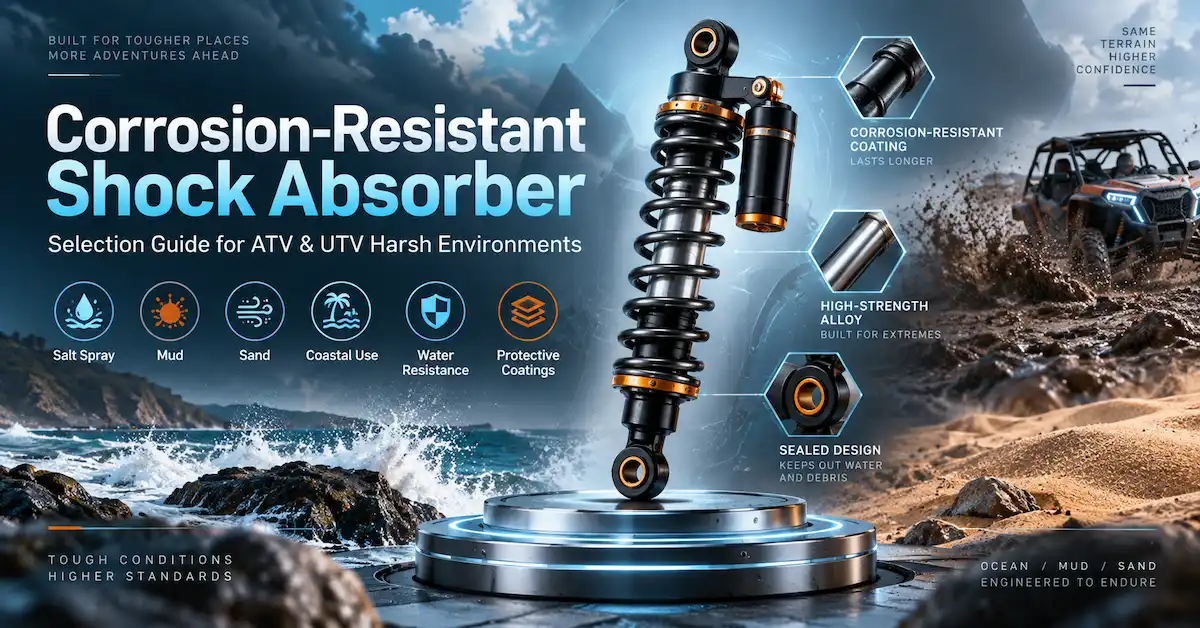
Sand and Beach
Suspension may experience:
- repeated movement;
- heat;
- sand;
- water;
- corrosion exposure.
BEDO's AU_HSA_04 ATV/UTV shock absorber is one example positioned for beach and uneven-terrain applications.
High-Speed Recreational Use
Performance tuning may prioritize:
- chassis control;
- repeatability;
- damping consistency;
- predictable handling.
There is no single “best performance shock” for all these applications.
How Vehicle Load Changes Performance Shock Selection
Load is often underestimated.
A UTV may operate with:
- driver;
- passengers;
- cargo;
- tools;
- roof;
- winch;
- bumper;
- storage box;
- spare tire.
All of these can change suspension behavior.
A shock chosen for the empty vehicle may no longer perform correctly at maximum operating weight.
For serious sourcing projects, provide both:
Curb weight
and
Typical / maximum operating weight
This gives the supplier a more realistic engineering basis.
Larger Tires and Accessories Can Change the Setup
Larger tires may influence:
- unsprung mass;
- steering;
- ride height;
- suspension loads;
- clearance;
- component angles.
Heavy accessories can add sprung mass and shift weight distribution.
This is why performance shock selection after vehicle modification should not be based only on the original OEM shock dimensions.
The vehicle should be reviewed as a new operating configuration.
Performance Shock Absorbers: Standard Upgrade or Custom Development?
A standard upgrade may be sufficient when:
- fitment is already established;
- load is within a known range;
- the buyer wants a proven performance profile.
Custom development may be better when:
- vehicle weight is significantly different;
- suspension geometry has changed;
- stock shocks bottom out;
- the buyer wants a specific spring rate;
- compression/rebound behavior needs revision;
- private-label differentiation is important;
- a new vehicle platform is being developed.
BEDO supports custom suspension projects from samples, drawings, CAD, and vehicle requirements. Buyers can review the custom suspension development files guide to understand what information should be prepared.
What Should Be Validated Before Bulk Purchasing?
For B2B buyers, a performance shock should not be approved based only on appearance or one short test ride.
1. Fitment
Check:
- mounting;
- clearance;
- full extension;
- full compression.
2. Static Setup
Review:
- ride height;
- sag;
- preload;
- load support.
3. Dynamic Performance
Evaluate:
- compression;
- rebound;
- bottoming;
- repeated bumps;
- wheel control.
4. Environmental Durability
Consider:
- mud;
- water;
- dust;
- sand;
- corrosion.
5. Production Repeatability
Confirm that the approved setup can be reproduced consistently.
Why Prototype Development Matters
Performance suspension development often requires iteration.
A typical project may follow:
Requirement Review → Initial Specification → Prototype → Vehicle Test → Feedback → Revision → Final Approval
Useful test feedback should be specific.
Instead of:
The shock feels bad.
Report:
Rear rebound is too fast after large compression events when the vehicle carries two passengers and cargo.
That gives the engineering team information that can support a targeted revision.
Why Small-Batch Production Can Reduce Risk
One successful prototype does not prove production consistency.
A pilot batch can help reveal:
- dimension variation;
- spring variation;
- damping variation;
- coating issues;
- assembly differences;
- packaging problems.
BEDO's small-batch OEM/ODM suspension guide describes small-batch production as a useful validation stage before larger production commitments.
How to Compare Performance Shock Absorber Suppliers
Do not compare suppliers only on price.
Use an engineering and supply matrix.
| Supplier Capability | Buyer Question |
|---|---|
| Vehicle understanding | Do they ask about weight, load, terrain? |
| Fitment | Can mounting and stroke be verified? |
| Spring development | Can spring rate be matched to load? |
| Damping capability | Can compression and rebound be discussed separately? |
| Sample development | Can they work from an existing shock? |
| Drawing/CAD | Can engineering files be reviewed? |
| Prototype support | Is testing and revision supported? |
| QC | Are dimensions and function controlled? |
| Small batch | Can production be validated before scaling? |
| Repeat supply | Can approved specifications be reproduced? |
A true performance suspension supplier should be able to explain why a setup is appropriate, not only say that it is “high performance.”
Common Performance Shock Absorber Buying Mistakes
Mistake 1: Buying the Stiffest Option
Stiffer does not automatically mean better handling.
Better approach: match spring rate to vehicle and load.
Mistake 2: Choosing by Appearance
Large bodies, bright springs, and reservoirs do not define performance.
Better approach: review technical specifications.
Mistake 3: Ignoring Rebound
Buyers often focus only on compression.
Better approach: evaluate both damping directions.
Mistake 4: Choosing by Length Only
Overall length does not define full fitment.
Better approach: check compressed length, stroke, and mounts.
Mistake 5: Ignoring Vehicle Modifications
Larger tires, accessories, and cargo can change suspension demands.
Better approach: provide the actual vehicle configuration.
Mistake 6: Skipping Prototype Validation
A shock can fit and still perform poorly.
Better approach: test under real load and terrain.
Mistake 7: Approving One Sample Without Batch Control
A good prototype is not enough.
Better approach: verify pilot production and revision control.
What Affects the Cost of Performance Shock Absorbers?
Performance shock pricing depends on the technical scope.
Cost can be influenced by:
- shock architecture;
- body size;
- reservoir configuration;
- spring specification;
- damping complexity;
- adjustability;
- materials;
- surface treatment;
- prototype quantity;
- testing;
- custom tooling;
- branding;
- packaging;
- production volume.
A standard fixed-damping replacement shock and a custom adjustable performance shock are not directly comparable.
Buyers should compare like-for-like specifications.
What Should Be Included in a Performance Shock RFQ?
A strong RFQ should include:
- Vehicle model/project code
- Front or rear position
- Vehicle curb weight
- Typical operating weight
- Maximum load
- Passenger count
- Tire size
- Accessories/modifications
- Extended shock length
- Compressed shock length
- Stroke
- Mounting dimensions
- Existing spring rate
- Existing damping data
- Typical terrain
- Current suspension problem
- Target performance
- Adjustable or fixed preference
- Sample availability
- Drawing/CAD availability
- Prototype quantity
- Estimated production quantity
- Branding/packaging requirements
The more accurately the supplier understands the application, the more meaningful the recommendation and quotation can be.
How BEDO Supports Performance Shock Absorber Projects
BEDO develops and manufactures shock absorbers and suspension springs for ATV, UTV, motorcycle, electric motorcycle, and other off-road or specialty-vehicle applications.
Depending on project requirements, buyers can discuss:
- shock length and stroke;
- mounting dimensions;
- spring rate;
- compression damping;
- rebound damping;
- adjustable configurations;
- surface finish;
- samples;
- drawings;
- CAD;
- prototype development;
- OEM/ODM;
- small-batch production.
You can review BEDO's current capabilities on the About Us page and available products on the Products page.
FAQ
What are Performance Shock Absorbers?
Performance Shock Absorbers are shock absorbers selected or developed to improve suspension control for a specific vehicle, load, terrain, or handling target.
Are performance shocks always stiffer?
No. Performance depends on the correct balance of spring rate, compression damping, rebound damping, stroke, and suspension geometry.
Are adjustable shocks better than fixed shocks?
Not always. Adjustable shocks provide tuning flexibility, while a properly developed fixed-damping shock may be more suitable for a stable application.
Do performance shocks need external reservoirs?
No. Reservoirs are one design option. The correct architecture depends on packaging and performance requirements.
How do I select spring rate?
Spring rate should be matched to vehicle weight, load, suspension geometry, ride height, and intended terrain.
What is the difference between compression and rebound damping?
Compression controls suspension movement as the shock compresses. Rebound controls how quickly the suspension extends again.
Do larger tires require different shocks?
Not automatically, but larger tires can change suspension loads and geometry. The existing setup should be reviewed.
Should performance shocks be tested under load?
Yes. Testing should represent realistic rider, passenger, cargo, and accessory conditions.
Can Performance Shock Absorbers be customized?
Yes. Depending on the project, dimensions, spring rate, damping, finish, adjustability, branding, and packaging may be customized.
What should I send for a performance shock quotation?
Provide vehicle specifications, load, terrain, dimensions, current suspension problems, target performance, samples or drawings, and expected order quantity.
Conclusion
Performance Shock Absorbers should be chosen by fitment, vehicle load, spring rate, damping, terrain, and target handling—not by stiffness or appearance alone. For OEM, aftermarket, or private-label projects, prototype validation and batch consistency are just as important as the initial setup.
If you have vehicle data, drawings, CAD, or an existing shock sample, submit them through the BEDO Contact Us page for project review and suspension development.