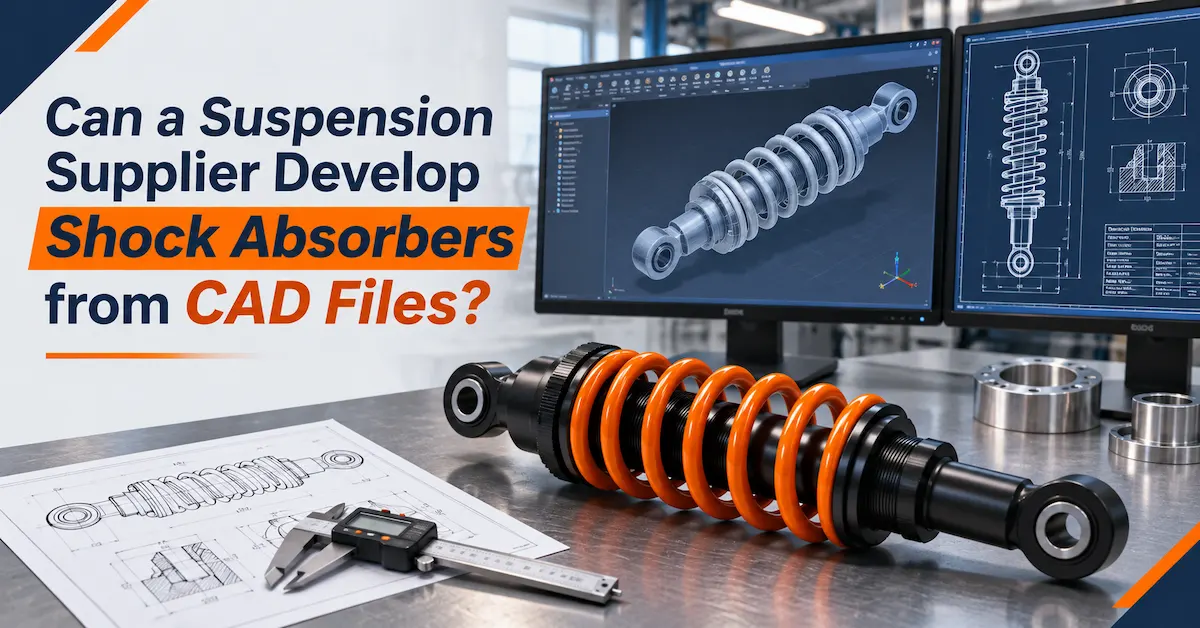

Often, yes. A shock absorber can be customized around the original mounting points when the supplier receives accurate interface dimensions, the intended length and stroke, the spring and damping target, and the vehicle's real movement and load conditions. Preserving the mounts does not mean every internal or external feature can change freely. The shock still has to fit the eye or clevis, carry the load through the correct axis, avoid binding, retain the spring, clear the vehicle through full travel, and deliver a controlled response.
The important distinction is between preserving an interface and preserving the entire original shock. A supplier may be able to change the body, spring, damping calibration, adjuster, finish, or reservoir arrangement while retaining the vehicle-side mounting geometry. The buyer must define which dimensions are fixed, which are negotiable, and which must be revalidated after a change.
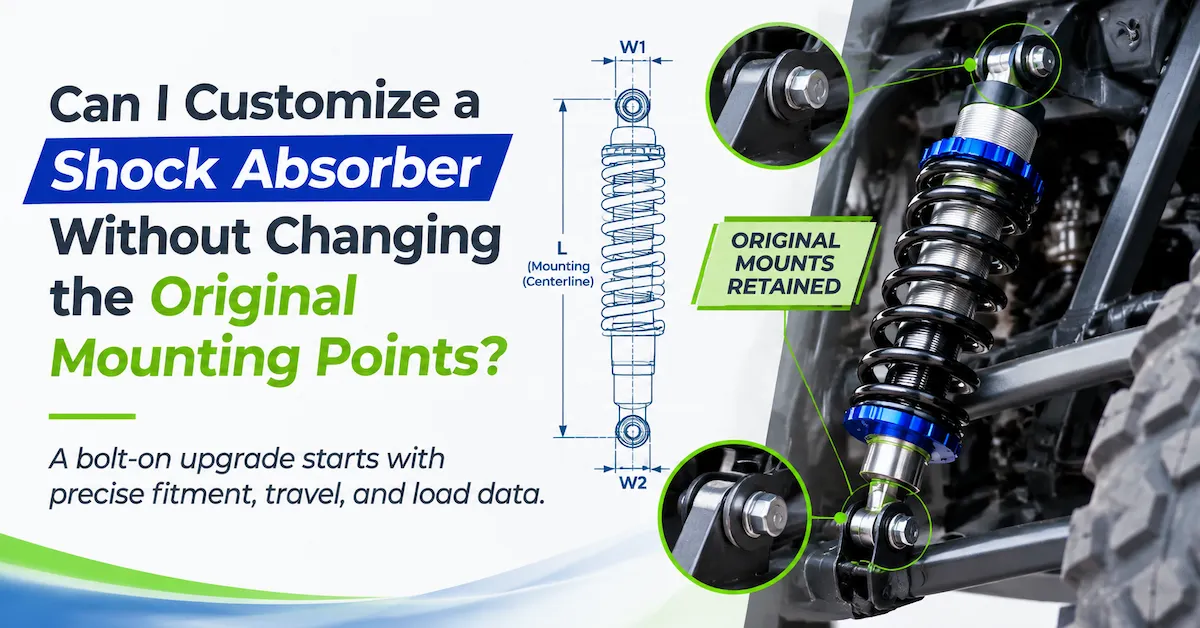
What does “keep the original mounting points” actually mean?
Buyers use the phrase “original mounting points” to describe several different requirements. Some mean the vehicle frame and control-arm brackets must remain untouched. Others mean the original bolt diameter must remain unchanged. Others mean the shock's eye-to-eye length and installation width must match the stock part. These are related but not identical constraints.
| Possible fixed condition | Dimensions or features to define | Why it matters |
|---|---|---|
| Vehicle-side brackets remain unchanged | Bracket hole centers, plate spacing, alignment, weld condition, and access. | Defines the load path and whether the new shock can be installed without structural modification. |
| Original fasteners remain | Hole diameter, bolt or thread, sleeve, clamping length, torque, and hardware class if known. | Prevents a hole that appears compatible from having poor engagement or incorrect bushing compression. |
| Original installation width remains | Eye or clevis width, bushing width, sleeve length, offset, and centerline. | Controls side load, alignment, and articulation at the mount. |
| Stock length remains | Measurement datums, extended length, compressed length, and installed orientation. | Preserves ride height only if the spring and installation condition also remain appropriate. |
| Vehicle modification is avoided | No new holes, brackets, welding, cutting, or frame changes. | Sets a true bolt-on boundary but may limit reservoir and adjuster packaging. |
Distinguish bolt-on from direct replacement
A bolt-on shock can use the original vehicle interfaces while changing the spring, damper, body diameter, or adjustment method. A direct replacement usually implies a closer match to the original length, installation, and operating behavior. A performance upgrade may intentionally alter spring rate or damping while preserving the mounts. The quotation should state which of these interpretations applies.
Identify the reference condition
Dimensions can change with the vehicle on a stand, at curb mass, at design ride height, or under a loaded condition. State the reference condition used for each measurement. A shock measured on the bench may have a different installed length once bushings, spacers, spring seats, and vehicle load are included.
Which parts of the shock can be customized?
Customization is not one feature. A supplier may customize a spring, a damping setting, an installation eye, a clevis, a body length, a reservoir, an adjuster, a finish, a label, or the complete assembly. The more the change affects the load path or the motion envelope, the more evidence is needed before the buyer can call the result a bolt-on upgrade.
| Customization area | Potential benefit | New verification required |
|---|---|---|
| Spring rate or free length | Changes support, static sag, ride height, and payload response. | Load-deflection data, installed height, preload, retention, and vehicle load-state checks. |
| Compression or rebound damping | Changes motion control, impact response, and recovery after a bump. | Defined bench condition, setting identity, temperature, and vehicle validation. |
| Eye, clevis, bushing, or sleeve | Matches original installation geometry. | Hole, width, centerline, articulation, hardware engagement, and side-load review. |
| Body diameter or reservoir | May support packaging or tuning changes. | Clearance through movement, bracket or hose routing, heat, and service access. |
| Spring seat or collar | Changes preload range, spring retention, and adjustability. | Full-droop retention, thread or seat condition, adjustment range, and locking method. |
| Finish, label, or color | Supports corrosion requirement, branding, or product identification. | Approved finish, marking, packaging, and traceability; appearance does not replace functional validation. |
Spring customization is not the same as damping customization
A higher spring rate can reduce sag and preserve bump travel under load, but it can also increase ride harshness when the vehicle is empty. More damping can slow movement, but too much rebound damping can prevent the suspension from recovering over repeated terrain. The supplier should evaluate the spring and damper as a pair and state which change is intended to solve which symptom.
Keep an eye on the installation axis
The original mount may allow some articulation through a bushing or spherical interface. If the custom shock changes the bushing, sleeve, or mount stiffness, it can introduce side load even when the hole centers match. Verify the axis at ride height and through the relevant articulation. A dimensional match in a straight-on view is not enough.
What technical information does a custom shock supplier need?
A supplier cannot responsibly promise a bolt-on custom shock from a vehicle model name alone. The data package should separate fixed interface requirements from performance targets and from information that is still unknown. That separation lets the supplier identify a feasible path instead of silently choosing assumptions.
| Data group | What to send | Buyer decision it supports |
|---|---|---|
| Original part reference | Stock shock photos, part number, drawing or CAD, measured dimensions, installed orientation, and known revisions. | Which dimensions are genuine vehicle constraints and which are only stock-part features. |
| Mounting interface | Hole or thread, width, sleeve, bushing, offset, centerline, fastener, and torque condition. | Whether the custom part can use the original brackets and hardware. |
| Motion envelope | Extended and compressed shock length, usable stroke, full bump, full droop, articulation, and bump-stop condition. | Whether the custom shock will bind, top out, or become an unintended stop. |
| Vehicle loads | Ready-to-run mass, axle and corner loads, passengers, cargo, accessories, battery, and towing or attachment states. | Spring selection, sag target, and damping demand. |
| Use environment | Speed, terrain, impact severity, temperature, mud, dust, water, salt, cleaning, and service interval. | Shock architecture, protection, finish, and test priorities. |
| Performance objective | Comfort, body control, bottoming resistance, rebound recovery, ride height, adjustment need, and acceptable tradeoffs. | Whether the proposal is a true upgrade or merely a dimensional substitute. |
| Project stage | Prototype quantity, pilot plan, annual demand estimate, branding, package, and approval records. | How the factory should separate development from production supply. |
Measure the stock shock with a repeatable method
Record how the length is measured, where the caliper or fixture contacts, whether the spring is installed, and whether the shock is fully extended by its internal stop or by an external fixture. Measure the mount width, hole centerline, sleeve length, and any offset. Take photographs that show the measurement reference, not only the final number.
Include vehicle measurements that the stock part cannot reveal
The shock does not define the complete suspension. Record wheel travel, control-arm or linkage movement, bump-stop engagement, tire and body clearance, brake-line and cable routing, and any nearby heat or rotating part. If the vehicle has been modified, record the modifications. A custom shock must work in the vehicle, not only in the original shock's envelope.
State what cannot change
Write “must remain unchanged” beside the actual requirement: frame bracket, bolt, installation width, ride height, wheel travel, or body clearance. Do not label every stock dimension as fixed unless the project truly requires it. Overconstraining the design can eliminate useful options, while underdefining the interface can create a fitment failure.
How does the supplier confirm that the original mounts are truly preserved?
Mount preservation should be checked in the drawing and on the sample. The drawing needs clear datums, tolerances, and interface definitions. The sample needs a controlled inspection and an installation check using the intended hardware. A supplier should not rely on “same size” language because two parts with the same nominal hole diameter can differ in width, offset, sleeve compression, or articulation.
| Inspection point | What to verify | Common hidden failure |
|---|---|---|
| Hole or thread | Diameter, pitch, centerline, thread engagement, and access. | Correct-looking hole with insufficient engagement or wrong axis. |
| Mounting width | Inner and outer width, bushing or sleeve compression, and washer stack. | Side load, loose hardware, or bracket distortion after tightening. |
| Offset and orientation | Centerline, eye angle, clevis direction, and clocking. | Mount binds or the shock is forced sideways during articulation. |
| Extended and compressed length | Measurement datum, full travel, internal stop, and installed condition. | Top-out, bottom-out, reduced travel, or changed ride height. |
| Spring seat and retention | Seat position, diameter, end shape, collar range, and full-droop retention. | Spring unloads, rubs, or loses the intended preload range. |
| Vehicle clearance | Frame, tire, control arm, drive shaft, brake line, body, and reservoir or adjuster. | Static fit passes but movement or steering creates interference. |
Use datums that a production inspector can repeat
A drawing should identify the surfaces and axes from which critical dimensions are measured. “Overall length” is weaker than a defined distance between mount centerlines at a stated condition. “Same as original” is weaker than a controlled dimension with tolerance and revision. The goal is to let engineering, quality, and purchasing refer to the same product definition.
Inspect the mount with the actual hardware
Install the prototype with the approved bolt, sleeve, bushing, washer, spacer, and torque condition. Hardware can change the effective width and articulation. A sample that fits with loose bolts may not fit after the mount is clamped. Record the installed stack in the approval file.
How can a bolt-on shock improve performance without changing geometry?
Preserving the mounting points limits the design space, but it does not prevent meaningful improvements. The supplier can often work on the spring rate, preload range, damping curve, internal valve configuration, reservoir arrangement, adjustability, finish, or assembly consistency. The improvement must be stated in terms of vehicle behavior and tested in the load states that matter.
| Vehicle complaint | Possible engineering direction | What must be checked |
|---|---|---|
| Rear sag with cargo | Review spring rate, installed length, preload range, and rear axle load. | Static ride height, sag, full-bump reserve, empty-vehicle comfort, and spring retention. |
| Repeated bounce after a bump | Review rebound damping and the spring-damper match. | Recovery time, repeated bumps, tire contact, temperature, and setting repeatability. |
| Harsh impact response | Review compression response, spring rate, bump stop, and available travel. | Impact behavior, bottoming, control, passenger load, and chassis clearance. |
| Heat fade during repeated use | Review damper architecture, fluid volume, reservoir need, and duty cycle. | Force response over time, temperature condition, seals, and vehicle control. |
| Different users or terrains | Consider an approved adjustment range or defined spring options. | Baseline, user instructions, safe limits, and consistent identification. |
The factory should avoid promising that one shock will solve every condition. If the vehicle carries a large load range, the buyer may need a spring option, a defined adjustment procedure, or separate applications. Preserving the mounts does not remove the need to select the product around the vehicle's actual load states.
Check motion ratio before changing the spring rate
Wheel load and shock load are related through the suspension motion ratio. A small change in wheel movement can correspond to a different shock movement depending on the control arm or linkage position. When the motion ratio changes through the stroke, one spring rate cannot be judged only by a static load calculation. The supplier should use the vehicle geometry or measure the installed response.
Check ride height separately from support
Ride height depends on load, spring free length, installed preload, motion ratio, and the vehicle's hard points. A shock with the original eye-to-eye length can still change ride height if the spring or seat condition changes. Record empty and loaded heights and compare them with the project target.
When is keeping the original mounting points not enough?
There are cases where a bolt-on requirement conflicts with the desired performance. A larger reservoir may have no safe package space. A longer shock may provide more theoretical travel but contact the chassis or change the suspension geometry. A much higher spring rate may support cargo but overload the mount or make the vehicle difficult to control when empty. A supplier should identify these conflicts rather than hide them inside a quotation.
| Conflict | Why it occurs | Possible project decision |
|---|---|---|
| More travel versus original length | The vehicle hard points, tire, body, and bump stop limit usable movement. | Keep length, redesign the vehicle-side geometry, or accept a different travel target. |
| Higher support versus comfort | More spring force reduces sag but increases empty-load stiffness. | Use a different spring option, preload range, or application-specific configuration. |
| Reservoir packaging versus no bracket change | The original mount area has no protected space for the reservoir. | Retain a standard body, approve a bracket, or revise the vehicle envelope. |
| More damping versus tire contact | Excessive damping can restrict wheel response over repeated terrain. | Retune compression or rebound and validate in the real duty cycle. |
| Large body versus clearance | A stronger or higher-volume body may interfere at articulation. | Use a different architecture or confirm a controlled clearance change. |
Define the no-modification boundary in writing
“No modification” should specify whether it prohibits frame drilling, welding, cutting, new brackets, different fasteners, spacer changes, or only changes to the main vehicle mounts. A supplier can then tell the buyer whether the requirement is feasible and what compromises it creates.
Accept a controlled change only when the vehicle owner approves it
If the original mounts cannot support the requested load or package, a vehicle-side change may be the correct engineering answer. It should be treated as a new design decision with strength, clearance, installation, and validation implications. It should never appear as an unannounced consequence of a “custom shock” quotation.
What testing should a bolt-on custom shock pass?
Testing should prove both interface preservation and the performance objective. A workbench dimensional check is necessary but not sufficient. The vehicle should be inspected at the relevant load states and through the movement conditions that could create a collision or loss of control.
| Test stage | Purpose | Pass evidence |
|---|---|---|
| Drawing and CAD review | Confirm fixed interfaces, stroke, package, and movement assumptions. | Approved drawing, marked CAD, assumptions, and open questions. |
| Prototype dimensional check | Confirm mount centers, widths, holes, length, seats, and hardware. | Inspection report tied to sample and revision. |
| Static installation | Confirm fit, torque, preload, and installation method. | Photos, measurements, hardware list, and fitment result. |
| Full-stroke clearance check | Find interference at bump, droop, steering, and articulation. | Clearance record and defined vehicle condition. |
| Bench spring and damping tests | Compare support and damper response at defined conditions. | Raw load-deflection or damping data, setting, temperature, and sample identity. |
| Vehicle validation | Confirm ride height, control, comfort, tire contact, and target improvement. | Load-state test record, observations, measurements, and approval decision. |
| Pilot inspection | Confirm the production-intent unit matches the approved prototype. | Lot, BOM, inspection plan, packaging, and release record. |
Test all load states that the product will be sold for
A shock that feels correct with one rider may not be correct with cargo, a passenger, a battery, or a tool attachment. Define the states before testing. If the product will be marketed for a narrow application, state that limit instead of implying that the same setting is suitable for every load.
Record the adjustment or preload setting
If the shock uses a collar or adjuster, record the exact setting during validation. A “passed” prototype with an undocumented setting is difficult to reproduce. The production package should identify the starting setting and the allowed adjustment range.
How should buyers compare quotations for a no-mount-change project?
Ask each supplier to quote the same definition of bolt-on. A lower price may reflect a dimensional replacement with no vehicle validation, while a higher price may include prototype tooling, test fixtures, tuning, records, and pilot inspection. The buyer needs to compare scope, not only unit price.
| Quotation question | Why it matters | Good response |
|---|---|---|
| Which dimensions are guaranteed? | Separates fixed interfaces from supplier proposals. | Lists datums, dimensions, tolerances, and measurement condition. |
| What does the sample include? | Reveals whether spring, hardware, adjuster, and finish are production-intent. | Provides sample BOM, revision, and exclusions. |
| How is performance evaluated? | Prevents vague upgrade claims. | Defines load states, bench tests, vehicle tests, and approval criteria. |
| What happens if the mount fits but the target is missed? | Shows whether the supplier has a controlled development loop. | Explains retune, redesign, re-sample, and decision responsibilities. |
| What is controlled for repeat orders? | Protects the buyer after the prototype passes. | Controls BOM, setting, inspection, packaging, traceability, and changes. |
Evidence boundary: a catalog product can demonstrate the supplier's product category and listed configuration, but it does not automatically prove fitment for a different vehicle, preservation of its original mounts, a universal load rating, certification, durability result, MOQ, or timing. Those points require project-specific confirmation and records.
FAQ: customizing a shock around original mounting points
Can I keep the original bolts and brackets but change the spring rate?
Often, yes, if the spring fits the seat, remains retained at full droop, matches the installed length and preload range, and supports the vehicle's load states without creating an unsafe mount or ride-height condition. Verify the full assembly rather than approving by spring number alone.
Can a custom shock use the original eye-to-eye length?
It can be designed around the same reference length, but the measurement condition must be defined. Extended length, compressed length, usable stroke, spring preload, bump stop, and installed ride height all matter. “Same length” does not guarantee the same movement or performance.
Will a bolt-on shock automatically be safe?
No. Fitment is one gate. The buyer also needs to verify clearance, alignment, spring retention, damping, ride height, tire contact, full bump and droop, load states, and production consistency. A bolt-on claim should describe the approved application and conditions.
Can I add a remote reservoir without changing the mounting points?
Possibly, but the reservoir requires its own protected package, bracket or attachment strategy, hose or passage routing, heat review, and service access. If the original vehicle envelope has no safe space, preserving the mounts may require a different damper architecture.
What drawings should I send for a custom shock?
Send the vehicle-side mount drawing or measured interface, stock shock drawing or CAD, extended and compressed conditions, stroke, spring seat, hardware stack, load states, vehicle movement and clearance data, and any modification boundary. Label measured, confirmed, estimated, and supplier-proposed dimensions.
How many prototypes are needed?
The quantity depends on whether the first stage is dimensional fitment, tuning, multi-corner vehicle validation, or pilot repeatability. Define the stage and the evidence required. One sample may answer an interface question, but it may not represent production spread or all vehicle positions.
Conclusion
A custom shock absorber can often be developed without changing the original mounting points, provided the buyer treats the mounts as a controlled interface and gives the factory enough information to evaluate the complete suspension. The supplier must preserve hole centers, widths, axes, hardware engagement, and movement limits while also matching spring support, damping behavior, ride height, and the real load states.
The practical path is to define fixed and flexible requirements, send measured interfaces and vehicle data, review the supplier's assumptions, validate the sample through full movement and load conditions, and freeze the exact configuration before repeat orders. Contact BEDO Auto for a bolt-on shock customization review with the stock shock data, vehicle photos, drawings, and performance objective so feasibility can be assessed before the project is priced as a finished solution.