
How should a buyer qualify an off-road mobility parts supplier?
Direct answer: qualify an off-road mobility parts supplier by checking whether it can manage the complete multi-model program: vehicle and year identification, OEM number cross-reference, mounting geometry, spring and damping configuration, sample approval, revision control, packaging, and repeat-order traceability. The best supplier is not simply the one with the lowest unit price or the largest catalogue. It is the supplier that can show which data is confirmed, which data needs measurement, how a sample becomes an approved part number, and how the same revision will be replenished.
For an ATV or UTV distributor, this means comparing the supplier's engineering questions and evidence package before comparing quotation totals. A supplier that only sends a photograph and a generic “fits many models” statement leaves the buyer responsible for fitment risk, wrong-year returns, mixed hardware, and untraceable revisions.
This article addresses a specific procurement question: how can an OEM, importer, aftermarket distributor, or vehicle builder compare a general parts trader with a real Off-road mobility parts supplier for a multi-model program? The answer requires a controlled data set rather than a catalogue search alone.
Ningbo Bedo Auto Parts Co., Ltd. publicly identifies itself as a manufacturer in Ningbo, Zhejiang, China, with a product scope that includes shock absorbers, suspension springs, ball joints, and custom solutions. Its public ATV OEM page describes fitment support for popular ATV platforms, model and year confirmation, OEM part-number requests, and options such as valving, spring rates, finishes, and branding. These are useful starting facts. Project-specific MOQ, lead time, testing equipment, packaging, and commercial terms still need written confirmation for the exact part family.
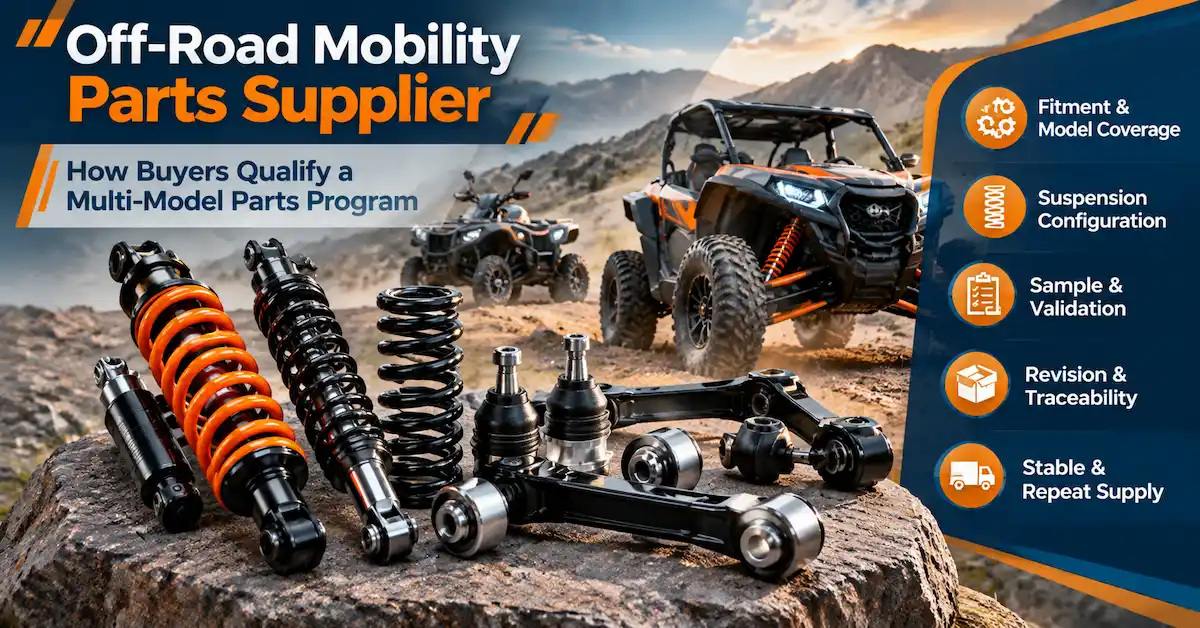
Why multi-model off-road programs are difficult to quote
An off-road mobility program can look simple because several vehicles may use a similar shock absorber shape. In practice, the model year, trim, drive layout, suspension position, spring support, mount width, hardware, body clearance, and intended load can change the correct configuration. A distributor may also need different labels, cartons, language inserts, and replacement rules for different markets. Treating every similar-looking part as interchangeable is one of the fastest ways to create returns.
ATV and UTV vehicles are used in mixed conditions. A recreational ATV may see a light rider and short trail use. A farm or utility unit may carry tools, a passenger, or a front attachment. A resort vehicle may prioritize stable low-speed transport, while a performance model may need a different balance between impact control and compliance. The supplier must know which use case the part number is intended to serve.
| Program variable | Why it changes the part | Buyer evidence |
|---|---|---|
| Vehicle identity | Year, trim, market, and suspension position may alter the interface. | Model code, year, side, position, photographs, and OEM number. |
| Load state | Rider, passenger, cargo, battery, and accessories change spring support. | Axle loads, payload range, sag target, and use condition. |
| Geometry | Length, stroke, angle, mount width, and travel determine fitment. | Measured drawing at droop, ride height, and bump. |
| Environment | Mud, water, salt, dust, and wash-down affect finish and sealing decisions. | Route, climate, cleaning process, storage, and service interval. |
| Channel | OEM, dealer, distributor, and service channels require different identity controls. | Forecast, packaging, labels, barcode, warranty, and replacement need. |
Ask the supplier to separate a confirmed fitment from an engineering proposal. If the supplier has only a model name and a photograph, the quotation should be marked provisional. If it has an OEM number, measured interface, approved spring and damping data, and a revision history, the buyer can make a more reliable commercial comparison.
Build a fitment matrix before requesting price
A fitment matrix is the central document for a multi-model program. It should have one row per vehicle and one column for every field that can create a different part. Keep the original customer description, the supplier response, and the final approved value in separate columns. This prevents an assumption from being copied into a production BOM just because it appeared in an early email.
Identify the platform and position
Record brand, model family, model year, market, engine or battery configuration, front or rear position, left or right side, and the intended application. Note whether the part is a direct replacement, an upgrade, or a component for a new vehicle. For a UTV, record seating arrangement, cargo bed, roof, winch, doors, and other accessories that influence mass or clearance. For a farm ATV, note racks, sprayers, plows, and loaded utility equipment.
Measure the mechanical interface
Capture extended length, compressed length, effective stroke, body diameter, spring seat, mounting hole or thread, bushing or sleeve, installation width, bolt size, and mounting angle. Photograph both ends with a scale and show the installed space around the shock. Measure full-bump and full-droop clearance to the tire, frame, drive shaft, brake line, battery, body panel, and any articulation member. A part that matches the hole can still be wrong if its body or spring contacts another component.
| Fitment record | Minimum fields | Approval question |
|---|---|---|
| Vehicle | Brand, model, year, trim, market, position, side, use. | Is this row a unique vehicle configuration or a verified common fitment? |
| Mount | Hole, thread, width, sleeve, bolt, angle, hardware. | Does the supplied hardware install without forcing alignment? |
| Travel | Total length, compressed length, extended length, stroke, bump stop. | Is usable travel available without coil bind or contact? |
| Spring | Rate, free length, installed length, preload, coil diameter. | Does the spring support each approved load state? |
| Damper | Fixed or adjustable, rebound, compression, setting, test condition. | Can the setting be identified and repeated in production? |
| Identity | Part number, revision, label, carton, barcode, instruction. | Can a dealer select the correct replacement after launch? |
For a supplier comparison, ask each candidate to return the matrix with missing fields highlighted. A supplier who asks for the same missing field on every row may be applying a disciplined process. A supplier who fills unknown values with broad compatibility language may be creating a hidden fitment liability.
Compare component capability, not only catalogue size
A large catalogue can be useful, but catalogue breadth is not the same as program capability. Buyers should compare the supplier's ability to connect shock absorbers, suspension springs, ball joints, mounts, hardware, and packaging to one controlled vehicle record. The supplier may manufacture some parts and source others; the important question is whether the responsibility boundary and incoming controls are clear.
For shock absorbers, ask how the supplier distinguishes a physical reference from an approved vehicle application. Confirm whether the spring rate, damper setting, mount, finish, and label are fixed by part number. For springs, request rate, free length, installed load, finish, and end-form information. For ball joints and other suspension parts, confirm taper, thread, boot, grease or service requirement, and vehicle interface. Do not use a generic “suspension kit” name as a substitute for a BOM.
| Capability | What the buyer should request | Risk controlled |
|---|---|---|
| Fitment engineering | Drawings, dimensions, OEM numbers, model-year matrix, and open points. | Wrong-year or wrong-position shipment. |
| Spring selection | Rate, length, installed condition, preload range, and approval record. | Incorrect ride height or load support. |
| Damping control | Fixed or adjustable setting, force conditions, tolerance, and revision. | Similar-looking parts with different behavior. |
| Hardware control | Bushing, sleeve, spacer, fastener, torque, and installation instruction. | Installation damage or loose fitment. |
| Packaging control | Individual protection, labels, barcode, carton, pallet, and language. | Damage, mixed models, and warehouse errors. |
| Service identity | Replacement number, warranty route, complaint fields, and change notice. | Unresolved field issues and uncontrolled substitutions. |
BEDO's public product information illustrates the level of technical detail a buyer can use in a response: length, stroke, spring rate, rebound and compression values, mounting holes, mounting widths, materials, and application. Treat those public values as reference data for an RFQ, not as a universal specification for every vehicle. The final approval must be tied to the exact model, year, configuration, and revision.
Use samples to close fitment and performance gaps
A sample is valuable when it answers a named question. “Send one sample” is not a test plan. Write what the sample must prove: installation, dimensions, clearance, ride height, sag, spring support, damping behavior, adjustment access, appearance, hardware, label, packaging, or all of these. A sample should carry an identity card that lists part number, revision, vehicle row, spring, setting, and included hardware.
Stage the approval gates
Start with document review, then dimensional inspection, static installation, dynamic vehicle test, pilot repeatability, and commercial release. If a dimension fails, do not judge dynamic behavior until the interface is corrected. If the vehicle uses a different tire or load than the approved condition, record the difference instead of treating the result as a universal conclusion.
| Gate | Purpose | Evidence |
|---|---|---|
| Document review | Confirm vehicle row, requirements, assumptions, and open points. | Controlled fitment matrix and supplier response. |
| Sample identity | Ensure the physical part matches the quote. | Part number, revision, spring, setting, photos, and packing list. |
| Static fitment | Check interfaces, clearance, travel, ride height, and hardware. | Measured dimensions, installation photos, load state, and corrections. |
| Dynamic check | Evaluate comfort, control, traction, bottoming, noise, and recovery. | Route, speed, tire, load, operator, setting, and observations. |
| Pilot release | Verify repeated parts, labels, packaging, and inspection. | Pilot report, final BOM, control plan, and approval. |
| Replenishment | Protect future orders from substitution. | Revision rule, lot record, change notice, and service identity. |
Keep a separate record for “fitment approved” and “performance approved.” A part may physically install but still need a spring or damping change. Conversely, a performance result is not useful if the installation depends on a temporary spacer or an unapproved hardware change. This distinction makes supplier comparisons fair and improves the quality of a purchase order.
Control revisions across a family of parts
Multi-model programs need clear rules for common and unique components. A common shock body may be shared while the mount, spring, length, setting, or label changes. A common carton may work for several sizes but still need a model-specific barcode. A common spring process does not mean a common spring rate. Document the boundary explicitly.
| Item | Can sometimes be shared | Must be checked by vehicle row |
|---|---|---|
| Shock body | Manufacturing process or body family. | Length, stroke, piston, seal, mount, and damping setting. |
| Spring | Material process, finish, or supplier. | Rate, free length, coil diameter, installed load, and preload. |
| Mount | General bushing family. | Hole, width, sleeve, angle, bracket, and hardware. |
| Finish | Color family or coating process. | Environment, corrosion requirement, appearance, and label. |
| Packaging | Outer carton dimensions or protective method. | Part identity, model, side, revision, barcode, and instructions. |
Change control should cover material source, spring supplier, damper setting, piston or valve, seal, coating, mount, hardware, label, carton, and inspection method. Ask when a change triggers remeasurement, bench testing, vehicle testing, customer approval, or only a document update. The answer should be part of the supplier agreement before the first repeat order.
Make the BOM readable to purchasing and service
A BOM should show the complete sellable assembly, not only the headline shock. Include spring, collars, bushings, sleeves, spacers, fasteners, labels, instruction sheet, and packaging. Give each item a part number or controlled description. If a component can be substituted, state the approved alternatives and the conditions for using them. Service teams need to know whether they can order a complete assembly or only a wear component.
When several models share an assembly, use a fitment table that maps each model to the exact row. Avoid a single description such as “ATV rear shock” when the spring, mount, or length differs. This improves web content, dealer selection, warehouse picking, and complaint investigation at the same time.
Evaluate manufacturing and quality evidence
The buyer should ask how engineering decisions are carried into production. Request the inspection points for length, stroke, mount, spring, appearance, leakage or movement where applicable, adjustment identity, label, and package. Ask how measurement tools are controlled and how a nonconforming lot is contained. If the supplier uses outside processes, request the responsibility boundary and incoming inspection method.
Public company information can establish the supplier identity and product direction, but it cannot replace project evidence. BEDO's public information describes a Ningbo manufacturing company, shock absorbers and springs, custom solutions, design support, and global supply activity. Use this information for initial qualification, then ask BEDO for current factory photographs, the process boundary, project-specific testing, actual packaging, MOQ, lead time, and authorized cases before publication or production approval.
| Evidence area | Useful record | Buyer decision |
|---|---|---|
| Company | Legal name, address, contact, manufacturing scope, responsible team. | Is the quote tied to the actual supplier? |
| Engineering | Drawing, BOM, matrix, revision, sample report, open-point list. | Can the program be repeated after the first sample? |
| Quality | Control plan, inspection record, tool status, nonconformance route. | How is a wrong part prevented from shipping? |
| Production | Process sequence, capacity assumption, pilot evidence, change rule. | Can the supplier support the forecast and revision? |
| Packaging | Photos, label proof, barcode, carton, hardware bag, instructions. | Can distribution identify and protect the correct part? |
| Service | Warranty basis, replacement number, complaint template, contact route. | Can field issues be resolved with traceable data? |
Plan packaging, logistics, and replenishment
Packaging is a technical control for off-road parts. Shocks can be damaged by rod contact, loose hardware, oil or surface contamination, or mixed left and right labels. Springs can be scratched or mixed across rates. Small mounts and sleeves can be lost if they are not bagged and identified. A distributor should approve the package at the same time as the part, not after the first shipment.
Specify individual protection, protective caps, hardware bag, label location, barcode format, carton count, pallet pattern, moisture protection, language, and installation instructions. State whether each carton represents one vehicle row or contains mixed configurations. Ask the supplier how production revision is shown on the label and how a warehouse can identify the replacement part without opening the carton.
| Commercial field | Question to ask | Why it matters |
|---|---|---|
| MOQ | Does the minimum apply to assembly, spring, label, carton, or complete vehicle family? | A low forecast may be viable for one part but not every variant. |
| Lead time | When does the clock start: drawing approval, deposit, materials, or purchase order? | Launch planning must include engineering and approval gates. |
| Forecast | Can the supplier quote by model row, family, and annual volume? | Shared components and unique variants need different planning. |
| Packaging | Are labels, barcode, instructions, carton, pallet, and export protection included? | Prevents damage, wrong picking, and extra post-processing. |
| Change | Which source, setting, material, and label changes require notice? | Protects fitment and field behavior after launch. |
Do not publish a universal MOQ or lead time based on a general company statement. These values vary with model count, customization, quantity, packaging, market, and approval status. Request written terms for the exact RFQ and keep the quotation revision with the fitment matrix.
Prepare a supplier-ready RFQ
A high-quality RFQ should help the supplier answer in one pass. Begin with the program scope and the vehicle family. Attach measured dimensions, model-year information, OEM numbers, photographs, load states, tire and wheel data, environmental use, forecast, market, packaging, and launch target. Mark every field as confirmed, estimated, calculated, or missing.
| RFQ section | Buyer supplies | Supplier returns |
|---|---|---|
| Company and market | Brand, channel, destination market, forecast, and service model. | Manufacturing scope, responsible contact, quotation assumptions. |
| Fitment | Model, year, position, OEM number, dimensions, photos, and clearance. | Fitment matrix, missing inputs, drawing, and sample proposal. |
| Performance | Loads, spring target, ride height, behavior, route, speed, and environment. | Spring and damper proposal, test method, and acceptance criteria. |
| Quality | Inspection, documents, traceability, certification, and change requirements. | Control plan, records, process boundary, and change procedure. |
| Commercial | Samples, pilot, production, MOQ, lead time, packaging, label, warranty. | Stage pricing, terms, shipping, and service response. |
Ask the supplier to return an explicit gap list. The gap list may request a clearer photograph, a wheel-off measurement, a load value, a sample, a tire specification, or a confirmation of the market label. This turns uncertainty into a task list and makes it easier for purchasing and engineering to decide whether the supplier is responsive.
Questions that separate a supplier from a listing
- Which vehicle rows are supported by confirmed OEM number or measured fitment?
- Which values are published reference data and which will be developed for this program?
- What changes between front, rear, left, right, trim, and model year?
- How are spring rate, damping setting, mounting hardware, and label connected to the part number?
- What is the sample-to-pilot approval process?
- What inspection and traceability records accompany production?
- What MOQ, lead time, packaging, warranty, and change terms apply to this exact family?
Off-road mobility parts supplier FAQ
What does an off-road mobility parts supplier provide?
The term can include shock absorbers, springs, ball joints, mounts, hardware, and related suspension parts for ATV, UTV, electric, utility, recreational, and special-use vehicles. The buyer should define whether the supplier is providing a catalogue replacement, a private-label assembly, or a development program.
Can one shock fit several ATV or UTV models?
Sometimes, but commonality must be verified against length, stroke, mount, spring, damping, clearance, load, and service identity. A similar appearance is not evidence of interchangeable fitment.
What should I send for an OEM parts quote?
Send brand, model, year, position, OEM number, dimensions, photographs, load, tire and wheel information, environment, quantity, market, label, packaging, and launch target. Mark unknown fields so the supplier can propose a measurement or sample plan.
Does BEDO publish a universal MOQ or lead time?
No. The exact MOQ and lead time depend on configuration, model count, quantity, customization, packaging, market, and approval stage. Request a written quotation for the specific project.
How should a distributor reduce wrong-part returns?
Use a controlled fitment matrix, model-year part numbers, clear position labels, approved photographs, barcode and carton rules, installation instructions, and a service complaint record that captures the installed vehicle and part revision.
What evidence supports a high-quality supplier page?
Use original product or factory photographs, public company identity, authorized product data, controlled drawings, sample records, packaging evidence, named author and technical reviewer, and explicit notes about project-specific fields such as MOQ, lead time, testing, and customer cases.
Conclusion
An off-road mobility parts supplier should be judged by the quality of its fitment and supply system, not by catalogue size alone. Buyers need a model-year matrix, measured interfaces, load and environment definitions, spring and damping records, sample gates, production controls, packaging identity, and a clear change process. This approach reduces wrong-part returns and gives purchasing a defensible basis for comparing quotations.
BEDO Auto's public information provides a factual starting point through its Ningbo manufacturer identity, ATV/UTV shock absorber references, suspension spring and related product scope, and custom-support positioning. Send a specific vehicle family and ask BEDO to confirm the exact fitment, configuration, evidence package, MOQ, lead time, packaging, and revision terms before approving a production order.