
When sourcing suspension components, buyers often face a key decision:
Should you choose OEM shock absorbers or aftermarket alternatives?
For distributors, fleet operators, and OEM buyers, understanding the difference between OEM vs aftermarket shock absorber options directly affects cost, performance, and long-term supply reliability.
The Challenge: Price vs Performance vs Supply Stability
Many buyers assume aftermarket parts are always cheaper and OEM parts are always better.
In reality, the decision is more complex:
- Lower-cost parts may lead to higher failure rates
- Premium OEM parts may increase procurement cost
- Inconsistent supply can disrupt operations
Choosing incorrectly can impact product quality, brand reputation, and customer satisfaction.
What OEM and Aftermarket Mean in Suspension Supply
Understanding definitions is essential.
OEM Shock Absorber:
- Manufactured to original specifications
- Designed for specific vehicle models
- Higher consistency and reliability
Aftermarket Shock Absorber:
- Produced as replacement parts
- May vary in design and material quality
- Broader compatibility across models
In the context of OEM vs aftermarket shock absorber sourcing, the key difference lies in quality consistency and supply positioning.
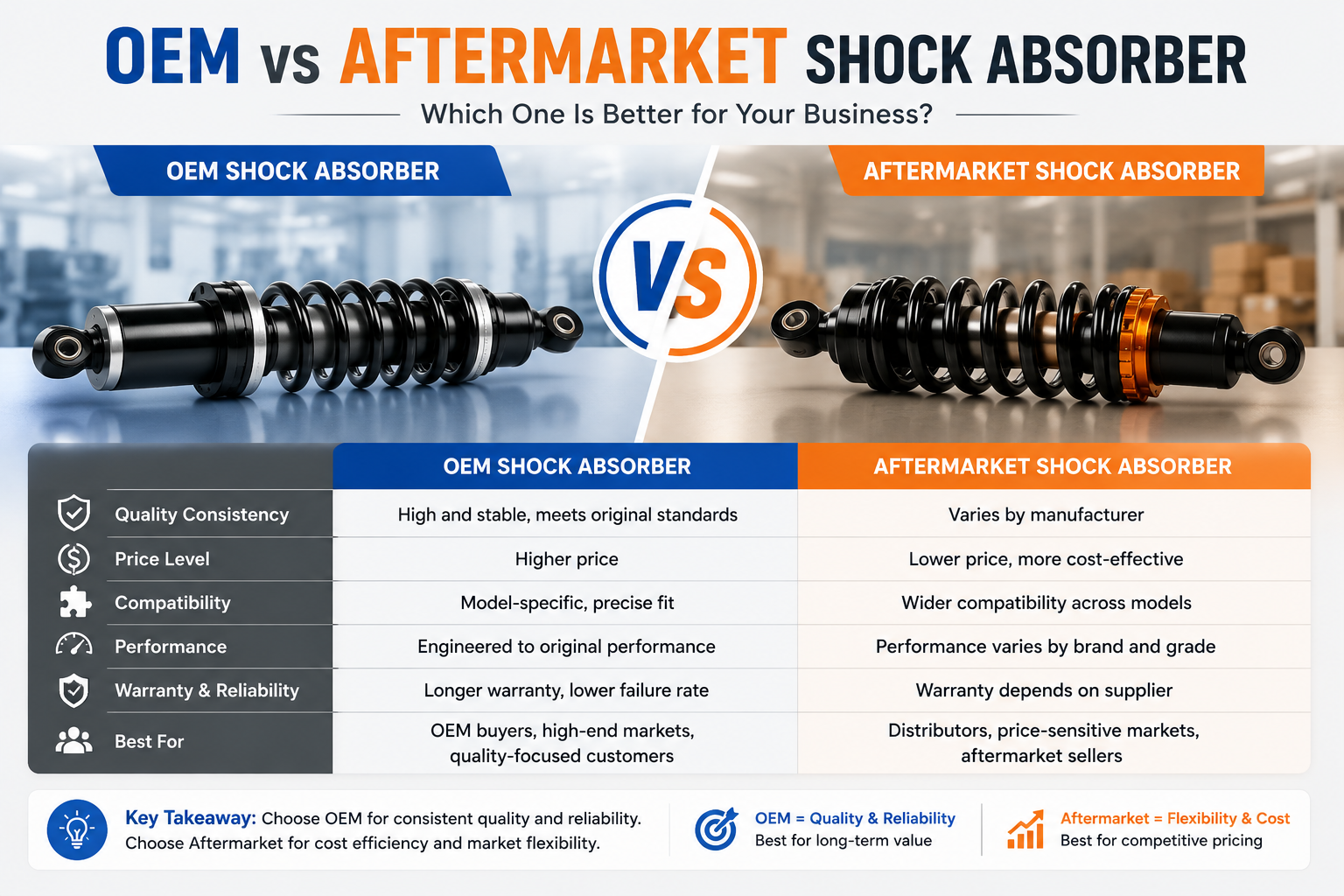
OEM vs Aftermarket: Key Differences for Buyers
| Factor | OEM Shock Absorber | Aftermarket Shock Absorber |
|---|---|---|
| Quality Consistency | High | Varies |
| Price Level | Higher | Lower |
| Compatibility | Model-specific | Broader |
| Branding | OEM-level | Private label possible |
| Supply Stability | Stable | Depends on supplier |
| Performance | Verified | May vary |
OEM focuses on precision and reliability, while aftermarket offers flexibility and cost advantages.
Solution: Choosing Based on Business Model
Instead of comparing only price, buyers should align selection with their business needs.
Choose OEM if:
- You need consistent product performance
- You are supplying to high-end markets
- You require strict specifications
Choose Aftermarket if:
- You focus on price-sensitive markets
- You need wider compatibility
- You require flexible product options
Explore suspension solutions here:
https://www.bedoauto.com/products
Cost and Risk Considerations
One common mistake buyers make is focusing only on unit price.
In practice:
- OEM reduces failure rates and after-sales issues
- Aftermarket may lower initial cost but increase maintenance risk
Choosing the wrong option can result in:
- Increased warranty claims
- Customer complaints
- Reduced brand trust
A clear understanding of OEM vs aftermarket shock absorber helps control long-term cost.
Why the Right Choice Improves Business Performance
Better Product Positioning
OEM supports premium product lines and brand reputation.
Higher Profit Flexibility
Aftermarket allows competitive pricing strategies.
Reduced Operational Risk
Stable supply and quality minimize disruptions.
Stronger Customer Satisfaction
Reliable performance builds long-term loyalty.
For bulk buyers and distributors, the right choice directly impacts profitability.
Real Application Scenarios
OEM Buyers: Require strict specifications and consistent quality
Distributors: Balance cost and performance across markets
Fleet Operators: Focus on durability and lifecycle cost
Aftermarket Sellers: Prioritize availability and pricing
In each case, OEM vs aftermarket shock absorber selection depends on business strategy.
Selection Advice for Buyers
When choosing between OEM and aftermarket, consider:
- Target market positioning
- Budget and cost strategy
- Required product lifespan
- Supplier manufacturing capability
- Quality control standards
Learn more about supplier capabilities:
https://www.bedoauto.com/about-us
FAQ
Q1: Are OEM shock absorbers always better than aftermarket?
Not always. OEM offers higher consistency, while aftermarket can be suitable for cost-sensitive applications.
Q2: Can aftermarket shock absorbers meet OEM quality?
Some high-quality aftermarket suppliers can match OEM standards, depending on manufacturing capability.
Q3: Which option is better for bulk procurement?
It depends on your target market—OEM for quality-focused buyers, aftermarket for price-driven markets.
Choosing the Right Strategy for Your Market
The decision between OEM vs aftermarket shock absorber is not just technical—it’s strategic.
A clear sourcing approach helps buyers reduce risk, optimize cost, and build a competitive product offering.
At Bedo, we support both OEM and aftermarket production, providing flexible solutions for global distributors and OEM clients.
For sourcing support or project consultation:
https://bedoauto.com
https://www.bedoauto.com/contact-us