
What Should a Heavy Load Suspension Manufacturer Actually Engineer?
Direct answer: a heavy load suspension manufacturer should not begin by choosing the stiffest spring or largest shock absorber. The project should start with the vehicle's real operating-weight range, front/rear and preferably corner loads, load location, permanent versus variable weight, suspension geometry, sag, usable travel, spring requirement, compression and rebound damping, terrain, duty cycle, and validation criteria.
The final suspension should then be validated in the load conditions the vehicle will actually experience and transferred into controlled drawings, spring and damping specifications, prototype records, pilot-batch checks, and production QC.
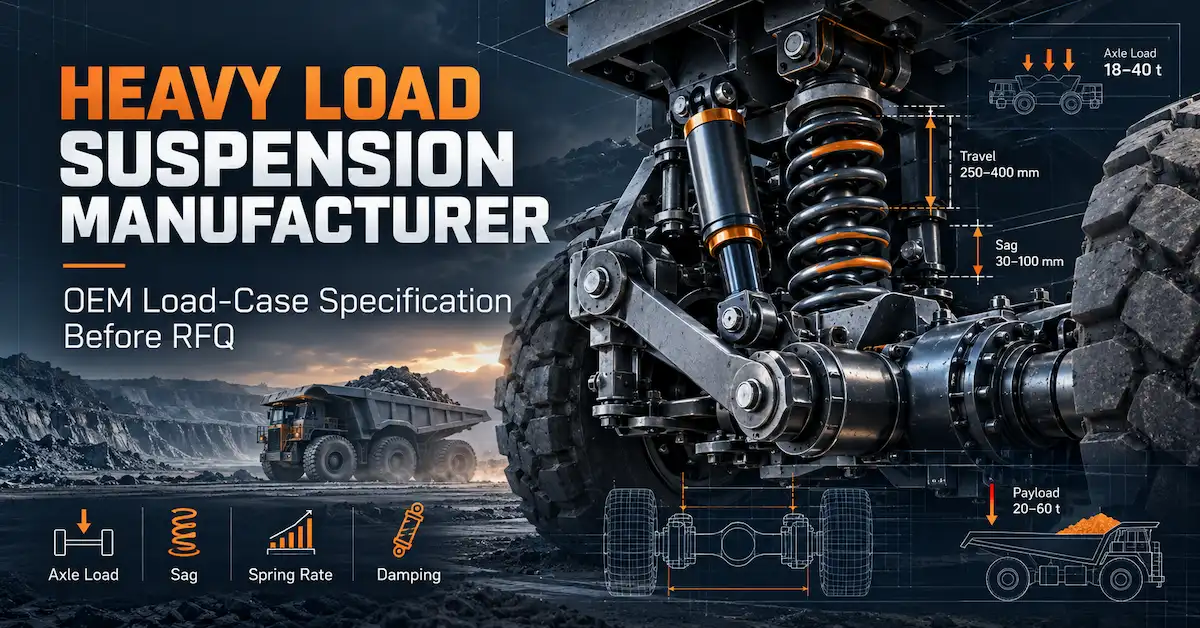
Heavy Load Is a Load Case, Not a Marketing Label
Terms such as “heavy duty,” “high load,” “reinforced,” and “strong suspension” are useful for product marketing, but they are incomplete engineering specifications.
A proper heavy load suspension project should establish several operating states.
| Load Case | What It Represents | Why It Matters |
|---|---|---|
| Base operating condition | Vehicle plus permanent equipment | Defines the true unloaded baseline |
| Typical working load | Normal passengers, cargo and equipment | Represents daily operation |
| Maximum intended load | Highest approved working condition | Defines upper suspension validation |
| Light-return condition | Vehicle after cargo is removed | Prevents an excessively harsh unloaded setup |
| Asymmetric load | Load concentrated to one side or position | Shows left/right or corner-load differences |
| Dynamic duty condition | Vehicle carrying load on representative terrain | Tests damping and usable travel |
This load-case method is more useful than simply writing:
“Vehicle payload: 400 kg.”
A heavy load suspension manufacturer needs to know whether that 400 kg is permanently installed, occasionally carried, distributed between occupants, concentrated behind the rear axle, or mounted close to the front suspension.
Permanent Load and Variable Load Need Different Thinking
Permanent equipment changes the baseline vehicle every time it operates.
Examples include:
- Winches
- Service bodies
- Tool cabinets
- Battery systems
- Heavy bumpers
- Protection systems
- Roof structures
- Fixed tanks
- Mounted machinery
Variable load may include passengers, supplies, tools, feed, construction materials, baggage, or other cargo that changes throughout the working day.
A spring developed only for the maximum load may be unnecessarily stiff during the lighter condition.
A spring selected only for the unloaded vehicle may sag excessively when the normal working cargo is added.
The engineering target is therefore an operating envelope, not one isolated load number.
Total Vehicle Weight Is Not Enough: Measure Axle and Corner Loads
Total operating weight gives useful context, but it does not show how much load each suspension position must support.
For heavy-load projects, front and rear axle loads are often more useful.
Where the project complexity justifies it, individual corner loads can provide even better information.
Why Axle Load Matters
Consider two utility vehicles with the same total operating weight.
Vehicle A carries tools close to the center of the chassis.
Vehicle B carries the same tool mass behind the rear passenger compartment.
Vehicle B may place substantially more demand on the rear suspension even though the scale shows the same total vehicle weight.
This can change:
- Rear sag
- Ride height
- Remaining compression travel
- Spring requirement
- Compression behavior
- Rebound requirement
- Vehicle pitch
Why Corner Load Can Matter
Some specialty vehicles carry equipment asymmetrically.
A battery pack, tank, tool system, operator position, mounted machine, or side storage system may place more weight on one side.
In those projects, axle load alone can hide a left/right imbalance.
A load brief for a heavy load suspension manufacturer can therefore include corner measurements when practical.
Useful buyer principle: total payload tells the manufacturer how much additional mass exists. Axle or corner load tells the manufacturer where the suspension actually has to support it.
Load Location Can Matter as Much as Load Mass
The suspension does not respond only to mass. The position of that mass relative to the vehicle geometry also matters.
A rear cargo box positioned far behind the rear suspension can influence the vehicle differently from the same mass mounted closer to the center.
Likewise:
- A front winch primarily increases front demand.
- A rear utility body usually increases rear demand.
- Passengers distribute weight according to seating position.
- A large battery can shift the vehicle's static balance.
- A trailer tongue load can increase rear suspension load.
This is why a heavy load suspension RFQ should include load position, not just load mass.
Create a Simple Load Map
The buyer can classify each added item as:
- Front permanent
- Center permanent
- Rear permanent
- Front variable
- Cabin/passenger variable
- Rear variable
This small step can reveal why a vehicle that appears acceptable when empty loses too much rear ride height when working.
Sag Is One of the Most Useful Heavy Load Suspension Measurements
Sag shows how much suspension movement is consumed by vehicle weight before the vehicle encounters terrain input.
For heavy-load suspension development, record suspension position in several conditions rather than one.
Recommended Measurement Conditions
- Full-extension reference where safely obtainable and appropriate to the vehicle.
- Base vehicle with permanent equipment.
- Typical working load.
- Maximum intended operating load.
Keep the measurement method consistent.
Where relevant, also keep consistent:
- Tire pressure
- Fuel state
- Rider or operator position
- Cargo placement
- Battery configuration
- Suspension adjustment settings
Why Sag Matters More Than Appearance
A vehicle can look level and still have too little suspension travel remaining.
If heavy load moves the shock deep into its stroke before the vehicle reaches rough terrain, the suspension may have inadequate compression reserve.
That creates a more useful engineering question than:
“Can you make the spring harder?”
The better question is:
“Under our normal operating load, how much usable compression travel should remain, and what spring/damping configuration achieves it?”
Preload Cannot Replace the Correct Spring Rate
Preload is useful, but it is frequently misunderstood in heavy-load suspension sourcing.
Preload changes the spring's installed starting condition.
For a linear spring, increasing preload does not change the inherent spring rate.
If the vehicle carries a load far outside the working range of the original spring, adding more preload may increase ride height without solving the fundamental spring-selection issue.
When Preload Is Useful
Preload can help:
- Set initial ride height
- Fine-tune case
- Compensate for a reasonable load variation
- Establish a defined baseline setup
When a New Spring Should Be Evaluated
Spring development becomes more relevant when:
- The normal working load has increased substantially.
- The vehicle repeatedly uses too much static travel.
- The preload adjustment approaches an impractical extreme.
- A permanent body or equipment package has been added.
- The vehicle is being redesigned for a new payload range.
BEDO's current suspension spring category can be used as a commercial starting point when discussing spring development.
Spring Rate Should Be Developed From the Load Envelope
A heavy load suspension manufacturer should treat spring rate as an engineering output, not simply a catalog number.
The required spring depends on:
- Static load
- Front/rear or corner distribution
- Suspension geometry
- Motion ratio
- Desired sag
- Available shock stroke
- Target wheel travel
- Variable-load range
- Terrain
- Desired unloaded behavior
Ask for Complete Spring Units
A spring rate without a complete unit is difficult to use for engineering comparison.
For a custom project, request clearly defined values such as an agreed rate unit together with the relevant spring dimensions and, where needed, load-deflection data.
If the buyer does not yet know the target spring rate, do not invent one to complete the RFQ.
Instead write:
Supplier engineering proposal required based on vehicle/load/sag data.
This creates a clear boundary between buyer requirements and supplier engineering.
Loaded and Unloaded Conditions Must Both Work
A utility vehicle may spend part of the day heavily loaded and part of the day nearly empty.
This creates a harder engineering problem than a vehicle with one fixed load.
The suspension may need to balance:
- Heavy-load support
- Acceptable unloaded compliance
- Usable shock travel
- Reasonable ride height
- Controlled rebound
Simply selecting the stiffest spring can solve one problem and create another.
Shock Travel Must Be Checked After the Spring Supports the Load
Spring support is only part of the heavy-load suspension equation.
The vehicle also needs enough usable shock travel in the loaded condition.
Record:
- Extended shock length
- Compressed shock length
- Effective stroke
- Loaded static shock position
- Remaining compression movement
- Available rebound movement
Why Loaded Shock Position Is Important
A shock may have a large total stroke on paper.
But if the normal working load pushes it deep into that stroke, the useful remaining compression range can be much smaller.
This is one reason heavy load suspension cannot be evaluated from catalog dimensions alone.
The heavy load suspension manufacturer should review the component after the vehicle has been placed in its actual working condition.
Do Not Confuse Shock Stroke With Wheel Travel
Suspension geometry can create a relationship between shock movement and wheel movement.
Therefore:
100 mm of shock stroke does not automatically equal 100 mm of wheel travel.
For new-platform development, provide suspension hard points or CAD where possible.
BEDO'S custom suspension development files guide explains which vehicle, load, drawing, CAD, spring, and damping data can help support a more controlled engineering review.
A Stronger Spring Usually Requires a Damping Review
The spring supports the load. The shock absorber controls the speed of suspension movement.
These roles are different but connected.
If spring rate changes substantially, the damper should be evaluated because the new spring can store and release energy differently.
Compression Damping
Compression damping influences how quickly the suspension compresses during terrain input.
Under heavy load, the suspension may already operate closer to the compressed side of its travel.
The damping target should therefore consider:
- Operating load
- Spring rate
- Shock position
- Terrain
- Vehicle speed
- Impact severity
- Duty cycle
More compression damping is not automatically better.
Too much can make the vehicle unnecessarily harsh and reduce compliance.
Rebound Damping
Rebound damping controls suspension extension after compression.
If a stronger spring is installed but rebound control remains too low, the loaded vehicle may feel bouncy or poorly controlled after impacts.
If rebound is excessive, the suspension may recover too slowly during repeated terrain events.
A useful OEM requirement therefore describes the vehicle behavior instead of simply requesting:
“More damping.”
Ask the Manufacturer for Damping Evidence, Not Just a Maximum Force Number
One isolated rebound or compression force does not describe the complete behavior of a shock absorber.
For a development project, useful evidence may include:
- Test configuration
- Shock revision
- Spring configuration
- Adjustment position
- Test speed or test conditions
- Compression results
- Rebound results
- Force-velocity data where available
- Acceptance range
If the buyer already has dyno data, send the original curve or report rather than summarizing it as:
“The old shock is too soft.”
If no test data exists, describe what the vehicle actually does.
Useful Engineering Feedback
- Rear suspension rebounds repeatedly after large bumps.
- Vehicle bottoms under the normal cargo load.
- Loaded vehicle loses too much ride height.
- Suspension becomes harsh when cargo is removed.
- Control deteriorates during long rough-road operation.
These observations give the heavy load suspension manufacturer a problem to investigate instead of a vague request for “stronger shocks.”
Heavy Load and Severe Duty Cycle Are Not the Same Thing
Load describes how much weight the suspension supports.
Duty cycle describes how intensely and how continuously the suspension has to work.
A heavily loaded utility vehicle moving slowly across a relatively smooth worksite has a different shock requirement from a heavily loaded vehicle operating for long periods on washboard roads or rocky terrain.
| Operating Case | Main Suspension Challenge |
|---|---|
| Heavy load + low speed + smooth terrain | Load support and ride height |
| Heavy load + repeated rough terrain | Load support, damping and durability |
| Variable load + mixed terrain | Wide operating envelope |
| Permanent load + long duty cycle | Baseline spring match and thermal consistency |
| Heavy load + large tires | Load support plus changed unsprung behavior |
This distinction matters when choosing between shock architectures.
Do Heavy Loads Automatically Require Reservoir Shocks?
No.
A reservoir configuration can be useful in some demanding duty cycles, but the presence of heavy load alone does not prove that a reservoir is necessary.
The decision should consider:
- Suspension cycling frequency
- Operating duration
- Terrain severity
- Heat generation
- Packaging
- Performance target
- Cost
The correct specification may be a properly matched conventional shock, a piggyback arrangement, or another architecture depending on the application.
Mounting Interfaces Must Be Checked Under Real Load
Heavy load suspension development should not focus only on spring and damping performance.
The physical interfaces also matter.
Review:
- Upper mounting width
- Lower mounting width
- Mounting-hole diameter
- Bushings
- Sleeves
- Fasteners
- Bracket geometry
- Clearance
- Installed shock angle
Load Can Change Clearance
When the vehicle settles under heavy load, surrounding clearances can change.
Check loaded conditions around:
- Shock body
- Spring
- Reservoir
- Control arm
- Tire
- Chassis
- Cargo structure
A shock that fits correctly in the unloaded workshop condition may still interfere after the vehicle reaches its working ride height.
Heavy Load Suspension Does Not Increase the Vehicle's Rated Payload
Important OEM distinction: changing the suspension does not automatically increase the vehicle manufacturer's rated payload, GVWR, towing limit, rack rating, tire rating, brake capability, frame capacity, steering capacity, or other system-level limits.
A heavy load suspension manufacturer develops suspension around a defined operating requirement.
The complete vehicle remains a system.
Other limiting components may include:
- Frame
- Brakes
- Tires
- Wheels
- Axles
- Steering
- Driveline
- Cargo structure
- Hitch system
For aftermarket projects, never use suspension upgrades as justification for exceeding the vehicle manufacturer's approved operating limits.
For a new OEM vehicle, system-level ratings should be established by the vehicle manufacturer through the appropriate engineering and validation process.
What Should a Heavy Load Suspension Manufacturer Validate?
Prototype validation should reproduce the intended operating conditions instead of testing only an unloaded vehicle.
Stage 1: Dimensional Verification
Confirm the approved component against the controlled drawing.
Relevant fields may include:
- Extended length
- Compressed length
- Stroke
- Mounting dimensions
- Body diameter
- Rod diameter where controlled
- Spring dimensions
- Reservoir configuration where applicable
Stage 2: Base-Load Vehicle Check
Install the suspension on the vehicle with permanent equipment and record:
- Ride height
- Sag
- Shock position
- Clearance
- Available travel
Stage 3: Typical Working Load
This is often the most important validation state because it represents daily operation.
Evaluate:
- Ride height
- Remaining compression travel
- Suspension response
- Compression control
- Rebound recovery
- Clearance
Stage 4: Maximum Intended Operating Load
Validate the highest approved project load within the vehicle's defined operating envelope.
Do not use this step to invent a new payload rating.
Stage 5: Light or Unloaded Return Condition
If the vehicle frequently returns without cargo, the suspension should also be evaluated in that state.
A setup that works only at maximum load may be unsuitable for a vehicle that spends half its duty cycle empty.
Build a Load Validation Matrix Before Prototype Approval
| Test Condition | Weight Data | Check | Acceptance Question |
|---|---|---|---|
| Base vehicle | Permanent equipment | Sag and ride height | Is baseline position acceptable? |
| Typical load | Normal passengers/cargo | Travel and damping | Does the vehicle work correctly in daily use? |
| Maximum intended load | Upper project condition | Remaining travel and control | Is sufficient suspension margin maintained? |
| Light return | Minimal cargo | Compliance | Is the unloaded setup excessively harsh? |
| Representative terrain | Selected load state | Dynamic behavior | Does control remain stable through the duty cycle? |
The exact numeric acceptance limits must come from the project.
A blog should not invent universal sag percentages, damping forces, travel margins, or durability cycles for every vehicle.
Prototype Testing and Production QC Are Different
This distinction is important for OEM procurement.
Prototype Validation
Prototype testing asks:
Does the proposed heavy load suspension design work for the defined application?
Pilot-Batch Validation
Pilot production asks:
Can the factory reproduce the approved design consistently?
Routine Production QC
Production QC asks:
Do later manufactured units continue to match the approved specification?
These stages should not be treated as interchangeable.
BEDO'S shock absorber testing before mass production guide provides more detail on dimensional inspection, damping verification, leakage, load evaluation, durability, adjustment checks, and vehicle validation.
What Production Evidence Should OEM Buyers Request?
A heavy load suspension manufacturer should be able to link the approved sample to controlled production information.
Depending on project complexity, request:
- Product code
- Drawing revision
- Approved prototype ID
- Spring specification
- Damping configuration
- Adjustment baseline
- Mounting hardware definition
- Surface treatment
- Inspection plan
- Test plan
- Acceptance criteria
Why Revision Control Matters
A heavy-load shock can look identical after an internal engineering change.
If the spring or damping configuration changes but the commercial SKU does not, the buyer may receive a product that appears correct yet performs differently.
Revision control should connect:
Vehicle Application → Drawing → Spring → Damping → Prototype → Production SKU
How to Evaluate a Heavy Load Suspension Manufacturer Before RFQ
This article is not another generic supplier checklist, but manufacturer capability still matters.
The useful question is whether the supplier can process the load data required by the project.
Engineering Questions
Ask whether the supplier can review:
- Vehicle operating weight
- Axle loads
- Corner loads where relevant
- Load location
- Sag measurements
- Shock travel
- Suspension geometry
- Spring requirements
- Damping data
- Duty cycle
Development Questions
Ask whether the supplier supports:
- Reference sample analysis
- Drawing review
- CAD review
- Spring proposal
- Prototype production
- Damping development
- Vehicle feedback revisions
- Pilot production
Production Questions
Ask how the supplier controls:
- Critical dimensions
- Spring version
- Damping configuration
- Assembly
- Leakage
- Product identification
- Revision changes
BEDO's public About Us page states that Ningbo Bedo Auto Parts Co., Ltd. manufactures shock absorbers and springs and supports customized solutions, professional design support, quality-control systems, R&D, and small-batch ordering.
Heavy Load Suspension for Different Vehicle Types
Heavy-load requirements vary significantly by vehicle platform.
| Vehicle | Typical Added Load | Main Suspension Question |
|---|---|---|
| ATV | Tools, racks, sprayers, hunting equipment | How much rear/front load changes? |
| UTV | Passengers, cargo bed, utility equipment | How broad is the loaded/unloaded range? |
| Golf / utility cart | Passengers, rear seat, equipment, battery changes | Does the base configuration still match? |
| Electric vehicle | Battery mass | Where is the battery weight located? |
| Specialty work vehicle | Permanent machinery or service body | What are the actual corner loads? |
| Modified off-road vehicle | Large tires, armor, winch, racks | What changed from the original baseline? |
BEDO already publishes narrower technical guides for heavy-duty ATV suspension for cargo and UTV suspension for heavy payload applications. Those application pages can support the broader heavy-load engineering cluster without duplicating this manufacturer's RFQ-focused page.
Cost Drivers in a Heavy Load Suspension Project
Heavy-load suspension quotations can differ substantially even when the external shock dimensions appear similar.
Cost may be affected by:
- Shock architecture
- Spring specification
- Custom mounting dimensions
- Body and rod requirements
- Damping development
- Reservoir configuration
- Adjustment features
- Surface treatment
- Prototype quantity
- Testing scope
- Engineering revisions
- Pilot-batch quantity
- Production volume
- Private-label requirements
- Packaging
Compare Equivalent Scope Before Comparing Price
A good procurement comparison follows this sequence:
Same Load Case → Same Technical Specification → Same Validation Scope → Same Commercial Scope → Price Comparison
Otherwise, one supplier may look cheaper only because the quotation excludes spring development, prototype validation, test evidence, or commercial customization.
What Should Be in a Heavy Load Suspension RFQ?
Vehicle Data
- Vehicle type, model and project code
- Front or rear suspension position
- Base operating weight
- Wheel and tire configuration
- Suspension geometry where available
Load Data
- Permanent accessory weight
- Passenger load
- Typical cargo
- Maximum intended cargo
- Cargo location
- Front/rear axle load where available
- Corner load where relevant
Existing Suspension
- Reference shock or spring
- Extended length
- Compressed length
- Shock stroke
- Mounting dimensions
- Spring specification
- Case data
- Current damping data where available
Performance Requirement
- Current problem
- Desired ride-height behavior
- Loaded travel requirement
- Terrain
- Duty cycle
- Unloaded behavior requirement
Commercial Requirement
- Prototype quantity
- Pilot quantity
- Production forecast
- Branding
- Packaging
- Target launch timing
If you do not know the spring rate or damping target, do not invent values.
Clearly mark:
Supplier engineering proposal required.
A Better Heavy Load Suspension Development Workflow
| Stage | Buyer Input | Manufacturer Output |
|---|---|---|
| 1. Load definition | Vehicle, cargo, passengers, equipment | Load-case review |
| 2. Geometry review | Sample, drawing, CAD, dimensions | Fitment assessment |
| 3. Spring proposal | Sag, load, travel targets | Spring specification proposal |
| 4. Damping development | Vehicle behavior and duty cycle | Compression/rebound proposal |
| 5. Prototype | Approved initial requirement | Development sample |
| 6. Vehicle validation | Loaded/unloaded test feedback | Engineering revision |
| 7. Approval | Final acceptance | Controlled specification |
| 8. Pilot batch | Approved configuration | Production-repeatability evidence |
| 9. Volume production | Purchase order | Controlled repeat supply |
This process gives a heavy load suspension manufacturer enough information to develop a repeatable product rather than simply supplying a shock that looks stronger than the original.
Preparing a Heavy Load Suspension RFQ?
Send BEDO your vehicle platform, permanent and variable loads, axle data, current shock or spring, sag measurements, drawings, CAD files, terrain, duty cycle and production forecast.
FAQ: Heavy Load Suspension Manufacturer
What does a heavy load suspension manufacturer need from an OEM buyer?
Provide the vehicle platform, base operating weight, permanent equipment, passenger and cargo loads, load position, axle or corner loads where available, current suspension dimensions, sag, spring information, terrain, duty cycle, current problem, and expected production quantity.
Is heavy load suspension just a stiffer spring?
No. The spring supports load, while the shock controls suspension movement. Heavy-load development should evaluate spring rate, sag, usable travel, compression damping, rebound damping, geometry, mounting interfaces, terrain, and duty cycle together.
Does a stronger suspension increase vehicle payload capacity?
No. Suspension changes do not automatically increase vehicle payload, GVWR, towing limits, tire ratings, braking capability, frame capacity, or other manufacturer-defined limits.
Why are axle loads more useful than total payload?
Total payload indicates how much mass is added, while axle load indicates where that mass is being supported. Rear-mounted cargo, front equipment and centrally located passengers can create very different front/rear suspension requirements.
Should heavy load suspension be tested unloaded?
Yes when the vehicle frequently operates unloaded or lightly loaded. A suspension developed only for maximum load may become unnecessarily harsh when cargo is removed.
Do heavy loads always require reservoir shocks?
No. Reservoir architecture becomes more relevant when load is combined with demanding terrain, frequent suspension cycling, longer operating periods, or thermal requirements. Heavy load by itself does not determine shock architecture.
When should spring rate be changed?
A new spring should be evaluated when the normal working load consumes too much suspension position, the original spring cannot reasonably support the required load range, or permanent vehicle weight has changed significantly.
Should damping be changed after fitting a stronger spring?
A significant spring-rate change should trigger a damping review. The new spring may change how energy is stored and released, affecting compression and rebound control.
What should I send if I do not know the target spring rate?
Send actual load data, sag measurements, suspension geometry, current spring information, shock travel, and the problem you want to solve. Ask the manufacturer to provide an engineering proposal instead of inventing a spring rate.
How should a heavy load suspension prototype be approved?
Approve it against defined base, typical, and maximum intended load cases. Check sag, ride height, usable travel, clearance, spring behavior, compression and rebound response, and representative terrain performance.
What should be controlled after prototype approval?
Control the drawing revision, spring specification, damping configuration, mounting interfaces, approved sample, inspection plan, test criteria, and product code before pilot and volume production.
Can BEDO support custom heavy load suspension projects?
BEDO's public website states that it manufactures shock absorbers and springs and supports customized solutions, design support and small-batch ordering. Project-specific heavy-load requirements should be reviewed using actual vehicle, load, suspension and validation data.
Conclusion
A heavy load suspension manufacturer should engineer around real load cases—not a generic “heavy-duty” label. Define where the load sits, measure axle or corner loads where practical, evaluate sag and usable travel, match the spring to the operating envelope, review damping after spring changes, and validate both loaded and light conditions before production.
For a custom heavy load suspension project, review BEDO's suspension products and suspension springs, then send your load data, sample, drawing or CAD and production requirements through the BEDO Contact Us page.