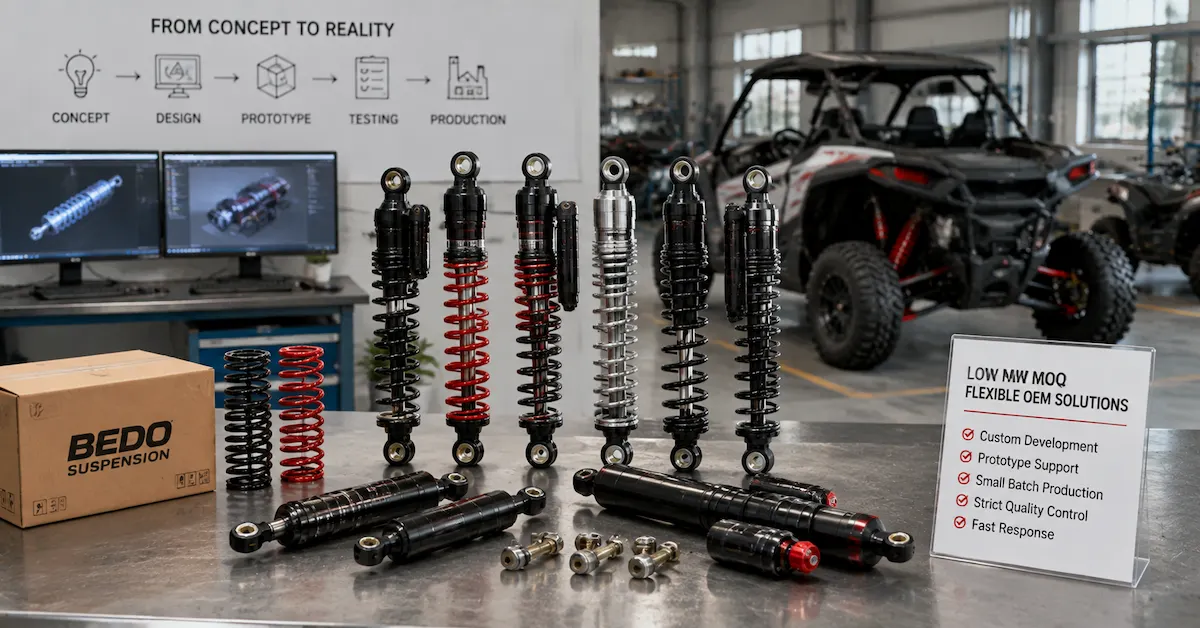

Yes. Custom UTV suspension for four-seat vehicles can be developed around actual passenger weight, seating position, front/rear axle loads, suspension geometry, shock travel, spring requirements, damping targets, and intended driving conditions.
The important point is that four seats alone do not define the suspension specification.
A four-seat vehicle carrying one driver behaves differently from the same vehicle carrying four adults plus tools or cargo. Additional occupants can move the suspension deeper into its travel, increase rear sag, change front/rear weight distribution, and alter how the shock absorbers must control vehicle movement.
A practical development path is:
Vehicle Configuration → Passenger Load → Axle Distribution → Existing Suspension Review → Spring & Damping Evaluation → Prototype → Loaded Vehicle Testing → Revision → Production
For UTV manufacturers, private-label brands, distributors, and specialty vehicle developers, suspension should therefore be selected around the vehicle's real loaded condition—not seat count alone.
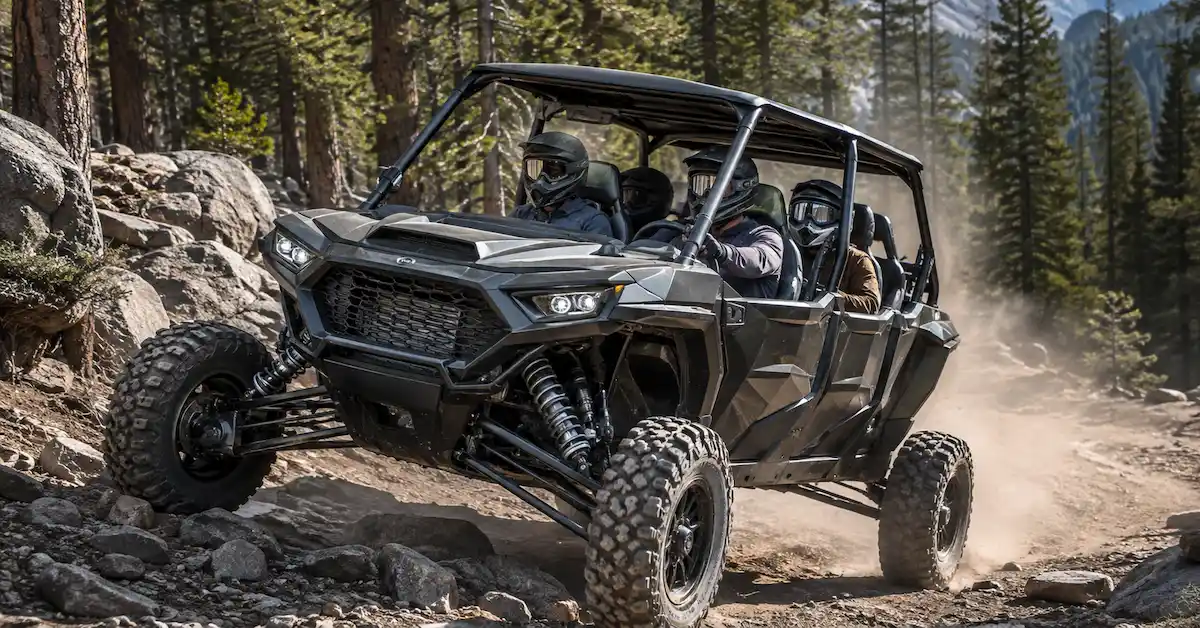
Why Does a Four-Seat UTV Need Different Suspension Evaluation?
Adding a second row does more than increase passenger capacity.
Compared with a two-seat vehicle, a four-seat or multi-passenger UTV may have:
- Higher operating weight
- More rearward passenger load
- A different wheelbase
- Different center-of-gravity behavior
- Higher rear suspension sag
- Less remaining compression travel
- Different spring requirements
- Different damping requirements
The basic relationship is:
More Occupants → Different Axle Load → Different Sag → Different Spring & Damping Demand
This does not mean every four-seat UTV automatically needs heavy-duty shocks.
If the standard suspension already supports the intended passenger load while maintaining appropriate ride height, travel, handling, and comfort, a custom setup may not be necessary.
Customization becomes relevant when the existing suspension does not adequately match the intended passenger configuration or operating conditions.
Passenger Count Alone Is Not Enough
One of the most common mistakes is telling a suspension supplier only:
We have a four-seat UTV.
That information identifies the seating configuration but does not describe the actual suspension load.
Consider two vehicles.
Vehicle A
- Driver
- One adult passenger
- Two lighter rear passengers
- No significant cargo
Vehicle B
- Four adults
- Rear cargo
- Added accessories
- Rough working terrain
Both are four-seat UTVs, but their suspension requirements may be substantially different.
Useful passenger information includes:
- Typical number of occupants
- Maximum number of occupants
- Approximate occupant weight
- Front-seat passenger weight
- Rear-seat passenger weight
- Passenger plus cargo condition
A useful engineering principle is:
Seat count defines capacity; actual occupant weight defines suspension load.
Why Does Rear-Seat Position Matter?
The location of the additional passengers affects how their weight reaches the suspension.
Rear-seat passengers are often positioned closer to the rear axle than front occupants.
Depending on vehicle architecture,adding rear occupants can increase:
- Rear axle load
- Rear spring compression
- Rear shock static compression
- Vehicle pitch
- Rear suspension sag
| Vehicle Condition | Main Suspension Consideration |
|---|---|
| Driver only | Baseline setup |
| Two front occupants | Front and overall load |
| Front + rear passengers | Increased rear influence |
| Four occupants | Full passenger load |
| Four occupants + cargo | Passenger and cargo load combined |
| Rear passengers + accessories | Variable plus permanent rear load |
For this reason, a supplier should ask not only how many passengers are carried, but also where they sit.
Why Are Front and Rear Axle Loads Useful?
Total vehicle weight provides only part of the engineering information.
For example:
Loaded vehicle weight: 950 kg
does not show whether most of the additional weight is carried by the front suspension or rear suspension.
When available, useful data includes:
- Front axle weight unloaded
- Rear axle weight unloaded
- Front axle weight with passengers
- Rear axle weight with passengers
- Axle weights with passengers and cargo
This helps identify which end of the vehicle experiences the largest change.
Total vehicle weight tells you how heavy the UTV is; axle weight tells you which suspension has to carry that weight.
For a new OEM platform, this information can be particularly valuable when developing custom UTV suspension for four-seat vehicles.
Should Four-Seat UTVs Use Stiffer Rear Springs?
Possibly, but not automatically.
A stronger rear spring may be worth evaluating if full passenger loading causes:
- Excessive rear sag
- Reduced ride height
- Frequent bottoming
- Insufficient compression travel
- Poor vehicle balance
Spring selection can depend on:
- Loaded rear axle weight
- Passenger configuration
- Existing spring specification
- Suspension geometry
- Motion ratio where relevant
- Available wheel and shock travel
- Target ride height
- Loaded versus unloaded operating conditions
If the Rear Spring Is Too Soft
Possible symptoms include:
- Rear end sits too low
- Reduced ground clearance
- Frequent bottoming
- Poor load support
- Too little remaining suspension travel
If the Rear Spring Is Too Stiff
Possible problems include:
- Harsh ride with one or two occupants
- Reduced wheel compliance
- Poor traction on uneven terrain
- Limited suspension articulation
- Lower passenger comfort
The objective should therefore be:
Enough spring support for full passenger load without making the lightly loaded vehicle unnecessarily harsh.
Can Preload Compensate for More Passengers?
Preload can help with moderate load variation, but it has limits.
Depending on the shock and spring configuration, preload adjustment may help:
- Restore ride height
- Reduce moderate sag
- Fine-tune vehicle stance
- Adapt to different passenger conditions
However, if a four-seat UTV regularly carries four adults and requires excessive preload to maintain reasonable suspension position, the spring itself may need to be reconsidered.
A useful rule is:
Preload adjusts suspension position; it does not replace an appropriately selected spring for a substantially different operating load.
Increasing preload excessively can also affect:
- Droop
- Compliance
- Unloaded ride behavior
Does Damping Need to Change for a Four-Seat UTV?
It should be evaluated if vehicle weight or spring rate changes significantly.
Spring rate and damping perform different functions.
The Spring Supports the Load
Spring configuration primarily influences:
- Static suspension position
- Sag
- Ride height
- Load support
The Shock Controls Suspension Movement
Damping primarily influences:
- Compression speed
- Rebound speed
- Body motion
- Wheel control
- Suspension oscillation
Installing a stronger spring while ignoring damping can leave the suspension poorly balanced.
A useful engineering relationship is:
Passenger Load → Spring Evaluation → Damping Evaluation
How Does Compression Damping Affect a Multi-Passenger UTV?
Compression damping controls how quickly the shock compresses as the wheel moves upward.
For a loaded multi-seat UTV, this can influence:
- Bump response
- Body movement
- Bottoming tendency
- Passenger comfort
- Rough-terrain control
When four passengers are added, the suspension may already sit deeper in its travel.
That changes the shock's working condition before the vehicle encounters a bump.
However, the answer is not simply to make compression damping as strong as possible.
Too much damping can produce:
- Harsh impacts
- Poor compliance
- Reduced comfort
- Less effective wheel movement
Compression characteristics should be matched to the vehicle, spring, geometry, operating load, and terrain.
Why Does Rebound Damping Matter?
Rebound damping controls how quickly the suspension extends after compression.
This affects:
- Suspension recovery
- Wheel contact
- Repeated-bump behavior
- Chassis stability
- Passenger comfort
If the spring rate changes substantially to support additional occupants, the rebound requirement may also change.
Insufficient rebound control can contribute to:
- Repeated bouncing
- Poor body control
- Unsettled suspension behavior
This is why a proper four-seat suspension project should consider the spring and shock absorber as one system.
Why Is Shock Travel Critical With Four Passengers?
Supporting additional passenger weight is only part of the problem.
The suspension must also retain sufficient usable travel.
Important dimensions include:
- Extended shock length
- Compressed shock length
- Shock stroke
- Loaded static position
- Remaining compression travel
- Available droop
Suppose the rear suspension uses a large portion of its shock stroke simply from passenger sag.
Even if the vehicle remains drivable, there may be too little compression travel left for:
- Holes
- Rocks
- Trail impacts
- Worksite terrain
This increases the risk of frequent bottoming.
A suspension that supports four passengers but leaves insufficient usable shock travel is not properly matched to the vehicle.
Four Passengers Plus Cargo Requires Separate Evaluation
Many four-seat UTVs do not operate with passengers alone.
They may carry:
Driver + Passengers + Tools + Cargo + Accessories
This creates a different load case from four occupants with an empty cargo bed.
Useful data includes:
- Passenger weight
- Cargo weight
- Cargo position
- Permanent equipment
- Rear accessories
For mixed-use applications, buyers should also review how passenger and cargo loads influence suspension together rather than treating them as separate problems.
A related sourcing decision is explained in our guide to UTV suspension for passenger and cargo loads.
Can a Two-Seat UTV and Four-Seat Version Use the Same Shocks?
Sometimes, but this should be validated rather than assumed.
A four-seat derivative may differ in:
- Wheelbase
- Frame geometry
- Vehicle weight
- Suspension mounting
- Rear load distribution
- Shock position
If a two-seat vehicle platform is extended into a four-seat version, copying the original shock specification without rechecking these factors can create:
- Excessive sag
- Poor ride balance
- Insufficient travel
- Incorrect damping behavior
A supplier should therefore review the actual four-seat vehicle configuration.
Does Wheelbase Affect Four-Seat Suspension Development?
Potentially, yes.
Many multi-passenger vehicles use a longer wheelbase to accommodate additional seating.
A different wheelbase can change:
- Vehicle weight distribution
- Pitch behavior
- Passenger position relative to the axles
- Suspension response
Wheelbase alone does not determine shock absorber specification, but it is part of the complete vehicle configuration that engineers should understand.
For OEM development, buyers should provide the actual platform information rather than asking for a generic four-seat UTV shock.
Should Multi-Passenger UTV Suspension Be Adjustable?
Adjustability can be useful when the operating load changes frequently, but it is not automatically necessary.
Depending on the project, possible adjustment may include:
- Spring preload
- Compression damping
- Rebound damping
Adjustability may help vehicles that operate under significantly different passenger and cargo conditions.
However, it can also introduce:
- Greater product complexity
- Higher cost
- Additional user setup requirements
Therefore:
Adjustability is valuable when the operating range requires it—not simply because more adjustment sounds more advanced.
Two-Seat vs Four-Seat UTV Suspension
| Evaluation Factor | Two-Seat UTV | Four-Seat UTV |
|---|---|---|
| Passenger capacity | Lower | Higher |
| Rear passenger load | Limited | Greater |
| Typical operating weight | Usually lower | Usually higher |
| Rear sag risk | Generally lower | May increase |
| Spring evaluation | Vehicle-specific | More load-sensitive |
| Damping evaluation | Application-specific | Loaded behavior especially important |
| Passenger testing | Fewer load conditions | Multiple load conditions |
| Cargo + passengers | Less complex | Often more important |
The purpose of this comparison is not to suggest that all four-seat vehicles need custom shocks.
It shows why a suspension specification validated on one platform should not automatically be transferred to another.
When Is Standard UTV Suspension Enough?
Custom development is unnecessary if a standard suspension already meets the real vehicle requirement.
A standard solution may be appropriate when:
- Full passenger load produces acceptable sag
- Adequate shock travel remains
- Ride height remains within the intended range
- Loaded handling meets the target
- Light-load ride remains acceptable
- A validated suspension already exists for the platform
Custom development becomes more relevant for:
- New four-seat vehicle platforms
- Two-seat to four-seat derivatives
- Significant rear sag
- Special passenger applications
- Passenger plus cargo use
- OEM/private-label programs
- Vehicles where standard suspension fails validation
This distinction helps buyers avoid unnecessary engineering cost.
How Should a Four-Seat Suspension Prototype Be Tested?
Prototype validation should reproduce real passenger conditions.
Driver Only
This helps evaluate:
- Light-load comfort
- Suspension compliance
- Basic vehicle balance
Two Occupants
This represents an intermediate operating condition.
Four Occupants
Evaluate:
- Front/rear sag
- Ride height
- Remaining shock travel
- Vehicle control
- Damping response
Four Occupants Plus Typical Cargo
If this is a realistic application, it should be evaluated separately.
| Test Condition | Main Validation Goal |
|---|---|
| Driver only | Light-load ride |
| Two occupants | Intermediate balance |
| Four occupants | Full passenger support |
| Four + cargo | Real maximum working condition |
| Rough terrain | Travel and damping control |
Prototype validation should focus on realistic operating conditions rather than only checking whether the shock physically fits.
What Should Buyers Check During Vehicle Validation?
Important checkpoints may include:
- Front suspension sag
- Rear suspension sag
- Ride height
- Ground clearance
- Shock travel
- Mechanical clearance
- Compression response
- Rebound recovery
- Passenger comfort
- Front/rear vehicle balance
If the vehicle is expected to alternate between one occupant and full passenger capacity, both conditions should be evaluated.
A suspension that performs well with four passengers but becomes excessively harsh with one driver may still need revision.
What Does a Custom Development Process Look Like?
A practical OEM development workflow is:
1. Vehicle Platform Review
Confirm:
- Two-seat/four-seat configuration
- Wheelbase
- Vehicle weight
- Suspension layout
2. Passenger and Load Data
Collect:
- Typical passenger load
- Maximum passenger load
- Seating positions
- Cargo conditions
3.Existing Suspension Review
Evaluate:
- Shock dimensions
- Spring configuration
- Mounting
- Travel
- Current problems
4. Spring and Damping Evaluation
Develop the proposed technical direction.
5. Prototype Production
Produce an engineering sample.
6. Vehicle Testing
Validate:
- One-passenger
- Partial-load
- Full passenger
- Passenger + cargo conditions where relevant
7. Engineering Revision
Use test feedback to revise the specification.
8. Pilot Batch
Evaluate production repeatability.
9. Production Approval
Use an approved engineering revision as the production reference.
The overall development route is:
Vehicle → Passenger Load → Engineering → Prototype → Loaded Testing → Revision → Pilot → Production
What Should an OEM Buyer Send to a Suspension Supplier?
A high-quality RFQ should include both engineering and commercial information.
Vehicle Information
Provide:
- UTV model or platform
- Four-seat or multi-seat configuration
- Wheelbase
- Vehicle operating weight
Passenger Information
Provide:
- Typical number of occupants
- Maximum number of occupants
- Approximate passenger weight
- Seating positions
Additional Load
Provide:
- Typical cargo
- Maximum cargo
- Cargo position
- Permanent equipment
- Front/rear axle load if available
Existing Suspension Information
Useful information includes:
- Shock absorber photographs
- Physical samples
- Extended length
- Compressed length
- Stroke
- Upper/lower mounting dimensions
- Existing spring specification
Current Suspension Problem
Avoid:
We need stronger shocks for four people.
Instead, explain the actual problem, for example:
The rear suspension has excessive sag and limited remaining compression travel when all four seats are occupied.
This gives the supplier a measurable development direction.
Engineering Files
Send when available:
- 2D drawings
- 3D CAD
- Suspension geometry information
Commercial Requirements
Include:
- Prototype quantity
- Pilot quantity
- Estimated production volume
- Target market
- OEM/private-label requirements
- Packaging requirements
Send your UTV platform, vehicle weight, passenger configuration, front/rear load data, existing shock specifications, current suspension problem, and expected order quantity for a multi-passenger suspension project evaluation.
How Should Buyers Evaluate a Four-Seat UTV Suspension Supplier?
A development-oriented supplier should be able to discuss more than product dimensions and price.
Ask whether the technical team can evaluate:
- Passenger loading
- Front/rear axle load
- Suspension sag
- Spring rate
- Shock stroke
- Compression damping
- Rebound damping
- Loaded/unloaded balance
- Prototype feedback
The supplier should also be able to explain how an approved prototype specification is transferred into repeat production.
If a supplier recommends “stronger four-seat shocks” without asking for vehicle weight or load information, buyers should ask how that specification was selected.
What Affects the Cost of Custom Four-Seat UTV Suspension?
Project cost can depend on:
- Shock architecture
- Dimensions
- Spring specification
- Damping requirements
- Adjustment features
- Reservoir configuration where applicable
- Custom components
- Prototype quantity
- Engineering revisions
- Validation requirements
- Surface finish
- Branding
- Packaging
- Production volume
When comparing quotations:
Same Specification → Same Development Scope → Same Validation Scope → Compare Price
A low unit price is not directly comparable if another supplier's quotation includes engineering, prototype revisions, or different components.
How Bedo Auto Supports Multi-Passenger UTV Suspension Projects
Bedo Auto supports customized shock absorber and suspension development for UTV, ATV, off-road, and specialty vehicle applications.
Buyers developing four-seat or multi-passenger vehicle platforms can provide:
- Vehicle information
- Passenger-load data
- Existing shock samples
- Technical drawings
- 3D CAD files
- Current suspension problems
- Target operating conditions
Depending on project requirements,engineering discussions may include:
- Front and rear shock configuration
- Spring requirements
- Damping targets
- Suspension travel
- Mounting conditions
- Prototype development
- Vehicle test feedback
- Engineering revision
- Pilot-batch evaluation
- OEM/private-label production preparation
Buyers can first review Bedo Auto shock absorber products for relevant product directions.
For projects where passenger loading is combined with cargo requirements, also review the guide to UTV suspension for passenger and cargo loads.
If increased load requires a broader suspension upgrade, the guide to UTV suspension for heavy payload applications provides additional selection criteria.
For project evaluation, buyers can contact Bedo Auto with vehicle, passenger-load, suspension, and production information.
FAQ
Can UTV suspension be customized for four-seat vehicles?
Yes. Custom UTV suspension for four-seat vehicles can be developed around actual passenger loads, axle distribution, suspension geometry, spring requirements, shock travel, damping, and operating conditions.
Does a four-seat UTV need different suspension from a two-seat UTV?
Possibly. Additional rear passengers, a longer platform, different vehicle weight, or changed load distribution can alter suspension sag, travel, and damping requirements.
Do four-seat UTVs need stiffer rear springs?
Not automatically. A different rear spring should be considered when actual passenger load causes excessive sag, insufficient travel, or other performance problems.
Is passenger count enough to select UTV suspension?
No.Passenger weight and seating position provide more useful engineering data than seat count alone.
Can preload compensate for four passengers?
Preload may help with moderate load changes, but it may not replace the correct spring specification for regular full-passenger operation.
Does damping need to change on a four-seat UTV?
If loaded vehicle weight or spring rate changes significantly, compression and rebound damping should be evaluated.
Should front and rear suspension both be customized?
Not necessarily. Front and rear suspension should be evaluated separately according to vehicle geometry and actual axle-load changes.
Should four-seat UTV suspension be tested fully loaded?
Yes. Realistic full-passenger conditions should be part of prototype validation. Passenger-plus-cargo testing should also be included when relevant to normal vehicle use.
Can a four-seat UTV use the same shocks as a two-seat model?
Only if fitment and performance are validated. Changes in weight, wheelbase, load distribution, or suspension geometry can require a different specification.
What should I send for a custom four-seat UTV suspension quotation?
Provide the vehicle platform, operating weight, seating configuration, passenger loads, front/rear weight data if available, existing shock specifications, operating conditions, and expected quantities.
Conclusion
Custom UTV suspension for four-seat vehicles should be developed around actual passenger weight, seating position, front/rear axle load, suspension geometry, spring rate, shock travel, damping, and real vehicle behavior—not simply the number of available seats.
The correct engineering process is:
Vehicle Configuration → Passenger Load → Axle Distribution → Sag → Spring Rate → Shock Travel → Damping → Loaded Validation → Engineering Revision → Production
For UTV manufacturers, vehicle developers, distributors, and private-label brands, the objective is to provide enough suspension support for full passenger operation while preserving usable travel, controlled damping, and acceptable performance when the vehicle carries fewer occupants.
A supplier can provide a much more meaningful technical proposal when the RFQ includes real vehicle weights, passenger configurations, existing shock specifications, suspension problems, prototype requirements, and expected production volumes.