
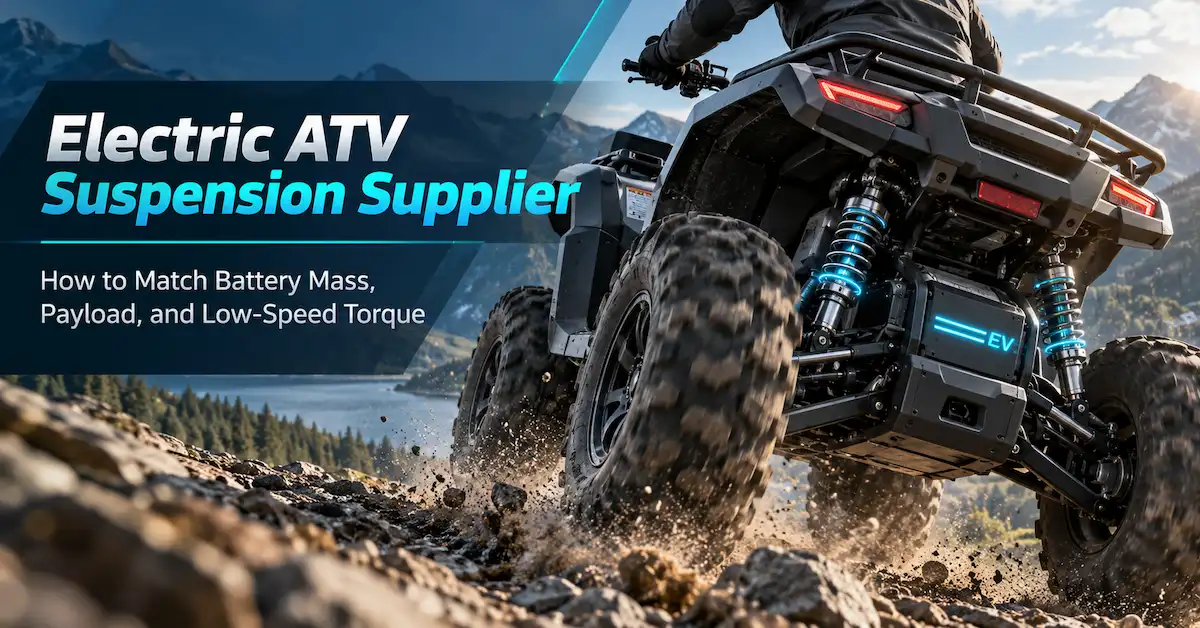
How should an electric ATV suspension supplier match battery mass and payload?
Short answer: an electric ATV suspension supplier should start with the battery pack position, sprung and unsprung mass, axle-load change, payload states, motor torque, and intended speed before recommending a spring or shock. A battery-powered ATV cannot be specified by a conventional model name alone. The supplier must prove that the proposed suspension keeps ride height, usable travel, tire contact, and controlled rebound across empty, normal, and maximum operating states.
The practical buying question is not simply "Do you sell ATV shocks for electric vehicles?" It is "Can you translate the electric platform's mass distribution and operating cycle into measurable suspension requirements, then validate the sample on the target vehicle?"
This article is for electric ATV brands, utility vehicle developers, fleet operators, importers, distributors, and aftermarket companies looking for an electric ATV suspension supplier. It focuses on a commercial investigation and RFQ intent: how to define the requirement, compare supplier evidence, and avoid approving a part that fits the mounting points but does not control the vehicle under battery and payload changes.
BEDO Auto publicly offers shock absorbers, suspension springs, ball joints, custom solutions, design support, and small-batch order support. Its public catalog includes ATV/UTV references and a separate electric motorcycle shock absorber reference. The current public product records reviewed for this article do not establish a dedicated electric ATV production model. That boundary matters: the correct procurement path is a technical review, sample, and vehicle validation, not an assumption that a conventional ATV part is automatically electric-vehicle ready.
Why an electric ATV needs its own suspension brief
Electric powertrains change the way mass is distributed in the chassis. The battery pack may be low in the frame, spread across the floor, placed behind the seat, or divided into modules. The motor, controller, wiring, protective enclosure, and charging hardware also affect the vehicle package. The result can be a lower center of gravity, a different front-to-rear load split, and a higher curb mass than a comparable combustion platform. Those changes influence static sag, spring compression, pitch, tire load, and the force that the shock must control.
Electric drive also changes the operating feel. Immediate motor torque can load the rear suspension during launch or low-speed climbing. Regenerative braking, if used, can alter deceleration response. A quiet electric vehicle can make suspension noise, rattles, and harsh impact more noticeable to the driver. Fleet use may involve repeated stop-start cycles, carrying a battery-heavy chassis, and operating at low speed over uneven ground rather than a short recreational ride.
| Electric ATV variable | Suspension consequence | RFQ evidence to prepare |
|---|---|---|
| Battery location | Changes axle loading, center of gravity, roll behavior, and spring demand. | Battery mass, center-of-mass estimate, mounting location, and protection structure. |
| Battery state of charge | Can create a small or meaningful mass difference depending on chemistry and system design. | Mass at full and minimum operating state, if relevant to the platform. |
| Motor torque | Can create squat, traction load, and repeated compression events at low speed. | Torque profile, drive mode, maximum gradient, and tire specification. |
| Payload and accessories | Changes ride height and may overload one axle or one corner. | Rider, cargo, passenger, winch, rack, trailer, and attachment states. |
| Operating environment | Water, mud, dust, and battery enclosure cleaning affect sealing and corrosion review. | Ingress exposure, wash-down procedure, climate, and storage. |
| Quiet vehicle NVH target | Suspension noise and impact harshness can become more prominent. | Noise concerns, bushing requirements, and ride comfort target. |
Define the electric ATV platform before selecting a supplier
Separate sprung mass from unsprung mass
The battery enclosure is normally mounted to the chassis and therefore contributes mainly to sprung mass, but the exact design matters. A hub motor, wheel-side reduction unit, heavy brake assembly, or special protective structure may add unsprung mass. The supplier needs to know which mass moves with the wheel and which mass is supported by the spring. A large increase in unsprung mass can demand a different damping response even when static ride height appears acceptable.
Provide front and rear axle weights in at least three states: vehicle ready to operate, normal payload, and maximum approved payload. If the platform has a passenger seat, rear rack, front cargo, winch, snow blade, sprayer, or trailer, record the mass and its position. The best electric ATV suspension supplier will treat the mass distribution as a design input, not as a footnote.
Measure the installed geometry
Record extended length, compressed length, effective shock stroke, upper and lower hole diameter, mounting width, sleeve details, spring outside diameter, spring free length, and the available clearance at full bump and full rebound. For a linkage suspension, provide the motion ratio or the relevant pivot dimensions. Also identify whether the shock is installed at an angle and whether the spring seat or preload adjuster can be accessed after the battery enclosure, body panel, or cargo accessory is installed.
Describe the vehicle's working cycle
Electric ATV use is not a single category. A vineyard inspection vehicle may move slowly on grass and slopes. A utility fleet may carry tools over rutted roads for many hours. A leisure vehicle may see higher speed and larger impacts. A campus or resort vehicle may prioritize quietness and comfort. State the speed band, cycle length, terrain percentage, slope, obstacle size, payload frequency, and charging or operating schedule. The supplier can then evaluate the combination of spring support and damping rather than guessing from "electric ATV."
How battery mass changes spring and damping decisions
Spring rate and static sag
Spring rate determines how much force is needed for a given compression. When battery mass is added to the chassis, the static load rises and the suspension may sit lower. If the spring is too soft, the vehicle loses bump travel and may bottom under payload. If the spring is too stiff, the tires may skip over small uneven surfaces and the vehicle can feel harsh when empty. The target is not the maximum possible spring rate. The target is an appropriate ride-height window for the platform's real load states.
Preload is useful for setting initial ride height and managing a defined load range. It is not a substitute for a spring that is incorrectly selected. Ask the supplier to show the relationship between load, installed length, sag, and remaining compression travel. If the electric ATV will have a removable battery or a large accessory package, define the lightest and heaviest vehicle states before choosing the spring.
Compression and rebound control
Compression damping affects the response to impacts, drive torque, braking, and chassis movement. Rebound damping controls the return after the spring has stored energy. An electric platform may need stable rebound with a relatively heavy chassis, but the setting must still allow the wheel to follow uneven ground. Excessive rebound control can pack down over repeated bumps. Insufficient rebound control can create repeated oscillation or a floaty feel.
Ask the supplier to report test speed, direction, force range, oil or gas configuration, and tolerance. A statement such as "high damping" does not create a reproducible design target. If the shock is adjustable, define the useful range and the reference setting. The number of adjustment positions is less important than whether each position produces a repeatable and useful change on the vehicle.
Low-speed torque and traction events
Motor torque can compress the rear suspension during launch, hill climbing, or a low-speed obstacle. That event may not look like a conventional high-speed impact, but it can change the vehicle's pitch and tire loading. The supplier should know the drive mode, torque ramp, gradient, tire grip, and whether the vehicle carries a rear attachment. A shock that feels acceptable on a flat road may behave differently when torque and terrain act together.
What an electric ATV suspension supplier should provide
Before selecting a supplier, define the evidence package. A product page can show the existence of a shock absorber, but an OEM buyer needs enough information to evaluate fit, performance, and repeatability. The following checklist can be used in a supplier comparison.
| Capability to evaluate | Evidence to request | Decision question |
|---|---|---|
| Dimensional engineering | Drawing review, sample measurement, interface confirmation, and change control. | Can the supplier prevent fitment errors before sampling? |
| Spring selection | Rate, preload, installed length, tolerance, and load-state recommendation. | Can the part support both battery-only and payload conditions? |
| Damping definition | Compression and rebound data with test speed, direction, and tolerance. | Can the buyer compare the sample to a repeatable target? |
| Vehicle validation | Test plan covering empty, normal, and maximum load plus terrain and speed. | Will the part be evaluated on the actual electric platform? |
| Environmental review | Material, finish, seal, cleaning, and corrosion evidence relevant to use. | Does the product match mud, water, dust, and storage conditions? |
| Production control | Incoming material checks, process checks, final inspection, and traceability. | Can repeat batches perform like the approved sample? |
| Commercial support | Sample cost, MOQ, lead time, packaging, labels, and shipping terms. | Can the supply plan support launch and after-sales demand? |
BEDO Auto references for an electric ATV project
BEDO Auto's public website identifies Ningbo Bedo Auto Parts Co., Ltd. in Ningbo, Zhejiang, China. Its public product direction includes shock absorbers, suspension springs, and ball joints for ATV/UTV, motorcycle, electric motorcycle, beach buggy, snowmobile, and golf cart applications. The site also presents custom solutions, design support, and small-batch order support. The home page publishes company figures such as a 2009 founding year, 60+ export countries, and 800,000+ monthly capacity. These statements should be checked against current company documents during supplier qualification.
The public catalog includes conventional ATV/UTV references that can be discussed with BEDO. The table below reports published values from the product records captured in the website knowledge base. It does not claim that the parts are dedicated electric ATV products.
| Public product reference | Published details | What must still be confirmed for an electric ATV |
|---|---|---|
| ATV/UTV shock absorber AU_HSA_01 | Rear shock; 465 mm total length; 130 mm effective stroke; 75 LBS spring rate; listed rebound 2,000 N and compression 650 N; aluminum alloy and steel pipe; internal gas chamber and oil-gas separation; 10 mm holes and 32 mm mounting width at both ends; fixed damping. | Battery and payload axle loads, installed sag, torque response, electric platform geometry, and vehicle validation. |
| ATV/UTV shock absorber AU_HSA_02 | Rear shock; 395 mm total length; 80 mm effective stroke; 250 LBS spring rate; listed rebound 3,000 N and compression 550 N; aluminum alloy and steel; internal gas chamber and oil-gas separation; 12 mm holes; upper 40 mm and lower 32 mm mounting widths; fixed damping. | Whether the higher listed spring rate, shorter stroke, and fixed damping match the electric vehicle's load range and ride target. |
Build an electric ATV RFQ that a supplier can actually quote
A useful RFQ translates the electric platform into measurable inputs. The following fields should be sent together. If the vehicle is still in development, label preliminary values and state which values will change before validation.
| RFQ field | What to include | Why the supplier needs it |
|---|---|---|
| Platform and position | Vehicle type, wheelbase, front or rear position, number of shocks, drive layout, target market. | Identifies the suspension architecture and application boundary. |
| Battery system | Pack mass, location, mounting, enclosure mass, removal condition, and center-of-mass estimate. | Defines the sprung load and mass distribution. |
| Axle and corner loads | Ready-to-run, normal payload, maximum payload, and accessory loads. | Supports spring selection and ride-height targets. |
| Geometry | Extended and compressed lengths, stroke, mounting holes, widths, bushings, motion ratio, clearances. | Prevents a dimensionally incorrect sample. |
| Drive and brake events | Torque, drive modes, gradient, brake behavior, and regenerative braking if used. | Identifies pitch and repeated compression conditions. |
| Terrain and cycle | Speed range, obstacle profile, slope, hours per day, cycles, and seasonal operation. | Creates a meaningful validation condition. |
| Target behavior | Static sag, ride height, comfort, bottoming limit, rebound feel, noise, and stability target. | Turns subjective expectations into acceptance criteria. |
| Commercial plan | Prototype quantity, forecast, launch date, packaging, label, spare part, and delivery needs. | Allows a realistic quote and supply plan. |
Ask the supplier to respond with a list of assumptions and open items. This prevents the quotation from hiding uncertainty. It also makes supplier comparison fair: each candidate is asked to address the same battery, payload, geometry, performance, and commercial conditions.
Validate the sample in stages
Stage one: dimensional and installation review
Measure the sample before installing it. Check eye-to-eye length, compressed length, stroke, mounting width, hole diameter, sleeve fit, spring seat position, preload access, and all nearby clearances. Install the shock without final road testing and cycle the suspension through the available motion. Confirm that the battery enclosure, drive components, brake lines, tires, body panels, and bump stops remain clear.
Stage two: static load and ride-height review
Measure ride height and sag with the vehicle empty, battery installed, rider or operator present, normal cargo, and maximum planned payload. Record front and rear values. If the vehicle carries a removable battery, repeat the relevant states. A shock can look correct on a workbench but still leave the vehicle too low, too high, or uneven at the working load.
Stage three: low-speed and repeated-cycle testing
Start with low-speed operation on the most common surface. Check steering balance, brake pitch, drive torque response, rebound after a bump, and contact with the bump stop. Then repeat the cycle under normal and maximum load. Look for heat-related change, leakage, noise, loosening, and abnormal tire behavior. Record the test route, speed, load, battery state, temperature, and sample revision.
Stage four: production release review
Before approving a repeat order, freeze the drawing, part number, spring specification, damping target, material and surface requirements, inspection points, packaging, and change-notification process. If the product is adjusted after the first vehicle test, mark the new revision and repeat the affected checks. Production release should be based on a written acceptance record rather than a verbal statement that the sample "feels good."
Environmental and thermal questions for electric ATV buyers
Electric ATV projects often operate in conditions where the battery and suspension are both exposed to water, mud, dust, and wash-down. The supplier should be asked to define the intended cleaning method and which seals, sliding areas, threads, and finishes need inspection. Do not assume that a waterproof product description equals a vehicle-level ingress rating. The battery enclosure, connector system, and shock absorber are different components and may have different protection requirements.
Repeated low-speed work with a heavy chassis can still create heat in the damper. If the vehicle runs continuously, climbs slopes, or crosses repeated ruts, ask how the supplier defines fade, operating temperature, and performance change. A buyer does not need to invent a test method, but should request the supplier's proposed method and acceptance limit. The public BEDO product pages reviewed for this article do not publish a dedicated electric ATV thermal or endurance result, so such evidence must be requested for the project.
MOQ, lead time, packaging, and after-sales planning
Technical suitability is only one part of the electric ATV suspension supplier decision. The project also needs a realistic supply plan. Ask for separate timing for drawing review, prototype production, shipping, vehicle test changes, pilot batch, and repeat production. If the vehicle launch is seasonal, include seasonal demand and spare-part requirements in the initial conversation.
For MOQ, state whether the request is for one evaluation set, a small pilot, a first production lot, or annual fleet supply. A supplier may support small-batch orders, but the actual quantity, price, and tooling condition must be confirmed in a project quotation. For packaging, specify individual protection, carton quantity, part-number labels, revision marks, hardware, and whether the package must protect the shock from corrosion or threaded-end damage during ocean transport.
For after-sales, ask how replacement shocks will be identified, whether the approved drawing is retained, how revisions are controlled, and what information is needed for a warranty or field issue. Electric ATV fleets benefit from a clear serial or batch reference because a suspension change can affect vehicle behavior. A supplier that cannot connect a replacement part to the approved specification creates avoidable service risk.
How to evaluate BEDO Auto for electric ATV sourcing
BEDO Auto can be evaluated as a China-based suspension component manufacturer with public ATV/UTV product references, a separate electric motorcycle shock reference, custom solution positioning, design support, and small-batch support. Its official product overview and shock absorber category are useful starting points. The company page provides manufacturer context, and the contact page gives the direct route for an RFQ.
The qualification question should be specific: can BEDO review this electric ATV's battery mass and geometry, propose a suitable spring and damping configuration, provide samples, document the measured result, and repeat the approved design? Ask for the answer in writing. Also request any available factory photos, testing records, material certificates, MOQ, lead time, packaging specification, and relevant customer or field case that BEDO is authorized to disclose. These are publication and procurement evidence items, not facts to be assumed from a general product page.
Electric ATV suspension supplier FAQ
Does an electric ATV need a different shock from a gasoline ATV?
Not automatically, but the vehicle mass, battery position, axle load, torque response, geometry, and duty cycle can be different. A conventional shock may be suitable only after those conditions are reviewed and validated.
What is the most important information to send a supplier?
Send the battery mass and location, front and rear axle weights, payload states, extended and compressed shock dimensions, stroke, mounting details, terrain, speed, duty cycle, and target ride height. Photos and drawings should support the measurements.
Can a heavier battery simply use a stiffer spring?
Sometimes the spring rate must increase, but a stiffer spring alone may create harshness, reduce tire contact, or change the damping balance. The supplier should evaluate rate, preload, damping, geometry, and available travel together.
Are the BEDO AU_HSA_01 and AU_HSA_02 electric ATV shocks?
The public product records identify them as ATV/UTV shock absorber references. They should not be described as dedicated electric ATV models without project confirmation from BEDO.
What test data should an OEM buyer ask for?
Ask for dimensional inspection, spring rate, compression and rebound force with test conditions, leakage inspection, sample revision, and a vehicle validation plan. Add endurance, corrosion, or wash-down evidence when the duty cycle requires it.
Does the website prove a specific MOQ or lead time?
No. MOQ and lead time depend on the part, customization, quantity, packaging, and production schedule. Request a written quotation for the exact project.
Can electric ATV and electric motorcycle suspension be sourced from the same supplier?
A supplier may support both categories, but the design inputs are not interchangeable. Wheel load, geometry, motion ratio, battery placement, rider position, and target behavior must be reviewed separately.
What makes an electric ATV supplier credible?
Credibility comes from traceable dimensions, clear assumptions, measurable spring and damping data, sample revision control, vehicle validation, repeat-production inspection, transparent commercial terms, and a named technical contact. Marketing language alone is not enough.
Conclusion
An electric ATV suspension supplier should be selected through a platform-specific engineering and procurement review. Battery mass, payload, axle distribution, motor torque, geometry, terrain, duty cycle, and environmental exposure all need to be translated into a suspension target. The buyer should then compare spring support, damping data, sample development, vehicle validation, production controls, packaging, MOQ, lead time, and after-sales traceability.
BEDO Auto has public ATV/UTV shock references and a published position around suspension manufacturing, customization, design support, and small-batch orders. The current public evidence does not establish a dedicated electric ATV SKU, so a responsible RFQ should ask BEDO to confirm the part, test path, and commercial conditions for the actual platform. That process gives the buyer a defensible basis for an electric ATV launch and avoids treating a dimensionally similar part as a validated solution.