
What Makes Off-Road Suspension Parts Durable?
Durability is one of the most important factors when selecting durable off-road suspension parts because off-road vehicles operate under conditions that create repeated mechanical stress. ATV and UTV suspension components must handle impacts, uneven terrain, changing loads, vibration, and long operating periods while maintaining fitment and performance.
For OEM buyers, durability does not come from one single feature. It depends on the complete suspension system, including:
- material selection;
- component design;
- spring characteristics;
- shock absorber configuration;
- manufacturing consistency;
- testing methods;
- application matching.
A suspension component that works well on a light recreational vehicle may not provide the same service performance on a cargo-focused utility vehicle.
BEDO develops shock absorbers and suspension springs for ATV and off-road applications. Buyers can review the available ATV and UTV suspension products to understand different suspension configurations.
Why Durability Matters for Off-Road Applications
Off-road vehicles experience conditions that are different from normal road vehicles.
Typical challenges include:
| Operating Condition | Suspension Challenge |
|---|---|
| Rocky terrain | Repeated impact loading |
| Mud and water exposure | Corrosion and contamination risk |
| Heavy cargo | Increased spring and shock load |
| Larger tires | Increased suspension stress |
| Long-distance riding | Heat and fatigue accumulation |
| Aggressive driving | Higher impact frequency |
| Utility operation | Continuous working loads |
For manufacturers and distributors, suspension failure can create:
- warranty claims;
- customer complaints;
- vehicle downtime;
- replacement costs;
- brand reputation issues.
Therefore, selecting durable suspension components is not only a technical decision but also a commercial decision.
Material Selection Influences Suspension Durability
The materials used in suspension components directly affect strength, weight, corrosion resistance, and manufacturing consistency.
Important considerations include:
- shock body material;
- piston rod surface characteristics;
- spring material;
- mounting components;
- bushings;
- sleeves;
- seals;
- reservoir components.
However, stronger material does not automatically create better suspension.
The material must match the application requirements.
For example:
A racing-oriented suspension may prioritize weight and performance response.
A utility suspension system may prioritize load support and long-term reliability.
BEDO's custom suspension development process evaluates suspension requirements based on vehicle application rather than selecting materials independently from the complete system.
Shock Absorber Design Affects Off-Road Reliability
The shock absorber is one of the most important components in an off-road suspension system.
A durable shock design should consider:
- shock length;
- stroke;
- mounting structure;
- spring compatibility;
- damping characteristics;
- sealing system;
- operating environment.
The correct design must balance:
- impact control;
- suspension movement;
- heat management;
- load capacity;
- ride behavior.
A shock designed only for dimensions may physically install but fail to provide suitable performance in demanding conditions.
BEDO's custom shock absorber development guide explains why vehicle requirements, loads, and performance targets should be defined before development.
Spring Design Is Critical for Heavy-Duty Applications
Durable off-road suspension parts are not only about stronger shock absorbers. Springs play an equally important role.
The spring supports vehicle load and determines:
- ride height;
- sag;
- available travel;
- load capacity;
- suspension balance.
A spring that is too soft may cause:
- excessive sag;
- reduced ground clearance;
- frequent bottoming.
A spring that is too stiff may create:
- harsh ride;
- reduced traction;
- poor small-impact response.
For utility and cargo vehicles, the correct spring specification should consider:
- vehicle weight;
- rider/passenger;
- cargo;
- accessories;
- terrain;
- suspension geometry.
BEDO's custom spring rate guide explains how spring development should be based on vehicle load rather than simply selecting a harder spring.
Damping Performance Determines Suspension Control
Durability is not only about surviving impacts. The suspension must also control vehicle movement.
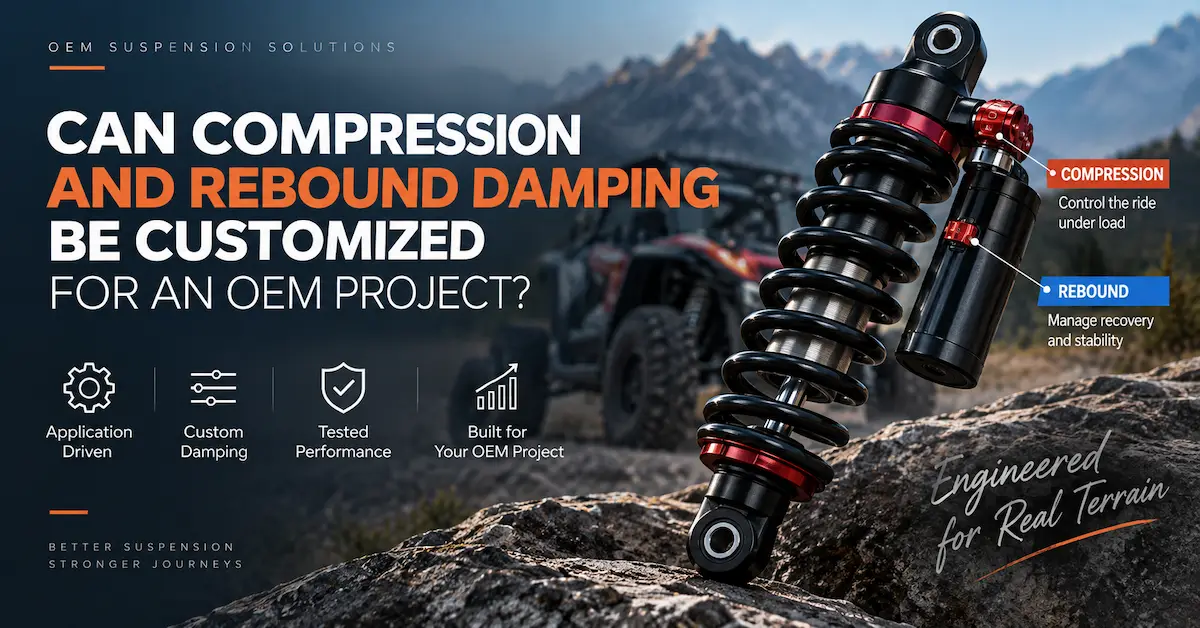
Compression damping controls resistance during suspension compression.
Rebound damping controls suspension recovery after compression.
Incorrect damping can create:
- excessive bouncing;
- slow recovery;
- harsh impact response;
- unstable vehicle behavior.
A durable suspension system should therefore combine:
Correct Spring → Correct Damping → Correct Vehicle Application
BEDO's compression and rebound damping customization guide explains why damping development should consider spring rate, vehicle load, terrain, and performance objectives.
Heavy-Duty Off-Road Applications Need Different Suspension Priorities
Not every off-road vehicle has the same durability requirements.
Recreational Trail Vehicles
Priorities:
- comfort;
- control;
- suspension response;
- moderate durability.
Utility Vehicles
Priorities:
- load support;
- reliability;
- repeated operation;
- maintenance reduction.
Cargo Applications
Priorities:
- higher load capacity;
- reduced sag;
- controlled suspension movement.
Performance Off-Road Vehicles
Priorities:
- impact control;
- damping adjustment;
- high-speed stability;
- repeated hard use.
A reliable supplier should understand these differences instead of offering one suspension specification for every application.
Why Testing Is Important for Durable Suspension Parts
Durability cannot be judged only by appearance or material description.
Professional suspension development may involve:
- dimensional inspection;
- leakage inspection;
- damping evaluation;
- load testing;
- prototype validation;
- vehicle testing.
BEDO's shock absorber testing guide covers different validation areas used during suspension development.
Testing helps confirm:
- whether the component matches design requirements;
- whether the suspension performs as expected;
- whether production units remain consistent.
For OEM buyers, testing evidence is especially important when developing a new suspension configuration.
Prototype Development Reduces Durability Risk
A prototype allows engineers to identify problems before large-scale production.
Prototype validation can reveal:
- incorrect mounting dimensions;
- clearance problems;
- spring mismatch;
- unsuitable damping;
- sealing issues;
- manufacturing challenges.
BEDO's prototype shock absorber development guide explains why prototypes are an important step between engineering design and production.
Skipping prototype validation may reduce initial development time but increase commercial risk later.
Manufacturing Consistency Determines Long-Term Reliability
A durable prototype does not automatically guarantee durable production.
For OEM and aftermarket buyers, production consistency is equally important.
A reliable manufacturer should control:
- incoming materials;
- component dimensions;
- assembly procedures;
- spring identification;
- damping configuration;
- leakage inspection;
- final product inspection.
The customer receives production units, not the original prototype.
Therefore, manufacturing capability is part of durability.
How Should Buyers Evaluate an Off-Road Suspension Supplier?
When selecting a supplier, compare more than product appearance or price.
Important evaluation factors include:
| Supplier Capability | Buyer Question |
|---|---|
| Engineering | Can they analyze application requirements? |
| Customization | Can they modify spring and damping? |
| Prototype | Can they support development samples? |
| Testing | Can they verify performance? |
| Manufacturing | Can they maintain consistency? |
| Quality Control | Are inspection processes defined? |
| Communication | Can technical changes be managed? |
| Production Support | Can they support future orders? |
A supplier with strong engineering support can often reduce long-term development risk.
Custom Off-Road Suspension Parts for OEM Projects
OEM customers often require suspension components that are different from standard replacement products.
Customization may include:
- different shock length;
- different stroke;
- custom spring rate;
- compression adjustment;
- rebound adjustment;
- reservoir configuration;
- mounting changes;
- private-label branding.
BEDO supports customized suspension development based on customer requirements, drawings, samples, and vehicle applications.
Before starting development, buyers should prepare:
- vehicle information;
- suspension position;
- load requirements;
- current suspension issues;
- drawings or samples;
- performance targets;
- prototype requirements.
How Larger Tires and Accessories Affect Suspension Durability
Many off-road users modify vehicles after purchase.
Common modifications include:
- larger tires;
- winches;
- bumpers;
- cargo racks;
- additional equipment.
These changes can increase suspension stress.
Larger tires can affect:
- unsprung weight;
- clearance;
- suspension movement.
Accessories can affect:
- vehicle load;
- spring requirements;
- ride height.
BEDO's ATV shock guide for larger tires and accessories discusses why modified vehicles may require suspension reassessment.
A durable suspension solution should consider the actual vehicle configuration rather than the original factory condition only.
Why Supplier Testing Capability Matters for OEM Buyers
A supplier’s testing ability provides confidence during development.
Useful supplier questions include:
- How are shock dimensions verified?
- How is damping evaluated?
- How are leaks detected?
- How are prototypes validated?
- How are production units checked?
- How are engineering changes controlled?
A supplier should be able to explain the connection between:
Design → Prototype → Testing → Production
This process is more valuable than simply claiming that a component is “heavy duty.”
MOQ and Lead Time Considerations
Durable off-road suspension parts often involve engineering before production.
Buyers should separate:
- prototype quantity;
- pilot batch quantity;
- production MOQ;
- repeat order quantity.
BEDO's custom shock absorber MOQ guide explains why quantities can depend on customization level, components, testing, and production requirements.
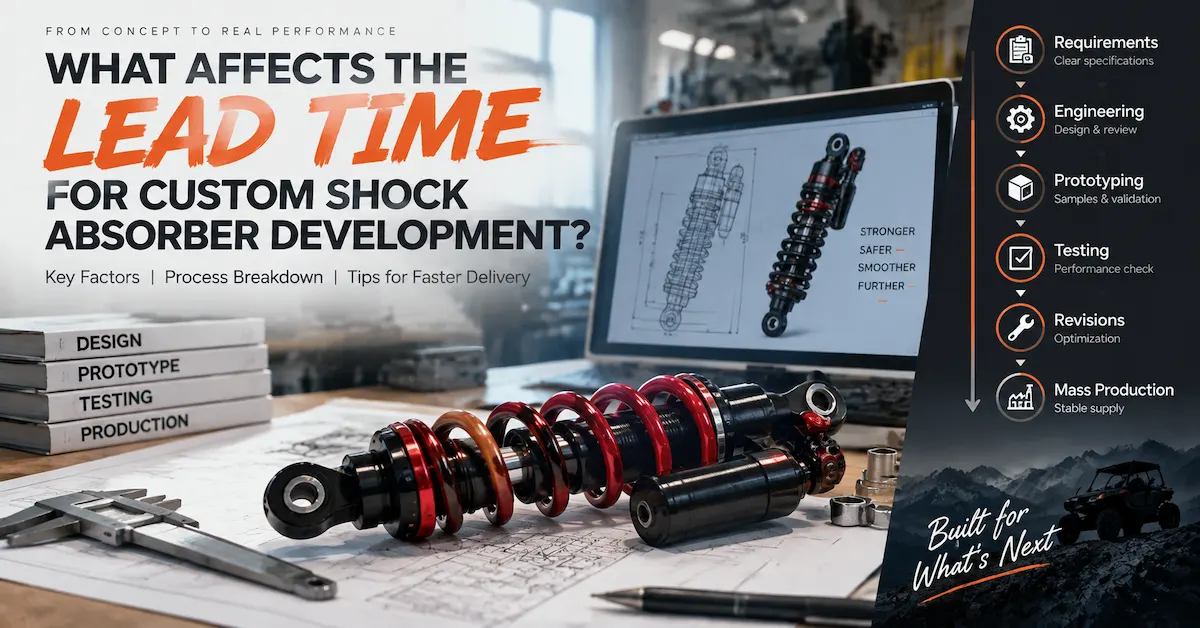
Development timing should also be divided into:
- engineering review;
- prototype production;
- testing;
- revision;
- production preparation.
BEDO's custom shock development lead time guide provides related planning information.
What Information Should Buyers Send Before Ordering?
A complete RFQ helps suppliers provide a better suspension solution.
Recommended information:
| Information | Purpose |
|---|---|
| Vehicle model | Defines application |
| Suspension position | Determines requirements |
| Current shock | Provides reference |
| Vehicle weight | Supports spring selection |
| Rider/cargo load | Defines working condition |
| Terrain | Defines durability target |
| Tire changes | Checks modification impact |
| Accessories | Defines added loads |
| Drawings/CAD | Supports engineering |
| Prototype plan | Defines validation |
| Production forecast | Supports planning |
BEDO's ATV suspension RFQ data guide provides additional guidance for preparing technical requirements.
Frequently Asked Questions
1. What Makes Off-Road Suspension Parts Durable?
Durability depends on material selection, engineering design, correct application matching, manufacturing consistency, and validation testing.
2. Are Heavy-Duty Suspension Parts Always Better?
Not necessarily. Suspension should match the vehicle application. Excessively stiff components can reduce comfort and performance.
3. Can Suspension Parts Be Customized for Different Loads?
Yes. Spring rate, damping, and component configuration can be developed according to vehicle load requirements.
4. Do Larger Tires Require Suspension Changes?
They may. Larger tires can affect weight, clearance, and suspension behavior.
5. How Are Durable Shock Absorbers Tested?
Testing may include dimensional checks, leakage inspection, damping evaluation, load testing, and vehicle validation.
6. Can OEM Buyers Order Prototype Suspension Parts?
Yes. Prototype development allows buyers to validate fitment and performance before larger production.
7. What Is the Difference Between Standard and Custom Suspension Parts?
Standard parts use existing specifications, while custom parts are developed around specific vehicle, load, or performance requirements.
8. How Do I Choose an Off-Road Suspension Supplier?
Evaluate engineering ability, customization support, testing capability, manufacturing consistency, and long-term supply support.
9. Do Durable Suspension Parts Cost More?
They may require higher development or manufacturing investment because of materials, testing, and engineering requirements.
10. What Should I Provide Before Requesting a Quote?
Provide vehicle details, suspension requirements, load conditions, drawings or samples, target performance, prototype needs, and production expectations.
Conclusion
Choosing durable off-road suspension parts requires more than selecting stronger-looking components. Reliable off-road suspension performance comes from matching materials, spring characteristics, damping behavior, vehicle loads, terrain requirements, manufacturing quality, and validation testing. For OEM manufacturers, aftermarket brands, and distributors, the right supplier should provide engineering support from concept development through prototype validation and production control. BEDO supports custom shock absorber and suspension spring development for ATV and off-road applications. To evaluate your suspension project, contact BEDO with your vehicle information, load requirements, technical specifications, and production plans to develop a reliable durable off-road suspension parts solution.