
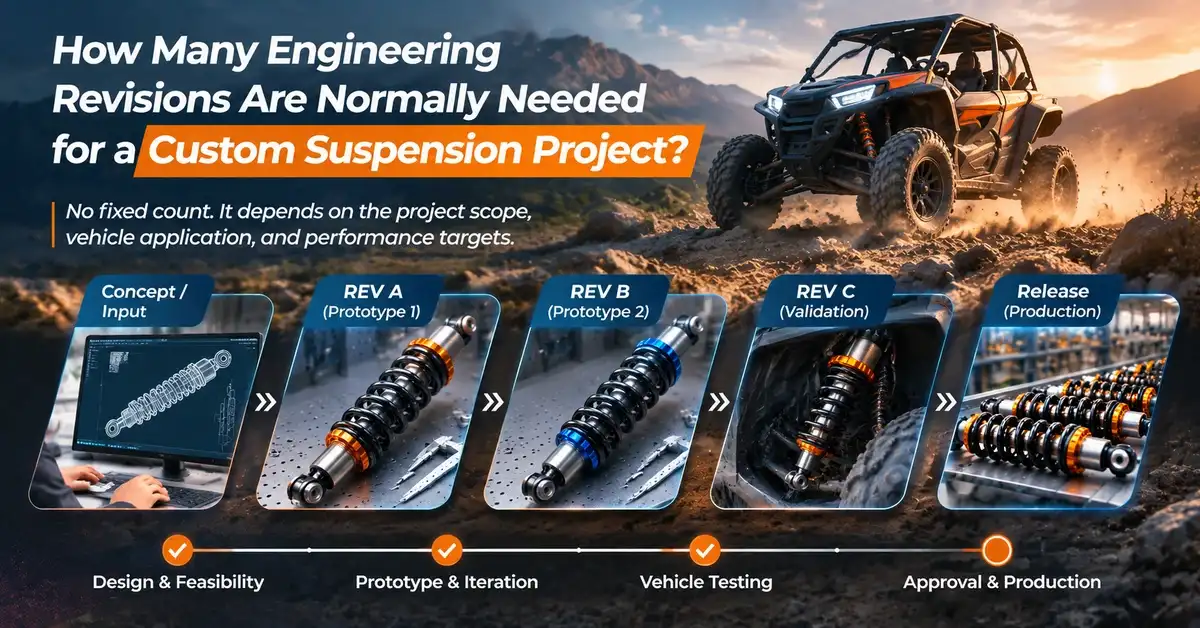
There is no responsible universal number of engineering revisions for a custom suspension project. A simple dimensional adaptation may reach approval after one prototype revision, while a new vehicle platform, changing load target, reservoir package, or difficult damping requirement may need several controlled revisions. The useful measure is not how few revisions the supplier promises. It is whether every revision answers a defined technical question and closes the risk that caused the change.
Buyers should therefore plan revisions by project stage: input correction, geometry and packaging, spring and damping direction, vehicle validation, production intent, and final release. A revision is normal when it is documented, testable, and tied to an approval decision. An undocumented “latest sample” is a control failure, even if the part works.
Why revision count cannot be answered from the product name
“Custom shock absorber,” “custom spring,” and “complete suspension kit” describe different engineering problems. A shock that keeps the original mounting points may need interface and clearance work but little vehicle-side redesign. A new suspension assembly may change mounts, travel, spring support, damping, packaging, and installation instructions at the same time. The product scope changes the number and type of decisions.
| Project condition | Likely revision pressure | Information that reduces avoidable rework |
|---|---|---|
| Customer supplies verified drawings and load states | Lower risk of early geometry and application correction. | Controlled CAD, datums, vehicle position, measured loads, and modification list. |
| Vehicle data is incomplete or estimated | Higher risk of fitment, travel, spring, and packaging changes. | Assumption register, measurement plan, photographs, and data ownership. |
| Performance target is descriptive only | More tuning loops because “comfort” or “control” has no test boundary. | Ride-height, sag, response, route, load, and pass/fail definitions. |
| Large production volume or strict traceability | Additional production-intent and process-control work before release. | BOM, inspection, sampling, labels, pilot plan, and change rules. |
| Multiple variants share a product family | More configuration and part-number revisions. | Application matrix, spring/damping identity, hardware, and package separation. |
Do not use “one revision” as a purchasing target
Pressuring a supplier to finish in one revision can encourage hidden assumptions, rushed approval, or an overbroad first sample that is difficult to diagnose. The better target is first-time-right input quality and an agreed revision process. A project with two transparent revisions is usually safer than a project that claims one revision while changing parts informally.
Do not treat every revision as supplier failure
Testing can reveal information that was not available from the original CAD or quotation. A vehicle may show unexpected articulation, heat, tire clearance, load transfer, or operator behavior. A controlled change based on new evidence is part of engineering. Repeated changes caused by lost drawings, mixed samples, or unclear approval are different and should be investigated as process problems.
What are the normal revision stages?
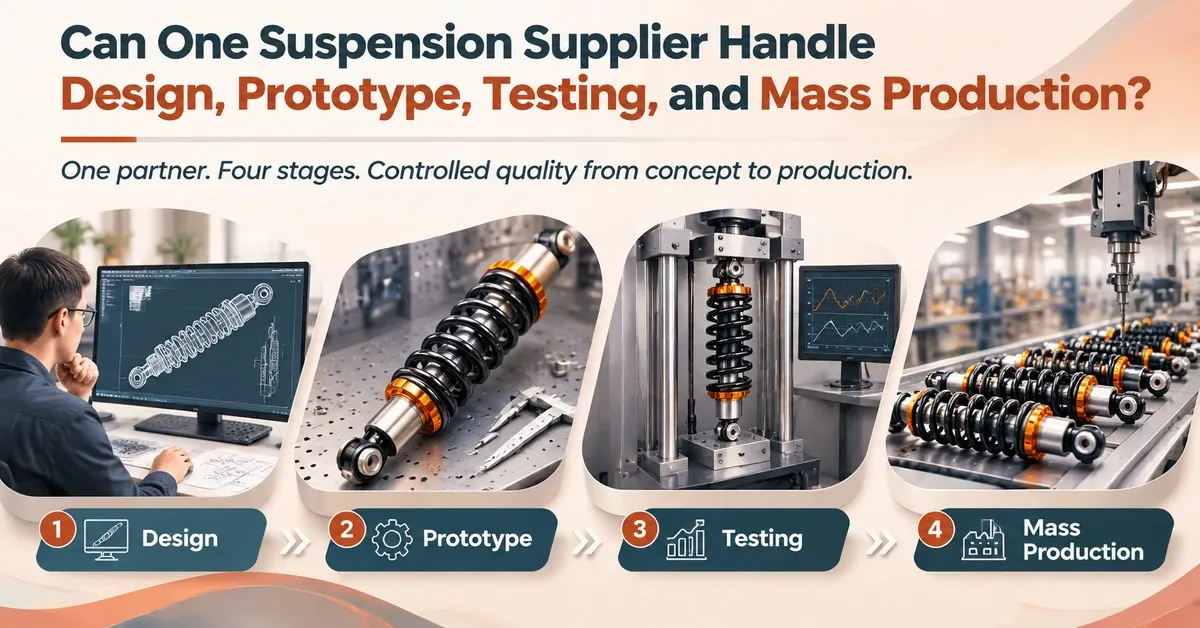
Most custom suspension programs can be organized into revision stages even when the actual number of versions differs. The names should be agreed before samples are built so that “prototype,” “pilot,” and “production” do not become interchangeable labels.
| Revision stage | Question to answer | Typical output |
|---|---|---|
| Input correction | Are the vehicle, loads, interface, and use conditions defined correctly? | Updated assumptions, measurements, CAD references, and application brief. |
| Geometry and packaging | Does the part install, move, clear, and retain the spring or hardware? | Interface revision, sample dimensions, fitment record, and open risks. |
| Functional tuning | Does the spring and damping direction address the intended vehicle behavior? | Spring or damper change, setting record, bench data, and vehicle feedback. |
| Validation correction | Does the design remain suitable across the defined load, route, temperature, and service condition? | Risk-based design change and repeated validation of the affected requirement. |
| Production-intent correction | Can production parts, fixtures, work instructions, and inspection reproduce the approved sample? | Frozen BOM, pilot results, process corrections, and release recommendation. |
| Release revision | Are all approved documents and application limits aligned for repeat orders? | Released drawing, BOM, inspection plan, label, package, and change route. |
These stages do not mean every project needs one separate physical prototype for each line. Some stages can be combined when the input is strong and the risk is low. The point is to make the decision logic visible so the buyer can see what the next sample is intended to prove.
What should be fixed before the first prototype?
The first prototype should not be asked to discover every requirement at once. Before design release, the buyer and supplier should agree which data is confirmed, which data is estimated, and which data the prototype is intended to learn.
| Pre-prototype item | Minimum definition | Risk if missing |
|---|---|---|
| Vehicle application | Model or platform, suspension position, stock or modified condition, and intended market. | Wrong geometry or a sample that fits only an unrepresentative vehicle. |
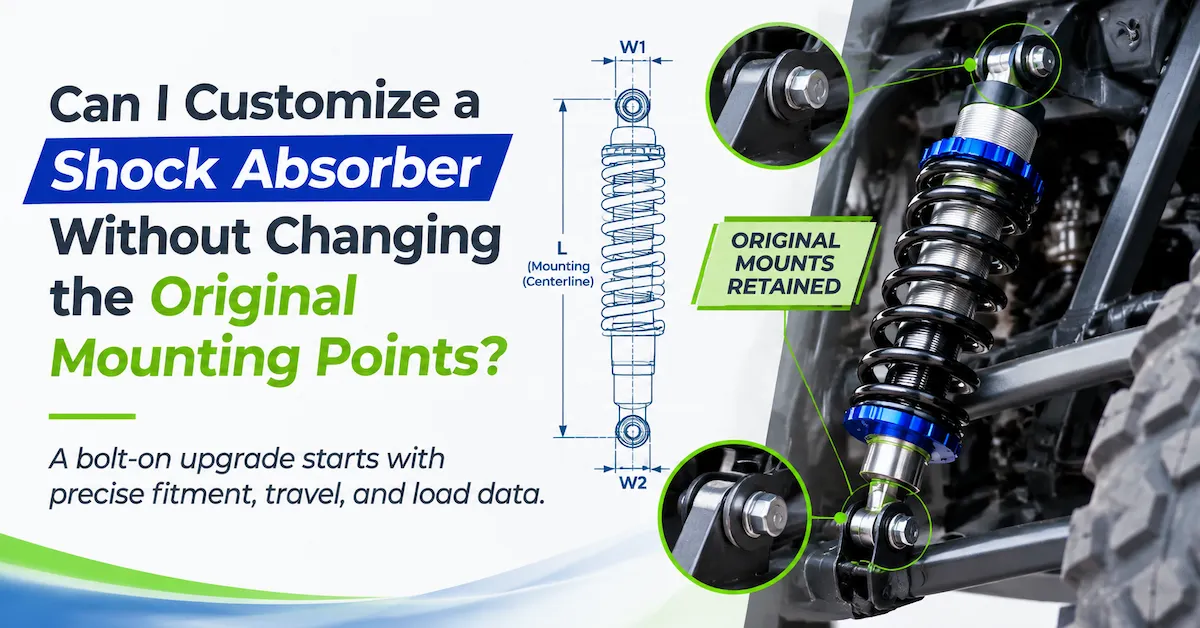
| Interface | Mount centers, width, hole or thread, offset, hardware, and installation axis. | Mounting rework or side load after installation. |
| Motion envelope | Extended and compressed lengths, stroke, wheel travel, bump stop, articulation, and clearance. | Top-out, bottom-out, binding, or contact. |
| Load states | Ready-to-run, normal operating, maximum planned, and load location. | Incorrect spring support and misleading vehicle feedback. |
| Performance objective | Ride height, sag, comfort/control priority, response symptom, and test condition. | Endless subjective tuning and disputed approval. |
| Approval authority | Who can accept geometry, function, deviation, and production release. | Conflicting instructions and unapproved sample changes. |
Use a revision baseline, not a pile of files
Every drawing, CAD export, sample, test record, and quotation should refer to a revision identifier or date-controlled baseline. Avoid file names such as “final,” “final-new,” or “latest.” They do not tell quality or purchasing which spring, damper setting, hardware, or test result belongs together.
Record the reason for the first change
If the first prototype changes because the compressed length is wrong, record that as a geometry issue. If it changes because the loaded vehicle recovers too slowly, record that as a damping or spring-damper issue. A clear reason helps the next revision change the correct variable instead of changing several parts without learning which one solved the symptom.
How do you decide whether another revision is necessary?
A new revision is justified when the current version fails a defined requirement, reveals a safety or production risk, or contains an approved change that affects the product definition. It is not justified merely because someone wants a different appearance or because the sample has not yet been compared with the agreed target.
| Trigger | Revision decision | Evidence to record |
|---|---|---|
| Hard fitment failure | Revise geometry, interface, or packaging before functional approval. | Contact point, measurement, vehicle condition, drawing change, and recheck. |
| Travel or bump-stop conflict | Revise length, stroke, spring seat, bump stop, or vehicle-side condition. | Full-stroke check, load state, clearance record, and affected requirement. |
| Spring support is wrong | Revise spring rate, free length, preload, or installed geometry. | Load-deflection data, ride height, sag, and empty/loaded comparison. |
| Damping response is wrong | Revise internal setting, adjustment, or spring-damper match. | Bench condition, vehicle symptom, setting, temperature, and retest plan. |
| Production variation appears | Revise process, tolerance, component control, or inspection rather than only the design. | Lot data, nonconformance, root-cause action, and pilot verification. |
| Requirement changes | Create a formal change request and assess impact on previous approvals. | New requirement, affected documents, cost/ timing impact, and approval. |
A change that affects only a nonfunctional finish may need a drawing or packaging revision but not a vehicle retest. A change to mount geometry, spring, damping, stroke, bushing, reservoir, or load application normally requires a focused recheck. The project plan should define these rules before disagreements occur.
How can buyers budget revisions without forcing a false number?
Instead of requesting “three revisions included,” ask the supplier to price or describe the work by stage and state what is included in each stage. This gives the buyer a more useful commercial comparison because it distinguishes design effort, sample hardware, test support, and rework caused by changed customer requirements.
| Commercial field | Question for the supplier | Why it matters |
|---|---|---|
| Initial feasibility | What data review and assumptions are included before the first quote? | Reduces avoidable prototype rework. |
| Prototype scope | What does the first sample include, and what is it not intended to prove? | Prevents a dimensional sample being treated as production approval. |
| Revision scope | Which changes are covered, and how are buyer-requested changes handled? | Separates engineering learning from scope expansion. |
| Testing scope | Which bench and vehicle checks are included, and who supplies the vehicle and load? | Clarifies whether test evidence is available at each gate. |
| Release scope | Are drawing, BOM, inspection, packaging, labels, and pilot records included? | Connects revisions to repeat production. |
| Change control | How are later design or process changes quoted and approved? | Protects the production configuration after launch. |
For a technical request, buyers can use BEDO's custom suspension design scope resource to organize the design boundary, then provide vehicle drawings, samples, load states, and target behavior through the official contact page. The supplier can then judge revision risk from actual inputs rather than a generic product name.
How should each revision be verified?
A revision should be verified against the requirement it changed and against any requirement that the change could affect. This is the principle of focused retest. It prevents the buyer from repeating every test for a small change while also preventing a major spring or geometry change from being accepted on appearance alone.
| Change type | Minimum focused verification | Possible additional review |
|---|---|---|
| Mount or length change | Dimensional inspection and full-stroke vehicle fitment. | Ride height, travel, articulation, steering, and structural contact. |
| Spring change | Load-deflection, installed height, sag, retention, and loaded clearance. | Damping match, empty ride, repeated-bump behavior. |
| Damping change | Bench force response at the approved setting and temperature. | Vehicle control, rebound recovery, comfort, and heat behavior. |
| Bushing or hardware change | Installation stack, torque condition, axis, and articulation. | Side load, noise, wear, and mount inspection. |
| Material or process change | Part identity and affected functional inspection. | Durability or validation retest based on the risk assessment. |
| Label or packaging change | Application identification, protection, and installation information. | Warehouse traceability and field-service review. |
Keep testing tied to sample identity
The test report should identify the exact sample, revision, spring, damper setting, hardware, vehicle state, and operator or machine condition. A result without sample identity cannot reliably approve a later production unit. This is especially important when several samples are physically similar.
Close the revision before ordering production
Do not let purchasing place a repeat order while engineering is still using informal tuning language. The approved revision should be visible in the purchase specification, drawing, BOM, and supplier acknowledgement. Any deviation should have a written disposition and an owner.
What causes unnecessary revisions?
Many revision loops come from preventable input and communication failures rather than difficult suspension physics. A buyer can reduce them by improving the information that enters the program and by limiting the number of people who can change the specification without recording it.
Common avoidable causes: vehicle position is omitted, modified hardware is not disclosed, CAD uses missing datums, load location is unknown, “comfort” is not tied to a test condition, sample labels are unclear, prototype and production parts are mixed, or a verbal change is never added to the controlled BOM.
Control the customer-side change queue
Customer changes to payload, wheel, tire, ride height, reservoir position, mounting hardware, appearance, or target market can invalidate earlier work. Use a change request that states what changed, why it changed, which documents are affected, and which tests must be repeated. This keeps a new requirement from being mistaken for supplier rework.
Use a single approval path
Engineering, purchasing, sales, and the end customer may all have useful input, but the project should have one authorized technical approval route. Otherwise, a supplier may build a sample from a newer email while quality inspects against an older drawing.
FAQ: custom suspension engineering revisions
What is a normal number of revisions for a custom shock?
There is no reliable universal number. The count depends on input quality, interface complexity, load and damping targets, vehicle access, test scope, and whether the design is genuinely new or adapted from an approved platform. The revision reason and evidence are more meaningful than the count.
Is one revision a sign of a better supplier?
Not by itself. One revision may indicate strong inputs and a simple application, or it may mean the project was not tested deeply. A supplier should be judged by documented assumptions, technical response, test evidence, and production control.
When does a revision require a new vehicle test?
Any change that can affect fitment, travel, ride height, spring support, damping, clearance, mount load, or the intended operating condition should receive a focused vehicle review. The exact scope should follow the project risk assessment.
Should revisions be included in the prototype quotation?
Ask the supplier to define the included design and sample scope, then distinguish technical iteration from customer-requested scope changes. A clear stage-based quotation is more useful than an unexplained revision allowance.
How do I stop the supplier from using the wrong sample?
Use sample numbers, revision identifiers, labels, controlled drawings, and test reports that reference the same configuration. Do not approve a sample by photograph or by the phrase “latest version” alone.
Conclusion
A custom suspension project does not have a fixed normal revision count. The right process defines the vehicle and performance baseline, divides work into clear engineering stages, records why each change was made, verifies the affected requirements, and freezes the configuration before production purchasing. A small number of controlled revisions is a good outcome; an artificially low number with hidden assumptions is not.
When requesting a custom suspension quotation, provide the drawings, measured interfaces, load states, use conditions, target behavior, prototype purpose, and approval route. This gives BEDO's engineering team the information needed to assess the likely revision path and propose a controlled development program through the official technical contact channel.