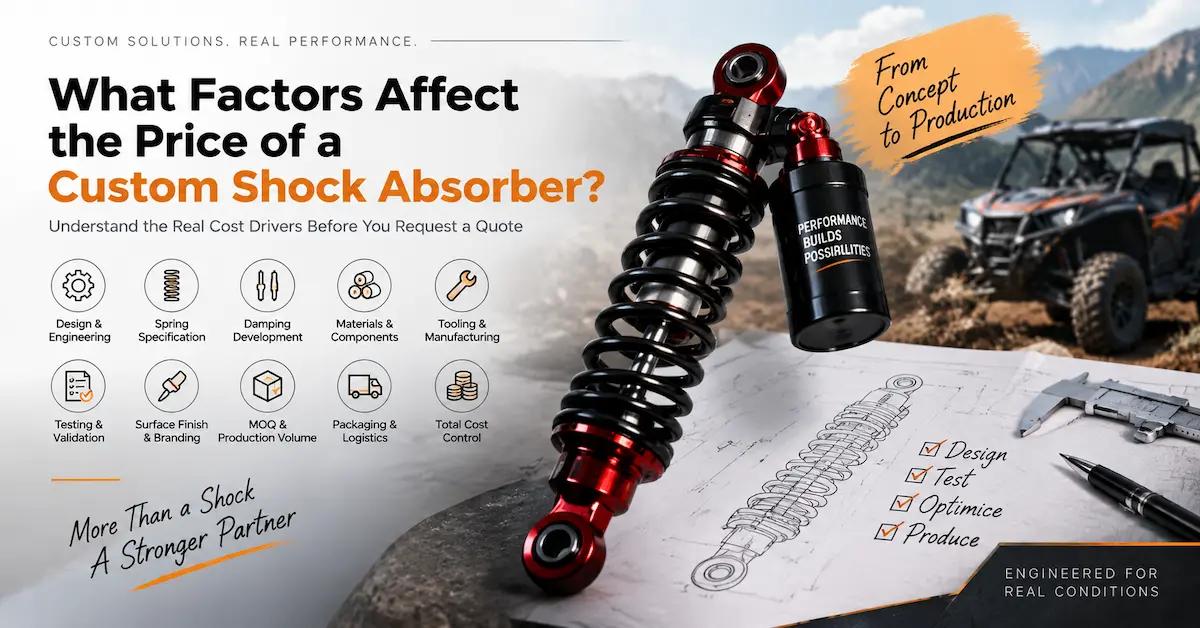

Does Custom Spring Rate or Damping Increase Suspension Development Cost?
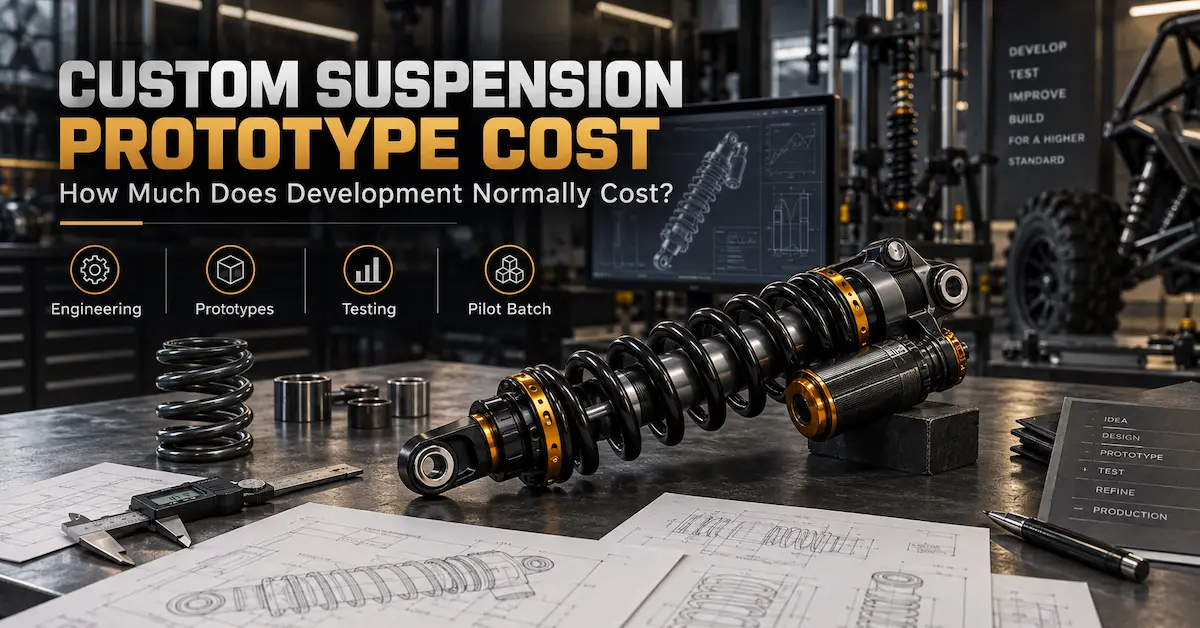
Yes, custom spring rate or damping can increase the custom suspension development cost, but the amount depends on how far the project moves away from an existing validated suspension configuration. If a suitable shock body, spring family, mounting structure, and damping platform already exist, engineering may only need to select or modify a limited number of parameters. If the project requires a newly developed spring, several compression and rebound configurations, vehicle testing, multiple prototypes, and repeated engineering revisions, the development scope becomes considerably broader.
The important point for OEM buyers is that spring rate and damping should not be viewed as two decorative options added to a quotation. They are performance specifications that interact with vehicle weight, suspension geometry, rider and cargo load, travel, preload, tire configuration, and intended terrain. BEDO’s OEM shock absorber customization process treats spring and damping development as part of the complete application-engineering process rather than simple catalog selections.
For purchasing teams, the correct question is therefore not only, “How much more does custom damping cost?” It is: Which engineering, samples, tests, components, and revisions are required to create and validate the requested spring and damping specification?
Separate Development Cost From the Final Shock Unit Price
A custom spring rate or damping specification can increase the engineering budget without increasing every future production unit by the same amount.
Development-stage expenses can include engineering analysis, prototype springs, alternative damping configurations, dyno testing, vehicle evaluation, and revision work. Once the specification has been approved and production is stable, many of those activities are no longer repeated on every shock.
A useful purchasing structure is to separate the project into:
Engineering Cost
Application review, spring calculation or selection, damping analysis, CAD/drawing review, technical communication.
Prototype Cost
Physical springs, shocks, custom components, machining, and assembly.
Validation Cost
Damping tests, fitment checks, leakage inspection, load evaluation, and vehicle testing where required.
Revision Cost
New springs, changed valving, modified components, and repeat testing following prototype feedback.
Production Unit Cost
Recurring manufacturing cost of the final approved configuration.
This makes the quotation easier to understand and prevents prototype-development expenses from being mistaken for the final mass-production shock price.
Why Custom Spring Rate Can Increase Development Cost
A spring-rate change can be simple when the supplier already has an appropriate validated spring. It becomes a development project when a new specification must be created around the vehicle.
Spring engineering may need to consider vehicle mass, front and rear axle loads, rider weight, cargo, permanent accessories, suspension position, motion ratio, shock angle, available travel, sag, preload, and required ride behavior.
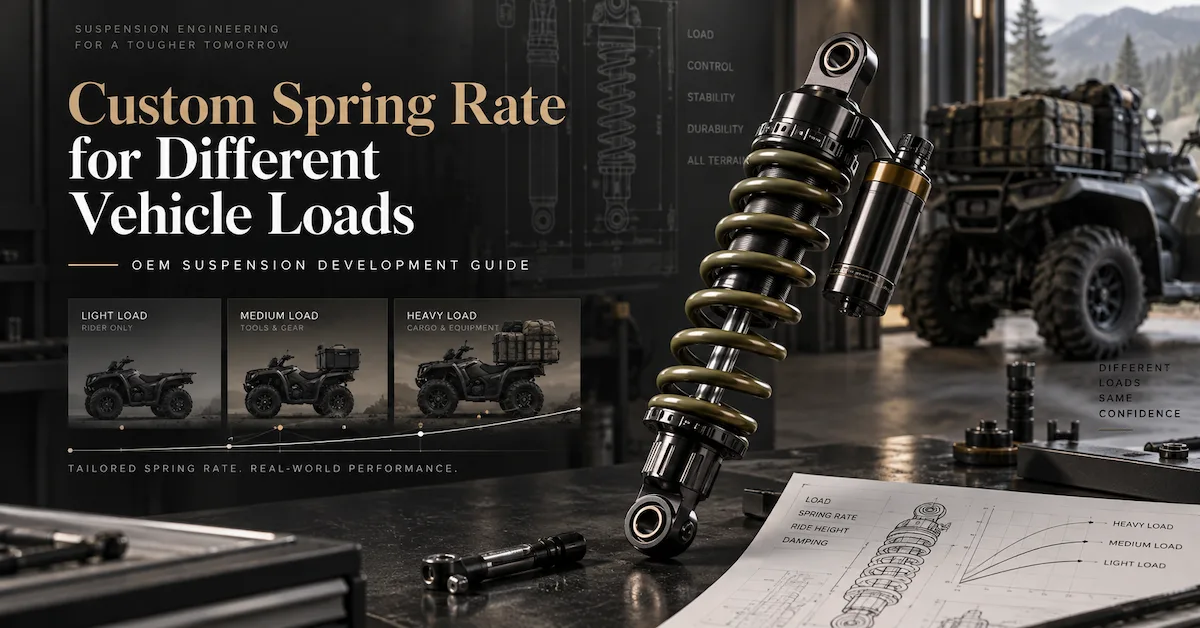
BEDO’s custom coil spring OEM guide provides a useful starting point for this type of project.
A new spring program may require work involving:
- spring-rate selection;
- free length;
- inner or outer diameter;
- wire or section dimensions;
- coil geometry;
- preload range;
- material requirements;
- finishing;
- prototype manufacture;
- load-deflection testing;
- vehicle validation.
If the buyer needs several load versions—for example, standard, heavy-rider, and cargo configurations—the project may require several prototype springs rather than one.
Existing Spring Versus New Spring Development
Spring cost should be evaluated according to the development route.
Existing Validated Spring
The supplier already has a spring that meets the target load and dimensional requirements. This usually minimizes new spring-development work.
Existing Spring With Minor Change
The spring family is suitable, but the project requires another rate, length, or finish. Some engineering and validation may still be required.
New Vehicle-Specific Spring
The spring must be developed around new vehicle loads, suspension geometry, sag targets, or travel requirements. This creates the broadest engineering scope.
A buyer should not request a newly designed spring if an existing validated specification already satisfies the application. Customization should solve a real vehicle requirement rather than simply make the product appear more specialized.
Why Different Vehicle Loads Can Create Additional Spring Versions
An ATV used by one rider with no cargo may require a different setup from the same platform carrying a toolbox, rear rack load, winch, heavy bumper, or other equipment.
If one spring cannot provide acceptable behavior across the entire operating range, the OEM may choose multiple configurations.
For example:
Standard Load Version
Normal rider and basic vehicle configuration.
Utility Version
Permanent equipment and typical cargo.
Heavy-Load Version
Higher approved working load within the vehicle’s design limits.
Each additional version can add prototype, testing, inventory, identification, and production-control requirements.
This is why spring customization affects not only the initial engineering budget but also the complexity of the eventual product family.
Why Custom Damping Can Increase Development Cost
Custom damping usually involves more than changing one number.
Compression and rebound characteristics must be developed around the spring, load, suspension geometry, shock movement, terrain, and desired vehicle behavior.
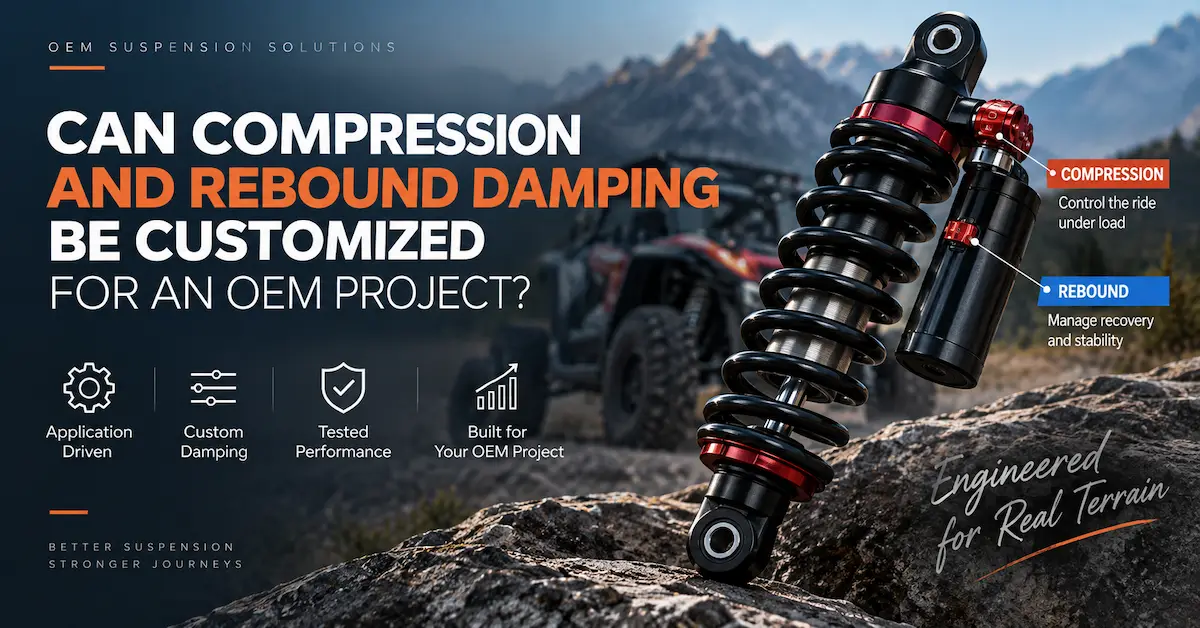
BEDO’s custom damping shock absorber guide addresses this application-specific development approach.
A damping project may require:
- analysis of the existing shock;
- baseline damping measurement;
- new internal configuration;
- prototype assembly;
- compression testing;
- rebound testing;
- force-velocity evaluation;
- vehicle testing;
- engineering feedback;
- revised prototype configuration.
If the first damping configuration does not meet the vehicle target, another prototype or internal revision may be required.
These engineering cycles are the primary reason custom damping can increase development cost.
Fixed Custom Damping Can Cost Less Than Fully Adjustable Damping
OEM customization does not automatically require external adjustment knobs.
A fixed-damping shock can still contain an application-specific factory setting designed for the target vehicle. This may be appropriate when the load and use case are predictable and the OEM wants consistent suspension behavior.
A separately adjustable compression and rebound shock typically introduces more complexity because the project can require:
- additional adjustment components;
- machining;
- assembly;
- wider validation range;
- testing at several settings;
- baseline-setting definition;
- customer setup instructions;
- additional QC checks.
Therefore, an OEM buyer should ask whether external adjustment provides real customer value before paying for the added architecture.
If one carefully developed fixed specification solves the application, the simpler architecture may reduce both development and production complexity.
Spring and Damping Changes Interact With Each Other
One of the most important cost considerations is that spring and damping development should not be treated independently.
A substantial spring-rate change can require damping to be reevaluated, particularly rebound behavior. Likewise, changing damping may reveal that the spring is using too much or too little suspension travel.
A development sequence might be:
Vehicle Load Review → Spring Proposal → Prototype → Sag Test → Damping Development → Dyno Test → Vehicle Test → Revision
If the spring changes again after damping has already been finalized, part of the damping work may need to be repeated.
This is why freezing the spring direction relatively early can help reduce unnecessary development cycles.
For related technical background, see BEDO’s compression and rebound damping customization guide.
Poor Input Data Can Increase Cost More Than the Custom Spring Itself
Incomplete requirements can create avoidable prototype revisions.
A buyer who says only, “Make this shock stiffer for a heavier ATV,” leaves many engineering questions unanswered.
The supplier may still need to establish:
- actual vehicle weight;
- rider weight;
- cargo weight;
- cargo location;
- front/rear distribution;
- current spring;
- current sag;
- shock travel;
- suspension geometry;
- tire modifications;
- current damping;
- terrain;
- target behavior.
If these details arrive after the first prototype has already been manufactured, the project may require another spring, another damping setup, or both.
A complete initial RFQ is therefore one of the most effective ways to reduce custom spring rate and damping cost without reducing engineering quality.
What Data Should Buyers Provide Before Spring or Damping Development?
A useful RFQ should include the target vehicle and operating condition, not only the shock itself.
Provide:
Vehicle Application
Model, year, variant, or internal OEM project code.
Suspension Position
Front or rear.
Current Shock
Drawing, specifications, or physical sample.
Dimensions
Extended length, compressed length, stroke, and mounting interfaces.
Vehicle Load
Vehicle weight, rider/passenger load, cargo, accessories, and axle-load data where available.
Existing Spring
Rate and dimensions where known.
Existing Damping
Test data or current configuration where available.
Current Problem
Sag, bottoming, harshness, bouncing, slow recovery, or another defined behavior.
Target Result
Load support, comfort, control, trail performance, utility behavior, or another measurable goal.
Prototype Quantity
Samples required for engineering validation.
Production Forecast
Expected initial and repeat-order quantities.
BEDO’s custom shock absorber development requirements provides further guidance on preparing application data before engineering begins.
Prototype Quantity Can Change the Development Budget
A project may need more than one spring or damping sample.
Consider three possible development programs.
Program A: Existing Spring + Existing Damping
Only dimensional fitment needs validation.
Program B: New Spring + Existing Damping
Several spring options may need comparison.
Program C: New Spring + New Damping
The project may compare spring configurations first and then develop compression and rebound behavior around the selected spring.
Program C naturally creates a wider prototype scope than Program A.
Prototype quantity should therefore be based on the engineering questions to be answered, not on an arbitrary minimum number.
BEDO’s prototype shock absorber development guide explains why prototype scope depends on the actual design and validation requirements.
Testing Scope Is Another Major Cost Driver
Custom spring or damping development should be validated appropriately.
Possible tests include:
- spring dimensions;
- spring load-deflection behavior;
- shock dimensions;
- compression damping;
- rebound damping;
- adjustment operation;
- leakage;
- vehicle fitment;
- load behavior;
- durability where required;
- real-vehicle evaluation.
A simple spring change for a known application does not necessarily require the same test program as a completely new adjustable performance shock.
The test plan should follow project risk.
BEDO’s shock absorber testing guide covers several relevant validation areas.
Ask every supplier which tests are included in the quoted development price and which require additional charges or samples.
Dyno Testing Can Add Cost but Reduce Subjective Development
Compression and rebound development should not depend only on comments such as “too hard” or “too soft.”
A damper dyno can provide objective information about how damping force changes under controlled shock movement.
BEDO’s compression and rebound damping testing guide discusses how controlled test data can support prototype comparison.
This test work creates development cost, but it can also make revisions more precise.
Instead of requesting a random internal change after a subjective test ride, engineers can compare the approved baseline, prototype result, and target behavior more systematically.
The purchasing question should therefore consider the value of better engineering evidence—not simply the testing fee itself.
Vehicle Testing Can Create Additional Cost and Time
Bench data cannot fully reproduce the interaction among:
- spring;
- shock damping;
- tire;
- suspension geometry;
- rider;
- cargo;
- terrain.
Real-vehicle evaluation remains important for a new or substantially changed suspension setup.
Vehicle testing can add project cost through:
- test samples;
- vehicle preparation;
- installation;
- rider or operator time;
- loading equipment;
- test location;
- engineering feedback;
- potential revision.
The scope should be proportional to the project.
A standard replacement product may need less vehicle-development work than a new performance or cargo-specific suspension package.
Adjustability Can Increase Testing Requirements
If the shock has external compression or rebound adjustment, the engineering team needs to understand more than one fixed setting.
Representative adjustment positions may need to be evaluated so the manufacturer can define a useful operating range.
The project may need to establish:
- minimum position;
- baseline position;
- maximum position;
- intermediate positions where relevant;
- repeatability;
- correct adjustment direction;
- customer setup guidance.
Each additional variable adds development and production-control work.
Do not specify a large number of clicks simply because it sounds premium.
The useful adjustment range matters more than the marketing number.
Reservoir Architecture Can Add Another Layer of Cost
Piggyback and remote-reservoir shocks can introduce additional components and development requirements.
Depending on the design, these may include:
- reservoir body;
- piston or separator components;
- fittings;
- hose;
- mounting bracket;
- routing review;
- additional sealing interfaces;
- additional assembly work.
If damping development also changes, the reservoir architecture may need to be evaluated together with the hydraulic configuration.
A remote reservoir should therefore only be included when it solves a real packaging, hydraulic, thermal, or performance requirement.
Manufacturing Components Can Affect Spring and Damping Development Cost
New engineering settings can sometimes require dedicated components.
For example, a spring version may require:
- a different spring itself;
- revised spring seat;
- altered preload range.
A damping version may require:
- different internal components;
- adjustment hardware;
- another reservoir configuration.
If these items are already part of the factory’s production platform, customization may be easier. If entirely new components must be manufactured or sourced, project cost can increase.
Ask the supplier which elements are existing and which must be newly developed.
Tooling and Fixtures May Be Separate From Spring and Damping Cost
Custom performance settings do not always require new tooling, but related structural changes might.
If new mounting dimensions, spring seats, reservoirs, or adjustment hardware are introduced, tooling or fixtures may be required for:
- machining;
- assembly;
- prototype holding;
- inspection.
These should be quoted separately where applicable.
For purchasing, ask:
Is the tooling one-time?
Will it be used for repeat orders?
Who owns it?
Does changing the design require another fixture?
This helps distinguish the engineering cost from recurring product price.
Revision Cycles Can Become the Largest Hidden Expense
Custom spring and damping development is iterative.
A realistic example could be:
Prototype 1
Spring too soft.
Prototype 2
New spring fixes sag but rebound recovery is too fast.
Prototype 3
Rebound is revised, but rough-terrain compression needs adjustment.
Prototype 4
Final spring and damping combination is approved.
Not every project requires four versions, but the example illustrates why the number of engineering revisions matters.
A quotation that includes one prototype round should not be compared directly with one that includes multiple tuning iterations.
Before the project starts, ask how engineering revisions will be priced.
When Does Custom Spring or Damping Add Little Additional Cost?
Customization may be relatively efficient when the requested specification is close to an existing validated platform.
Examples can include:
- an existing spring rate already suits the application;
- a nearby spring specification is already manufactured;
- the required damping is already used on a related vehicle;
- shock architecture and mounts remain unchanged;
- existing testing and manufacturing methods can be reused.
In these situations, the supplier may be selecting or adapting an existing technical platform rather than performing a completely new development program.
This is why buyers should ask the factory to review existing options before requesting a clean-sheet design.
When Does the Cost Increase More Significantly?
Development scope becomes broader when the project combines several new requirements at the same time.
For example:
New vehicle + new spring + new damping + new mounting + remote reservoir + adjustable compression/rebound + multiple load versions
This project creates considerably more engineering work than:
Existing vehicle + existing shock platform + one new spring rate
For purchasing teams, the cost is not being created by the words “custom spring” or “custom damping.” It is created by the number of unresolved technical variables that must be engineered and validated.
Custom Spring Rate vs Custom Damping: Which Usually Adds More Cost?
There is no universal answer because the scope can differ significantly.
A new spring may require development, manufacturing, and load testing but leave the hydraulic shock unchanged.
A new damping configuration may require multiple internal iterations, dyno testing, vehicle evaluation, and revised prototypes.
Another project might use an existing damping configuration but need several completely new springs.
The better comparison is:
Which requirement needs the most new engineering, components, samples, and testing?
That requirement is more likely to dominate the development budget.
A Practical Cost Comparison Framework
When comparing project routes, use the following logic.
Existing Spring + Existing Damping
Lowest technical change. Main work may be fitment and vehicle confirmation.
Custom Spring + Existing Damping
Adds spring development, sample springs, sag/load evaluation, and potential damping review.
Existing Spring + Custom Damping
Adds damping engineering, prototypes, testing, and vehicle tuning.
Custom Spring + Custom Damping
Adds both development streams and creates a higher chance that one revision affects the other.
Custom Spring + Adjustable Damping + Reservoir
Adds more hardware, testing conditions, production controls, and user setup requirements.
This framework helps buyers understand why two visually similar shock absorbers can have different development quotations.
How Can Buyers Reduce Spring and Damping Development Cost?
The objective should be to reduce wasted engineering rather than eliminate necessary testing.
Provide Accurate Load Data
Use real vehicle, rider, cargo, and accessory information.
Provide Existing Spring Data
Include spring rate, dimensions, preload, and current sag where available.
Provide Existing Damping Data
Send test results if they exist instead of asking the factory to recreate the baseline.
Define the Current Problem Clearly
“Bounces twice after a large bump” is more useful than “make it better.”
Use Existing Platforms Where Appropriate
Ask whether a validated shock body, mount, spring family, or damping platform can be adapted.
Freeze Major Geometry First
Do not tune damping around a suspension geometry that is still changing.
Test Spring Direction Before Fine Damping Tuning
Avoid repeatedly tuning damping against a spring that will later be replaced.
Control Engineering Revisions
Record why each prototype changes so previous decisions do not need to be repeated.
These steps can reduce unnecessary development cycles without reducing product quality.
Low-Volume Development Can Reduce Commercial Risk
Buyers do not need to jump directly from custom spring and damping development into a large inventory order.
BEDO supports prototype and low-volume development routes for customized suspension projects.
A practical path is:
Engineering Prototype → Spring/Damping Validation → Revised Prototype → Pilot Batch → Initial Production → Scale-Up
The prototype and low-volume suspension guide explains how small quantities can be used to validate technical and manufacturing risk before bulk production.
Low volume may carry a higher unit cost, but it can reduce the much larger risk of producing a high quantity of an incorrect suspension setup.
Pilot Production Should Verify the Approved Spring and Damping
One prototype proves that one shock can meet the target.
Pilot production asks whether normal manufacturing can repeatedly build the same product.
For a custom spring-and-damping project, verify:
- correct spring version;
- spring identification;
- approved preload;
- correct damping configuration;
- compression consistency;
- rebound consistency;
- adjuster function where applicable;
- leakage;
- dimensions;
- traceability.
If several technical variants look similar, clear product identification becomes especially important.
Do Custom Spring and Damping Increase MOQ?
They can, but not automatically.
The final MOQ can be influenced by:
- new spring manufacturing requirements;
- custom internal components;
- adjustment hardware;
- reservoir components;
- surface treatment;
- manufacturing processes;
- packaging.
An existing spring and damping platform may support smaller commercial quantities more easily than a project requiring several unique components.
BEDO’s custom shock absorber MOQ guide explains why prototype quantity, pilot quantity, production MOQ, and repeat-order quantity should be discussed separately.
Does Custom Spring and Damping Increase Lead Time?
It can because each additional engineering variable can add design, sample, testing, and revision work.
Custom spring development may require load review and prototype springs.
Custom damping development may require test and vehicle-feedback cycles.
When both are new, the project may need to stabilize the spring first and then refine damping around it.
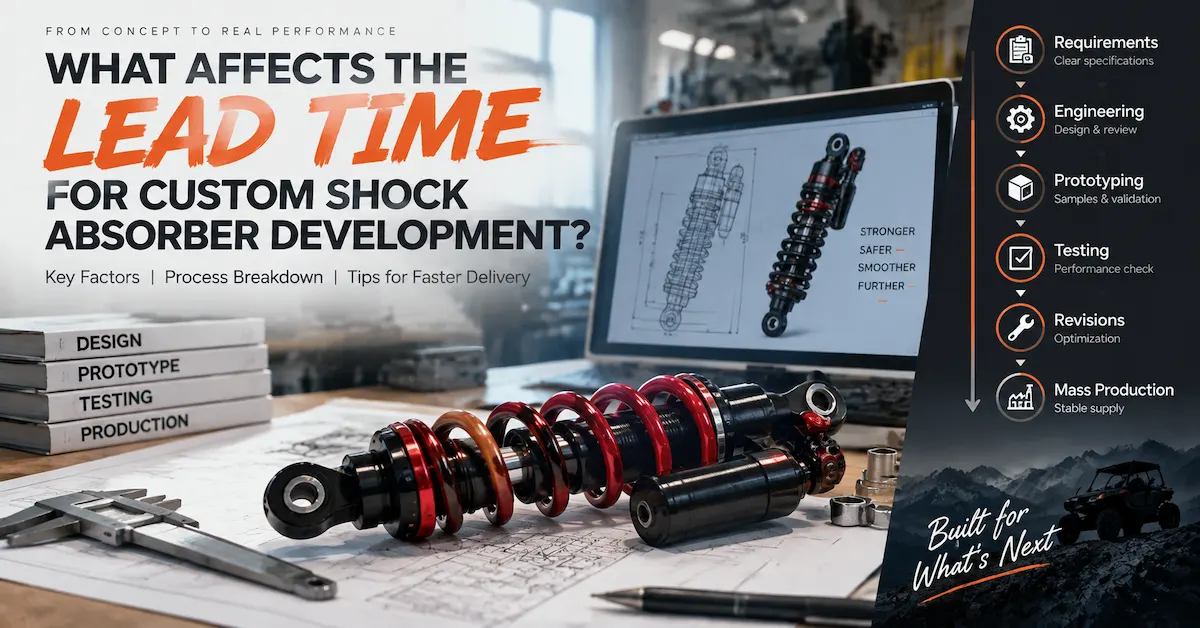
BEDO’s custom shock absorber development lead-time guide provides a related framework for separating engineering, prototypes, revisions, pilot production, and mass-production timing.
For project planning, ask for:
Initial Prototype Lead Time
Engineering Revision Lead Time
Pilot-Batch Lead Time
Mass-Production Lead Time
rather than one overall number.
What Should Buyers Ask a Supplier Before Approving the Development Budget?
Ask the factory to clarify:
- Are we using an existing shock architecture?
- Is the spring existing or newly developed?
- How many spring versions are included?
- Is damping existing or custom?
- How many damping iterations are included?
- Which tests are included?
- Is vehicle testing included?
- Are adjustment components new?
- Are tooling or fixtures required?
- What happens if another prototype revision is needed?
- What quantity applies to the pilot batch?
- What is the final expected production-cost basis?
These questions turn an ambiguous “custom development charge” into an understandable engineering scope.
What Should You Send BEDO for a Spring and Damping Cost Review?
For an accurate project review, prepare:
- vehicle model or platform;
- installation position;
- existing shock/sample;
- drawings or CAD;
- vehicle weight;
- rider/passenger weight;
- cargo and accessories;
- front/rear axle load where available;
- existing spring rate;
- spring dimensions;
- preload/sag information;
- existing damping data;
- terrain;
- current suspension problem;
- desired behavior;
- adjustment requirements;
- prototype quantity;
- expected pilot quantity;
- projected production volume.
BEDO’s custom spring development guide and custom damping guide provide useful technical starting points before you submit the final RFQ.
For project-specific engineering and quotation review, use BEDO Contact Us.
Frequently Asked Questions
1. Does Custom Spring Rate Always Increase Suspension Development Cost?
Not always significantly. If an existing validated spring already meets the required load and dimensions, the factory may only need to select that configuration. A completely new spring can require engineering, samples, and validation.
2. Does Custom Damping Always Cost More Than Standard Damping?
A new vehicle-specific compression or rebound specification can require additional engineering and testing compared with using an existing validated setting.
3. Which Costs More: Custom Spring or Custom Damping?
There is no universal answer. Cost depends on how much new engineering, hardware, samples, and testing each requirement creates.
4. Can Spring Rate Be Changed Without Retuning Damping?
A small change may or may not require another damping specification, but a significant spring change should normally trigger a damping review because suspension behavior can change.
5. Can Damping Fix an Incorrect Spring Rate?
No. Damping controls movement while the spring primarily supports load. A fundamentally unsuitable spring should be corrected rather than hidden with stronger damping.
6. Does Adjustable Compression and Rebound Increase Cost?
It can because adjustable designs add components, manufacturing controls, additional test positions, and setup requirements.
7. Does a Remote Reservoir Increase Development Cost?
It can introduce reservoir components, fittings, hose or mounting hardware, additional sealing points, packaging review, and testing.
8. Can Low-Volume Production Reduce Development Risk?
Yes. Prototype and pilot quantities allow buyers to validate the technical configuration and manufacturing consistency before committing to larger inventory.
9. What Information Helps Reduce Development Cost?
Complete vehicle load data, accurate dimensions, spring information, existing damping data, drawings or CAD, and a clearly described performance problem can reduce avoidable engineering revisions.
10. How Can I Get an Accurate BEDO Spring and Damping Quote?
Provide the application, vehicle/load data, current spring and damping information, drawings or reference sample, target behavior, prototype requirements, testing scope, and expected production volume through BEDO Contact Us.
Conclusion
Yes, custom spring rate or damping can increase the custom suspension development cost, but the increase comes from the engineering work required to create and validate the new specification—not simply from labeling the product “custom.” A new spring can require load analysis, prototype manufacturing, sag and load evaluation, while new compression and rebound damping can require internal revisions, controlled testing, and vehicle validation. When both are customized together, additional development cycles may be required because spring and damping directly influence one another. The most cost-efficient route is Define Vehicle Load → Select or Develop Spring → Verify Sag and Travel → Develop Damping → Prototype → Test → Revise Only Where Necessary → Pilot Production → Controlled Scale-Up. BEDO supports suspension spring and shock absorber development for ATV and other vehicle applications. To define the appropriate engineering scope and budget, contact BEDO with your vehicle data, spring and damping requirements, drawings or samples, prototype plan, testing needs, and production forecast so unnecessary customization can be avoided while the required performance remains properly validated.