
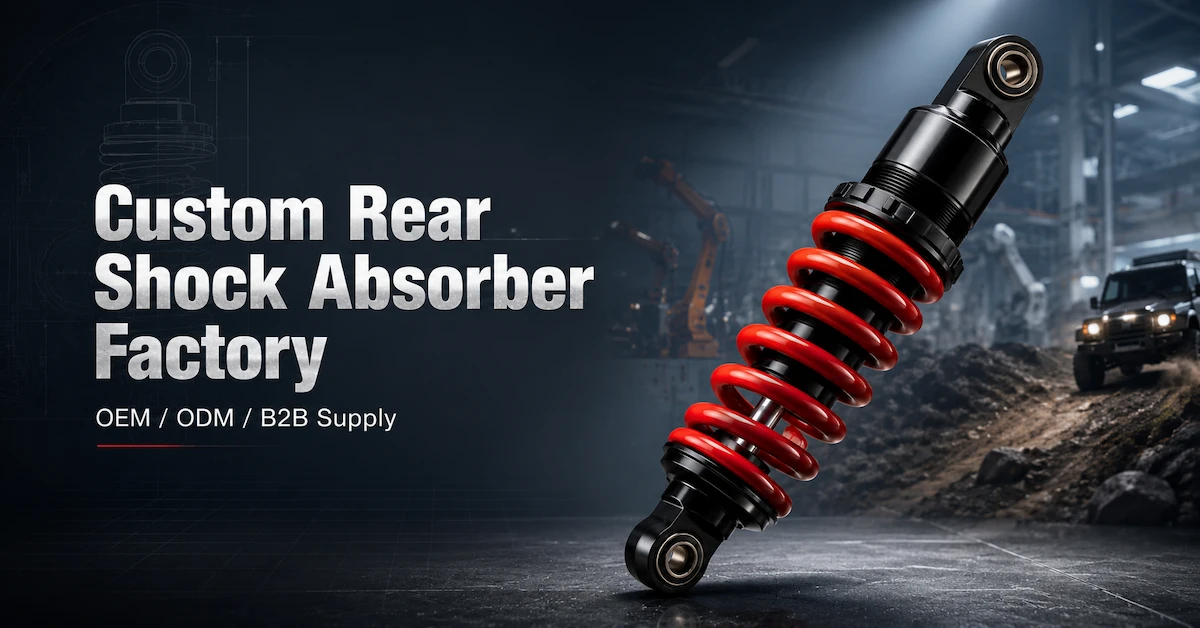
Choosing a custom rear shock absorber factory is an important sourcing decision for motorcycle, electric motorcycle, ATV, UTV, snowmobile, beach buggy, and specialty vehicle brands.
A rear shock absorber does more than connect the frame and suspension arm. It supports vehicle weight, controls compression and rebound, maintains ride height, absorbs road or terrain impacts, and influences handling stability.
Standard replacement shocks may work for common applications, but they are not always suitable when a buyer needs different mounting dimensions, load support, suspension travel, damping behavior, appearance, branding, or packaging.
For these projects, customized manufacturing provides greater control over fitment, performance, and product positioning.
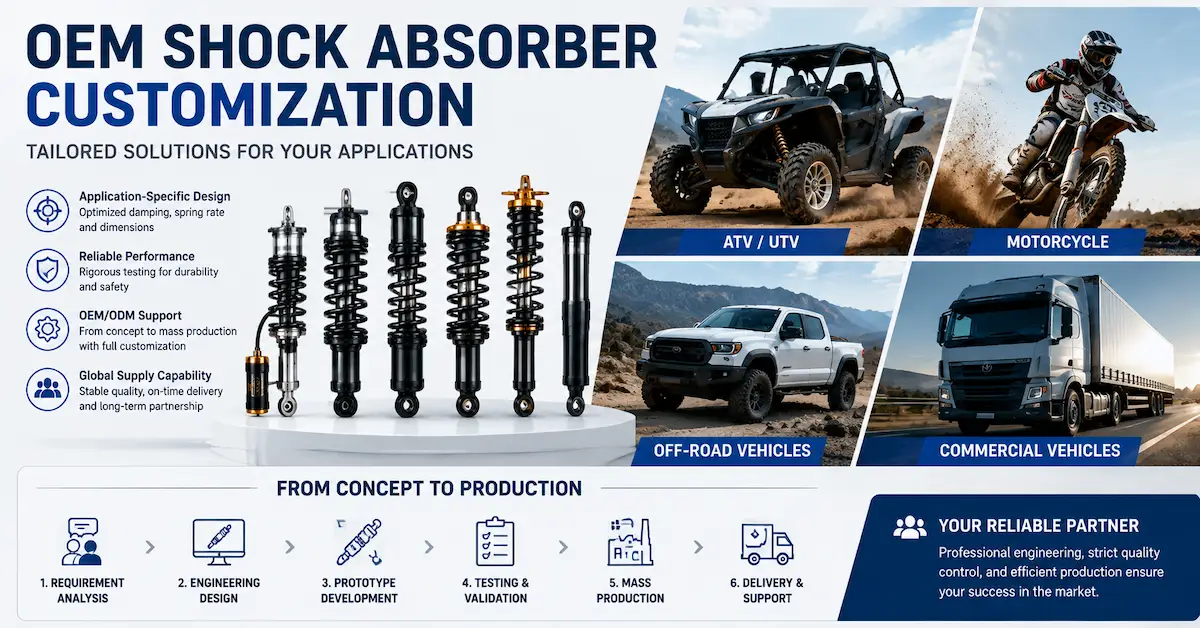
Bedo Auto supports shock absorber and suspension component development based on customer drawings, samples, technical parameters, and target applications. Available product options can be reviewed through the Bedo Auto Products page.
Who Needs a Custom Rear Shock Absorber Factory?
Customized rear shock absorbers are commonly required by companies developing new vehicles, replacement parts, performance upgrades, or private-label product lines.
Typical buyers include:
- Motorcycle manufacturers
- Electric motorcycle brands
- ATV and UTV manufacturers
- Off-road vehicle brands
- Importers
- Suspension wholesalers
- Aftermarket distributors
- Modification workshops
- Racing component suppliers
- Private-label brands
- OEM and ODM purchasing teams
Each buyer may have a different objective.
A vehicle manufacturer may require stable production for a new model. An aftermarket brand may need an upgraded shock with adjustable damping. An importer may need a cost-effective replacement product with customized packaging.
The factory must understand these differences before beginning development.
Why Standard Rear Shocks May Not Meet Every Application
Two rear shock absorbers can look similar while delivering very different suspension performance.
Differences may include:
- Extended length
- Compressed length
- Effective stroke
- Spring rate
- Spring preload
- Compression damping
- Rebound damping
- Piston diameter
- Rod diameter
- Mounting width
- Mounting hole size
- Reservoir structure
- Oil and gas configuration
- Surface treatment
A shock absorber selected only by overall length may fit the vehicle but still cause poor ride quality or insufficient load support.
For example, a rear shock designed for a lightweight motorcycle may not be suitable for a heavier electric motorcycle with a large battery. Similarly, a recreational UTV shock may not support the cargo requirements of a utility vehicle.
A professional factory should analyze both fitment and operating conditions.
What Can Be Customized in a Rear Shock Absorber?
A custom rear shock absorber factory should offer multiple engineering and commercial customization options.
| Customization item | Purpose |
|---|---|
| Extended length | Matches the vehicle’s mounting position |
| Compressed length | Prevents interference at full compression |
| Stroke length | Controls suspension travel |
| Mounting hole diameter | Ensures bolt compatibility |
| Mounting width | Matches the frame and suspension bracket |
| Spring rate | Supports vehicle and payload weight |
| Spring preload | Adjusts sag and initial support |
| Compression damping | Controls impact response |
| Rebound damping | Controls suspension return speed |
| Shock body material | Balances strength, heat management, and weight |
| Piston rod diameter | Influences strength and sealing |
| Reservoir design | Supports heat and pressure management |
| Surface treatment | Improves corrosion resistance |
| Spring color | Supports product differentiation |
| Logo marking | Supports OEM branding |
| Packaging | Supports retail and distribution requirements |
Not every project requires all these options. The final configuration should be based on the vehicle and target market rather than unnecessary complexity.
Key Information Buyers Should Provide
Accurate technical information reduces development time and prevents repeated sample revisions.
Buyers should provide as much of the following information as possible:
| Required information | Why it matters |
|---|---|
| Vehicle type | Defines the basic suspension application |
| Vehicle model | Helps confirm compatibility |
| Installation position | Rear-left, rear-right, center-mounted, or dual-shock system |
| Vehicle weight | Influences spring and damping requirements |
| Rider or passenger load | Affects operating suspension sag |
| Cargo load | Important for utility and commercial vehicles |
| Extended length | Defines maximum shock length |
| Compressed length | Confirms full-compression clearance |
| Stroke | Determines available movement |
| Mounting dimensions | Ensures correct installation |
| Existing spring specification | Provides a reference for load support |
| Terrain | Defines impact and durability requirements |
| Performance target | Comfort, stability, heavy load, racing, or upgrade |
| Existing sample | Supports reverse development |
| Drawing | Defines dimensions and tolerances |
When complete vehicle data is unavailable, a physical sample can provide useful dimensional and structural information.
However, sample-based development is more accurate when combined with application details and target performance.
Rear Shock Development from Samples
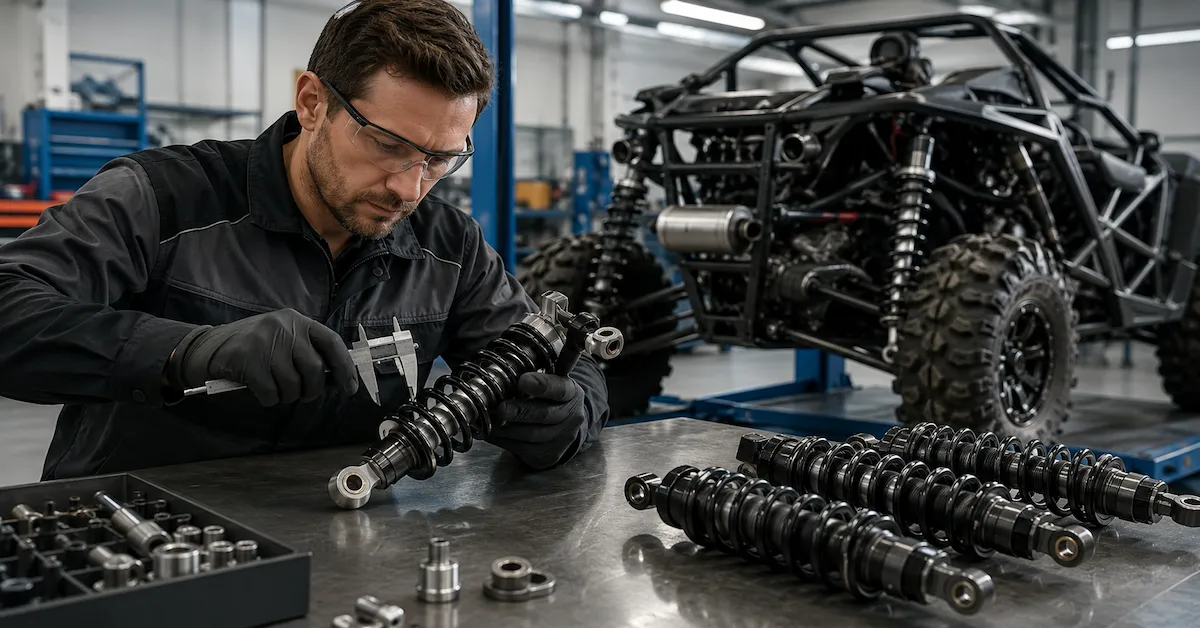
Many aftermarket and replacement projects begin with an existing rear shock absorber.
A factory can inspect the sample to evaluate:
- Total length
- Stroke
- Mounting structure
- Spring dimensions
- Body diameter
- Rod diameter
- Adjustment features
- Surface finish
- Connection components
The sample can then be used as a development reference.
However, directly copying external dimensions may not reproduce the correct performance. Internal valve settings, oil specifications, gas pressure, spring rate, and friction characteristics also influence suspension behavior.
The buyer should explain whether the new product must:
- Match the original performance
- Improve load support
- Provide a softer ride
- Improve off-road control
- Support heavier vehicle weight
- Add adjustable damping
- Reduce manufacturing cost
- Create a premium upgrade version
This allows the factory to develop a product based on objectives rather than appearance alone.
Rear Shock Development from Drawings
Drawings provide a clearer technical reference for new vehicle and OEM projects.
A complete drawing may define:
- Extended and compressed lengths
- Stroke
- Mounting eye dimensions
- Mounting width
- Hole diameter
- Body dimensions
- Rod dimensions
- Spring dimensions
- Material requirements
- Surface treatment
- Tolerance ranges
The factory should review the drawing before confirming production feasibility.
Engineering review may identify:
- Dimensions that are difficult to manufacture
- Insufficient installation clearance
- Potential interference during compression
- Weak mounting structures
- Unreasonable tolerances
- Conflicts between stroke and overall length
- Material or coating risks
Early review helps reduce tooling changes and prototype failures.
How Spring Rate Affects Rear Suspension
The spring supports the weight carried by the rear suspension.
This includes:
- Vehicle weight
- Rider weight
- Passenger weight
- Battery weight
- Cargo
- Accessories
- Additional equipment
A spring that is too soft may cause:
- Excessive sag
- Reduced ground clearance
- Frequent bottoming
- Poor stability under load
- Insufficient suspension travel
A spring that is too stiff may cause:
- Harsh riding
- Reduced comfort
- Poor response to small bumps
- Lower tire contact on uneven terrain
- Increased vibration
The correct spring rate depends on vehicle weight, suspension geometry, desired sag, available travel, and target use.
A professional rear shock absorber supplier should not recommend spring stiffness from vehicle type alone.
How Compression and Rebound Damping Affect Performance
Spring support and damping must be matched together.
Compression Damping
Compression damping controls how quickly the shock absorber compresses when the wheel encounters a bump or landing force.
Insufficient compression damping may cause:
- Rapid suspension collapse
- Frequent bottoming
- Excessive body movement
- Poor control during jumps
Excessive compression damping may cause:
- Harsh impact response
- Reduced comfort
- Poor movement over repeated bumps
- Increased stress on the vehicle structure
Rebound Damping
Rebound damping controls how quickly the suspension extends after compression.
Insufficient rebound damping may cause:
- Repeated bouncing
- Unstable rear movement
- Reduced control
- Rapid weight transfer
Excessive rebound damping may cause:
- Slow suspension recovery
- Reduced available travel
- Suspension packing over repeated bumps
- Poor tire contact
For adjustable products, the adjustment range should be practical and repeatable rather than simply offering the largest number of settings.
Important Rear Shock Absorber Structures
Different vehicles require different shock absorber configurations.
Coilover Rear Shock
A coilover combines the spring and damper into one assembly.
It is commonly used for:
- Motorcycles
- Electric motorcycles
- ATV and UTV applications
- Beach buggies
- Specialty vehicles
It offers compact installation and integrated spring support.
Twin Rear Shock System
Some motorcycles and utility vehicles use one shock on each side.
Important considerations include:
- Matching damping between both shocks
- Consistent spring specifications
- Equal extended length
- Mounting alignment
- Batch consistency
Monoshock System
A monoshock system uses one centrally mounted rear shock.
Because one shock carries the rear suspension load, spring and damping specifications are especially important.
Remote Reservoir Shock
A reservoir can increase oil and gas capacity and improve heat management.
It may be suitable for:
- Off-road riding
- Racing
- Long-duration operation
- High-frequency suspension movement
- Premium aftermarket products
The reservoir position and hose routing must be compatible with available installation space.
Materials and Surface Treatments
The rear shock absorber operates under repeated loading, vibration, contamination, and environmental exposure.
Material selection should consider:
- Structural strength
- Fatigue resistance
- Wear resistance
- Heat transfer
- Corrosion protection
- Product weight
- Manufacturing cost
Common material options may include steel and aluminum components, selected according to the product structure and target positioning.
Surface treatments may include:
- Painting
- Powder coating
- Plating
- Anodizing
- Polishing
- Protective finishing
Off-road, snow, and coastal applications may require stronger corrosion protection than products used in dry environments.
Quality Control in a Custom Rear Shock Absorber Factory
Quality control should cover the complete manufacturing process rather than only final appearance.
Incoming Material Inspection
The factory should inspect:
- Tubes
- Piston rods
- Springs
- Seals
- Bushings
- Mounting components
- Machined parts
- Surface condition
Dimensional Inspection
Critical dimensions include:
- Extended length
- Compressed length
- Stroke
- Mounting hole diameter
- Mounting width
- Spring length
- Spring outside diameter
- Rod diameter
- Body diameter
Assembly Control
Assembly procedures should control:
- Component cleanliness
- Seal installation
- Valve assembly
- Oil filling
- Gas charging
- Tightening torque
- Spring preload
- Adjustment functions
Leakage Testing
The finished shock should be checked for visible leakage and abnormal pressure loss.
Functional Testing
Movement should be smooth and free from:
- Sticking
- Unusual noise
- Excessive friction
- Uneven resistance
- Adjustment failure
Damping Verification
Compression and rebound forces should be checked against the approved specification where performance verification is required.
Final Inspection
Final checks should include:
- Surface quality
- Dimensions
- Color
- Logo position
- Label accuracy
- Packaging
- Quantity
Why Prototype and Small-Batch Testing Matter
A prototype allows the buyer to confirm basic dimensions, appearance, installation, and performance.
However, one sample may not reveal every production risk.
Small-batch production provides a more realistic validation stage.
It helps buyers evaluate:
- Product consistency
- Fitment across multiple vehicles
- Suspension behavior
- Spring support
- Damping repeatability
- Surface quality
- Packaging
- Installer feedback
- Market response
Small-batch validation is especially useful for new brands, upgraded suspension products, modified vehicles, and projects developed from incomplete technical data.
Standard Supplier vs Custom Rear Shock Absorber Factory
| Evaluation point | Standard product supplier | Custom factory |
|---|---|---|
| Dimensions | Fixed | Developed to project requirements |
| Spring rate | Standard | Matched to vehicle and load |
| Damping | General setting | Customized or adjusted |
| Mounting structure | Fixed | Customizable |
| Appearance | Limited options | Color and finish customization |
| Branding | Usually limited | Logo, labels, and packaging |
| Prototype support | Limited | Sample development available |
| Small batch | Not always available | Suitable for project validation |
| Best application | General replacement | OEM, ODM, upgrade, and private label |
A standard supplier may be suitable for common replacement products. A custom factory provides greater value when the buyer needs technical differentiation or vehicle-specific development.
How to Evaluate a Custom Rear Shock Absorber Factory
Before selecting a supplier, buyers should evaluate several areas.
Engineering Capability
Confirm whether the factory can:
- Review samples and drawings
- Analyze vehicle applications
- Confirm mounting dimensions
- Recommend spring specifications
- Adjust damping
- Produce prototypes
- Record approved specifications
Manufacturing Capability
Evaluate:
- Machining and assembly capability
- Production process control
- Quality inspection
- Material management
- Small-batch flexibility
- Mass-production capacity
- Repeat-order consistency
Testing Capability
Ask whether the supplier can perform:
- Dimensional inspection
- Leakage inspection
- Functional testing
- Damping verification
- Surface inspection
- Sample comparison
Communication Capability
A qualified supplier should ask technical questions before confirming the final solution.
Questions about weight, load, stroke, terrain, mounting dimensions, and performance targets indicate a more professional development process.
How Bedo Auto Supports Custom Rear Shock Projects
Bedo Auto supports customized shock absorber and suspension component development for motorcycle, electric motorcycle, ATV, UTV, snowmobile, beach buggy, and specialty vehicle applications.
Project support can include:
- Sample evaluation
- Drawing review
- Dimension confirmation
- Spring specification development
- Damping adjustment
- Material selection
- Surface treatment
- Prototype production
- Small-batch validation
- OEM and ODM branding
- Customized packaging
- Repeat-order production
Buyers can review available products through the Bedo Auto Products page, learn more about the company through the About Bedo Auto page, or send project details through the Contact Us page.
FAQ
What information does a custom rear shock absorber factory need?
The factory normally needs vehicle type, vehicle weight, payload, mounting dimensions, extended length, compressed length, stroke, terrain, performance targets, and estimated order quantity.
Can a rear shock absorber be developed from an existing sample?
Yes. A factory can measure and analyze the sample. Providing vehicle data and target performance requirements improves development accuracy.
Can the spring rate be customized?
Yes. Spring rate, spring dimensions, preload, and surface color can be customized according to the vehicle and load.
Can compression and rebound damping be adjusted?
Yes. Damping can be developed or adjusted according to the product structure, vehicle weight, terrain, and performance goals.
Can the factory add a customer logo?
Yes. OEM projects may include logo marking, product color, labels, cartons, and customized packaging.
Is small-batch production available?
Small-batch production can be used to verify fitment, performance, consistency, and market response before mass production.
What vehicles can use customized rear shocks?
Customized rear shocks can be developed for motorcycles, electric motorcycles, ATV, UTV, snowmobiles, beach buggies, and other specialty vehicles.
Conclusion
Choosing the right custom rear shock absorber factory helps vehicle brands, distributors, and aftermarket companies control product fitment, suspension performance, branding, and supply consistency.
A reliable factory should understand the complete application rather than simply copying external dimensions. Spring rate, damping behavior, stroke, mounting structure, materials, sealing, surface protection, and production consistency must all be considered.
Through sample development, drawing review, prototype testing, small-batch validation, and controlled production, Bedo Auto helps B2B buyers develop rear shock absorber products for different vehicles, operating conditions, and target markets.