
Choosing reliable custom motorcycle suspension parts is essential for motorcycle manufacturers, electric motorcycle brands, importers, wholesalers, distributors, modification companies, and private-label aftermarket businesses.
Motorcycle suspension directly influences ride comfort, handling stability, tire contact, braking behavior, load support, and rider confidence. A suspension part may look similar to the original component but still perform poorly if its dimensions, spring rate, damping force, mounting structure, or material specification is incorrect.
This is especially important when developing suspension products for:
- Standard motorcycles
- Electric motorcycles
- Dirt bikes
- Touring motorcycles
- Utility motorcycles
- Off-road motorcycles
- Modified motorcycles
- Performance aftermarket applications
A professional suspension supplier should evaluate the complete vehicle application before confirming a final specification.
Bedo Auto supports customized shock absorbers, suspension springs, and related suspension components for motorcycle and specialty vehicle projects. Buyers can review available solutions through the Bedo Auto Products page.
What Are Custom Motorcycle Suspension Parts?
Custom motorcycle suspension parts are components developed according to a buyer’s drawings, samples, vehicle data, technical parameters, performance objectives, branding requirements, or target market.
They may include:
| Suspension component | Main function |
|---|---|
| Rear shock absorber | Controls rear suspension compression and rebound |
| Front suspension component | Supports steering stability and impact control |
| Coil spring | Carries vehicle, rider, passenger, and cargo weight |
| Piston rod | Transfers movement inside the shock absorber |
| Shock body | Holds the piston, oil, valves, and pressure system |
| Spring seat | Positions and supports the spring |
| Bushing | Reduces vibration and supports mounting movement |
| Mounting eye | Connects the shock to the frame or swingarm |
| Reservoir | Increases oil and gas capacity where required |
| Preload adjuster | Changes initial spring compression |
| Rebound adjuster | Controls suspension return speed |
| Compression adjuster | Controls resistance during compression |
| Connection hardware | Secures the suspension assembly |
Some buyers purchase complete shock absorber assemblies, while others source individual parts for their own assembly or replacement programs.
Who Needs Customized Motorcycle Suspension Components?
Different B2B buyers require customized suspension products for different reasons.
Motorcycle Manufacturers
Vehicle manufacturers may need suspension components for:
- New motorcycle models
- Model upgrades
- Regional specification changes
- Different rider weight ranges
- Utility or commercial versions
- Electric motorcycle platforms
Importers and Distributors
Importers may need:
- Replacement suspension products
- Private-label packaging
- Market-specific fitment
- Customized colors
- Competitive aftermarket options
- Stable repeat-order supply
Aftermarket Brands
Aftermarket companies often focus on:
- Improved damping
- Adjustable preload
- Premium appearance
- Performance upgrades
- Lowered or raised ride height
- Customized spring rates
- Remote-reservoir designs
Modification Workshops
Modification businesses may require small-batch products for:
- Custom motorcycles
- Café racers
- Scramblers
- Touring conversions
- Electric motorcycle upgrades
- Off-road builds
A qualified supplier should adjust its development process according to the buyer’s market and technical objectives.
Why Standard Motorcycle Suspension Parts May Not Work
Standard suspension parts are developed for a defined motorcycle weight, geometry, load, and riding environment.
They may become unsuitable when the motorcycle is modified or used outside its original conditions.
Common causes include:
- Heavier battery packs
- Added luggage systems
- Passenger use
- Modified swingarms
- Different wheel sizes
- Lowered or raised chassis height
- Cargo boxes
- Performance riding
- Rougher road conditions
- Increased rider weight
Incorrect suspension matching may cause:
- Excessive sag
- Harsh riding
- Poor tire contact
- Unstable cornering
- Frequent bottoming
- Excessive bouncing
- Slow suspension recovery
- Oil leakage
- Premature bushing wear
- Abnormal suspension noise
A professional supplier should confirm both installation dimensions and operating requirements.
Main Information Buyers Should Provide
Accurate technical data helps reduce sample revisions and avoids fitment problems.
| Project information | Why it matters |
|---|---|
| Motorcycle type | Defines the basic suspension structure |
| Motorcycle model | Helps confirm vehicle compatibility |
| Installation position | Front and rear parts have different functions |
| Vehicle weight | Influences spring and damping requirements |
| Rider weight | Affects suspension sag |
| Passenger load | Changes rear suspension support needs |
| Battery weight | Important for electric motorcycles |
| Cargo or luggage | Influences operating load |
| Extended shock length | Defines the full suspension length |
| Compressed length | Prevents interference at full compression |
| Effective stroke | Controls available suspension movement |
| Mounting dimensions | Ensures correct installation |
| Existing spring rate | Provides a performance reference |
| Riding environment | Road, touring, city, off-road, or racing |
| Performance target | Comfort, control, load support, or upgrade |
| Existing sample | Provides structural and dimensional references |
| Technical drawing | Defines tolerances and production requirements |
| Estimated quantity | Supports prototype and production planning |
Buyers should also explain the problem the new product must solve.
Examples include:
- Increasing load support
- Reducing harshness
- Improving cornering stability
- Preventing bottoming
- Supporting a heavier electric motorcycle
- Adding rebound adjustment
- Creating a premium private-label product
- Replacing an unavailable original component
Developing Custom Motorcycle Suspension Parts from Samples
Many replacement and aftermarket projects begin with an existing physical sample.
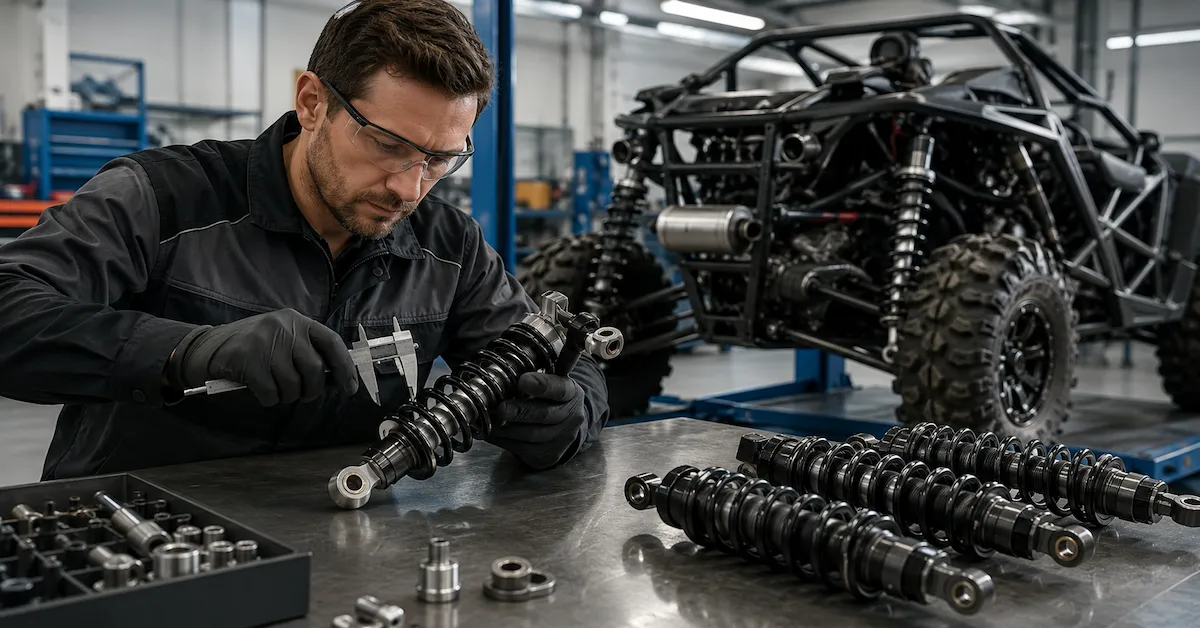
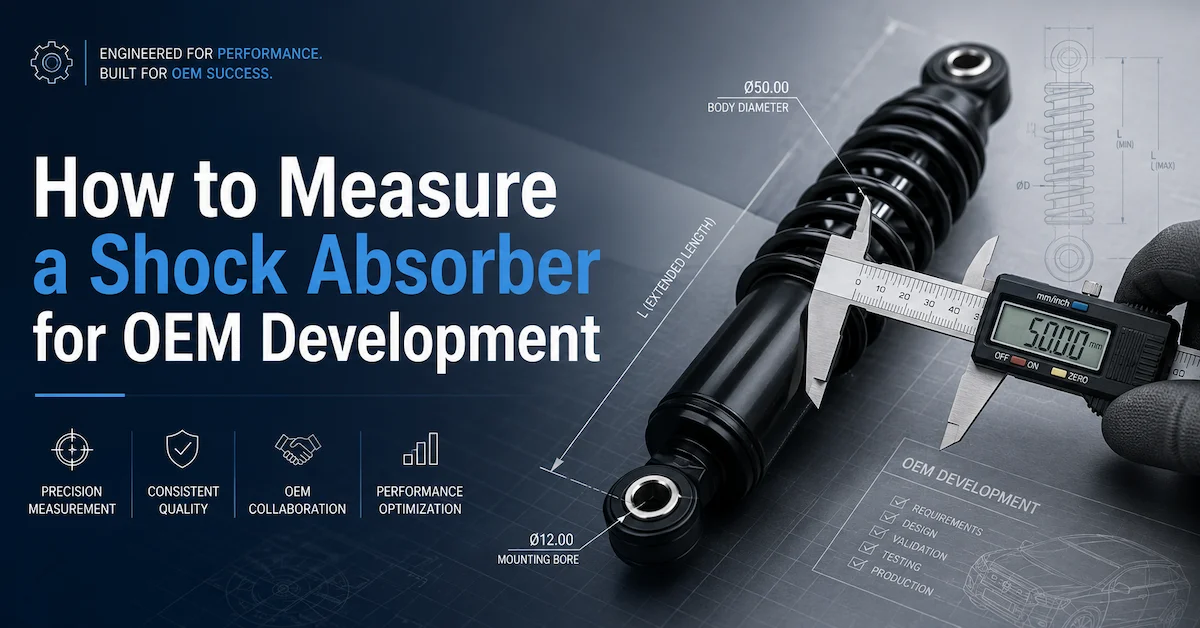
A supplier can measure and evaluate:
- Extended length
- Compressed length
- Stroke
- Mounting-hole diameter
- Mounting width
- Shock-body diameter
- Piston-rod diameter
- Spring dimensions
- Reservoir structure
- Adjustment mechanisms
- Surface finish
However, external measurements do not reveal every internal specification.
Hidden factors may include:
- Spring rate
- Compression damping
- Rebound damping
- Valve structure
- Oil specification
- Gas pressure
- Internal friction
- Seal structure
- Material grade
For better results, the sample should be combined with motorcycle weight, rider load, riding conditions, and performance targets.
Drawing-Based OEM Development
Technical drawings provide a more controlled reference for original equipment and new motorcycle projects.
A drawing may specify:
- Extended and compressed lengths
- Effective stroke
- Mounting-hole diameter
- Mounting width
- Body diameter
- Rod diameter
- Spring free length
- Spring outside diameter
- Reservoir position
- Hose length
- Materials
- Surface treatment
- Dimensional tolerances
- Branding position
Before prototyping, the supplier should review the drawing for:
- Installation clearance
- Full-compression interference
- Swingarm movement
- Mounting alignment
- Structural strength
- Adjustment accessibility
- Reservoir clearance
- Manufacturing feasibility
- Tolerance requirements
Early engineering review helps prevent repeated prototype changes and unnecessary tooling costs.
Spring Rate Selection for Motorcycle Suspension
The spring supports the motorcycle, rider, passenger, luggage, battery, and accessories.
Spring rate influences:
- Static ride height
- Rider sag
- Suspension travel
- Bottoming resistance
- Load capacity
- Initial ride feel
- Front-to-rear balance
A spring that is too soft may cause:
- Excessive sag
- Reduced ground clearance
- Frequent bottoming
- Unstable handling under load
- Limited usable suspension travel
A spring that is too stiff may cause:
- Harsh riding
- Reduced comfort
- Poor small-bump response
- Lower tire contact
- Increased vibration
A motorcycle suspension parts manufacturer should consider:
- Vehicle weight
- Rider weight range
- Passenger use
- Luggage load
- Suspension geometry
- Motion ratio
- Desired sag
- Available travel
- Riding environment
Spring appearance alone cannot indicate whether it is suitable for the vehicle.
Compression Damping and Impact Response
Compression damping controls how quickly the suspension compresses when the motorcycle encounters a bump, braking force, or sudden load transfer.
Insufficient compression damping may cause:
- Rapid suspension collapse
- Excessive body movement
- Frequent bottoming
- Poor cornering support
- Unstable braking behavior
Excessive compression damping may cause:
- Harsh impact response
- Reduced comfort
- Poor movement over repeated bumps
- Increased stress on mounting components
- Lower tire contact
The correct setting should provide support without preventing the suspension from moving when needed.
Rebound Damping and Suspension Recovery
Rebound damping controls how quickly the suspension extends after compression.
If rebound damping is too weak, the motorcycle may experience:
- Repeated bouncing
- Rapid weight transfer
- Unstable rear movement
- Poor tire contact
- Reduced control after impacts
If rebound damping is too strong, the suspension may:
- Recover too slowly
- Lose usable travel
- Pack down over repeated bumps
- Feel harsh on uneven roads
- Reduce traction
Spring rate and rebound damping must be developed together. A stronger spring may require more rebound control, but excessive damping can still reduce suspension performance.
Fixed vs Adjustable Motorcycle Shocks
| Feature | Fixed shock absorber | Adjustable shock absorber |
|---|---|---|
| Damping | Factory preset | User or technician adjustable |
| Product complexity | Lower | Higher |
| Cost | Usually lower | Usually higher |
| Setup | Simple | Requires correct adjustment |
| Load flexibility | Limited | Preload may support changing loads |
| Riding flexibility | One general setting | Can adapt to different preferences |
| Best application | Standard replacement | Performance and premium aftermarket |
Adjustable suspension products may include:
- Spring-preload adjustment
- Rebound adjustment
- Compression adjustment
- High-speed compression
- Low-speed compression
- Shock-length adjustment
More settings do not automatically create a better product. The adjustment range must provide useful and repeatable changes.
Monoshock and Twin-Shock Applications
Motorcycles commonly use monoshock or twin-shock rear suspension systems.
Monoshock Suspension
A monoshock uses one centrally mounted rear shock absorber.
Important development factors include:
- High load concentration
- Linkage ratio
- Installation angle
- Spring rate
- Damping force
- Mounting strength
- Available clearance
Because one unit controls the rear suspension, accurate performance matching is especially important.
Twin-Shock Suspension
Twin-shock systems use one shock absorber on each side.
Both shocks should maintain consistent:
- Extended length
- Spring rate
- Damping force
- Mounting dimensions
- Preload
- Surface treatment
Differences between the left and right units may create uneven suspension movement.
Suspension Requirements for Electric Motorcycles
Electric motorcycles often require different suspension settings from conventional models because of:
- Battery weight
- Different weight distribution
- Higher total vehicle mass
- Different frame structures
- Different acceleration characteristics
- Cargo or delivery applications
Using a standard lightweight motorcycle shock on a heavier electric model may cause:
- Excessive sag
- Frequent bottoming
- Unstable rear movement
- Shorter component life
- Poor passenger support
Custom motorcycle suspension parts should therefore be developed according to the actual electric vehicle configuration.
Material Selection for Motorcycle Suspension Parts
Suspension components operate under repeated impact, vibration, heat, friction, and environmental exposure.
Material selection should consider:
- Structural strength
- Fatigue resistance
- Wear resistance
- Heat transfer
- Corrosion resistance
- Machining accuracy
- Component weight
- Target cost
Important components include:
- Shock body
- Piston rod
- Piston
- Valve components
- Mounting eyes
- Bushings
- Spring seats
- Coil springs
- Reservoirs
- Adjustment mechanisms
Steel and aluminum may be used in different areas according to structural and performance requirements.
The lightest component is not automatically the best, and the heaviest component is not always the strongest complete solution.
Piston Rod and Sealing Quality
The piston rod moves through the sealing system during every suspension cycle.
Its quality affects:
- Seal life
- Smooth operation
- Internal friction
- Oil retention
- Corrosion resistance
- Long-term damping stability
Potential problems include:
- Scratched surfaces
- Bent rods
- Corrosion
- Incorrect diameter
- Poor surface treatment
- Excessive side loading
A suitable sealing system may include:
- Oil seals
- Dust seals
- Wipers
- Guide components
- Protective finishes
Off-road and utility motorcycles require stronger contamination protection because of dust, mud, water, and debris exposure.
Surface Treatment and Branding Options
Surface treatments improve appearance and help protect components from corrosion.
Available options may include:
- Painting
- Powder coating
- Plating
- Anodizing
- Polishing
- Protective finishing
OEM and ODM customization may include:
- Spring color
- Shock-body finish
- Customer logo
- Laser marking
- Product labels
- Model identification
- Customized cartons
- Private-label packaging
The coating should be selected according to both appearance and operating environment.
Quality Control for Custom Motorcycle Suspension Parts
Quality control should cover materials, dimensions, assembly, performance, appearance, and packaging.
Incoming Material Inspection
The supplier should inspect:
- Tubes
- Piston rods
- Springs
- Seals
- Bushings
- Machined components
- Mounting parts
- Reservoir components
- Adjustment parts
Dimensional Inspection
Critical dimensions include:
- Extended length
- Compressed length
- Effective stroke
- Mounting-hole diameter
- Mounting width
- Spring free length
- Spring outside diameter
- Rod diameter
- Body diameter
- Reservoir position
Assembly Control
Production procedures should control:
- Component cleanliness
- Seal installation
- Valve assembly
- Oil filling
- Gas charging
- Tightening torque
- Spring preload
- Adjuster installation
- Mounting alignment
Leakage and Functional Testing
Finished products should be checked for:
- Oil leakage
- Gas or pressure loss
- Abnormal noise
- Sticking
- Excessive friction
- Uneven movement
- Adjustment failure
Damping Verification
Compression and rebound forces should be compared with the approved specification when performance testing is required.
For adjustable shocks, different positions should produce controlled and measurable changes.
Final Inspection
Final checks should cover:
- Surface finish
- Critical dimensions
- Spring color
- Logo position
- Product labels
- Adjustment markings
- Packaging
- Quantity
- Carton condition
Why Prototype Testing Is Important
A prototype allows buyers to confirm:
- Installation compatibility
- Mounting clearance
- Suspension travel
- Ride height
- Spring support
- Compression behavior
- Rebound recovery
- Adjustment access
- Reservoir position
- Product appearance
Testing should reflect realistic riding and load conditions.
A rear shock intended for a heavy electric motorcycle should not be approved using only an unloaded workshop test.
Why Small-Batch Validation Reduces Risk
One prototype confirms the design concept, while a small batch helps verify production consistency.
Pilot-batch evaluation may reveal:
- Dimensional variation
- Spring-rate variation
- Damping inconsistency
- Leakage risks
- Adjustment problems
- Coating defects
- Installation differences
- Packaging errors
- Customer feedback
This step reduces the risk of placing a large order before the product and production process are fully validated.
Complete Assemblies vs Individual Suspension Parts
| Evaluation point | Complete shock assembly | Individual components |
|---|---|---|
| Purchasing complexity | Lower | Higher |
| Assembly responsibility | Supplier | Buyer |
| Damping matching | Controlled by supplier | Buyer must manage |
| Quality inspection | Completed before shipment | Requires buyer assembly control |
| Customization | Complete product solution | Component-specific |
| Best suited for | Brands and distributors | Vehicle factories and assemblers |
Motorcycle brands and distributors often prefer complete shock absorbers. Vehicle manufacturers with internal assembly capabilities may purchase springs, shock bodies, bushings, and mounting parts separately.
How to Evaluate a Motorcycle Suspension Supplier
Before beginning an OEM project, buyers should evaluate four main areas.
Engineering Capability
Confirm whether the supplier can:
- Review samples and drawings
- Analyze motorcycle applications
- Confirm mounting geometry
- Develop spring specifications
- Adjust compression and rebound
- Produce prototypes
- Document approved standards
Manufacturing Capability
Evaluate:
- Material management
- Machining accuracy
- Spring-production control
- Assembly procedures
- Cleanliness management
- Small-batch flexibility
- Mass-production capacity
- Repeat-order consistency
Testing Capability
Ask whether the supplier can support:
- Dimensional inspection
- Spring inspection
- Leakage testing
- Functional testing
- Damping verification
- Adjustment testing
- Surface inspection
Communication Capability
A professional supplier should ask about:
- Motorcycle model
- Vehicle weight
- Rider weight
- Passenger and luggage load
- Installation position
- Stroke
- Mounting dimensions
- Riding environment
- Performance target
- Order quantity
A quotation based only on a photograph may overlook important fitment and performance risks.
How Bedo Auto Supports Custom Motorcycle Suspension Projects
Bedo Auto supports customized shock absorbers, suspension springs, and related parts for motorcycles, electric motorcycles, ATV, UTV, snowmobiles, beach buggies, and specialty vehicles.
Project support can include:
- Existing-sample analysis
- Technical drawing review
- Vehicle and load evaluation
- Mounting-dimension confirmation
- Spring-rate development
- Compression and rebound adjustment
- Reservoir configuration
- Material selection
- Surface-treatment customization
- Prototype production
- Small-batch validation
- OEM and ODM branding
- Customized labels and packaging
- Repeat production support
Buyers can review available products through the Bedo Auto Products page and learn more about manufacturing support through the About Bedo Auto page.
Samples, drawings, technical specifications, and purchasing requirements can be submitted through the Contact Us page.
FAQ
What are custom motorcycle suspension parts?
They are shock absorbers, springs, bushings, mounts, reservoirs, adjusters, and related components developed according to a motorcycle’s dimensions, load, performance, branding, or market requirements.
Can motorcycle suspension components be developed from samples?
Yes. Samples provide structural and dimensional references. Vehicle weight, rider load, riding conditions, and performance targets should also be provided.
Can spring rate and damping be customized?
Yes. Spring rate, preload, compression damping, rebound damping, and adjustment ranges can be developed according to the motorcycle and application.
Are motorcycle and electric motorcycle shocks interchangeable?
Not always. Electric motorcycles may have different total weight, battery position, frame structure, and load distribution, requiring different suspension specifications.
Can suspension colors and logos be customized?
Yes. OEM projects may include custom spring colors, body finishes, logos, labels, adjustment markings, cartons, and private-label packaging.
Is small-batch production available?
Small-batch production can help confirm fitment, damping consistency, spring support, appearance, and packaging before mass production.
Can Bedo Auto supply complete shock absorbers and individual parts?
Bedo Auto can support customized suspension projects based on samples, drawings, parameters, and purchasing requirements. The final supply format should be confirmed according to the specific project.
Conclusion
Reliable custom motorcycle suspension parts must match the motorcycle’s weight, mounting geometry, suspension travel, rider load, spring requirements, damping target, and riding environment.
A component that fits physically may still perform poorly if its internal specification is incorrect. Spring rate, compression damping, rebound damping, sealing, materials, mounting parts, and surface protection must be developed as one coordinated system.
Through sample analysis, drawing review, spring and damping development, prototype testing, small-batch validation, and controlled OEM/ODM production, Bedo Auto supports motorcycle suspension projects for global manufacturers, brands, importers, wholesalers, distributors, and aftermarket companies.