
How Should You Select ATV Suspension for Utility Versus Trail Riding?
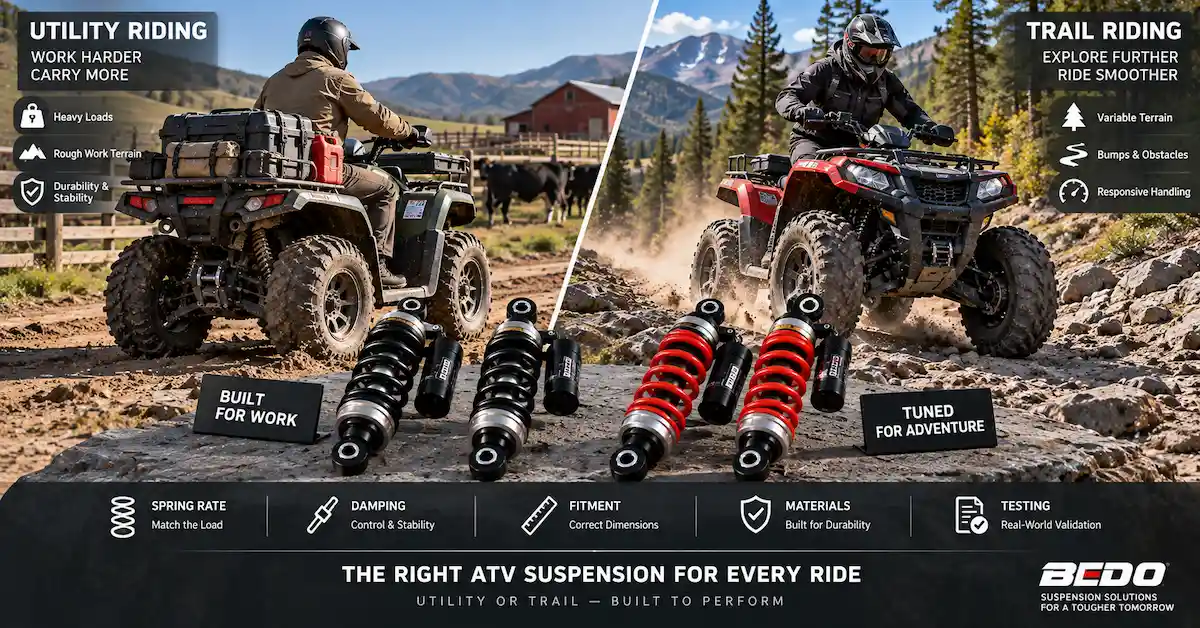
For utility work, select ATV suspension around working loads, loaded ride height, and controlled movement over the intended terrain. For trail riding, emphasize bump response, suspension recovery, and consistent damping during repeated impacts. Both applications still require compatible mounting dimensions and springs matched to the vehicle. Utility suspension does not automatically mean the stiffest setup, and trail suspension does not automatically mean the softest. BEDO’s heavy-duty ATV shock absorber guide makes application-specific support and damping central to selection. For OEM and aftermarket buyers, the objective is to define what the product must do before choosing its features.
Compare Operating Conditions Before Comparing Products
A farm ATV carrying equipment and a recreational ATV crossing rocky trails can both encounter demanding conditions, but their development priorities may differ. A vehicle used for both jobs needs evaluation in both configurations rather than a specification based only on its average use. The following table is a proposed selection framework, not a set of BEDO product ratings or universal adjustment settings.
| Selection question | Utility-oriented application | Trail-oriented application |
|---|---|---|
| What loads should be evaluated? | Rider, normal cargo, accessories, and the highest intended permitted working load | Rider with equipment, normal carried gear, and relevant vehicle accessories |
| Which terrain should be represented? | Work roads, ruts, field entrances, and loaded crossings | Roots, rocks, uneven corners, and repeated bumps |
| What should spring selection demonstrate? | Suitable loaded ride height without unacceptable behavior when cargo is removed | Suitable rider sag and usable movement across the intended terrain |
| What should damping evaluation demonstrate? | Controlled compression and recovery under working loads | Impact control and recovery between successive bumps |
| What should the final approval describe? | Approved load configurations and setup requirements | Approved vehicle, rider range, terrain, and setup requirements |
Define the Utility Load Range Before Selecting Springs
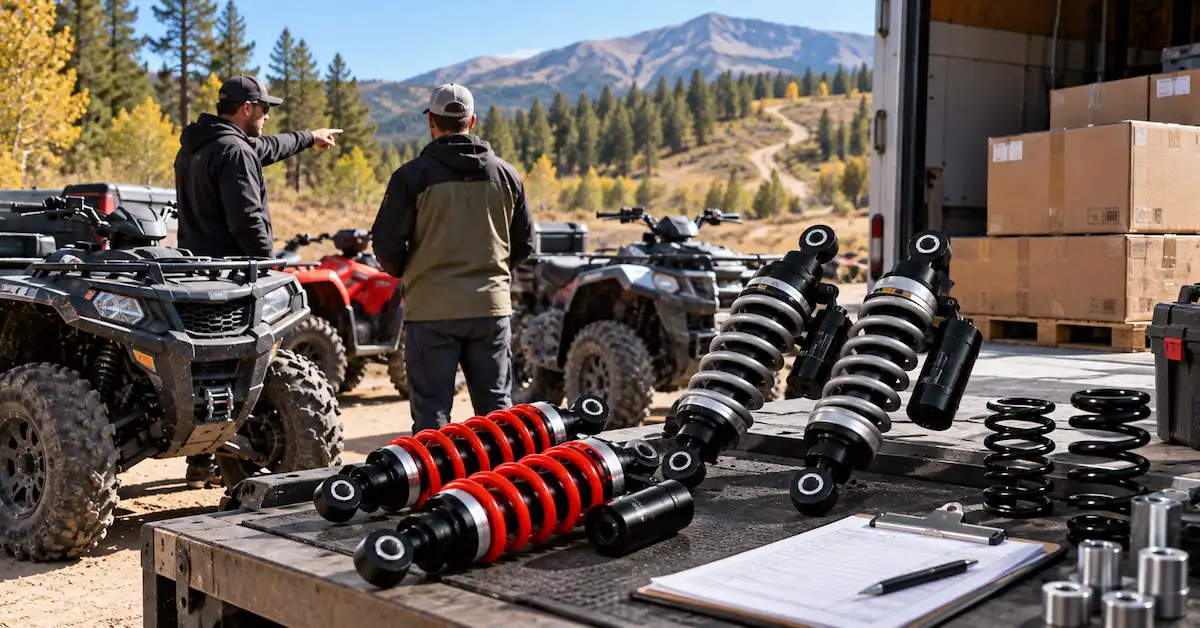
For utility ATV suspension, record more than the maximum cargo figure. Identify the usual working load, where equipment is mounted, and what remains on the vehicle when the cargo is removed. A front-mounted accessory, a rear toolbox, and equipment distributed between racks should not be treated as identical configurations simply because their total mass is similar. BEDO’s custom shock absorber development requirements specifically request cargo location and accessory information. For your project, prepare separate records for normal trail use, ordinary work, and the heaviest intended operating condition within the vehicle’s published limits. Ask the engineering team to review representative front and rear axle loads where available, rather than dividing the added weight equally among the shocks.
Choose Spring Rate and Preload for Different Reasons
Spring Rate Establishes the Load–Deflection Relationship
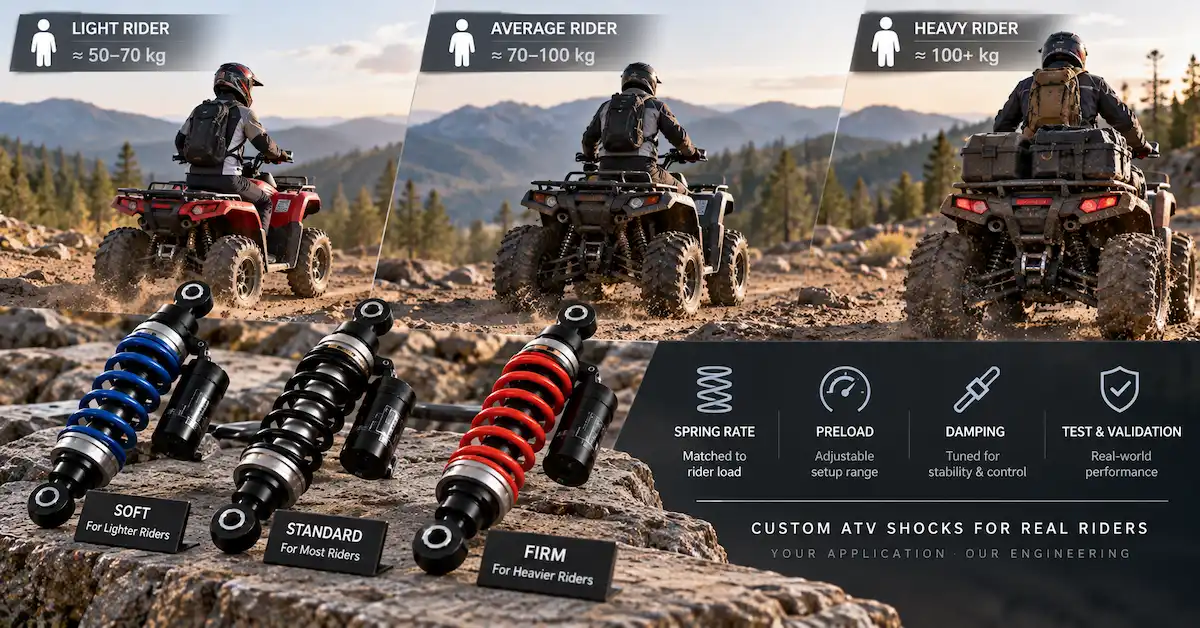
Spring rate describes how much additional force is required to compress a spring by a given distance, commonly expressed in N/mm or lb/in. An unsuitable rate can produce excessive sag under load or poor response to smaller bumps. For a utility application, evaluate support with cargo and behavior without it; for trail use, evaluate the ready-to-ride load and intended terrain. BEDO’s ATV spring-rate guide connects spring selection with ride height and damping. Neither “heavy duty” nor “comfort” is a complete spring specification.
Preload Establishes the Starting Setup
Preload applies initial compression to the installed spring and can alter settled ride height and sag. It does not change the rate of a linear spring or correct every load mismatch. Record the approved preload setting and measure sag—the suspension’s settled displacement from a defined full-extension reference—under the intended operating conditions. Agree on measurement points and targets for the actual vehicle rather than applying one percentage to every ATV. If acceptable loaded and unloaded behavior cannot be achieved within the approved adjustment range, request a spring review instead of simply adding more preload.
Match Damping to Suspension Movement, Not the Riding Label
Compression Damping Must Balance Support and Impact Response
Compression damping resists movement as the shock compresses. Utility testing should examine controlled movement under the working load, while trail testing should include the sharp and repeated inputs expected on the route. Where a design offers separate low-speed and high-speed compression controls, those terms refer to damper movement speed—not the ATV’s road speed. A slowly moving vehicle can still encounter a sharp impact. BEDO’s adjustable off-road shock guide explains this distinction; do not equate utility use with only low-speed damping requirements.
Rebound Damping Must Allow Recovery Between Bumps
Rebound damping controls extension after compression. Too little control can allow repeated bouncing; too much can delay recovery and leave less movement available for the next bump. This matters on both a loaded work route and a recreational trail. Evaluate rebound with the selected spring and actual load rather than assuming that maximum resistance provides maximum stability. When a utility spring specification changes, include damping in the review instead of treating the spring replacement as a complete performance approval.
Check Fitment and Available Travel Before Requesting an Upgrade
A longer shock or greater published stroke is not automatically a trail upgrade. Extended and compressed dimensions, mounting interfaces, installation angle, and surrounding components must work together. BEDO’s length and stroke customization guide treats these as linked development requirements. Keep shock stroke separate from wheel travel, which also depends on suspension geometry. Use the following specification table for either a utility or trail inquiry; request a dimensioned drawing wherever a catalog field lacks a clear reference.
| Technical item | What to confirm |
|---|---|
| Application | Vehicle model, year, variant, installation position, and modifications |
| Length | Extended and compressed dimensions measured between defined references |
| Stroke | Effective shock movement and the associated vehicle movement limits |
| Mounting | Upper/lower hole diameters, widths, sleeves, bushings, and orientation |
| Clearance | Spring and body clearance throughout intended compression, extension, and steering movement where relevant |
| Performance | Spring specification, preload limits, damping requirements, and evaluation conditions |
| Approval | Drawing revision, tested configuration, acceptance criteria, and setup instructions |
Do Not Label BEDO Models as Utility or Trail by Stroke Alone
BEDO’s AU_HSA_02 and AU_HSA_03 provide a useful screening comparison. Both are listed as rear ATV/UTV shocks with an internal gas chamber, oil–gas separation, and no adjustable damping levels, but their dimensions differ. These published specifications help identify questions for engineering review; neither page establishes a universal utility or trail application rating.
| Published specification | AU_HSA_02 | AU_HSA_03 |
|---|---|---|
| Installation position | Rear | Rear |
| Total length | 395 mm | 445 mm |
| Effective stroke | 80 mm | 130 mm |
| Cylinder outer diameter | 38 mm | 42 mm |
| Upper/lower mounting-hole diameter | 12 / 12 mm | 10 / 10 mm |
| Upper/lower mounting width | 40 / 32 mm | 30 / 35 mm |
| Adjustable damping levels | None | None |
The additional stroke listed for AU_HSA_03 does not make it a direct replacement for AU_HSA_02: the mounting interfaces and total length also differ. Preserve the product-page term “total length” until a drawing establishes its measurement references. The pages also display spring values in “LBS” without a distance denominator, so obtain complete spring-rate units before comparing load-support requirements. Do not assign a utility load rating or rider-weight range from these catalog fields alone.
Choose Adjusters and Reservoirs Only When the Duty Justifies Them
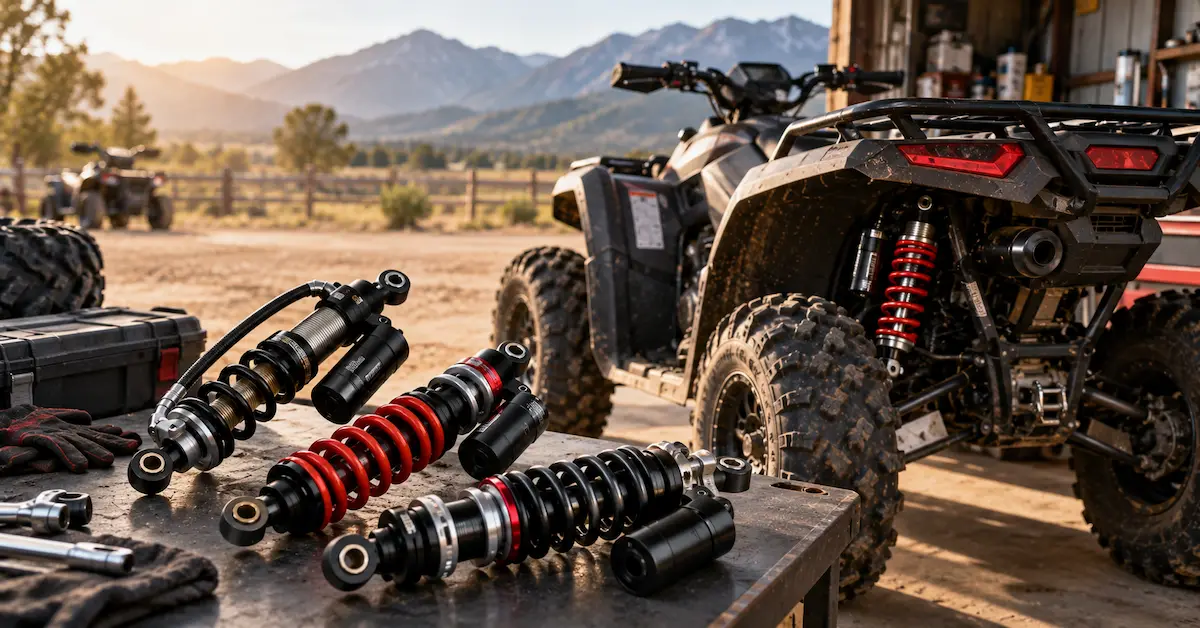
A fixed-damping shock may suit an application with predictable requirements, while an adjustable configuration can offer useful flexibility when loads or terrain vary. The adjustment range must still match the vehicle, and operators need clear setup instructions. A reservoir may be worth evaluating when sustained suspension cycling creates a heat-management requirement, but it also introduces packaging and installation considerations. BEDO’s aftermarket ATV suspension guide treats these features as application decisions rather than automatic upgrades. Do not assume every trail product needs a reservoir or every utility product should use fixed damping. For procurement, request the actual function of each control—not merely the number of adjustment clicks or a performance-oriented appearance.
For Mixed Use, Validate Two Operating Setups
Consider a proposed customer who uses one ATV for weekday equipment transport and weekend trail riding. Build the development brief around two complete configurations: rider and normal trail equipment, then rider and representative working cargo. Ask whether one spring-and-damper specification can meet both sets of acceptance criteria with documented adjustments. If it can, identify the settings, permitted operating conditions, and method for returning to the baseline. If it cannot, consider separate configurations rather than marketing a compromise as universally suitable. For a distributor, this is also a product-identification decision: different approved spring or damping versions should remain distinguishable in purchasing records, packaging, and dealer instructions.
Evaluate Materials, Sealing, and Service Requirements
Both work and trail environments can expose suspension components to contamination and repeated loading. During supplier review, request the relevant material specifications, surface-treatment requirements, sealing arrangements, and inspection criteria for the proposed design. BEDO’s ATV shock absorber production guide describes material selection, component manufacturing, assembly, and quality checks. Ask how critical dimensions and assembly requirements are controlled, and distinguish documented protection requirements from general “rust-proof” descriptions. Also confirm which parts are serviceable, what replacement components are available, and what maintenance instructions apply. Do not assume that every shock can be rebuilt or that every finish has passed the same environmental test.
Approve the Suspension Under the Conditions You Intend to Sell
For a new or modified product, agree on the validation plan before sample production. Utility evaluation should include the intended cargo configurations; trail evaluation should represent the rider range and terrain described in the brief. Where mixed use is claimed, assess both. BEDO’s shock absorber testing guide covers dimensional, damping, leakage, load, durability, temperature, and vehicle-testing considerations. Select the relevant checks, define acceptance criteria, and keep the tested configuration identifiable. Review current quality-system documents separately, including scope and validity; they do not replace product-specific evidence. Record sample changes under controlled revisions so a revised spring, damper setting, or mounting component does not silently inherit an earlier approval.
Translate Utility and Trail Requirements into an OEM Product Plan
Ningbo Bedo Auto Parts Co., Ltd. manufactures shock absorbers and springs and describes professional design support and small-batch ordering in its company profile. Its OEM ATV shock absorber program lists valving, spring-rate, finish, and branding options. For an OEM or private-label project, ask BEDO to assess whether an existing configuration is suitable, whether a modification is needed, or whether the application requires further development. Keep the technical distinction between utility and trail versions separate from their colors or labels. These categories should represent documented requirements, not simply two cosmetic treatments of an unvalidated product.
Compare Development Cost, MOQ, and Available Production Timing
Request a quotation for the actual configurations you intend to launch. Separate recurring product costs from samples, engineering, testing, and tooling or fixtures where required. Confirm whether minimum order quantities apply by model, spring specification, damping version, finish, or packaging. BEDO’s low-volume OEM development guide describes small-batch support, but specific quantities and schedules need project confirmation. Ask for separate milestones for technical review, prototypes, revisions, validation, and production after approval, together with available capacity for the proposed order mix. Where customer drawings or brand artwork are involved, agree their permitted use. Compare equivalent technical and delivery scopes rather than assuming a trail-labeled product should always cost more than a utility version.
Frequently Asked Questions
Should Utility ATV Suspension Always Use Stiffer Springs?
No. Select the spring around the confirmed load, geometry, and desired operating position. Excessive stiffness can make the vehicle harsh when cargo is removed. Evaluate the intended working range rather than choosing the strongest available spring.
Should Trail Suspension Always Be Softer?
No. Trail selection must balance compliance with adequate support and impact control. Define the rider load and terrain, then evaluate the complete spring-and-damper combination rather than using softness as the performance target.
Can Preload Turn a Trail Setup into a Utility Setup?
Only within the configuration’s approved range. Preload does not change a linear spring’s rate or resolve every load mismatch. Have the supplier evaluate the working-load condition before treating an adjustment as sufficient.
Does More Shock Stroke Automatically Improve Trail Performance?
No. Additional stroke must be compatible with the vehicle’s movement limits and installation geometry. Request full compression and extension checks; a larger catalog stroke is not evidence of a suitable upgrade.
Should the Front and Rear Use Identical Settings?
Request position-specific recommendations rather than copying settings. Provide front and rear installation information and load data, then ask the engineering team to confirm the appropriate spring and damping requirements for each position.
Can One Setup Cover Both Work and Weekend Riding?
Approve that claim only after both configurations have been evaluated. Document any required adjustments and the operating limits. When one specification cannot satisfy both, keep separate approved configurations rather than advertising unlimited flexibility.
Does Upgraded Suspension Increase the ATV’s Permitted Payload?
Do not treat replacement shocks or springs as permission to exceed the vehicle manufacturer’s published loading, rack, passenger-use, or towing limits. Keep suspension development within the approved vehicle operating requirements.
What Should a Buyer Prioritize with a Limited Budget?
Prioritize verified fitment, appropriate spring support, suitable damping, and the required validation before cosmetic finishes or additional controls. Request an existing-product option alongside a custom proposal when both are technically feasible.
Can BEDO Develop Separate Utility and Trail Versions?
BEDO lists spring-rate and valving customization within its OEM ATV program. Submit the two application briefs for review; feasibility, component differences, validation requirements, pricing, and quantities must be confirmed for the particular project.
What Information Is Needed to Start with Existing Shocks?
BEDO’s sample development process accepts existing samples as engineering inputs. Include vehicle details, known sample defects, mounting measurements, rider and cargo conditions, and the specific behavior you want to retain or improve.
Conclusion
Selecting ATV suspension for utility versus trail riding means matching the product to operating conditions, not choosing between “hard” and “soft” labels. Define the load configurations, verify fitment and travel, select spring support, evaluate damping, and validate the use cases before approving an OEM or aftermarket product. For mixed-use vehicles, document the boundaries of each approved setup rather than promising universal suitability. To discuss a BEDO project, submit your utility and trail ATV suspension requirements, including vehicle details, drawings or samples, rider and cargo information, terrain, and purchasing plans. Request a technical review and a clearly defined sample proposal before committing to production.