How to Choose a Shock Absorber Drawing and Development Partner
For a simple replacement component, a drawing-only vendor may be sufficient.
For a new OEM suspension project, buyers should look beyond CAD capability.
Evaluate whether the supplier can connect drawings to:
Sample analysis
Vehicle application review
Prototype production
Spring development
Damping adjustment
Testing
Engineering revisions
Small-batch validation
OEM production
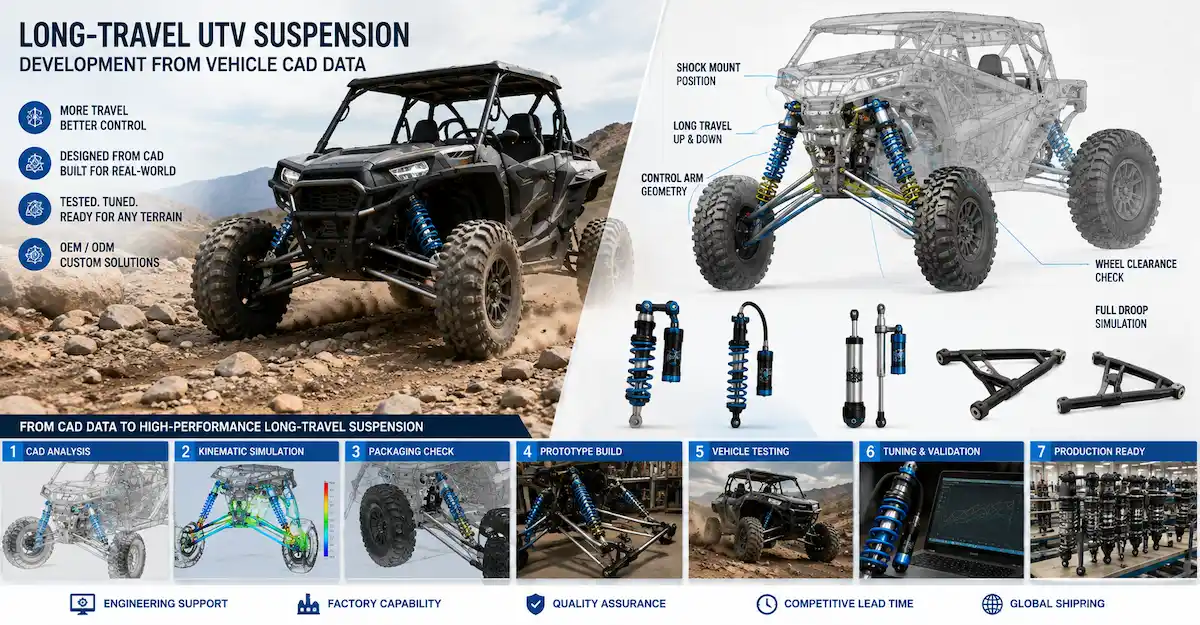
Bedo Auto's published prototype process includes these connected development capabilities for motorcycle, electric motorcycle, ATV, UTV, golf cart, utility vehicle, and specialty vehicle projects.
Buyers can review Bedo's current shock absorber product range before discussing a custom project, or move directly to a technical review when an existing product does not meet the required geometry or performance target.
How Bedo Auto Supports Shock Absorber Drawing Projects
Bedo Auto positions drawing review as part of a broader custom suspension development workflow rather than an isolated drafting task. Its published prototype support includes sample analysis, drawing review, suspension design support, prototype manufacturing, spring development, damping adjustment, testing validation, small-batch production, and OEM manufacturing.
This approach is particularly relevant to buyers who have:
A useful RFQ does not need to be perfect, but it should make the project objective clear.
Send whichever of the following you already have:
Vehicle type and model
Front or rear suspension position
Photos of the installation
Existing shock absorber sample
Current 2D drawing
3D CAD data
Extended and compressed dimensions
Required stroke
Mounting details
Vehicle empty and loaded weight
Existing spring data
Target performance
Prototype quantity
Expected future production requirements
If important parameters are unknown, identify them as unknown so they can be reviewed rather than guessed.
You can submit drawings, reference samples, and technical requirements through the Bedo Auto contact page. Bedo's existing project guidance directs prototype customers to provide samples, drawings, and technical requirements for review.
FAQ
What is a shock absorber drawing service?
A shock absorber drawing service prepares technical documentation for suspension development using vehicle requirements, dimensions, reference samples, sketches, or existing CAD information. Depending on the project, it can support fitment review, prototyping, manufacturing, and inspection.
Can you create a shock absorber drawing from a sample?
A physical sample can be used for dimensional analysis and drawing development. Bedo Auto lists sample analysis and drawing review as part of its prototype-development support.
What dimensions are most important on a shock absorber drawing?
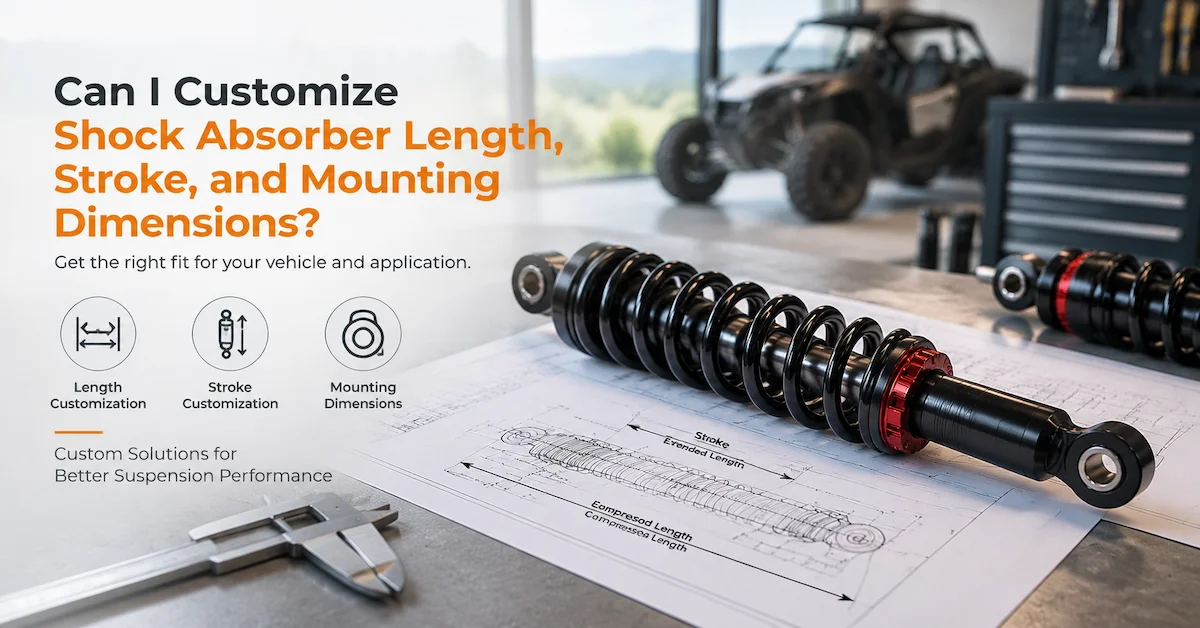
Common critical data includes extended length, compressed length, stroke, mounting-hole diameter, bushing width, mounting type, body envelope, spring envelope, and reservoir position. The exact requirements depend on the suspension application.
Does a drawing include spring rate?
Spring information can be added to project documentation, but spring rate is a performance-related specification rather than simply a geometric dimension. It should be selected and validated according to the vehicle application.
Does a drawing define compression and rebound damping?
A drawing can reference target specifications, but damping behavior requires engineering definition and physical validation. Bedo connects prototype development with damping adjustment and testing rather than relying only on drawings.
Do I need both 2D drawings and 3D CAD?
Not always. 2D drawings are useful for dimensions, tolerances, notes, and approvals, while 3D CAD can support packaging and interference review. The required deliverable should match the development task.
Can an existing drawing be modified for a new vehicle?
Yes, but the supplier should first verify whether the new vehicle has different mounting dimensions, weight, suspension geometry, payload, or performance requirements.
What standards can be used for technical drawing presentation?
ISO 128-1:2020 provides general rules for technical drawings, and ISO 129-1:2018 covers presentation of dimensions and associated tolerances. ISO 1101:2017 provides rules and symbols for geometrical specification.
What happens after a shock absorber drawing is approved?
The normal next stage for a new custom design is prototype manufacture and validation. The prototype can then be tested and revised before pilot or OEM production. Bedo describes this connected prototype-to-production workflow in its current development guidance.
How do I request a custom shock absorber drawing?
Prepare your available sample, drawings, vehicle specifications, mounting dimensions, load conditions, target application, and performance requirements, then submit them through Bedo Auto's contact page for project-specific review.
Conclusion
A shock absorber drawing service is most valuable when it converts incomplete suspension information into a clear engineering reference that can support fitment review, prototype manufacturing, validation, and later production.
For OEM buyers, the key is not simply receiving a CAD file. The drawing should clearly define the critical geometry and interfaces, identify the information that still requires verification, and connect naturally to prototype and testing work.
Technical drawing standards such as ISO 128-1 and ISO 129-1 provide useful principles for consistent representation, dimensions, and tolerances, but suspension performance still needs to be proven through engineering development and physical validation.
Bedo Auto's current development workflow combines sample analysis, drawing review, suspension design support, prototype manufacturing, spring and damping development, testing validation, and OEM production support.
If you are developing a custom ATV, UTV, motorcycle, electric vehicle, utility vehicle, or specialty suspension project, send your reference shock, sketches, CAD files, vehicle information, and required dimensions through Bedo Auto for technical review.