
What should a buyer require from a vehicle upgrade shock manufacturer?
Short answer: a vehicle upgrade shock manufacturer should turn an improvement claim into a measurable product definition, then control the product from drawing or sample through prototype, vehicle validation, pilot production, inspection, packaging, and repeat supply. The buyer should not judge a manufacturer only by a polished shock body, a low price, or the word “performance.” The useful questions are which vehicle problem is being solved, under which load and terrain, with which spring, damping, geometry, test method, and production tolerance.
An aftermarket or upgrade shock can be successful when the customer can install it, understand its setting, feel the intended improvement, and receive the same performance when ordering a replacement. That requires engineering and manufacturing discipline as well as product appearance.
Start with the upgrade outcome, not the shock design
“Upgrade” is a commercial word, not an engineering requirement. A buyer may want less bottoming with cargo, more stable control on rough ground, better passenger comfort, a different ride height, reduced rebound, a wider adjustment range, a replacement for an obsolete part, or a branded product for a specific vehicle family. Each outcome changes the specification and test plan.
| Upgrade objective | Parameters that may change | Evidence of success |
|---|---|---|
| Reduce bottoming | Spring rate, preload, compression damping, stroke, bump-stop reserve. | Measured clearance and controlled loaded runs without harsh impact. |
| Improve empty-vehicle comfort | Spring support, low-speed damping, friction, tire condition. | Repeatable route evaluation with a defined empty load state. |
| Support added cargo or passengers | Rear spring rate, ride height, rebound control, axle load distribution. | Ride height, sag, comfort, and control at normal and maximum load. |
| Increase ride height | Shock length, spring preload, linkage angle, droop, clearance. | Geometry check at bump and droop, not only a higher static measurement. |
| Add user adjustment | Compression/rebound range, click map, seals, labeling, setup instructions. | Each setting creates a repeatable and useful change on the target vehicle. |
| Replace an obsolete part | Interface, length, spring, damping, finish, hardware, packaging. | Installation, load behavior, service identification, and repeat supply. |
Write the intended outcome in one sentence before requesting a quotation. For example: “Develop a rear shock for a two-seat utility vehicle that maintains ride height with a defined cargo load, avoids bottoming over a repeated rut route, and can be supplied as a private-label replacement.” This gives a vehicle upgrade shock manufacturer a decision to solve instead of an adjective to interpret.
Manufacturer, supplier, and catalog seller are different roles
What a catalog seller can do well
A catalog seller can be efficient when the vehicle is unchanged, the original part number is known, the fitment is documented, and the buyer needs a standard replacement. This route minimizes development cost and can support a small aftermarket order. The buyer should still confirm part identity, dimensions, packaging, and replacement policy.
What an engineering supplier should add
An engineering supplier reviews samples or drawings, identifies missing dimensions, proposes spring and damping changes, supports prototypes, and helps the buyer define a vehicle test. This is useful when the application is modified, when the original part is no longer available, or when the upgrade claim is more specific than “stronger.”
What a manufacturer must control
A manufacturer must repeat the approved configuration. That means controlling drawings, spring specifications, damping targets, materials, finishes, assembly, inspection, labels, packaging, and change notification. A prototype that performs well is not enough if the next batch changes a spring, seal, oil, gas condition, mounting bushing, or adjustment map without approval.
When qualifying a vehicle upgrade shock manufacturer, ask which parts of the process are internal, which are sourced, how changes are approved, and what records are available. A confident marketing page is not a substitute for a traceable production plan.
Define the technical specification for the upgrade product
Interface and packaging
Start with the base vehicle and the final vehicle configuration. Record extended length, compressed length, effective stroke, upper and lower mounting-hole diameter, mounting width, sleeve or bushing type, thread, installation angle, spring outer diameter, body diameter, and clearance around the tire, chassis, brake line, and body. If there is a reservoir or adjustment knob, record its required space and service access.
For a replacement part, compare the sample to the vehicle at full bump and full droop. For a new upgrade kit, provide CAD or a dimensioned drawing. A supplier should be able to explain what is fixed, what can be changed, and which assumptions must be confirmed with a physical sample.
Spring rate and ride height
State vehicle mass, front and rear axle loads, normal passenger or cargo load, maximum intended load, and the ride-height or sag target. A spring rate is meaningful only when its measurement method and intended installation are understood. Preload can adjust the installed position, but it does not convert an under-rated spring into a correctly supported one.
If the upgrade product covers more than one vehicle or load case, create an application matrix. Similar total lengths do not prove that the same spring and damping are suitable. The matrix should identify vehicle, position, load, tire, modification, part number, and approved setting.
Compression and rebound damping
Ask for compression and rebound force data with test speed, direction, temperature, adjustment setting, stroke position, and tolerance. If the product is fixed, ask what vehicle and load condition the fixed setting represents. If it is adjustable, ask for the baseline, the number of usable settings, the expected direction of change, and customer instructions.
The purpose of an upgrade is not to maximize force. A stronger damping number can make a vehicle harsh, reduce tire contact, or overload the mounting structure. The correct target depends on spring, mass, motion ratio, tire, speed, and the terrain that the customer will actually use.
Materials and environmental requirements
Define the body, rod, spring, seal, bushing, coating, paint, fastener, and label requirements. State whether the vehicle sees salt, mud, water, wash-down, dust, coastal air, winter storage, or high temperature. Ask how surface condition, leakage, rod movement, spring specification, and adjustment action are inspected. Avoid publishing a specific corrosion, waterproof, or durability rating unless the supplier provides supporting evidence for the product configuration.
Public BEDO product references for upgrade shock development
BEDO's public ATV/UTV catalog provides useful examples of the fields a buyer should compare. AU_HSA_01 is listed as a rear shock with 465 mm total length, 130 mm effective stroke, 75 LBS spring rate, 2000 N rebound, 650 N compression, 10 mm mounting holes, and 32 mm mounting width at both ends. The product record describes fixed damping, an internal gas chamber, oil-gas separation, aluminum alloy and steel pipe construction, and corrosion-resistant, waterproof, rust-proof steel language.
AU_HSA_02 is listed with 395 mm total length, 80 mm effective stroke, 250 LBS spring rate, 3000 N rebound, 550 N compression, 12 mm mounting holes, upper 40 mm and lower 32 mm mounting widths, and fixed damping. These references show why a manufacturer quotation should include more than product length. They do not establish that either configuration is the correct upgrade for an unspecified vehicle.
| Reference field | AU_HSA_01 public listing | AU_HSA_02 public listing |
|---|---|---|
| Position and damping | Rear; fixed damping. | Rear; fixed damping. |
| Length and effective stroke | 465 mm; 130 mm. | 395 mm; 80 mm. |
| Spring rate | 75 LBS listed. | 250 LBS listed. |
| Maximum damping force | 2000 N rebound; 650 N compression. | 3000 N rebound; 550 N compression. |
| Mounting dimensions | 10 mm holes; 32 mm upper and lower widths. | 12 mm holes; 40 mm upper and 32 mm lower widths. |
Move from concept to a controlled prototype
Phase 1: application and target definition
Freeze the base vehicle, final modifications, load states, target market, customer type, expected annual volume, and the one improvement the product must deliver. Record what is not yet known. This protects the program from moving into sample production while the vehicle itself is still changing.
Phase 2: drawing or sample review
Send the current shock, vehicle drawing, CAD, or measured interface. Ask the manufacturer to return confirmed dimensions, missing data, packaging concerns, proposed spring and damping assumptions, and the expected sample configuration. A good review should identify a risk that a simple price quotation would miss.
Phase 3: prototype build
Give the prototype a revision and part number. Record total length, stroke, spring, preload, damping setting, materials, finish, hardware, labels, and any special assembly instruction. If the product is adjustable, record the baseline position and the setting direction. Do not compare two samples without verifying that their configurations are actually the same except for the intended change.
Phase 4: bench checks
Inspect dimensions, spring rate, adjustment operation, compression and rebound force, leakage, rod movement, surface condition, mounting hardware, and visual assembly. The test conditions should be written beside the result. If a force value is reported without velocity or direction, ask for the missing context before using it as a supplier comparison.
Phase 5: vehicle validation
Install the prototype on the final vehicle configuration. Test empty, normal, and maximum intended conditions. Record ride height, sag, clearance, bottoming, topping out, braking pitch, acceleration squat, cornering, repeated bumps, steering, noise, temperature, and passenger or rider feedback as relevant. Use a repeatable route and document tire pressure and alignment so the shock is not judged against an uncontrolled vehicle state.
Phase 6: pilot and production release
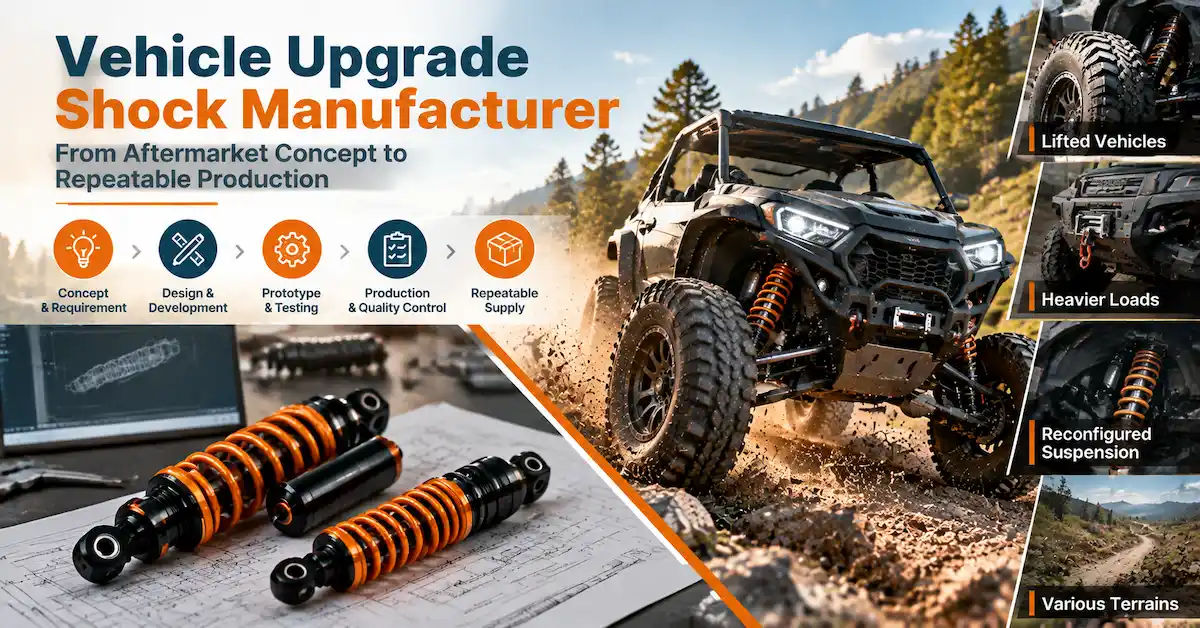
Use a pilot batch to verify that the approved prototype can be assembled and inspected repeatedly. Freeze drawing, spring, damping, adjustment map, materials, finish, packaging, labels, and service identification. Define what requires buyer approval before a change. This is the stage that separates a vehicle upgrade shock manufacturer from a one-off prototype source.
Quality control and packaging are part of the upgrade product
Aftermarket customers experience more than the shock's bench performance. They experience whether the correct part arrives, whether the mounting hardware is complete, whether the adjustment label is understandable, whether the installation instructions match the part, and whether a replacement can be identified months later. Packaging and documentation therefore belong in the product specification.
| Control area | Production question | Customer risk reduced |
|---|---|---|
| Dimensions | Are length, stroke, holes, widths, threads, and clearances checked against the approved drawing? | Incorrect fitment, installation delay, and return shipments. |
| Spring | Is the spring specification, preload, finish, and identification controlled? | Ride-height and load-support variation between batches. |
| Damping | Are fixed or adjustable force values checked under defined conditions? | Different ride behavior from the approved prototype. |
| Sealing and finish | Are leakage, rod condition, surface treatment, and corrosion-related requirements inspected? | Early field complaints and environmental failures. |
| Assembly | Are bushing, sleeve, fastener, adjustment, and label revisions traceable? | Incorrect installation or inability to diagnose a field issue. |
| Packaging | Are part number, vehicle application, hardware, instructions, and carton quantity controlled? | Mixed SKUs, missing hardware, and distributor inventory errors. |
Ask the vehicle upgrade shock manufacturer which records accompany a pilot batch and which records can be supplied for repeat production. A buyer does not need every internal document, but needs enough evidence to verify the approved product and investigate a nonconformance.
Control the application matrix after launch
An upgrade program can lose its technical discipline after launch when several vehicles share similar-looking parts. Keep an application matrix that connects each part number to vehicle position, model revision, ride height, tire, battery or fuel condition, normal load, spring, damping setting, mounting hardware, and packaging label. If a new model appears compatible, review it against the matrix instead of adding it to the same SKU because the bolt holes look similar. This small record helps distributors prevent mixed inventory, helps installers choose the correct setting, and gives the vehicle upgrade shock manufacturer a clear basis for replacement and revision decisions.
For after-sales support, keep the customer-facing identification simpler than the engineering record but never disconnect the two. The carton and instruction sheet can use the market-facing vehicle name, while the internal label or batch record retains the approved revision. That allows the buyer to trace a field complaint to the correct spring, damping, hardware, and production condition without forcing the customer to understand the entire engineering history.
Commercial questions for an upgrade shock manufacturing program
Price comparisons are meaningful only when the technical scope is aligned. A standard fixed shock, a private-label product, and a new adjustable prototype may have very different costs even if they are similar in size. Ask the manufacturer to separate development, sample, fixture or tooling, unit, packaging, label, testing, and freight assumptions.
| Commercial item | Request in writing | Why it matters |
|---|---|---|
| Sample scope | Quantity, revision, included hardware, changes allowed, and sample approval method. | Prevents a low sample price from hiding a limited development scope. |
| MOQ and price breaks | Prototype, pilot, first production, repeat production, and annual-volume assumptions. | Shows whether the product can be launched without excessive inventory risk. |
| Lead time | Drawing review, prototype, revision, pilot, production, and shipping stages. | Creates a realistic schedule for the vehicle upgrade launch. |
| Packaging and private label | Carton, labels, colors, instructions, barcode, brand marks, and spare hardware. | Connects the technical part to the aftermarket sales channel. |
| Change control | Notice, approval, affected components, and records retained. | Protects the approved calibration and customer fitment. |
| After-sales | Part identification, replacement route, warranty basis, and technical contact. | Reduces downtime and unstructured field troubleshooting. |
The public BEDO website presents custom solutions, design support, and small-batch order support, but it does not establish one universal MOQ, lead time, packaging standard, or warranty for every upgrade project. Confirm those terms for the exact configuration and quantity.
Prepare a manufacturer-ready upgrade shock RFQ
Send the following fields as a single file. A manufacturer can then respond with a defined product rather than a generic recommendation.
| RFQ section | Required content | Supporting file |
|---|---|---|
| Target vehicle | Brand, model, year, position, market, customer, and number of units. | Vehicle specification and photographs. |
| Upgrade purpose | Comfort, cargo support, height, bottoming control, stability, adjustment, or replacement. | Field complaint, ride report, or competitor sample. |
| Final configuration | Lift, tire, wheel, battery, seats, cargo, winch, armor, and other modifications. | Modification bill of material and CAD. |
| Load cases | Unloaded, normal, maximum, passenger, cargo, towing, and axle loads. | Mass table and measurement record. |
| Fitment | Lengths, stroke, holes, widths, sleeves, angle, motion ratio, bump, droop, and clearance. | Drawing, 3D model, or measured sample. |
| Performance | Spring target, damping preference, adjustment, sag, ride height, route, and acceptance criteria. | Test plan and route description. |
| Launch | Sample quantity, pilot quantity, annual volume, packaging, label, and target delivery. | Forecast, artwork, and carton specification. |
Vehicle upgrade shock manufacturer FAQ
What makes a manufacturer different from a shock reseller?
A manufacturer should be able to control the approved drawing, spring, damping, materials, assembly, inspection, packaging, and change process. A reseller may still be appropriate for a standard replacement, but the buyer should not assume that a reseller can develop or repeat a new upgrade specification.
Is a “performance” shock automatically a better upgrade?
No. The right product depends on the vehicle, load, tire, geometry, speed, surface, spring, and user target. A higher force or more adjustment can make a vehicle worse when it is not matched to the system.
Should an upgrade shock use adjustable damping?
Use adjustment when the customer has meaningful changes in load, terrain, or riding goal and can follow a setting guide. For a simple replacement or fleet product, a validated fixed setting may provide better repeatability and lower support burden.
What is the first measurement to request?
Start with the full interface: extended and compressed length, stroke, holes, widths, sleeves, installation angle, spring dimensions, and clearances at bump and droop. Then add axle loads and the intended performance target.
Can the AU_HSA_01 or AU_HSA_02 be sold as a universal upgrade?
No. They are public ATV/UTV reference configurations with listed dimensions and force data. Universal fitment or upgrade claims require application-specific geometry and vehicle evidence.
How many prototypes should a buyer order?
The quantity depends on whether the program is one vehicle, multiple positions, multiple load cases, or several vehicle applications. The RFQ should define the sample purpose and revision so the supplier can recommend a meaningful quantity.
What should be tested before a pilot batch?
Check dimensions, spring, damping, adjustment, leakage, surface, hardware, and packaging, then validate on the target vehicle under unloaded, normal, and maximum conditions. Record route, tire, alignment, temperature, load, and observations.
What information reduces quotation time?
A complete drawing or sample, modification list, axle loads, target performance, environment, sample quantity, annual volume, private-label requirements, packaging, and delivery destination usually produce a more useful response than a vehicle model name alone.
What claims should not be published without evidence?
Do not publish specific durability, certification, waterproof rating, customer result, universal fitment, MOQ, lead time, warranty, or production-capacity claims without a current record or written company confirmation for the product being described.
Conclusion
A vehicle upgrade shock manufacturer should be chosen for controlled product development and repeatability. The buyer needs a measurable upgrade objective, a complete vehicle and modification profile, confirmed geometry, load states, spring and damping targets, an evidence-based prototype process, vehicle validation, production inspection, packaging control, and clear commercial terms.
BEDO Auto's public ATV/UTV shock references demonstrate the level of detail available for a technical starting point: length, stroke, spring rate, damping force, mounting dimensions, construction, and damping type. The next step is to send the final vehicle configuration and ask BEDO to confirm the upgrade specification, test evidence, sample path, MOQ, lead time, packaging, and change control for the intended market.