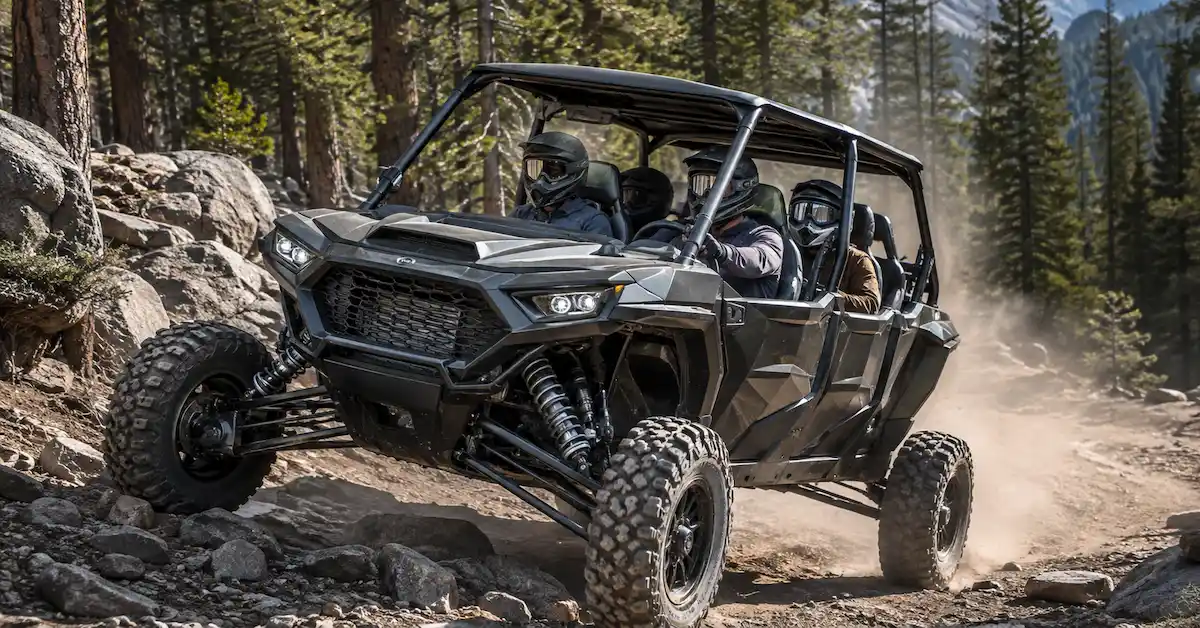

What should a vehicle suspension solution company provide?
Direct answer: a vehicle suspension solution company should connect the vehicle platform, suspension geometry, spring support, shock damping, mounting hardware, environmental requirement, validation plan, production control, and service identity. The supplier should be able to show which parts are catalogue references, which are custom-developed, which inputs are missing, and what evidence releases the program from prototype to repeat supply.
For a B2B buyer, the deliverable is therefore larger than a shock absorber. It is a controlled system definition with an application boundary. Depending on the vehicle, the program may include shocks, coil springs, mounts, bushings, sleeves, labels, packaging, drawing review, sample development, testing, and change management.
This article is for OEM vehicle brands, electric mobility companies, powersports importers, farm and resort fleets, aftermarket kit companies, distributors, and procurement teams deciding whether they need a single replacement part or a broader engineering and sourcing partner. Its unique purchasing question is how to compare a Vehicle suspension solution company capable of building a complete, traceable suspension program.
Ningbo Bedo Auto Parts Co., Ltd. publicly identifies itself as a manufacturer in Ningbo, Zhejiang, China. Its official website presents shock absorbers, suspension springs, ball joints, custom solutions, design support, and small-batch ordering. The public company page describes a 2009 establishment, ISO9001 certification history, global export activity, and manufacturing capability. Those facts establish the company and product scope for an initial review. They do not prove that every new vehicle receives the same parts, capacity, test evidence, MOQ, lead time, warranty, or material specification.
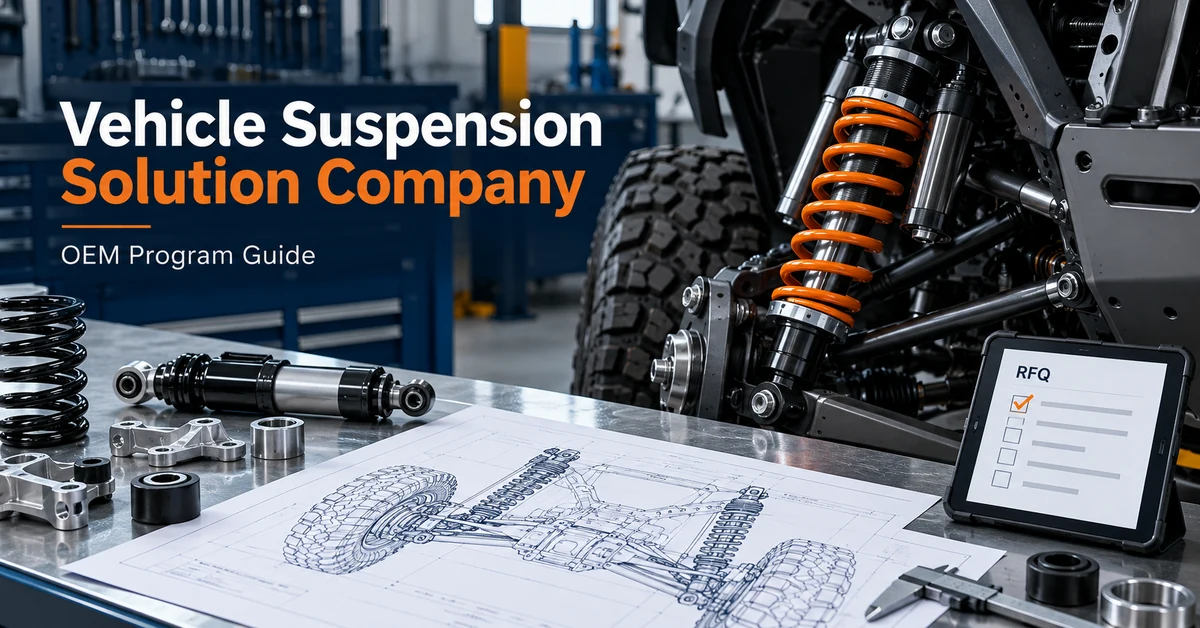
Decide whether the project needs a part or a solution
Buyers often start with a request for "a stronger shock." That description may hide a spring problem, an installation problem, a load change, a tire change, or a mismatch between the vehicle's use and its original configuration. A vehicle suspension solution company should first classify the problem before choosing a component.
| Project type | Likely scope | Decision evidence |
|---|---|---|
| Like-for-like replacement | Existing fitment, spring, damping, mounts, label, and packaging. | Original part, model/year, dimensions, position, and failure record. |
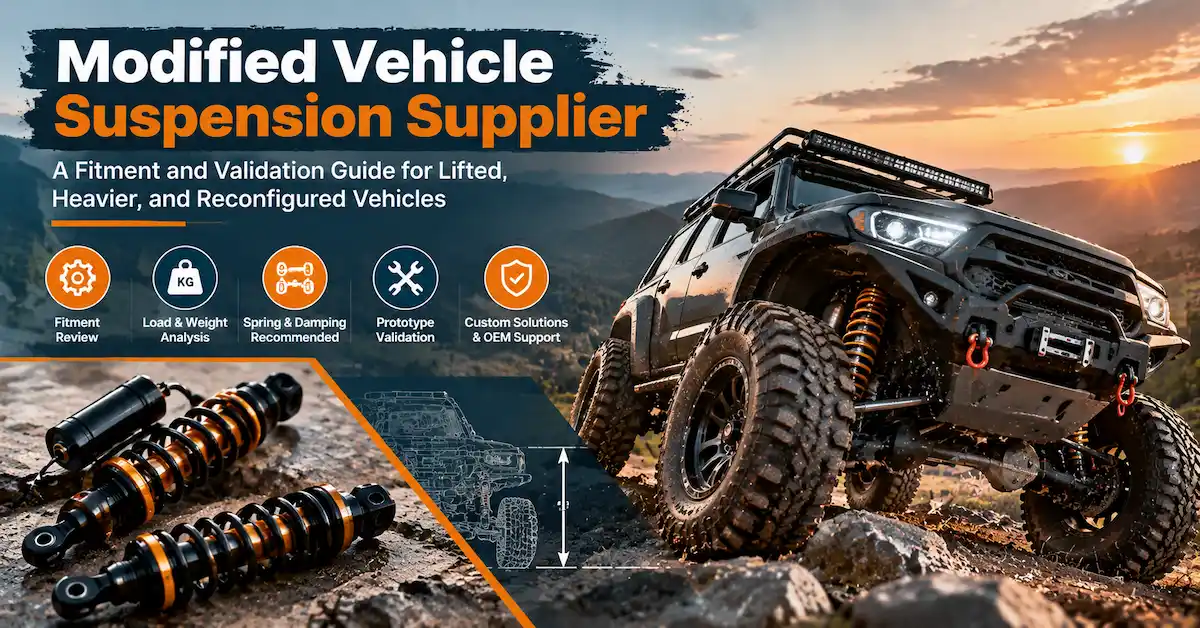
| Vehicle upgrade | New load, ride height, travel, spring, damping, and clearance. | Before and after loads, tire, geometry, target behavior, and test route. |
| New vehicle platform | Interface, spring, damper, mounts, prototypes, validation, and production release. | CAD or measured vehicle data, requirement sheet, and program gates. |
| Multi-model family | Common parts, unique interfaces, shared process, and model-specific settings. | Platform matrix, common-parts strategy, and revision rules. |
| Fleet or utility program | Duty cycle, cargo, service interval, environment, spare parts, and training. | Route, loading states, maintenance history, field feedback, and stock plan. |
A supplier should be comfortable saying that a part-only quote is insufficient. That is evidence of engineering discipline. The buyer can then decide whether to purchase an existing reference, develop a custom configuration, or change the vehicle requirement before spending on samples.
Map the vehicle before selecting components
The system starts with vehicle identity and geometry. Give the supplier the platform code, model year, market, front or rear position, left or right requirement, drive layout, wheel and tire package, battery or fuel condition, accessories, and intended use. Add photographs or CAD showing the shock at ride height, full bump, full droop, steering lock, and articulation. Record the mounting axis, extended and compressed length, effective stroke, hole diameter, mounting width, bushings, sleeves, thread, spring seat, and surrounding clearance.
Use load cases, not one curb weight
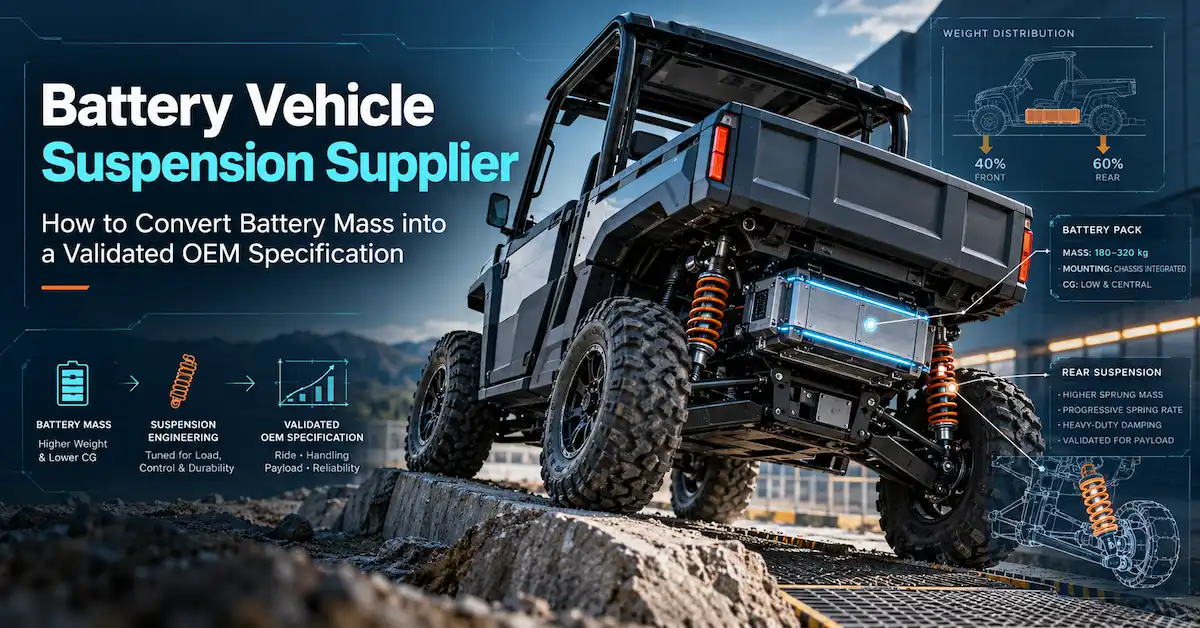
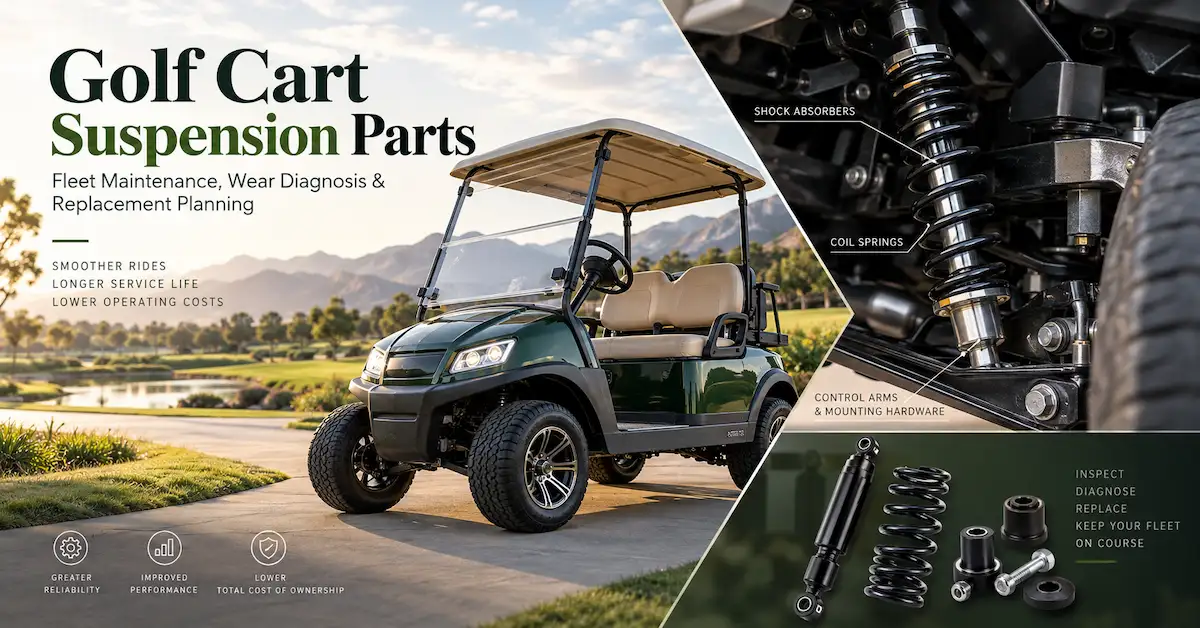
List empty, rider or driver, passenger, cargo, battery, tools, and maximum conditions. For an ATV or UTV, separate utility work from recreational trail use. For an electric motorcycle, state battery mass and the intended rider range. For a golf cart or resort vehicle, include rear seats, battery conversion, and route grade if relevant. A single average weight can hide the condition that creates bottoming, excessive sag, or poor control.
| Vehicle map field | Examples of useful data | What it affects |
|---|---|---|
| Identity | Platform, year, market, position, side, drive, tire, wheel, accessories. | Fitment, revision, sales application, and service identity. |
| Geometry | Shock lengths, stroke, wheel travel, motion ratio, angle, linkage, bump, droop. | Spring movement, damping ratio, clearance, and usable travel. |
| Loads | Axle loads, rider, passenger, cargo, battery, fuel, accessory distribution. | Spring rate, preload, sag, ride height, and reserve. |
| Environment | Road, trail, farm, mud, dust, water, salt, temperature, wash-down, storage. | Sealing, finish, corrosion, thermal, and service requirements. |
| Targets | Comfort, control, traction, bottoming, roll, pitch, noise, durability, cost. | Test method, acceptance criteria, and trade-off decisions. |
Mark each value as confirmed, estimated, calculated, or missing. This small step helps a vehicle suspension solution company respond honestly. It also protects purchasing from a common failure in which a provisional measurement becomes a firm requirement without anyone noticing.
Build the component architecture
A suspension solution should state what is shared and what is vehicle-specific. A family of vehicles may use a common shock body with different mounts, springs, lengths, damping settings, or labels. That can improve purchasing efficiency, but it can also create fitment and revision risks if commonality is assumed before geometry and load are checked.
| Component or record | May be common | Often vehicle-specific | Release question |
|---|---|---|---|
| Shock body | Body diameter or manufacturing process. | Length, stroke, piston, oil, setting, mount. | Does the common body support every load and travel condition? |
| Spring | Material process or color. | Rate, free length, coil diameter, installed length. | Is the spring matched to axle load and motion ratio? |
| Mount | General bushing family. | Hole, width, sleeve, angle, hardware, bracket. | Does it fit without forcing the vehicle geometry? |
| Adjustment | Knob family or marking method. | Range, baseline, setting map, access, instructions. | Can a user return to the approved setting? |
| Packaging | Outer carton style or protection method. | Label, barcode, model, side, hardware, market language. | Can distribution identify the correct revision? |
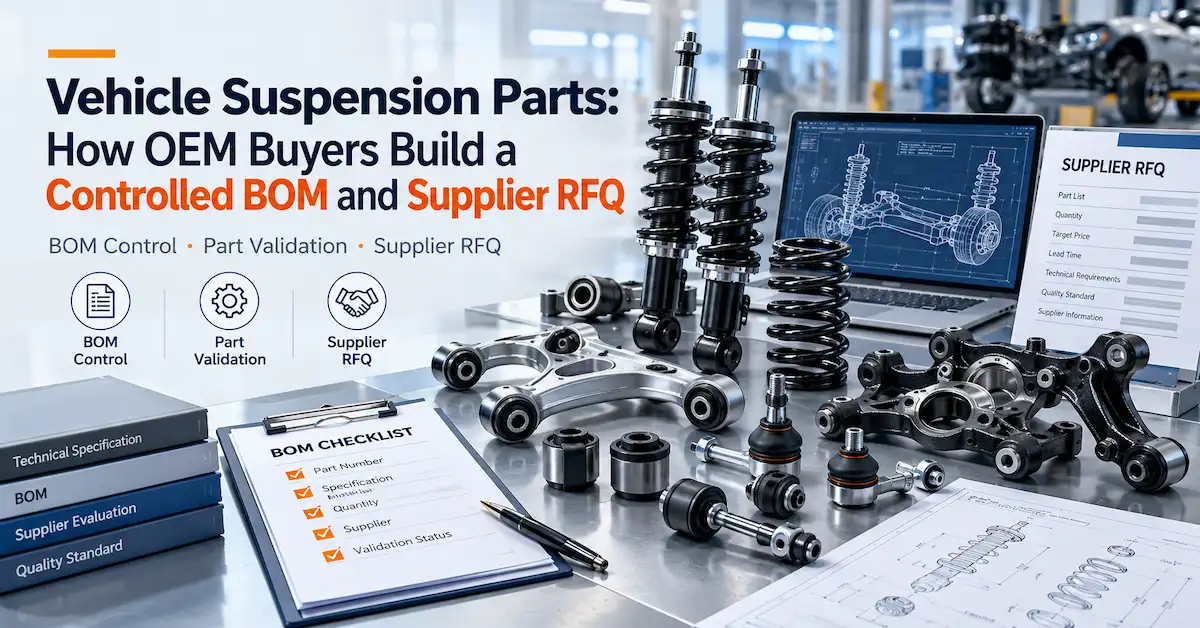
Use a platform matrix with one row per model and one column per component, dimension, setting, and test requirement. The matrix should show common, unique, optional, and not applicable fields. This becomes the bridge between engineering, purchasing, quality, and the supplier's production team.
Public product evidence: BEDO's product catalog covers shock absorbers and suspension springs for motorcycles, ATV/UTV, electric motorcycle, and related applications. Selected public product pages show technical fields such as total length, effective stroke, spring rate, rebound and compression values, mounting holes, mounting widths, adjustment levels, and material descriptions. These references demonstrate the information structure available for an RFQ. They do not prove that a published item fits every platform or that its data applies to a new configuration without confirmation.
Match spring support and damper behavior
Spring and damper decisions should be made together but recorded separately. The spring supports static and dynamic load; the damper controls motion. Preload sets the installed position within a defined range. Changing one variable can create a misleading improvement in a different symptom. For example, adding preload may restore ride height while reducing droop travel. Adding damping may slow a bounce without solving a spring that is too soft for the load.
Define the spring requirement
Ask for rate, free length, installed length, coil diameter, end shape, material or treatment requirement, preload range, sag target, and coil clearance. State whether the buyer wants a single spring for all loads or a changeable spring strategy. A multi-model program needs a clear rule for when a spring is different enough to receive a separate part number.
Define the damping requirement
Specify fixed or adjustable damping, rebound and compression preference, direction, velocity, temperature, adjustment position, target vehicle behavior, and acceptable variation. A force-versus-velocity record gives more useful information than a label such as high performance. For adjustable shocks, record the baseline, number and meaning of clicks, adjustment direction, access, and user instructions.
| Requirement | Buyer should state | Supplier should return |
|---|---|---|
| Static support | Axle loads, ride height, sag, rider/passenger/cargo states. | Spring proposal, preload, load-deflection basis, and reserve. |
| Motion control | Comfort, recovery, bottoming, pitch, roll, traction, route, and speed. | Damping proposal, bench conditions, setting or adjustment map. |
| Travel | Full droop, ride height, full bump, wheel travel, bump stop, clearance. | Interface drawing, stroke, clearance review, and test plan. |
| Environment | Dust, water, salt, temperature, wash-down, vibration, storage. | Seal, finish, material, inspection, and evidence boundary. |
| Service | Replacement interval, label, hardware, instructions, dealer support. | Part identity, packaging, setting baseline, and after-sales route. |
Plan prototypes and validation gates
A solution company should show how the project moves from requirements to samples, pilot units, and production. The gates do not need to be complicated, but each one needs an owner, an input, an output, and a decision. A sample should not be approved just because it fits physically. It should be checked for spring, ride height, travel, clearance, damping, hardware, finish, label, packaging, and intended vehicle behavior.
| Gate | Purpose | Required record |
|---|---|---|
| Requirement review | Confirm platform, loads, geometry, environment, targets, and commercial scope. | Approved brief, assumptions, open-point list, and responsibility matrix. |
| Concept review | Choose common and unique parts, spring, damper, mounts, and adjustment. | Concept drawing, risk list, proposal, and quotation basis. |
| Prototype fitment | Confirm installation, travel, clearance, hardware, and static loads. | Measured dimensions, photographs, load condition, and correction list. |
| Vehicle validation | Evaluate target behavior in defined load, route, and environmental states. | Setting, operator, tire, route, speed, result, and approval decision. |
| Pilot release | Check repeatability, packaging, labels, inspection, and service readiness. | Pilot report, final revision, acceptance, and corrective action. |
| Production release | Control repeat orders and future changes. | Drawing, BOM, inspection, change rule, and lot traceability. |
When a buyer cannot provide a proving ground or formal durability facility, the limitation should be written down. Bench data can verify component behavior under named conditions. Static vehicle checks can verify fitment and clearance. Dynamic vehicle checks can reveal comfort and control. A supplier should not present one layer as proof of all layers.
Assess manufacturing and quality capability
A vehicle suspension solution company must carry engineering decisions into production. Ask who controls drawings, BOMs, spring records, damping settings, labels, packaging, and change notices. Ask which parts are manufactured internally and which are sourced. A sourced component can be acceptable, but the responsibility for its identity, incoming inspection, and change control must be clear.
| Capability area | Evidence to request | Risk controlled |
|---|---|---|
| Design control | CAD or drawing, BOM, revision, approval, and open-point register. | Unapproved dimensions or settings reach production. |
| Spring control | Rate record, free length, finish, installed measurement, and supplier identity. | Ride height, sag, or load support changes between batches. |
| Damper control | Force or movement check, setting identity, temperature, and tolerance. | Samples look identical but behave differently. |
| Assembly control | Work instruction, torque or process checks, operator records. | Hardware, seals, mounts, or adjustment parts are assembled inconsistently. |
| Final control | Dimension, appearance, leakage or movement, label, packaging, and lot record. | Field replacement cannot be traced to the correct revision. |
| Change control | Notice, affected stock, approval, retest, and new revision procedure. | Material or process changes alter vehicle behavior unnoticed. |
The public BEDO company page describes advanced manufacturing equipment, quality-control systems, custom solutions, design support, and small-batch ordering. Treat those statements as public positioning and verify the project-specific scope during supplier review. Ask for the actual records relevant to the vehicle program instead of assuming a general capability statement closes the quality question.
Include environment, packaging, and service in the solution
The suspension is sold as a physical part, but its commercial performance depends on the conditions around it. Water, mud, dust, salt, wash-down, temperature, vibration, storage, and transport all affect seals, finishes, springs, mounts, labels, and cartons. A solution brief should state environmental risks and the evidence expected. Avoid converting "durable" or "corrosion resistant" into an unverified test claim.
Packaging is part of technical control. A correct shock with a missing sleeve, damaged rod, wrong side label, or mixed revision can create a fitment complaint. Specify individual protection, hardware bag, barcode, carton, pallet, language, instruction sheet, and part identification. For a distributor, packaging also controls how the warehouse identifies front, rear, left, right, model, and revision.
| Program detail | What to define | Why it matters |
|---|---|---|
| Environmental use | Water, dust, mud, salt, temperature, wash-down, storage, vibration. | Connects material, finish, seals, and inspection to actual use. |
| Hardware | Bushings, sleeves, fasteners, spacers, torque, and installation access. | Reduces incorrect fitting and premature wear. |
| Packaging | Protection, bag, label, barcode, carton, pallet, and instructions. | Preserves condition and revision identity through distribution. |
| Service | Replacement part number, baseline setting, warranty basis, technical contact. | Lets dealers and fleet teams resolve field issues consistently. |
Make commercial planning part of the RFQ
Engineering and purchasing should work from the same project definition. Ask the supplier to separate development price, sample price, pilot price, production price, tooling or fixture assumption, packaging, label, inspection, shipping, and after-sales support. Specify whether MOQ applies to the complete shock, spring, hardware, label, carton, or service part. Ask when lead time begins and which approvals are excluded.
| Commercial item | Buyer question | Risk when unclear |
|---|---|---|
| Development | Are drawing review, sample iterations, fixtures, and testing included? | The engineering budget is exceeded before fitment is approved. |
| MOQ | What minimum applies to prototype, pilot, production, spring, label, and carton? | The supply model is not viable for the actual forecast. |
| Lead time | What starts the clock and which approval gates affect it? | The launch date ignores engineering and material steps. |
| Packaging | Are carton, barcode, instruction, pallet, and export protection included? | Distribution damage or wrong revision increases cost. |
| Warranty and service | What evidence and process support a field issue? | Complaints cannot be classified or resolved quickly. |
| Change control | Which material, source, process, or setting changes require approval? | A later batch changes vehicle behavior without notice. |
BEDO's public site promotes custom solutions and small-batch orders, but it does not publish one universal MOQ, lead time, packaging format, development fee, or warranty for every vehicle suspension program. Request written, application-specific terms for the exact quantity, market, label, packaging, and revision.
Prepare a vehicle suspension solution RFQ
A supplier-ready RFQ should be concise enough to answer but complete enough to expose risk. Start with one platform or one family matrix. Attach drawings, measured samples, images, load cases, vehicle use, target behavior, environmental conditions, annual forecast, market, and launch date. Ask for a responsibility matrix showing what the buyer, supplier, vehicle test team, and quality team each own.
| RFQ section | Buyer information | Requested supplier response |
|---|---|---|
| Company and scope | Program type, market, volume, channel, and required manufacturing role. | Factory identity, product scope, process boundary, and responsible contact. |
| Vehicle | Platform, year, position, geometry, load, tire, battery, accessories. | Fitment review, missing inputs, common and unique part proposal. |
| Performance | Ride height, sag, comfort, control, bottoming, traction, route, speed. | Spring, damping, adjustment, bench, vehicle test, and acceptance proposal. |
| Quality | Inspection, documents, traceability, certification, and change requirements. | Control plan, records, revision process, and evidence schedule. |
| Commercial | Sample, pilot, forecast, MOQ, lead time, label, packaging, warranty. | Quotation assumptions, stage plan, shipping, and service route. |
Request a written gap list after supplier review. A gap list makes the next action clear: measure the vehicle, supply a missing load case, approve a proposed spring, provide a tire, arrange testing, or remove an unsupported claim from the specification. This is more useful than a broad promise that the company can "customize anything."
Make internal ownership part of the solution
A complete program needs an owner on the buyer side as well as a responsible engineer at the supplier. Purchasing should own the commercial assumptions, engineering should own the vehicle requirements and approval criteria, quality should own inspection and change records, and after-sales should own the service identity and field feedback route. When no one owns an input, the supplier is forced to guess or the project remains in an endless sample loop.
Use one controlled platform brief for every model and a summary matrix for the family. The brief can contain measured geometry, load cases, photographs, tires, accessories, environmental risks, and target behavior. The summary matrix can show which shocks, springs, mounts, labels, and instructions are common or unique. This makes a multi-model program easier to quote and gives the factory a clear rule for when a change creates a new revision.
After launch, keep the same data structure for complaints and replenishment. A field report should include the vehicle model, part number, revision, load, installation position, symptom, photographs, and service history. Without these fields, a solution company cannot tell whether a problem came from the approved component, an incorrect installation, an unapproved vehicle modification, or a later production change. Traceability is therefore part of the product, not an administrative extra.
Vehicle suspension solution company FAQ
What is a vehicle suspension solution company?
It is a supplier that connects vehicle requirements to suspension components, engineering decisions, validation, production control, and service identity. It may manufacture shocks and springs directly or manage a defined component network, but the responsibility boundary must be clear.
Does a complete solution always require a new shock?
No. The right answer may be an existing fitment, a spring change, a mount correction, a new damping setting, or a new assembly. The vehicle data and failure or performance target should determine the scope.
Can one shock be shared across several models?
Possibly, but commonality should be proven against geometry, load, travel, clearance, spring support, damping, and service requirements. A common body does not mean a common complete configuration.
What information should an OEM send first?
Send platform identity, model year, position, dimensions, mounts, travel, loads, tire and wheel, battery or cargo, environment, target behavior, quantity, market, packaging, and timeline. Mark unknown fields so the supplier can propose a measurement plan.
What evidence supports a high-quality suspension program?
Use original product or factory photos, controlled drawings, spring and damping records, test conditions, inspection data, pilot evidence, packaging samples, service instructions, named author and reviewer, and confirmed company information. Customer cases require authorization.
Does BEDO publish universal MOQ and lead time?
No. Public company pages describe custom solutions and small-batch ordering, but the terms depend on vehicle, configuration, quantity, label, packaging, market, and revision. Request project-specific confirmation.
How should a buyer compare two solution companies?
Compare the evidence and responsibility matrix, not only the price. Check geometry questions, spring and damping method, validation gates, factory control, change process, packaging, service, MOQ, lead time, and ability to provide a complete RFQ response.
Conclusion
A vehicle suspension solution company earns its place in an OEM program by connecting the complete decision chain: platform data, loads, geometry, spring support, damping, environment, prototypes, validation, manufacturing, packaging, and service. The most useful supplier makes assumptions visible and provides a controlled path from a measured vehicle to a repeatable order.
BEDO Auto's public information provides a factual starting point through its Ningbo manufacturer identity, shock absorber and suspension spring categories, custom-support positioning, and global company profile. Send a platform-specific RFQ and ask BEDO to confirm the exact product scope, engineering responsibility, evidence package, MOQ, lead time, packaging, and change-control terms before approving a sample or production order.