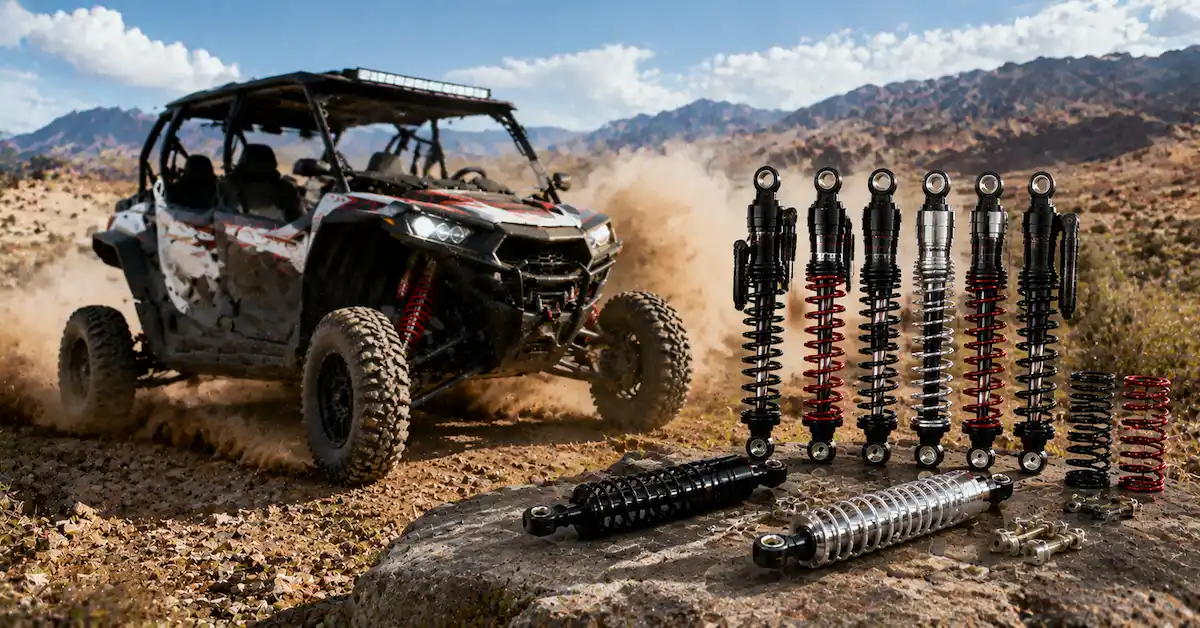

How should OEM buyers source vehicle suspension parts?
Direct answer: OEM buyers should source vehicle suspension parts as a controlled vehicle-level bill of materials, not as unrelated catalog items. The RFQ must connect each shock absorber, spring, mounting interface, bushing, ball joint, and hardware item to the same vehicle revision, axle load, suspension geometry, operating environment, performance target, inspection plan, packaging identity, and change-control process.
A supplier is ready for an OEM program when it can show what it will manufacture, which inputs remain the buyer's responsibility, how samples will be identified and tested, which characteristics are checked in production, and how an approved revision will be reproduced. Price comparison becomes meaningful only after the BOM and evidence package are aligned.
This article is for vehicle manufacturers, ATV and UTV brands, special-vehicle developers, aftermarket product managers, importers, distributors, and procurement engineers who need a coordinated suspension parts program. Its unique task is to help the buyer build a controlled BOM and RFQ. It does not repeat a replacement-parts guide or a general explanation of how suspension works.
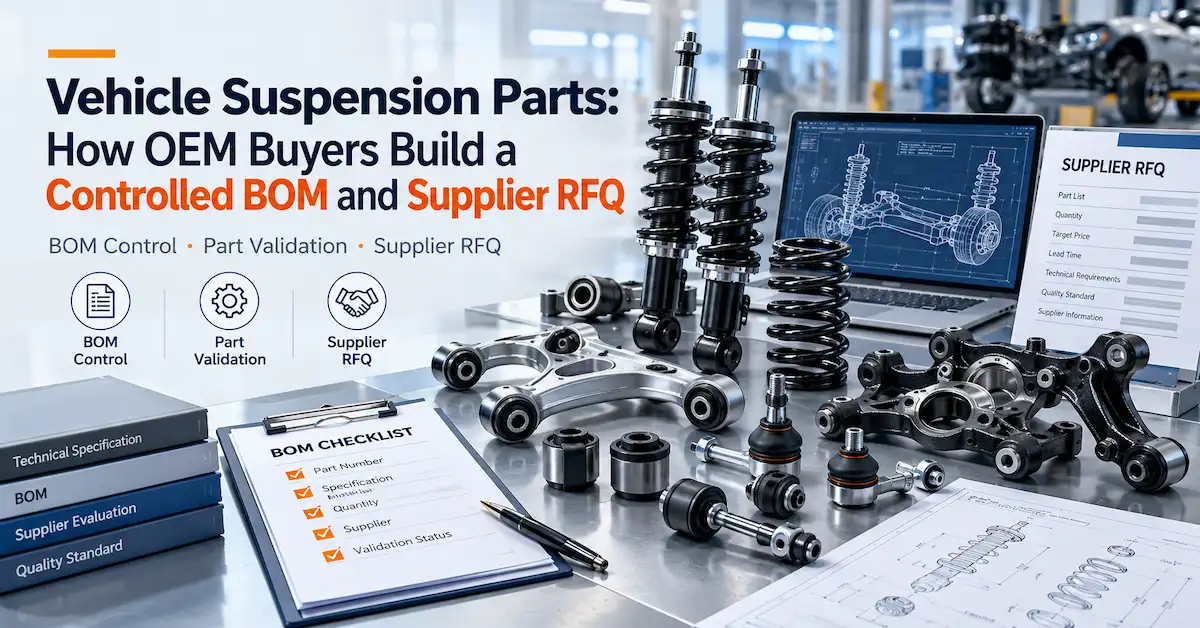
Define the suspension BOM before requesting prices
A bill of materials is more than a list of part names. For suspension sourcing, it should tell engineering, purchasing, quality, the supplier, and the assembly plant exactly which revision belongs to which vehicle. It should also identify the interfaces between parts. A spring can meet its drawing and still create the wrong ride height. A shock can meet eye-to-eye length and still run out of stroke. A bushing can fit the shock eye and still be too narrow for the bracket.
| BOM group | Primary function | Fields that must be controlled |
|---|---|---|
| Shock absorber assembly | Controls compression and rebound movement. | Position, extended/compressed length, stroke, force target, reservoir, adjustment, mounting, seal and finish. |
| Suspension spring | Supports static load and sets the working ride-height range. | Rate, free length, installed length, wire and coil geometry, preload, coating, identification and tolerance. |
| Mounting eyes, sleeves and bushings | Transfer load while controlling alignment, noise, and articulation. | Hole diameter, sleeve length, installation width, hardness, bonding, orientation and hardware interface. |
| Ball joint or related articulation component | Supports controlled movement at the suspension or steering interface. | Taper or thread, stud and housing dimensions, articulation range, boot, grease and installation orientation. |
| Fasteners and spacers | Locate and retain the suspension assembly. | Size, grade, coating, torque responsibility, washer/spacer stack and pack quantity. |
| Labels, instructions and packaging | Preserve part identity through shipping, assembly, service, and reordering. | Part number, vehicle application, side/position, revision, batch, barcode, protection and carton quantity. |
Each line should have an owner and approval state. If the buyer controls the vehicle drawing but the supplier proposes the spring, say so. If a mounting sleeve comes from a separate supplier, identify who validates the assembled width. If a shock and spring are supplied as a coilover assembly, control both the component drawings and the assembled preload. These decisions prevent gaps between suppliers.
Create a procurement baseline for every released BOM
A quotation BOM, prototype BOM, pilot BOM, and production BOM may contain the same part names while describing different hardware. Give each baseline a revision, release date, vehicle application, approver, and effective order. Attach the drawing revision, supplier part number, sample identity, and deviation status to every line. When a temporary sleeve, spring, or valve setting is approved only for evaluation, mark it as prototype-only so it cannot enter a repeat order by mistake.
The baseline should also record supersession. If revision B replaces revision A, state whether old stock may be consumed, reworked, returned, or scrapped and which vehicle serial range receives the new part. Purchasing should place orders against the released baseline rather than a description copied from an email. Incoming inspection, assembly, service parts, and warranty analysis then refer to the same identity.
For multi-component vehicle suspension parts, use one change log that shows the system effect of each revision. A longer sleeve may alter bracket clamping; a spring change may require different rebound control; a coating change may affect seat fit. Record the reason, affected interfaces, validation repeated, result, and approval. This discipline is especially important when shocks, springs, ball joints, and hardware have different suppliers or production schedules.
Start from vehicle requirements, not component descriptions
Vehicle identity and market
Record the vehicle type, platform code, model year, market, front or rear position, left/right requirement, number of passengers, tire, wheel, drive layout, and whether the product is OEM, replacement, or upgrade. Different markets may require different labels, packaging languages, service documents, or evidence. A sample labeled only "UTV rear shock" is not enough to control future orders.
Load states and weight distribution
Measure curb, normal, and maximum intended operating states. Record front and rear axle loads rather than only total mass. Add passengers, cargo, battery, fuel, accessories, tool boxes, winches, racks, or trailer tongue load in the state where they are actually used. The spring supports those loads, while the damper controls the motion they create. A change in one part can make the approved setting of another part unsuitable.
Geometry and mechanical limits
Provide extended and compressed shock length, effective stroke, installation angle, upper and lower interfaces, spring clearance, bump-stop engagement, droop limit, wheel travel, and linkage or motion ratio. Check brake lines, drive shafts, ball joints, control arms, tires, body panels, reservoirs, and adjustment knobs through full movement. The shock should not become an unintended suspension stop.
Duty cycle and environment
Describe road, trail, farm, sand, mud, snow, utility, or mixed use. Include speed, obstacle frequency, daily hours, temperature, water, salt, dust, wash-down, storage, and maintenance. A corrosion statement is only useful when the required exposure and acceptance method are defined. The same is true for durability: a cycle count without load, stroke, frequency, temperature, and failure criteria cannot be compared.
Performance and customer outcome
Write measurable targets where possible: ride-height window, sag, bottoming limit, rebound behavior, passenger comfort, handling response, fixed or adjustable damping, and acceptable noise. "Premium," "heavy duty," and "high performance" may describe a market position, but they do not tell a supplier what to build or quality control what to inspect.
Control interfaces between shocks, springs, and mounting parts
Many suspension problems occur between components rather than inside one component. A spring may be correct on a standalone load test but wrong at its installed length. A shock may produce the specified force but be paired with a spring whose stored energy requires more rebound control. A bushing may use the correct material but position the eye off-center in the bracket.
| Interface | Common sourcing risk | Required verification |
|---|---|---|
| Spring to shock | Incorrect seat diameter, preload, coil clearance, or spring rate. | Assembly drawing, installed length, seat fit, preload record and compression clearance. |
| Shock to bracket | Wrong hole, sleeve, width, orientation, or articulation. | Bracket drawing, gauge or sample fit, torque method and full-travel inspection. |
| Shock stroke to wheel travel | Shock bottoms before the vehicle bump stop or limits droop. | Motion-ratio review and physical bump/droop validation. |
| Spring to damping | Good ride height but excessive bounce, harshness, or packing. | Force data plus vehicle tests at defined loads and surfaces. |
| Ball joint to control arm | Incorrect taper, articulation, or boot clearance through travel. | Interface drawing, installation fixture and geometry validation. |
| Part to packaging | Mixed side, position, or revision reaches assembly or service. | Approved label, barcode, pack list, protection and receiving check. |
The BOM should refer to an interface-control drawing or a vehicle assembly drawing. When the supplier changes a sleeve, spring seat, coating thickness, or mounting eye, the review must consider the mating part. Change control should not stop at the component boundary.
What public BEDO evidence can support an RFQ?
BEDO's public catalog offers a concrete ATV/UTV rear shock reference, AU_HSA_01. Its product page lists aluminum alloy and steel pipe, an internal gas chamber, oil-gas separation, a 0.1 m/s inspection speed, 465 mm total length, 130 mm effective stroke, 75 LBS spring rate, 2000 N rebound, 650 N compression, 10 mm upper and lower holes, and 32 mm upper and lower mounting widths. It is listed as a fixed-damping rear configuration.
The site also presents suspension-spring products and states on selected spring pages that springs are precision wound and load tested. The product taxonomy includes ball joints. These public pages establish that BEDO discusses multiple suspension-component categories, but they do not define a complete BOM for an unidentified vehicle.
| Public evidence | What it supports | What the buyer still needs |
|---|---|---|
| AU_HSA_01 product page | Published materials, dimensions, stroke, spring, damping, mounting, weight and product image. | Vehicle fitment, tolerance, current revision, test report, durability, MOQ, lead time and packaging. |
| Suspension spring category | BEDO's public spring product direction. | Vehicle-specific rate, material grade, process route, load-deflection report and coating specification. |
| Product overview | Shock absorber, suspension spring and ball-joint categories. | Controlled BOM, component ownership, interface drawings and application matrix. |
| About BEDO Auto | Ningbo manufacturer identity, customization and small-batch positioning, public technical-capability statements. | Current audit evidence, process flow, equipment list, capacity by product and project contacts. |
Evidence boundary: the factory and product images, company identity, address, contact details, catalog categories, and AU_HSA_01 data are public BEDO evidence. A formal approval file still needs named drawings, material specifications, process flow, inspection records, project MOQ, sample and production lead times, packaging approval, and an authorized case if those claims will appear on the published page.
Choose sample-based or drawing-based development
When a physical sample is the starting point
A sample can reveal external geometry, installation width, bushing construction, spring dimensions, body size, reservoir arrangement, finish, labels, and visible wear. Measure and photograph it before shipment. Identify whether the goal is an exact replacement or a change in load support, damping, corrosion protection, appearance, or service life.
A sample does not automatically reveal internal valving, gas pressure, oil, seal specification, material grade, heat treatment, or production tolerance. It also does not explain whether a worn sample represents the approved design. Pair it with vehicle data, complaints, performance targets, and any available drawing.
When drawings and CAD are available
Drawings should define dimensions, datums, tolerances, materials, finishes, spring fields, damping target or test reference, labels, and critical characteristics. CAD supports packaging and interference review but does not replace physical validation. Ask the supplier to return a manufacturability review and mark every proposed deviation before sample production.
When several suppliers contribute to one BOM
Assign one organization to own the system interface. If BEDO supplies the shock and spring while another supplier provides brackets or ball joints, define who checks assembled width, articulation, torque, and full-travel clearance. Share only released revisions and keep a record of which sample was tested with which mating parts.
Build evidence into prototype and pilot approval
A prototype proves the concept; a pilot batch proves that the approved concept can be repeated. The buyer should define acceptance records before ordering samples, so a visually acceptable part is not mistaken for a production release.
| Release stage | Minimum evidence | Decision |
|---|---|---|
| Requirement review | Vehicle revision, BOM, loads, geometry, duty cycle, target, open-point list. | Is the project defined well enough to quote? |
| Design review | Drawings, interface check, material/finish proposal, test plan, DFM comments. | Can a controlled sample be built? |
| Prototype inspection | Dimensions, component identities, spring data, damping data, leakage, appearance and revision. | Does the sample match the intended configuration? |
| Vehicle validation | Fitment, ride height, sag, clearance, load states, route, bottoming, rebound, noise and observations. | Does the assembly satisfy the vehicle target? |
| Pilot batch | Variation across units, traceability, packaging, labels, assembly feedback and nonconformance response. | Can production repeat the approved sample? |
| Production release | Frozen BOM, inspection plan, approved limits, packaging, change control and supply terms. | Can purchasing place a repeat order without ambiguity? |
For shock absorbers, the inspection file may include extended and compressed length, stroke, mounting dimensions, spring identification, leakage, rod movement, and force verification under agreed conditions. For springs, it may include free length, rate or load-deflection points, coating, and identification. The exact scope should match product risk and the contract rather than a generic checklist.
Define MOQ, lead time, packaging, and change control in writing
The public BEDO site states support for small-batch ordering, but it does not publish one universal MOQ for every component. Ask for separate minimums and prices for prototype, pilot, first production, and repeat production. A spring, machined mount, shock assembly, and branded carton may have different economic quantities.
Split lead time into drawing review, material preparation, sample build, revision, pilot, production, inspection, packaging, and shipping. A single delivery number hides which activity starts only after buyer approval. Define what happens if the vehicle drawing changes or a sample fails validation.
Approve packaging as part of the BOM. Specify corrosion and impact protection, individual wrapping, hardware containment, side and position marking, barcode, carton quantity, gross-weight limit, instruction sheet, and pallet requirements. For mixed vehicle programs, scan or manually verify labels during pilot packing.
Change control should cover spring material or geometry, seal, oil, gas condition, valve, body or rod, bushing, sleeve, fastener, coating, supplier, manufacturing process, inspection method, label, and packaging. State which changes require notification, new samples, test repetition, or buyer approval.
Use a supplier scorecard tied to evidence
| Area | Strong supplier response | Warning sign |
|---|---|---|
| Application understanding | Asks for vehicle revision, axle loads, geometry, terrain and target. | Quotes from a photo and model name alone. |
| Technical scope | Separates confirmed facts, assumptions and missing inputs. | Uses "heavy duty" or "OEM quality" without measurable definitions. |
| Component interfaces | Reviews spring, shock, mounts, clearance and mating parts together. | Treats every BOM line as isolated. |
| Evidence | Connects records to part number, revision, unit or batch and test condition. | Provides undated photos or reports that cannot be linked to the product. |
| Production control | Explains inspection, traceability, nonconformance and change approval. | Relies on the approved prototype without a repeat-production plan. |
| Commercial clarity | States sample terms, MOQ, stage lead times, packaging and exclusions. | Quotes a unit price without defining revision or included work. |
A scorecard should not reward the largest document package. It should reward relevant, traceable evidence that reduces the project's actual risk. A clear two-page interface review can be more useful than a generic capability presentation.
Vehicle suspension parts RFQ checklist
Send one controlled package containing the vehicle identity, application, BOM, drawings or samples, axle loads, passenger and cargo states, geometry, environment, performance target, inspection requirements, sample quantity, expected annual volume, branding, packaging, delivery destination, and target launch date. Mark estimates and open fields rather than guessing.
Ask the supplier to return a line-by-line BOM response. For each part, request the proposed part number, drawing responsibility, material/finish status, sample plan, inspection evidence, price basis, MOQ, lead time, packaging, and exclusions. Also request one consolidated list of assumptions and questions.
For BEDO, buyers can begin with the shock absorber range, the suspension spring category, and the company page. The RFQ should then narrow the public catalog into a vehicle-specific package.
Vehicle suspension parts FAQ
What are the main vehicle suspension parts in a BEDO sourcing project?
BEDO's public product categories include shock absorbers, suspension springs, and ball joints. A project may also require mounting eyes, bushings, sleeves, fasteners, spacers, labels, and packaging, depending on the released BOM.
Should shocks and springs be sourced from one supplier?
Not always, but one owner must control their interface. If different suppliers are used, define who approves spring rate, installed length, preload, damping match, seats, tolerances, and vehicle validation.
Can a sample replace a technical drawing?
A sample is useful for measurement and structural reference, but it may be worn and cannot reveal every internal specification. A released drawing and acceptance criteria are still needed for repeat production.
What suspension data should an RFQ include?
Include vehicle revision, position, axle loads, load states, extended/compressed length, stroke, mounting dimensions, angle, motion ratio, spring information, terrain, environment, performance target, sample quantity, and production forecast.
How should damping data be compared?
Compare compression and rebound values only when velocity, direction, temperature, adjustment setting, stroke position, units, tolerance, and test method are clear. A maximum force alone does not define the complete damping curve.
Does BEDO publish an MOQ and lead time?
The public company page mentions small-batch ordering, but one universal MOQ or lead time is not published for every product. Request project-specific sample, pilot, and production terms in writing.
What packaging information belongs in the BOM?
Control part number, vehicle application, front/rear or side, revision, quantity, hardware, protective material, barcode, carton, instruction sheet, and any private-label requirement.
Which BEDO product data can be treated as verified public evidence?
Use values clearly published on the relevant official product page, such as the AU_HSA_01 materials, dimensions, stroke, spring rate, damping, weight, and mounting fields. Confirm current revision and project suitability before purchasing.
What prevents this draft from being published immediately?
BEDO should add a named author and technical reviewer, confirm every cited product field, provide approved production or inspection evidence, and insert the actual project MOQ, lead time, packaging, and authorized case only if those claims are intended for publication.
Conclusion
Vehicle suspension parts should be purchased through a vehicle-level BOM, interface plan, and evidence-based release process. Shocks, springs, mounts, articulation components, hardware, labels, and packaging must point to the same vehicle revision and acceptance criteria. This approach turns a collection of parts into a controllable supply program.
BEDO Auto's public catalog and factory information provide a practical starting point: a Ningbo manufacturer identity, shock absorber and spring capabilities, small-batch positioning, factory imagery, and product-level parameters such as those published for AU_HSA_01. The next step is to send a complete BOM and ask BEDO to confirm drawings, materials, process ownership, testing, samples, MOQ, lead time, packaging, and change control for the exact vehicle.