
Snowmobile Rear Suspension: OEM Guide to Spring Rate, Shock Travel & Winter Load Control
Snowmobile rear suspension is a system, not simply a rear shock absorber. The rear assembly has to manage changing rider position, cargo, track loads, suspension movement, spring support, damping, terrain inputs, packaging limits, and cold-weather operating conditions. For an OEM or aftermarket buyer, selecting a rear shock only by its physical length can therefore create fitment and performance problems later.
A better approach is to define the rear suspension around the complete vehicle. The buyer should establish the intended load range, rear suspension geometry, shock mounting points, available stroke, spring requirement, damping target, terrain, duty cycle, environmental exposure, and validation method before approving a production specification.
This guide focuses specifically on the engineering and procurement decisions behind Snowmobile Rear Suspension. It is designed for snowmobile manufacturers, aftermarket brands, importers, distributors, repair-parts suppliers, specialty vehicle developers, and OEM/ODM buyers who need a repeatable suspension product rather than a generic replacement component.
1. What Is Snowmobile Rear Suspension?
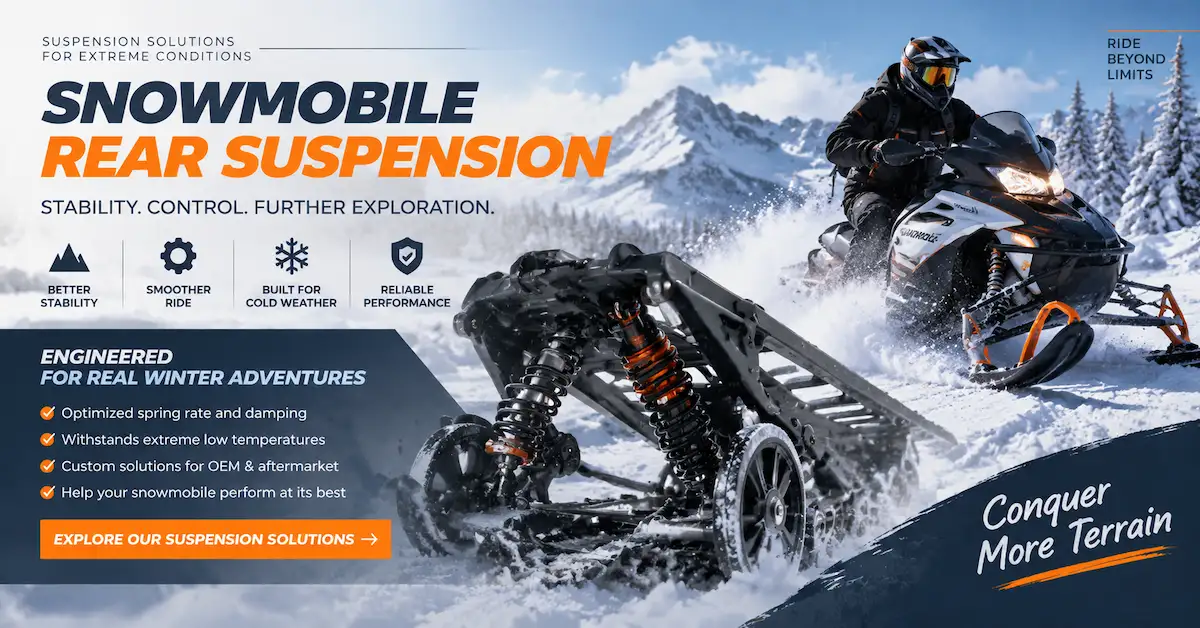
Snowmobile rear suspension is the assembly that connects the rear portion of the vehicle structure to the track-supporting mechanism and controls how the rear of the machine responds to terrain, rider movement, and load changes.
The exact architecture varies between snowmobile platforms. Depending on the design, the rear module can include a skid frame or rail structure, suspension arms, idler wheels, springs, shock absorbers, mounting interfaces, and other mechanical elements that work together to guide movement and absorb energy.
That variation is important for B2B buyers because the term rear suspension does not identify one universal component layout.
A supplier may manufacture a rear shock absorber, a spring, or another suspension component, but the final behavior is determined after the component is installed into the vehicle geometry.
For procurement purposes, Snowmobile Rear Suspension can therefore be viewed at three levels:
- Component level: rear shock absorber, spring, bushing, mount, or related part.
- Assembly level: the rear suspension mechanism and its interacting components.
- Vehicle level: the complete relationship between rear suspension, track, chassis, rider, cargo, terrain, and operating conditions.
These three levels should not be confused during sourcing.
If a buyer is replacing a known shock on an unchanged vehicle, component-level sourcing may be sufficient. If the buyer is developing a new snowmobile or modifying the rear suspension geometry, assembly- and vehicle-level engineering become much more important.
2. Why the Rear Suspension Cannot Be Specified by Shock Length Alone
One of the most common purchasing mistakes is to send a supplier one number such as “rear shock length: 400 mm” and ask for a quotation.
That number may be useful, but it does not define the complete suspension requirement.
A production-ready rear shock specification may also require:
- Extended length
- Compressed length
- Effective shock stroke
- Upper mounting-hole diameter
- Lower mounting-hole diameter
- Upper mounting width
- Lower mounting width
- Body diameter
- Rod dimensions
- Spring dimensions
- Spring rate
- Preload arrangement
- Compression damping
- Rebound damping
- Adjustment range where applicable
- Reservoir arrangement where applicable
- Installed angle
- Clearance throughout suspension travel
Two shocks can have the same nominal length and still behave differently or fail to fit because their stroke, mounting interface, spring, body envelope, or damping configuration is different.
Buyer rule: Treat overall length as one screening parameter, not as a complete fitment specification. BEDO's own measurement guidance emphasizes separate consideration of extended length, compressed length, stroke, mounting dimensions, spring information, and vehicle application.
This distinction becomes even more important when developing a private-label replacement shock. A visually similar product can create an expensive return problem if the actual mounting width, compression length, or suspension travel is wrong.
3. The Rear Suspension Has a Different Job From the Front
A snowmobile is not a four-wheel vehicle with a simple rear axle. Its track and rear suspension interact with the chassis and terrain in a different way, and the rider can deliberately move body weight forward, rearward, or laterally.
As a result, the rear suspension has to respond to both mechanical inputs and rider-driven weight transfer.
BEDO's published snowmobile engineering content describes riders leaning forward during climbs, moving rearward on descents, and shifting body weight during turns. It also identifies cargo racks and two-up seating as sources of additional load variation.
For an OEM buyer, that means the rear suspension specification should not be based only on the empty machine.
A practical load matrix might look like this:
| Vehicle Condition | Rear Load Input | What to Evaluate |
|---|---|---|
| Unloaded | Vehicle baseline without additional rider/cargo load | Ride height, basic compliance, available travel |
| Typical rider | Normal ready-to-ride rider condition | Sag, spring support, damping response |
| Heavy rider | Upper end of intended rider range | Ride height, travel reserve, bottoming resistance |
| Two-up configuration | Rider plus passenger where applicable | Rear load support and chassis balance |
| Utility load | Rider plus equipment or cargo | Spring capacity, damping and remaining travel |
The important point is not that every snowmobile needs every condition. The point is that the buyer should define the conditions that actually matter for the target vehicle.
4. Understand the Rear Skid Suspension as a Moving System
For many snowmobile designs, the rear suspension is closely associated with the skid assembly under the vehicle. The skid mechanism controls track support while allowing the suspension to move relative to the chassis.
From an engineering perspective, the key issue is that the shock does not necessarily move one-to-one with the track or another visible suspension point.
The relationship between wheel or track-side movement and shock movement is affected by the geometry of the suspension mechanism.
That relationship is commonly described through a motion ratio, although different engineers may define the ratio in different directions.
For example, if a project defines motion ratio as:
Motion Ratio = Shock Displacement ÷ Wheel-Side Suspension Displacement
then a first-order linearized relationship can be written as:
Wheel Rate ≈ Spring Rate × Motion Ratio²
This is only a simplified engineering relationship. Real suspension geometry can change the effective ratio through the travel range, and the track-side load path can be more complicated than a basic linear spring-damper model.
That is why an OEM buyer should not request a spring rate without also explaining the suspension geometry or providing an existing reference component.
Why Motion Ratio Matters to the Supplier
Suppose two snowmobiles use the same physical spring rate but have different suspension leverage.
The rider may not experience the same effective wheel rate.
Similarly, two shocks with the same damping force can produce different vehicle-level responses if the installation geometry changes.
This is one reason that a supplier who understands only the shock absorber as an isolated product may ask for additional vehicle data before confirming a final specification.
5. Spring Rate Is the First Major Rear-Suspension Decision
The suspension spring provides the primary elastic support for the vehicle and its changing load.
In a Snowmobile Rear Suspension project, spring rate influences:
- Static ride height
- Suspension case
- Load support
- Available compression travel
- Bottoming tendency
- Initial ride response
- Vehicle attitude under changing load
If the spring is too soft for the intended operating load, the rear suspension may sit too low and consume a large portion of its available compression travel before a major terrain event occurs.
If the spring is too stiff, the rear suspension may become harsh when the machine is lightly loaded and may not respond as effectively to smaller terrain inputs.
Neither extreme is desirable for a product that has to serve a broad customer base.
Rider Weight
Rider weight is a direct input to the rear load case, but it should not be treated as the only input.
Two riders with different body weights may also use the machine at different speeds, on different terrain, or with different riding positions.
A performance snowmobile program therefore needs more than a simple “spring for 80 kg rider” description if the objective is a production suspension specification.
Passenger and Cargo Load
A two-up snowmobile or utility snowmobile can place substantially different rear loads on the suspension than a single-rider recreational configuration.
When cargo is carried behind the rider, its location can also affect the rear load path.
For an OEM program, record not only cargo mass but, where practical, its location relative to the vehicle.
Preload
Preload changes the initial spring position and can be useful for setting ride height or adapting a defined operating range.
However, preload should not be used as a universal substitute for the correct spring rate.
If the spring itself is fundamentally unsuitable for the vehicle's load range, adding preload may improve one measurement while making another operating condition worse.
A better process is to select a spring appropriate to the defined load envelope and then establish a reasonable preload or setup range.
6. How to Decide Between Linear and Progressive Spring Behavior
Spring behavior is not only about the nominal spring rate. Some suspension designs may use a spring arrangement or geometry that changes effective support through travel.
For OEM buyers, the correct question is not “Is progressive always better?”
The better question is:
What spring behavior gives the vehicle the required balance between initial compliance, load support and travel utilization?
A linear spring can provide a predictable force-displacement relationship within its operating range.
A progressive setup can provide softer initial response and stronger support as the suspension moves deeper into its travel, depending on the design.
However, spring behavior should always be evaluated together with suspension geometry and damping.
A spring change that looks attractive on a component test can create an unwanted vehicle response after installation.
7. Rear Shock Stroke Is Not the Same as Rear Suspension Travel
This distinction is critical in OEM suspension development.
Shock stroke is the amount of movement available inside the damper.
Suspension travel describes movement at the relevant vehicle or suspension reference point.
They may not be equal because the shock is installed within a mechanical linkage.
If the buyer specifies “we need 100 mm of rear suspension travel,” the supplier needs to understand where that 100 mm is measured.
Likewise, if the buyer says “the shock needs 100 mm stroke,” that does not automatically establish the total track-side movement.
| Parameter | Definition for Project Communication | Buyer Risk if Missing |
|---|---|---|
| Extended length | Shock dimension at the defined extended condition | Incorrect installation envelope |
| Compressed length | Shock dimension at the defined compressed condition | Mechanical interference |
| Effective stroke | Defined usable damper movement | Insufficient suspension movement |
| Wheel/track-side travel | Vehicle-side suspension movement | Incorrect interpretation of travel |
| Motion ratio | Relationship between shock and suspension movement | Incorrect spring/damping translation |
For this reason, an engineering drawing should define measurement references instead of relying on ambiguous terms.
8. Full Compression and Full Extension Must Be Checked
A shock can fit at normal ride height and still fail during full suspension movement.
At full compression, check:
- Shock compressed length
- Spring clearance
- Shock-body clearance
- Reservoir clearance where applicable
- Skid and chassis interference
- Track-related clearance
- Bump-stop engagement
- Whether the damper reaches its mechanical limit before the intended suspension stop
At full extension, check:
- Shock extended length
- Spring seating
- Mount alignment
- Joint movement
- Hardware engagement
- Clearance between moving components
- Whether the shock becomes the unintended mechanical travel limiter
At ride height, check:
- Installed shock angle
- Spring position
- Static sag
- Available compression travel
- Available rebound travel
- Adjustment access where applicable
This three-position review is much more reliable than confirming only the center operating position.
9. Compression Damping and Rebound Damping Solve Different Problems
Spring rate and damping should be developed together, but they perform different jobs.
The spring stores and releases elastic energy.
The damper controls the speed of movement.
Compression damping influences how the rear suspension responds as it moves into compression after a terrain input.
Rebound damping controls how quickly the suspension extends afterward.
This distinction becomes important when a snowmobile encounters repeated bumps.
If compression control is insufficient, the suspension may move too quickly into the available travel during larger impacts.
If rebound control is insufficient, the suspension can return too quickly after compression and create an unsettled response.
If rebound damping is excessive, the suspension may not recover sufficiently between closely spaced terrain inputs.
The correct solution is therefore not simply “more damping.”
What Happens When Rebound Is Too Slow?
When rebound is excessively slow, the suspension may not return toward its normal operating position quickly enough before the next bump.
During repeated inputs, the available travel can gradually become less useful because the suspension does not recover between events.
This is often discussed as pack-down.
For snowmobile applications, this can become particularly important when the machine moves through repeated uneven terrain.
What Happens When Rebound Is Too Fast?
Excessively fast rebound can make the rear suspension feel unsettled after a compression event.
The rider may experience repeated chassis movement rather than a controlled return.
The appropriate rebound target depends on spring rate, geometry, vehicle mass, terrain, and riding style.
10. Rear Suspension Must Be Tuned Around the Terrain
Snow is not a single surface.
For procurement and engineering purposes, it is more useful to define the target terrain than to use the generic term “winter use.”
| Terrain Profile | Rear Suspension Concern | Development Focus |
|---|---|---|
| Groomed trail | Repeated smaller inputs and speed consistency | Comfort, rebound control, repeatability |
| Hardpack / icy trail | Sharper impacts and reduced compliance | Compression response, traction behavior, control |
| Deep powder | Different suspension recovery and chassis loading | Rebound behavior, travel utilization, spring support |
| Mountain terrain | Large attitude changes and rider weight transfer | Geometry, travel, rebound, chassis control |
| Utility operation | Equipment and cargo variation | Load support, ride height, repeatability |
| Mixed terrain | Rapidly changing inputs | Balanced compression and rebound behavior |
A rear suspension that works well on a groomed trail may not have the same target behavior as one developed for aggressive mountain riding.
For an OEM buyer, this means “off-road” should be treated as a starting category rather than a complete performance specification.
11. Cold Weather Still Matters—But It Is Only One Part of the Rear System
Low temperature affects the working environment of a snowmobile suspension, but cold-weather performance should be considered as one part of the complete rear suspension design rather than the only topic.
Cold can influence fluid behavior, sealing, material response, lubrication, gas pressure behavior, and surface exposure.
BEDO's published snowmobile design article describes low-temperature damping fluid rated for -40°C, cold-tolerant seals and bushings, rebound-calibrated valving, gas-pressure tuning, and anti-ice surface treatment. It also describes cold-chamber dyno testing, salt-spray and corrosion exposure, field tests, multi-cycle fatigue testing, and geometry integration checks.
These are published BEDO claims for its snowmobile shock development content, not universal specifications that should automatically be applied to every snowmobile product.
OEM documentation rule: If a customer specification requires a specific low-temperature rating, test duration, corrosion test level, seal compound, or damping target, put that requirement into the controlled project specification and request the applicable test evidence. Do not convert a general marketing statement into an unverified engineering guarantee.
12. Rear Suspension Problems: Diagnose the System Before Changing the Shock
When an existing Snowmobile Rear Suspension performs poorly, replacing the shock immediately may not solve the root cause.
The symptom may originate from the spring, mounting interface, geometry, preload, damping, or another part of the suspension assembly.
| Observed Problem | Possible Area to Investigate | Useful Evidence |
|---|---|---|
| Rear sits too low | Spring rate, preload, load condition | Ride height and loaded/unloaded measurements |
| Frequent bottoming | Spring support, travel, compression damping, geometry | Shock position during full compression |
| Rear rebounds too quickly | Rebound damping, spring behavior | Repeated-bump test and rebound observation |
| Rear rebounds too slowly | Excessive rebound damping, cold condition, setup | Temperature and repeated-cycle comparison |
| Harsh over small bumps | Spring stiffness, damping, friction | Light-load ride test |
| Response changes during repeated use | Damping stability, temperature, internal condition | Repeated-cycle test |
| Oil leakage | Seal, rod, contamination, impact, installation | Visual inspection and service history |
| Unusual movement at the mount | Bushing, sleeve, mounting width or alignment | Mounting inspection and dimensional check |
This diagnostic approach is especially valuable for aftermarket brands.
If a replacement product is marketed as an “upgrade” but the underlying problem is actually incorrect spring support or a damaged mounting interface, changing only the damper can create another customer complaint.
13. When a Standard Rear Shock Is Appropriate
Not every snowmobile project needs a new suspension design.
A standard or existing rear shock may be appropriate when:
- The snowmobile platform is unchanged.
- The mounting dimensions are already confirmed.
- The load range remains within the established application.
- The existing spring behavior is acceptable.
- The damping behavior is acceptable.
- No major geometry changes are planned.
- The buyer needs replacement supply rather than new vehicle development.
In this situation, the supplier's job is primarily to confirm fitment, specification, quality, packaging, and repeat production.
The buyer should still avoid assuming that a shock is compatible merely because it is listed as a snowmobile rear shock.
Vehicle model, installation position, dimensions, stroke, spring characteristics, and mounting details should be verified.
14. When Custom Snowmobile Rear Suspension Development Makes More Sense
Custom development becomes more appropriate when the vehicle or its intended operating conditions differ materially from the original design.
Typical triggers include:
- New snowmobile platform
- Modified rear suspension geometry
- Different mounting locations
- Different rear load range
- Two-up conversion
- Utility equipment
- Different rider-weight target
- Different terrain profile
- Longer or shorter required travel
- Changed ride height
- Performance-oriented aftermarket positioning
- Private-label product development
- Replacement of an unavailable original component
BEDO's published snowmobile content states that custom shock development can address length, stroke, mounting size, spring rate, damping, surface treatment, color, logo, and packaging.
That distinction is commercially important.
A buyer asking for a color and logo change is dealing with a different project from a buyer asking for a new rear shock around a changed skid geometry and load condition.
15. Sample-Based Development for Snowmobile Rear Suspension
Many aftermarket and OEM buyers do not have complete engineering drawings.
They may instead have:
- An original rear shock
- A competitor sample
- A damaged component
- An old supplier sample
- A vehicle with an existing suspension
- Partial measurements
- Photographs and installation information
A physical sample can be a useful starting point.
It can provide measurable information such as length, mounting dimensions, body dimensions, spring dimensions, and other accessible features.
However, a used sample should not automatically become the production master.
Inspect it first for worn bushings, bent mounting points, damaged threads, corrosion, seal leakage, spring settling, missing sleeves, or previous repair work.
Otherwise, the supplier may reproduce a worn condition rather than the intended design.
Have an Existing Snowmobile Rear Shock Sample?
BEDO's sample-based development approach can use a physical reference as an engineering starting point. Provide the sample together with vehicle information and the changes you need.
Submit Your Sample-Based Project → Review Sample-to-Drawing Guidance16. Drawing and CAD Data: What Should Be Defined?
A production drawing should do more than show an outline.
For Snowmobile Rear Suspension development, the drawing should identify the critical interfaces and measurement references that control fitment and production.
| Drawing Item | Why It Matters |
|---|---|
| Extended length | Defines the open-state dimensional reference |
| Compressed length | Controls compression envelope |
| Stroke | Defines damper movement |
| Upper mount | Controls chassis-side interface |
| Lower mount | Controls suspension-side interface |
| Mounting-hole diameter | Controls hardware compatibility |
| Mounting width | Controls bracket and bushing fit |
| Spring envelope | Controls surrounding clearance |
| Body diameter | Controls packaging and clearance |
| Reservoir location | Controls installation space where applicable |
| Surface treatment | Controls production appearance and protection |
BEDO's published CAD-development guidance emphasizes reviewing suspension movement rather than relying only on catalog dimensions. At full bump, clearance and mechanical limits should be reviewed; at ride height, installed position and adjustment access should be checked; at full droop, extension, seating, joint movement and limiting components should be considered.
For a new platform, 3D CAD can therefore reduce prototype risk by allowing the manufacturer and buyer to review packaging before physical samples are finalized.
17. What a Snowmobile Suspension Manufacturer Should Ask Before Quoting
A technically capable supplier should ask questions before confirming a final quotation.
For a Snowmobile Rear Suspension project, useful questions include:
- Which snowmobile platform is involved?
- What is the model or project code?
- Is the component front or rear?
- Is the application single-rider, two-up, utility, recreational, or another configuration?
- What is the vehicle weight?
- What rider or passenger load is expected?
- Is cargo carried at the rear?
- What terrain is the machine expected to operate on?
- What are the current shock dimensions?
- What are the mounting dimensions?
- What is the existing spring specification?
- What problem is the current suspension showing?
- Is the goal replacement, improvement, or a new platform?
- Is adjustable damping required?
- What temperature range must be validated?
- Is there a physical sample?
- Are 2D drawings or 3D CAD available?
- How many prototypes are required?
- What is the expected production volume?
- Is private-label branding required?
The quality of these questions is itself a useful supplier-evaluation signal.
A quotation that contains only price and quantity may be fast, but it does not necessarily demonstrate that the supplier has understood the suspension application.
18. OEM RFQ Checklist for Snowmobile Rear Suspension
Technical Information
- Snowmobile model or project code
- Model year or variant where relevant
- Rear suspension installation position
- Vehicle curb weight
- Typical operating weight
- Maximum intended load
- Rider weight range
- Passenger information where applicable
- Cargo type and approximate location
- Existing rear shock sample
- Extended shock length
- Compressed shock length
- Effective shock stroke
- Upper mounting-hole diameter
- Lower mounting-hole diameter
- Upper mounting width
- Lower mounting width
- Spring dimensions
- Known spring rate
- Known damping information
- Installed shock angle if available
- Suspension travel information
- Rear suspension CAD
- 2D technical drawing
- Installation photographs
- Current suspension problem
- Target performance change
- Typical terrain
- Operating temperature
- Duty cycle
Commercial Information
- Prototype quantity
- Expected production quantity
- Target launch timing
- Private-label requirements
- Body and spring color
- Logo requirements
- Packaging requirements
- Target sales market
- Expected seasonal demand
- Repeat-order requirements
If some technical information is unavailable, state that clearly.
For example, “The damping target is not yet defined, but the rear suspension rebounds too quickly after repeated large impacts” is useful engineering information.
It is better than inventing an arbitrary damping value simply to make an RFQ look complete.
19. How to Validate a Snowmobile Rear Suspension Prototype
Prototype validation should be designed around the risks of the project.
Stage 1: Dimensional Validation
Measure the prototype against the approved drawing.
Check critical dimensions including mounting interfaces, length, stroke, body envelope, spring dimensions, and other project-controlled features.
Stage 2: Static Installation
Install the prototype on the actual vehicle and verify:
- Mounting alignment
- Ride height
- Static sag
- Spring seating
- Body clearance
- Reservoir clearance where applicable
Stage 3: Full Suspension Movement
Move the rear suspension through the relevant compression and extension range.
Confirm that the damper is not unintentionally becoming the mechanical stop and that surrounding components maintain clearance throughout the movement.
Stage 4: Controlled Ride Test
Use a defined rider/load condition and a repeatable route or test condition.
Evaluate:
- Initial compliance
- Compression behavior
- Rebound behavior
- Repeated-bump recovery
- Bottoming tendency
- Chassis movement
- Rider feedback
Stage 5: Environmental Validation
If the project is intended for cold-weather operation, the test plan should include the relevant temperature conditions.
If moisture, salt, snow, or road chemicals are important, those exposures should also be reflected in the agreed validation plan.
Stage 6: Durability Validation
Repeated-cycle testing can help identify changes that are not visible during a short installation test.
The exact cycle count, force profile, temperature, and acceptance criteria should be defined for the project rather than invented as a universal number.
20. Why Damping Test Data Is More Useful Than “Soft” or “Hard”
Subjective language can start a discussion, but it should not become the final technical specification.
Statements such as:
- “The rear shock is too soft.”
- “The rebound is too strong.”
- “We want a harder suspension.”
are useful descriptions of user experience, but they do not identify the engineering target.
A stronger development request describes the operating condition.
For example:
“Under the normal rider load, the rear suspension reaches the lower portion of its available travel too quickly on repeated hardpack impacts.”
Or:
“After a large compression event, the rear suspension returns too quickly and the chassis continues to move through the following terrain input.”
These descriptions can then be connected to spring rate, damping, geometry, and test conditions.
BEDO's published quality-control guidance also emphasizes that damping should be treated as a controlled technical specification rather than only a subjective description.
21. Fixed vs Adjustable Rear Damping
Adjustable damping can provide tuning flexibility, but it should not be selected simply because it sounds more advanced.
For a stable vehicle configuration with a well-defined operating range, fixed damping can be a practical solution.
For a vehicle expected to operate under substantially different loads or riding conditions, adjustable damping may provide additional tuning capability.
Before specifying an adjustable rear shock, ask:
- What parameter is being adjusted?
- What is the useful adjustment range?
- How will each setting be identified?
- What is the approved baseline setting?
- Will the end user be expected to adjust it?
- How will the adjustment range be validated?
- Does the packaging allow convenient access?
Twenty adjustment positions are not automatically better than one correctly developed setting.
The value of adjustment depends on whether the adjustment range solves a real vehicle requirement.
22. How the Rear Spring and Damper Should Be Developed Together
A common development mistake is to select a spring first and leave damping until later as if it were an independent accessory.
Spring and damper are mechanically different but dynamically connected.
When the spring rate changes, the amount of energy stored during compression changes.
That can change how the rear suspension returns after an impact.
When damping changes, the speed of suspension movement changes.
That can alter how effectively the spring and available travel are used.
For this reason, a practical development sequence is:
- Define vehicle load conditions.
- Confirm suspension geometry.
- Define target ride height and usable travel.
- Establish a preliminary spring specification.
- Develop a preliminary damping target.
- Build a prototype.
- Test under defined load and terrain.
- Revise spring and damping where evidence requires it.
- Freeze the approved specification.
This process creates better traceability than changing spring and damping randomly between prototypes.
23. Rear Suspension Geometry and Packaging Are Especially Important for Custom Projects
Packaging becomes a major issue when the buyer requests a new shock length, external reservoir, larger body, or modified mounting arrangement.
A component that fits on the workbench may not fit once the suspension moves.
For CAD-based development, review:
- Shock body envelope
- Spring outside diameter
- Reservoir envelope
- Mounting hardware
- Skid-frame clearance
- Chassis clearance
- Moving suspension components
- Track-side clearance
BEDO's published CAD guidance recommends checking the suspension at full bump, ride height, and full droop rather than relying on a single static CAD position.
That approach is especially valuable when a customer is creating a new aftermarket rear shock that must fit a modified vehicle.
24. Quality Control for a Production Snowmobile Rear Suspension Component
Prototype performance is only part of the sourcing decision.
An OEM buyer also needs confidence that the approved configuration can be reproduced.
Quality control can be organized into several stages.
Incoming Material Control
Depending on the component, relevant incoming checks can include material specifications, tube dimensions, piston-rod dimensions, spring-wire information, seal condition, bushing condition, mounting-part dimensions, surface condition, and supplier batch information.
Dimensional Inspection
Critical dimensions should be measured against the approved drawing or controlled sample.
Particular attention should be paid to mounting-hole diameter, mounting width, length, stroke, body diameter, rod diameter, spring dimensions, and other fitment-critical dimensions.
Assembly Control
Controlled assembly may include component cleanliness, seal installation, piston and valve assembly, oil filling, gas charging where required, fastening, preload setup, adjustment operation, and final movement.
Leakage and Functional Inspection
The finished component should be checked for visible oil leakage, seal damage, abnormal movement, unusual noise, inconsistent resistance, and other project-defined functional requirements.
Damping Verification
For an OEM product, damping verification is particularly useful because two components can have almost identical external dimensions while producing different dynamic behavior.
The final acceptance method should be based on the agreed technical specification and test method.
25. Surface Treatment Matters in Winter Suspension Applications
Snowmobile suspension components can encounter moisture, snow, ice, road chemicals, dirt, and temperature cycling.
Surface treatment should therefore be selected according to the actual application.
Potential project considerations include:
- Corrosion exposure
- Moisture exposure
- Salt or road-chemical exposure
- Freeze-thaw cycling
- Coating adhesion
- Surface scratches
- Exposed metal
- Thread protection
- Color consistency
The buyer should distinguish between a general “rust-resistant” requirement and a measurable corrosion-validation requirement.
If the end market requires a defined corrosion test, include that requirement in the RFQ and approval plan.
26. What Does a Snowmobile Rear Suspension Project Cost?
There is no single reliable price for a custom rear suspension component without defining the technical and commercial scope.
Important cost variables can include:
- Existing product vs. new development
- Number of prototypes
- Custom length
- Custom mounting interfaces
- Spring development
- Damping development
- Adjustable mechanism
- Reservoir configuration
- Surface treatment
- Color
- Logo
- Packaging
- Testing requirements
- Drawing and CAD development
- Production quantity
- Seasonal demand planning
For procurement teams, the correct way to compare quotations is to compare equivalent technical scope.
| Quotation Element | What Buyer Should Compare |
|---|---|
| Unit price | Price for the same defined configuration |
| Prototype cost | Number of samples and included development work |
| Testing | Included tests and acceptance criteria |
| Engineering | Drawing, CAD and tuning support |
| Branding | Logo, color, label and packaging scope |
| Production | Repeatability and inspection requirements |
A lower unit price is not necessarily lower total sourcing cost if it requires repeated samples, additional engineering revisions, or creates fitment and warranty problems.
27. Small-Batch Validation Before Seasonal Bulk Orders
Snowmobile components have a particularly important commercial characteristic: demand is strongly connected to the winter season in many markets.
That makes product timing important.
However, ordering a large quantity before the product has been validated can create unnecessary inventory risk.
A controlled small batch can allow the buyer to verify:
- Vehicle fitment
- Spring behavior
- Damping response
- Cold-weather performance
- Surface treatment
- Packaging
- Private-label appearance
- Installer feedback
- Customer response
Once the configuration has been approved, the buyer can move toward repeat production with greater confidence.
BEDO's published company and product content states that the company supports small-batch ordering and customized suspension development.
28. OEM, ODM and Aftermarket Projects Need Different Specifications
The phrase “custom snowmobile suspension” can describe several different commercial projects.
| Buyer Type | Typical Priority | Important Project Inputs |
|---|---|---|
| Snowmobile OEM | Vehicle integration and repeat production | CAD, geometry, loads, spring, damping, validation |
| Aftermarket brand | Fitment and differentiated performance | Vehicle application, sample, dimensions, target use |
| Importer / distributor | Reliable SKU and repeat supply | Fitment, quality, packaging, order plan |
| Repair-parts supplier | Replacement compatibility | Vehicle model, original sample, critical dimensions |
| Private-label brand | Product plus commercial identity | Technical specification, color, logo, packaging |
| Specialty vehicle developer | New application engineering | Vehicle data, geometry, load cases, prototype testing |
For OEM development, the product should normally be controlled by an approved technical specification.
For aftermarket projects, the fitment definition may be the most important starting point.
For private-label programs, commercial customization becomes important after the technical product has been defined.
29. How BEDO Supports Snowmobile Suspension Development
BEDO's official company information states that Ningbo Bedo Auto Parts Co., Ltd. specializes in manufacturing shock absorbers and springs and provides customized solutions with professional design support. The company also states that it supports small-batch ordering and has advanced manufacturing equipment, quality-control systems, automated production lines, customization capabilities, an innovation laboratory, an expert technical team, and continuous process improvement.
BEDO's published snowmobile-specific content additionally describes support for snowmobile shock absorber projects, including discussion of application, front or rear requirements, samples or drawings, mounting dimensions, stroke, spring rate, damping preference, surface treatment, branding, packaging, and seasonal order planning.
For a buyer, this means a snowmobile project can be approached through different development routes depending on the available information.
| Starting Information | Possible Development Route |
|---|---|
| Known part number and unchanged application | Standard product evaluation |
| Physical rear shock sample | Sample measurement and development |
| 2D drawing | Drawing-based manufacturing |
| 3D CAD | Geometry and packaging review |
| Vehicle data without complete shock design | Application-based engineering discussion |
| New platform concept | Vehicle-specific OEM/ODM development |
Buyers can review the current BEDO shock absorber product range, learn more about the company through the About BEDO page, and send project information through the Contact Us page.
30. What Should Be Frozen Before Production?
Once a prototype has been approved, the project should move from development language to controlled production language.
The production specification should identify the approved configuration.
Depending on the project, this can include:
- Product code
- Drawing revision
- Extended length
- Compressed length
- Stroke
- Mounting-hole dimensions
- Mounting widths
- Spring dimensions
- Spring rate
- Damping specification
- Adjustment specification where applicable
- Material requirements
- Surface treatment
- Color
- Logo position
- Packaging
- Inspection requirements
- Acceptance tolerances
This documentation prevents a common B2B problem: the prototype is approved, but the production team later works from a different drawing, an older sample, or an informal email instruction.
Revision control is therefore part of suspension quality.
31. How to Compare Two Snowmobile Rear Suspension Quotations
Do not compare only the price column.
Instead, create a technical comparison matrix.
| Evaluation Point | Supplier A | Supplier B | Buyer Decision |
|---|---|---|---|
| Application understood | Confirmed / unclear | Confirmed / unclear | Choose based on evidence |
| Mounting dimensions | Defined | Defined | Compare exact values |
| Stroke definition | Defined | Defined | Confirm measurement reference |
| Spring specification | Defined | Defined | Compare equivalent units |
| Damping | Defined | Defined | Compare test conditions |
| Prototype | Included / separate | Included / separate | Compare development scope |
| Validation | Defined | Defined | Compare actual test requirements |
| Production control | Drawing / inspection | Drawing / inspection | Check repeatability |
| Branding | Defined | Defined | Compare equivalent scope |
This approach prevents a technically incomplete quotation from appearing cheaper simply because it excludes engineering or validation work that another supplier has included.
32. A Practical Development Workflow for Snowmobile Rear Suspension
A controlled Snowmobile Rear Suspension project can follow this sequence:
| Stage | Main Activity | Output |
|---|---|---|
| 1. Application definition | Vehicle, rider, passenger, cargo, terrain | Project brief |
| 2. Existing-part review | Sample, dimensions, drawing, CAD | Reference specification |
| 3. Geometry review | Mounts, stroke, travel, clearance | Fitment requirements |
| 4. Spring development | Load and ride-height requirements | Preliminary spring specification |
| 5. Damping development | Compression and rebound targets | Preliminary damping specification |
| 6. Prototype | Manufacture development sample | Prototype |
| 7. Vehicle validation | Installation and dynamic testing | Test feedback |
| 8. Revision | Modify specification where required | Revised prototype |
| 9. Approval | Freeze final product | Approved drawing/specification |
| 10. Pilot batch | Confirm repeatability | Pilot production evidence |
| 11. Production | Controlled repeat manufacturing | Production supply |
This workflow also gives the buyer a clear point at which engineering decisions become commercial production decisions.
33. Ten Questions OEM Buyers Should Ask Before Approval
- Does the rear shock physically fit through the complete suspension movement?
- Are extended and compressed lengths clearly defined?
- Is the shock stroke clearly distinguished from vehicle suspension travel?
- Has the spring rate been selected around the actual load range?
- Have spring and damping been developed together?
- Has the vehicle been tested in its actual intended configuration?
- Have light-load and heavy-load conditions both been considered?
- Has the cold-weather operating condition been included in validation where required?
- Has the approved prototype been converted into a controlled production specification?
- Can the supplier reproduce the same specification for repeat orders?
If the answer to several of these questions is “not yet,” the project may still be in the engineering-development phase rather than ready for mass production.
34. FAQ: Snowmobile Rear Suspension
1. What is Snowmobile Rear Suspension?
Snowmobile Rear Suspension is the rear suspension assembly that controls movement between the vehicle structure and the track-supporting system. Depending on the snowmobile architecture, it can include suspension arms, rails or skid structures, springs, shock absorbers, wheels, mounts, and other components.
2. Is the rear shock the same thing as the rear suspension?
No. The rear shock absorber is one component of the suspension system. Its performance depends on spring rate, geometry, mounting position, available travel, vehicle load, and other suspension components.
3. How do I choose a snowmobile rear shock?
Start with the vehicle application, installation position, load range, mounting dimensions, extended and compressed lengths, stroke, spring requirement, damping requirement, terrain, and temperature conditions. Do not select the product only by overall length.
4. Does a longer shock provide more suspension travel?
Not automatically. Shock length and shock stroke are different parameters, and vehicle suspension travel depends on the mechanical geometry between the shock and the moving suspension structure.
5. How does spring rate affect a snowmobile rear suspension?
Spring rate affects load support, ride height, sag, available travel, bottoming behavior, and ride response. A spring that is too soft may create excessive sag, while an overly stiff spring may reduce compliance under lighter loads.
6. Should I increase spring rate if the rear suspension bottoms out?
Possibly, but bottoming should be diagnosed before changing the spring. Insufficient travel, damping, geometry, preload, or another suspension condition can also contribute to bottoming.
7. What is pack-down in snowmobile suspension?
Pack-down refers to a condition in which the suspension does not recover sufficiently between repeated compression events, leaving less useful travel for subsequent impacts. Excessive rebound damping can be one factor, but the complete spring, damper, geometry, and terrain combination should be reviewed.
8. Can a snowmobile rear shock be customized from a sample?
Yes. A physical sample can provide useful dimensional and structural information for development. However, the sample does not automatically reveal every internal material, damping, fluid, pressure, tolerance, or original design assumption, so vehicle and performance information should also be provided.
9. Do snowmobile rear shocks need cold-weather testing?
If the product is intended for cold-weather operation, the relevant temperature range should be included in the validation plan. Cold can influence fluid behavior, seals, materials, pressure behavior, and damping response.
10. What information should I send to a snowmobile suspension manufacturer?
Provide the snowmobile model, rear installation position, vehicle and rider loads, cargo information, terrain, existing shock sample, extended and compressed dimensions, stroke, mounting dimensions, spring information, damping requirements, drawings or CAD, prototype quantity, production expectations, and branding requirements.
Conclusion
Snowmobile Rear Suspension should be developed as a vehicle system rather than selected as an isolated rear shock. The most important inputs are the snowmobile's actual load range, rear suspension geometry, shock mounting dimensions, extended and compressed lengths, stroke, spring rate, damping behavior, terrain, duty cycle, and environmental conditions.
For OEM buyers, the critical distinction is between a component that physically fits and a suspension component that performs correctly within the vehicle. A rear shock can match the mounting points and still deliver poor results if the spring is incorrectly specified, the damping does not match the operating condition, the available travel is insufficient, or the installation geometry is wrong.
The most reliable development process therefore follows a clear sequence: vehicle requirements → load definition → geometry review → spring and damping development → prototype → full-movement fitment → vehicle validation → revision → production approval.
Ready to Develop Your Snowmobile Rear Suspension?
Send BEDO your snowmobile model, existing rear shock, drawing, CAD file, load information, suspension dimensions, terrain requirements, or current suspension problem.
Request an OEM Suspension Review → Explore Shock Absorbers Learn About BEDO