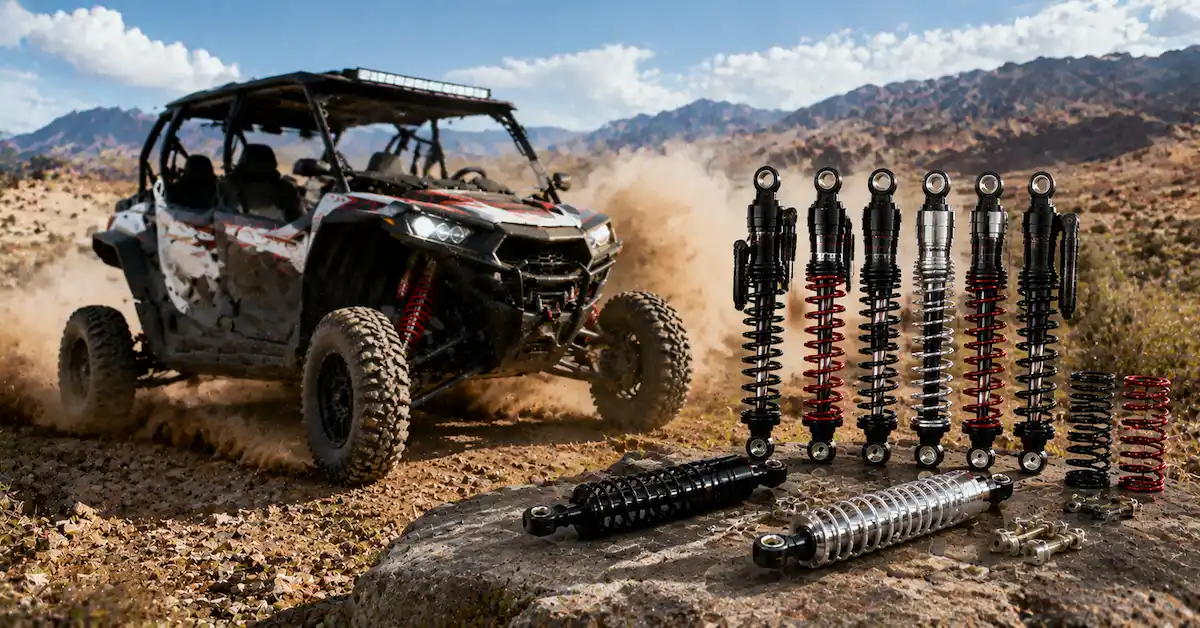

What should a buyer expect from a modified vehicle suspension supplier?
Short answer: a modified vehicle suspension supplier should review the complete change to the vehicle, not simply sell a longer or stiffer shock. Lift kits, larger tires, wheel changes, added seats, battery conversions, cargo accessories, winches, altered springs, and changed mounting points can affect ride height, motion ratio, wheel travel, clearance, axle load, and the load transferred into the chassis. The supplier's job is to connect those changes to a controlled suspension specification and a validation plan.
The buyer should therefore ask for a fitment review, load profile, geometry check, spring and damping recommendation, prototype revision control, vehicle test records, and commercial terms for samples and production. A modified vehicle is a system; replacing one component without reviewing the system can create a part that bolts on but performs poorly or reaches a mechanical limit.
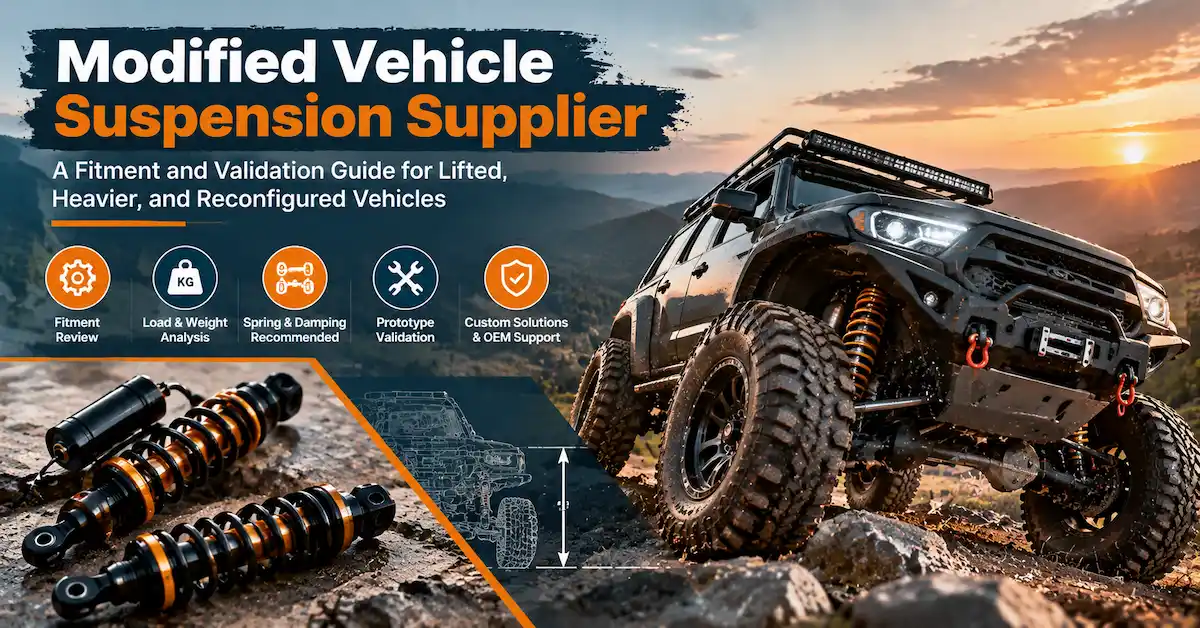
Why modified vehicles create fitment risk
A standard replacement is normally tied to a known platform, known mounting points, a known spring, and an expected operating range. Modification breaks some of those assumptions. A lift kit changes the static position of the suspension and may change the angle of a control arm or linkage. A larger tire adds unsprung mass and can move closer to a shock body, spring, brake line, or chassis at full compression. A rear seat or cargo box changes the load at one axle. A new wheel offset changes leverage and may increase forces at the hub and suspension mounts.
These effects are often combined. A golf cart may receive a lift kit, larger wheels, a lithium battery, a rear seat, and a cargo bed in one project. An ATV may receive a rack, winch, armor, and a heavier utility attachment. A motorcycle may receive a different battery, passenger seat, or delivery box. The right part cannot be chosen by the modification name alone.
| Modification | Potential suspension change | Supplier review required |
|---|---|---|
| Lift kit or altered ride height | Changes shock position, linkage angle, available travel, and mechanical limits. | Extended and compressed length, angle, bump stop, droop, and clearance. |
| Larger or heavier tires | Increases unsprung mass and can change wheel clearance and impact response. | Tire mass, diameter, width, offset, steering lock, and full-bump clearance. |
| Added seats or cargo | Changes static sag, axle load, spring support, and rear ride height. | Normal and maximum passenger/cargo conditions with axle measurements. |
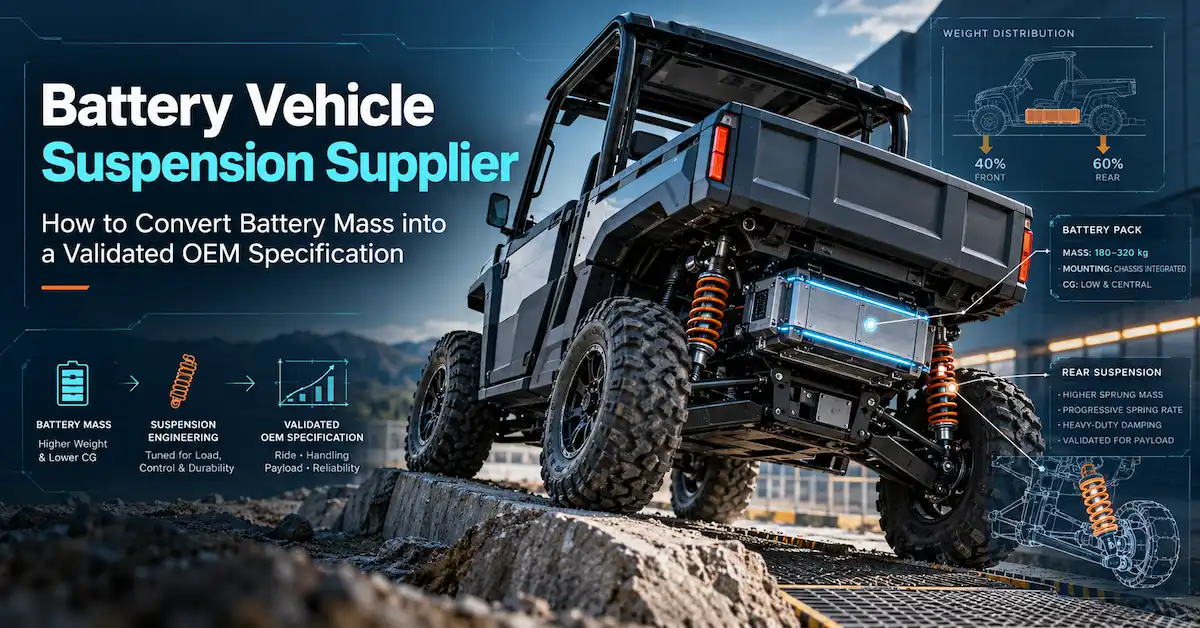
| Battery conversion | Changes total mass and front/rear distribution; may create new packaging constraints. | Battery location, enclosure, mass, center of gravity, and operating states. |
| Winch, armor, or accessories | Adds concentrated mass and can affect front sag and steering response. | Accessory mass, mounting location, and whether it is always installed. |
| Changed brackets or linkage | Changes motion ratio and force transmitted into the shock. | CAD or drawing, pivot locations, angles, and the mechanical stop strategy. |
Create a modification baseline before contacting suppliers
Document the vehicle before and after the modification
Photographs are useful, but a supplier needs measurements. Record the original and modified vehicle mass, front and rear axle loads, ride height at consistent points, tire size, wheel offset, spring condition, shock dimensions, and the location of added components. Photograph the suspension at normal ride height, full compression, and full droop if it can be done safely. Mark the measurement points so another person can repeat them.
Write down the purpose of the modification. “More aggressive” is not a sufficient performance target. The target may be improved ground clearance, less bottoming with cargo, stable passenger comfort, better control on washboard roads, reduced rebound after a bump, or a repeatable product for an aftermarket kit. Each target suggests a different validation method.
A modified vehicle suspension supplier should receive the baseline and the intended change in the same package. That makes it possible to distinguish a genuine suspension improvement from a result caused by a new tire, different pressure, altered alignment, or a changed load.
Use load states, not one maximum number
Define an unloaded state, normal operating state, and maximum intended state. If the vehicle is used by a workshop or fleet, include the load that occurs most often, not only a theoretical limit. For a modified utility vehicle, document passengers, tools, cargo, battery, accessories, and trailer tongue load. For a performance vehicle, document rider weight, protective equipment, fuel or battery state, and the terrain where the improvement is expected.
Axle load matters because a total mass number can hide a major distribution change. An accessory mounted at the front can affect steering and front sag. A rear seat or battery pack can increase rear axle load and reduce reserve travel. A suspension supplier can recommend a spring and damping configuration more responsibly when the load is connected to a location and a ride-height measurement.
Describe the intended surface and speed
Modified vehicles are often sold for a broad range of uses: road, trail, farm, resort, beach, worksite, or competition. The shock requirement changes with speed, obstacle frequency, and the number of repeated cycles. List the typical surface, the roughest routine surface, speed range, operating hours, temperature, water and mud exposure, cleaning method, and storage. This also gives the supplier a practical basis for discussing sealing, corrosion protection, and durability evidence.
Review geometry before choosing a longer or heavier shock
Extended length is only a starting point
Measure the installed shock at normal ride height, full extension, and full compression. Check the actual shock stroke, not only the vehicle's wheel travel. Confirm upper and lower hole diameter, installation width, sleeve dimensions, bushing type, thread, mounting angle, and spring clearance. If the vehicle uses a linkage, record pivot locations and the motion ratio at several points of travel.
A longer shock can increase ride height, but it can also pull the suspension into an unsafe droop condition, reduce half-shaft or ball-joint angle margin, or cause a tire to contact the body at full compression. A shorter shock can protect a component while sacrificing usable travel. The supplier should explain the trade-off in terms of the actual vehicle geometry.
Check mechanical limits and clearance
At full bump, inspect the bump stop, shock body, spring coils, tire, brake line, body panel, chassis, and battery enclosure. At full droop, inspect hose routing, joint angle, spring seating, and whether the shock becomes the suspension's limiting strap. The shock should not be asked to act as a structural stop unless the design specifically accounts for it.
Clearance should be measured with the final wheel, tire, accessories, and body installed. A prototype that clears on a bare chassis may contact after the production bracket, brake line, fender, or mud guard is installed. Provide the supplier with photos and a simple clearance envelope so the design review captures the modified vehicle rather than an incomplete mock-up.
Match spring and damping to the modified use case
Choose spring support from the real load range
Spring rate influences ride height, sag, bottoming reserve, and tire contact. A heavier spring can support a lifted or loaded vehicle, but it can also make an unloaded vehicle harsh. A softer spring may improve comfort while using too much travel under cargo. Preload can adjust installed height, but it cannot remove the need to evaluate the spring's load-deflection behavior.
Ask the modified vehicle suspension supplier to state the intended load range and the reason for the proposed spring. If the supplier offers several rates, ask for the condition each rate is designed to support. A rate stated without its measurement convention, installed length, or intended axle load is difficult to compare between companies.
Use compression and rebound language precisely
Compression damping affects the resistance as the wheel moves upward; rebound damping affects recovery after compression. The two directions should not be treated as interchangeable. Too little compression control can allow bottoming. Too much can transmit impacts to the chassis. Too little rebound can produce repeated bouncing. Too much can prevent the wheel from following successive bumps.
Ask for force data with velocity, direction, temperature, adjustment position, stroke position, and tolerance. If the shock is fixed, ask how the fixed setting was selected. If it is adjustable, ask for the usable setting range and a baseline map. More adjustment positions do not automatically mean more performance if the change between positions is not repeatable or useful on the vehicle.
Separate a suspension problem from a tire or geometry problem
A modified vehicle can feel unstable because of tire pressure, alignment, wheel offset, steering geometry, worn bushings, incorrect spring preload, or a changed anti-roll relationship. A stiffer shock may mask one symptom while leaving the cause in place. The supplier should ask what was changed, what the vehicle did before the change, what it does now, and under which load and surface the symptom occurs.
Public BEDO ATV/UTV references for a modified vehicle project
BEDO Auto's public catalog includes ATV/UTV rear shock absorber references that show how a product record can be used in an engineering discussion. AU_HSA_02 is publicly listed with a 395 mm total length, 80 mm effective stroke, 250 LBS spring rate, 3000 N rebound, 550 N compression, 12 mm mounting holes, upper 40 mm and lower 32 mm mounting widths, and fixed damping. The record also lists internal gas chamber, oil-gas separation, aluminum alloy and steel construction, and corrosion-resistant, waterproof, rust-proof, customizable design language.
AU_HSA_01 is publicly listed with a 465 mm total length, 130 mm effective stroke, 75 LBS spring rate, 2000 N rebound, 650 N compression, 10 mm mounting holes, and 32 mm mounting width at both ends. These values are reference configurations for ATV/UTV products, not a declaration that the parts suit every lifted, heavier, or reconfigured vehicle. The final decision still depends on the modified platform and load case.
| Public reference | Published values | How to use the information responsibly |
|---|---|---|
| AU_HSA_02 ATV/UTV reference | 395 mm total length; 80 mm effective stroke; 250 LBS spring rate; 3000 N rebound; 550 N compression; 12 mm holes; upper 40 mm and lower 32 mm widths; fixed damping. | Compare the dimensions and force fields with the modified vehicle; do not infer a lift-kit or payload approval from the catalog listing. |
| AU_HSA_01 ATV/UTV reference | 465 mm total length; 130 mm effective stroke; 75 LBS spring rate; 2000 N rebound; 650 N compression; 10 mm holes; 32 mm widths; fixed damping. | Use as a second reference for a different length and travel range, then review the actual mounting and motion ratio. |

How to compare a modified vehicle suspension supplier
Compare suppliers by the risk they can remove, not only by the shock body or quoted price. A modification program needs enough technical control to prevent fitment mistakes, inconsistent samples, and a production part that performs differently from the approved prototype.
| Supplier capability | Evidence to ask for | Buyer decision |
|---|---|---|
| Fitment and drawing review | Marked drawing, CAD comments, measurement sheet, and assumption list. | Can the supplier identify geometry risks before making samples? |
| Spring and damping engineering | Rate proposal, preload range, compression/rebound data, test speed, and tolerance. | Is the performance proposal tied to the modified load and use? |
| Prototype control | Sample revision, part number, configuration record, and change log. | Can the buyer compare two samples without hidden changes? |
| Vehicle testing | Load matrix, test route, measurements, photos, observations, and approval record. | Will the modified kit be validated as a system? |
| Production quality | Dimensional inspection, spring control, leakage check, damping check, and traceability. | Can the supplier repeat the approved configuration? |
| Commercial support | Sample terms, MOQ, lead time, packaging, labels, spare parts, and after-sales route. | Does the supplier fit the aftermarket or fleet launch plan? |
Use a gated workflow for modified suspension development
Step 1: write the modification bill of material
List every change that affects mass, geometry, clearance, wheel load, or vehicle use. Include the part that seems unrelated to suspension. A new rear seat, wheel spacer, battery tray, armor plate, winch, cargo rack, or body panel can change the result. Identify what is final and what is still under development.
Step 2: measure the baseline
Record axle loads, ride height, sag, shock dimensions, spring condition, tire, wheel, and clearances. Photograph the installation. If the vehicle already has a complaint, record when it occurs and under what load. A supplier can then distinguish a modification effect from a pre-existing worn bushing, leaking shock, or incorrect alignment.
Step 3: approve the geometry concept
Review length, stroke, angle, motion ratio, bump and droop limits, mounting hardware, and clearance. Confirm that the proposed part is not being used to solve an unsafe linkage angle or a structural problem that belongs elsewhere in the vehicle.
Step 4: build a controlled prototype
Record the spring, preload, damping setting, finish, hardware, revision, and measured dimensions. Install the sample on the final or clearly defined vehicle configuration. Do not add another unrecorded modification while evaluating the prototype.
Step 5: validate the actual operating states
Test unloaded, normal, and maximum intended conditions. Include representative surfaces, repeated bumps, braking, acceleration, cornering, steering clearance, noise, bottoming, topping out, ride height, and passenger or cargo feedback where relevant. A modified vehicle suspension supplier should receive observations in a controlled format rather than only a statement that the vehicle feels better.
Step 6: release the production specification
Freeze the drawing, spring, damping, dimensions, materials, finish, labels, packaging, inspection plan, and change process. If the aftermarket kit has several vehicle versions, create an application matrix with a part number for each confirmed configuration. Do not merge SKUs merely because their total shock length is similar.
Build a complete modified vehicle RFQ
A strong RFQ reduces back-and-forth and makes supplier quotations comparable. The buyer should clearly separate facts, estimates, preferences, and open questions.
| RFQ field | What to include | Why it is needed |
|---|---|---|
| Base vehicle | Brand, platform, year, front/rear position, number of units, market, and intended user. | Defines the original application and replacement context. |
| Modification list | Lift, tire, wheel, spacer, seat, battery, cargo, winch, armor, brackets, and body changes. | Shows what changed the mass or geometry. |
| Dimensions | Extended and compressed length, stroke, holes, widths, sleeves, angle, and clearance. | Controls fitment and mechanical limits. |
| Load states | Unloaded, normal, maximum, passenger, cargo, towing, and axle distribution. | Controls spring selection and validation conditions. |
| Performance problem | Bottoming, sag, bounce, harshness, instability, noise, poor clearance, or inconsistent ride height. | Connects the proposed change to an observable result. |
| Environment | Road, trail, mud, sand, water, salt, dust, temperature, speed, and daily hours. | Supports sealing, finish, and duty-cycle review. |
| Commercial plan | Prototype quantity, pilot quantity, annual volume, launch timing, packaging, labels, and private label. | Lets the supplier quote the actual program rather than a one-off part. |
Ask the modified vehicle suspension supplier to return a technical summary, open-point list, proposed sample configuration, test plan, price breakdown, MOQ, lead time, packaging, and change-control terms. This format also makes it easier to compare a local workshop supplier with a manufacturing partner.
Modified vehicle suspension supplier FAQ
Can a longer shock solve a lifted vehicle problem?
It may be part of the solution, but length alone does not confirm safe geometry. Check compression, extension, stroke, bump stop, droop, motion ratio, tire clearance, joint angles, and installation hardware before selecting a longer shock.
Does a larger tire always require a heavier shock?
No. A larger or heavier tire changes unsprung mass, clearance, leverage, and sometimes speed. The spring and damping response should be reviewed with the complete wheel and tire specification, not changed automatically.
Should I replace the spring and shock together?
That depends on the diagnosis. If the spring support is wrong, a different shock cannot restore ride height. If the spring is correct but motion is uncontrolled, the shock may need adjustment. Modified vehicles often require both to be reviewed because the load and geometry changed together.
What is more important, axle load or total vehicle weight?
Both are useful, but axle and corner loads are more actionable for suspension selection. Total weight can hide a front/rear distribution change that affects spring support and pitch.
Are catalog ATV/UTV shocks suitable for a modified vehicle?
They may be a starting reference when dimensions and loads are close, but a catalog listing does not confirm a modified vehicle's lift, tire, payload, or linkage geometry. Request fitment review and vehicle validation.
What should be measured before sending an RFQ?
Measure the installed shock, extended and compressed length, effective stroke, holes, mounting widths, sleeves, ride height, sag, axle loads, tire and wheel dimensions, and clearances at bump and droop. Provide photos and drawings where possible.
Is adjustable damping necessary for an aftermarket modification kit?
It is useful only when the buyer can define the conditions and provide a baseline. A fixed configuration can be easier for customers to install and support. The decision should account for price, setup, repeatability, and after-sales complexity.
What does a supplier need to quote a small batch?
Provide the sample or drawing, confirmed modification list, target dimensions, load cases, expected quantity, private-label requirements, packaging, delivery destination, and launch timing. Ask for sample terms, MOQ, lead time, and revision control in writing.
What claims require internal approval before publication?
Claims about a specific modified vehicle, payload, certification, durability result, customer case, corrosion rating, MOQ, lead time, and warranty require project records or written confirmation. Public catalog data should remain clearly separated from project-specific evidence.
Conclusion
A modified vehicle suspension supplier should be evaluated by its ability to understand the whole modification and control the path from measurement to repeatable production. The essential inputs are the modification list, axle loads, geometry, clearances, spring and damping targets, environment, duty cycle, and intended commercial volume. The essential outputs are a reviewed interface, a controlled prototype, a vehicle test record, a frozen specification, and clear supply terms.
BEDO Auto's published ATV/UTV references give buyers concrete dimensions and damping fields to discuss, including the AU_HSA_02 and AU_HSA_01 configurations. The next step is to send the actual modified vehicle data and ask BEDO to confirm fitment, spring, damping, samples, testing, MOQ, lead time, packaging, and change control for the intended program.