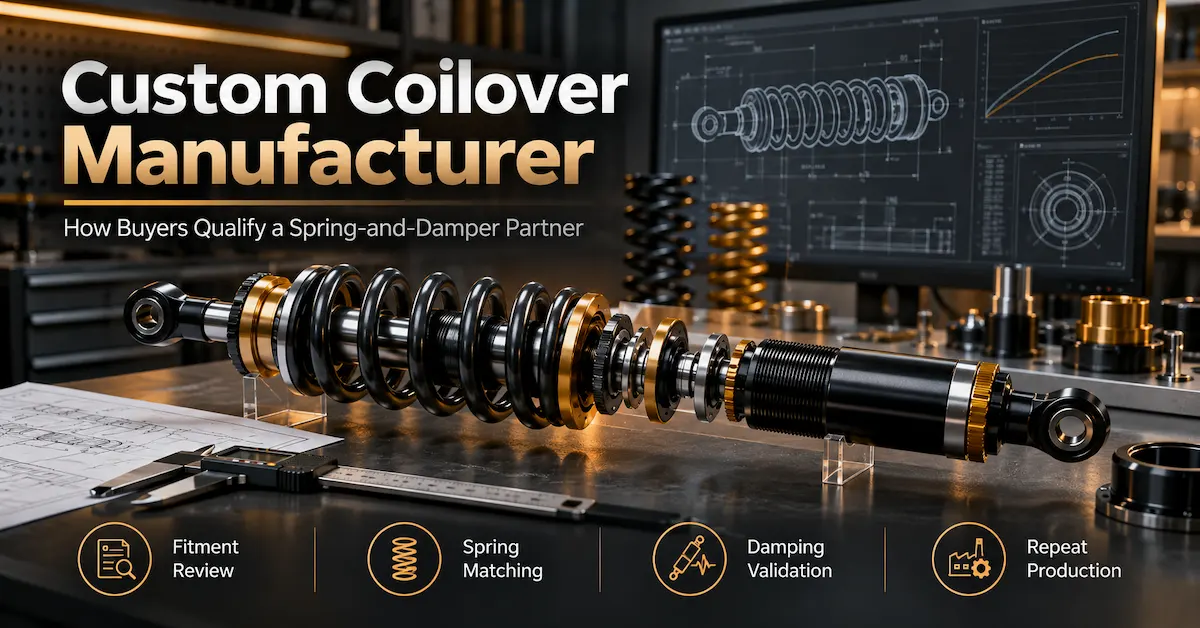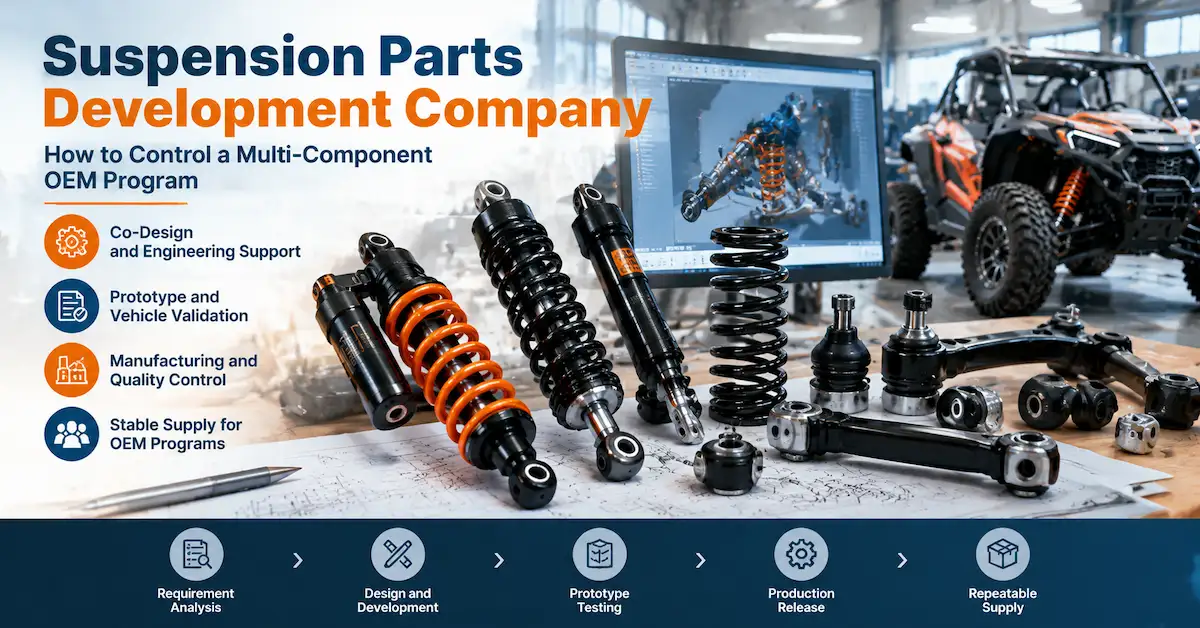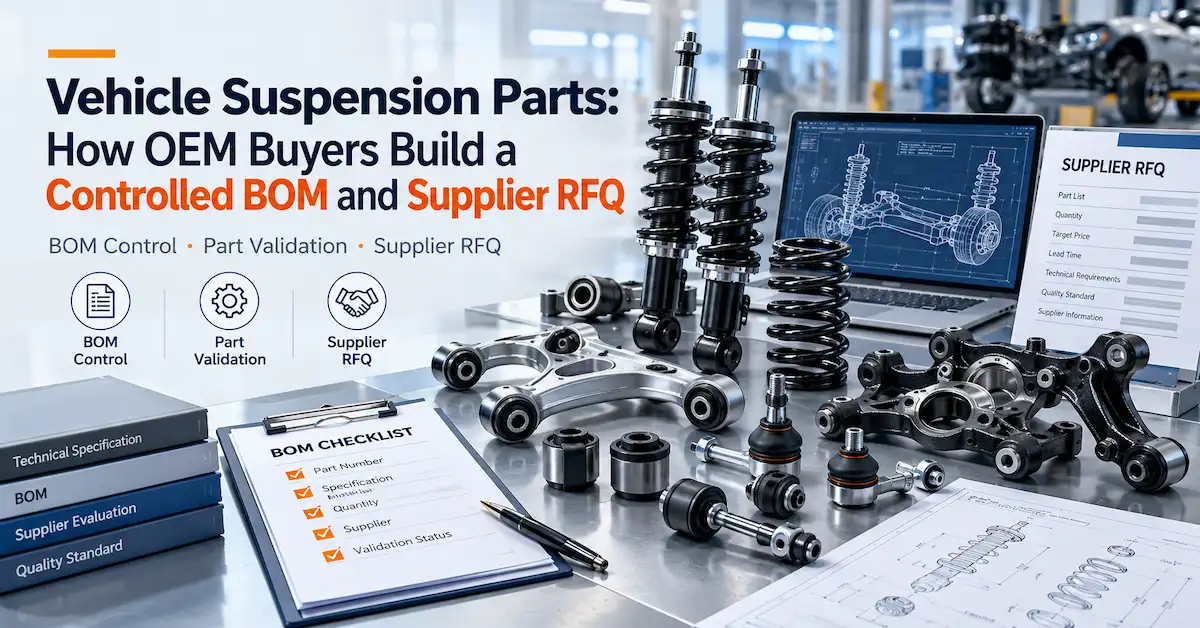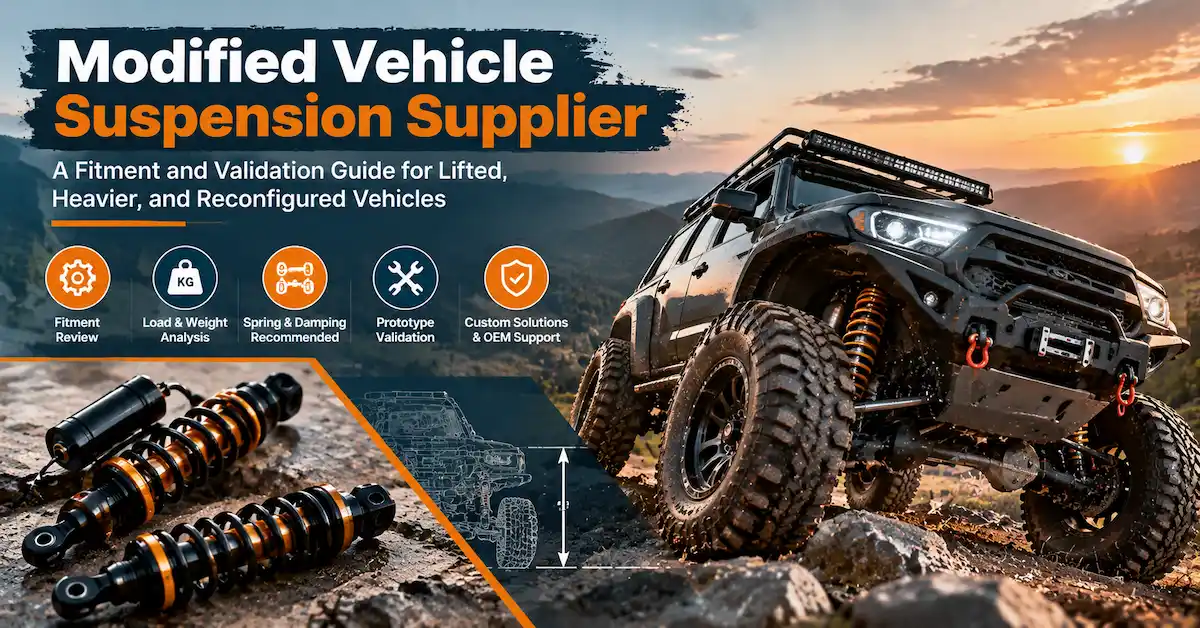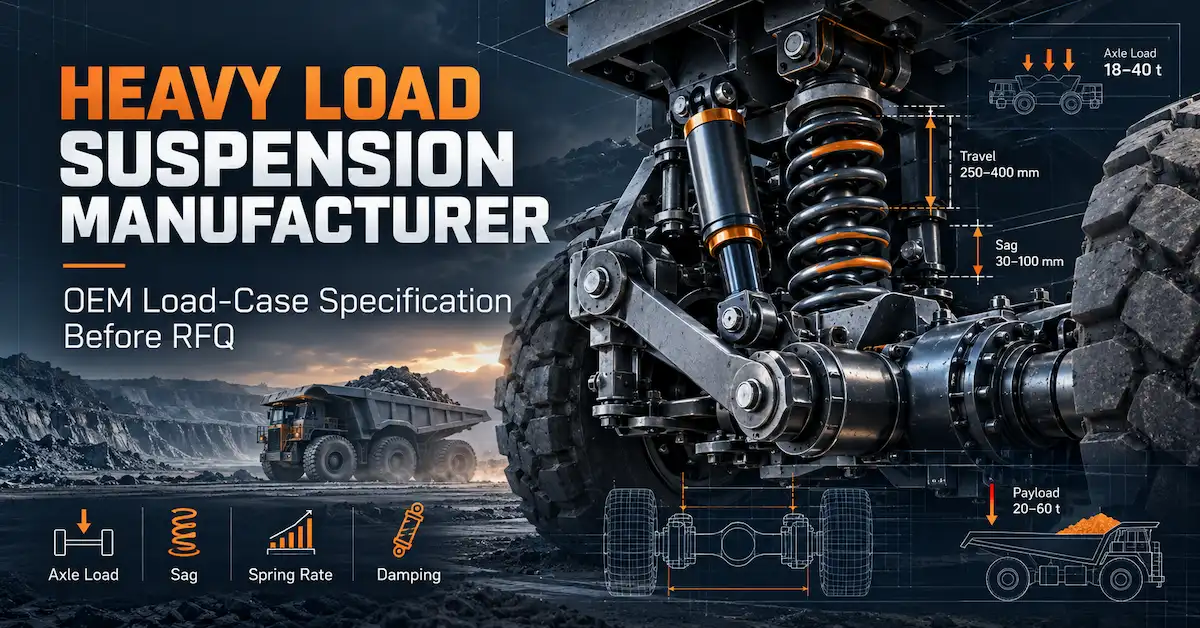

How should buyers qualify a custom vehicle shock absorber factory?
Direct answer: qualify a custom vehicle shock absorber factory by its ability to connect the vehicle requirement, drawing or sample, spring and damping definition, prototype evidence, production inspection, packaging identity, and change control. A factory is suitable for a custom program only when it can explain what it will make, what remains to be confirmed, which records prove the approved configuration, and how the same specification will be repeated after the prototype is accepted.
The buyer should compare factories on traceable engineering and manufacturing evidence, not on product photos, a low first quotation, or a general claim such as "heavy duty." The practical output of qualification is a controlled project path: requirement review, design responsibility, sample revision, vehicle validation, pilot release, production terms, and after-sales identification.
This article is for vehicle brands, aftermarket suspension companies, powersports distributors, retrofitters, fleet operators, and procurement teams sourcing a custom vehicle shock absorber factory. Its unique question is how to qualify a factory before committing to development and repeat production. It does not replace a product fitment guide or a general explanation of how dampers work.
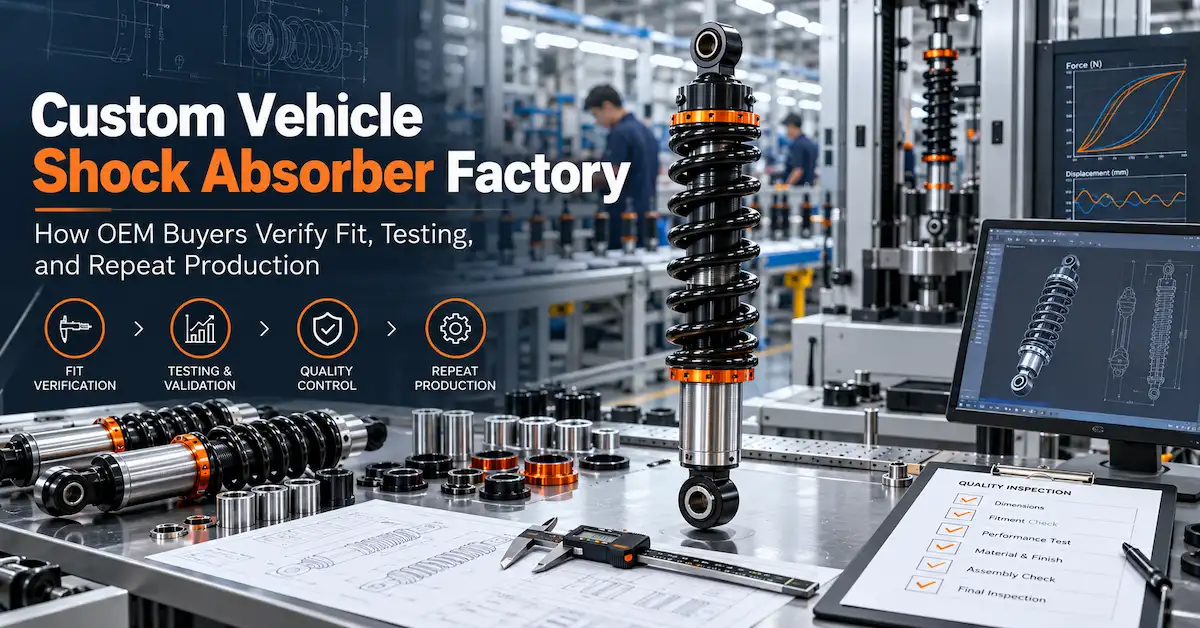
Separate factory qualification from product selection
A factory can be suitable for one standard replacement and unsuitable for a new custom vehicle shock absorber. Product selection asks whether a known reference appears to fit. Factory qualification asks whether the supplier can manage unknowns, engineering changes, inspection limits, and repeat orders. These are related decisions, but they use different evidence.
| Qualification question | What the buyer should learn | Evidence to request |
|---|---|---|
| Who owns the design? | Whether the buyer, factory, or both control the drawing, spring, damping target, and interfaces. | Design responsibility matrix, drawing review notes, and approved revision. |
| What can the factory actually make? | Which operations are internal, sourced, or performed by an approved partner. | Process map, supplier responsibilities, and inspection ownership. |
| How is a sample identified? | Whether a prototype can be distinguished from a later production part. | Part number, revision, sample label, configuration sheet, and deviation list. |
| How is performance verified? | Whether dimensions, spring, damping, leakage, and vehicle behavior use defined conditions. | Inspection plan, force test conditions, vehicle test plan, and acceptance limits. |
| How are changes controlled? | Whether a material, seal, valve, bushing, or process change can occur without notice. | Change request, approval route, notification rule, and retained records. |
| Can the part be reordered? | Whether the approved product can be found, packed, inspected, and shipped again. | Production BOM, packaging drawing, label example, MOQ, and stage lead time. |
A factory presentation can support the conversation, but it should not close the qualification by itself. Ask the supplier to tie each capability statement to a relevant part, process, record, or controlled project step. If the supplier cannot show evidence yet, record the point as open rather than treating it as confirmed.
Freeze the custom shock requirement before comparing factories
Identify the vehicle and market
State the vehicle type, platform code, model year, position, market, wheel and tire package, number of passengers, drive layout, and whether the part is OEM, replacement, upgrade, or private label. Include the final modification list if the vehicle is not standard. A custom vehicle shock absorber factory cannot make a meaningful proposal from a model name alone when the vehicle has a lift, larger tire, battery change, cargo rack, winch, armor, or altered linkage.
Market information also affects labels, instructions, packaging language, service identification, and the evidence the buyer expects. Put the sales channel and destination in the RFQ. A product sold through a distributor may need a different carton and part-number system from an OEM assembly-line component, even when the hardware is similar.
Control the mechanical interface
Record extended and compressed length, effective stroke, mounting-hole diameter, installation width, sleeve or bushing type, thread, rod and body clearance, spring seat, installation angle, bump-stop position, and full bump and droop conditions. Include a dimensioned sample or CAD if available. Check tire, brake line, drive shaft, control arm, body, reservoir, and adjustment access through the complete movement range.
Do not allow the shock to become an unintended mechanical stop. A longer shock can change droop, an oversized spring can contact the chassis, and a mounting sleeve can alter bracket clamping. The factory review should mark each interface as confirmed, proposed, or missing. This simple status is more useful than a quotation that silently assumes the dimensions.
Define load and duty cycle
Provide curb mass, front and rear axle loads, normal passenger or cargo state, maximum intended routine state, accessory mass, towing or trailer tongue load where applicable, speed range, terrain, daily hours, temperature, water, dust, salt, wash-down, and storage. The spring supports the static and changing load; the damper controls movement created by that load. Both must be evaluated together.
Write the intended result in measurable terms. Examples include a ride-height window, sag range, bottoming reserve, reduced oscillation, stable control over repeated bumps, comfortable empty operation, or a repeatable adjustment map. Words such as premium, strong, durable, and performance are useful commercial descriptions but are not acceptance criteria.
Define the commercial stage
Tell factories whether the immediate need is a drawing review, reverse engineering from a sample, one prototype, a small pilot, private-label stock, or repeat production. Separate sample quantity, pilot quantity, annual forecast, target launch date, and packaging requirement. A supplier may support small-batch ordering while still needing different quantities for springs, machined hardware, labels, or cartons. Ask for those conditions instead of assuming a universal MOQ.
Review the manufacturing route without inventing factory capabilities
Qualification should follow the part through the process. The buyer does not need an unsupported list of machines; the buyer needs to know how critical characteristics are created, checked, identified, and protected from uncontrolled change. Ask the custom vehicle shock absorber factory to describe the route at the level needed for the project's risk.
| Process stage | Critical question | Record or sample evidence |
|---|---|---|
| Requirement and drawing review | Are vehicle, load, interface, spring, damping, environment, and packaging inputs complete? | Review checklist, open-point list, assumptions, and approved design responsibility. |
| Material and component sourcing | Are body, rod, spring, seal, oil, gas, bushing, sleeve, fastener, and finish requirements identified? | Material or component specification, supplier status, incoming check, and lot identity. |
| Spring preparation | How are free length, rate or load-deflection points, preload, finish, and identification controlled? | Spring record, measurement method, tolerance, and batch traceability. |
| Shock assembly | How are seals, oil, gas, valve or adjustment, rod, body, spring seat, bushing, and hardware assembled? | Assembly instruction, torque or setup record, visual standard, and deviation process. |
| Functional inspection | How are length, stroke, movement, leakage, damping, and adjustment checked? | Inspection plan, test speed and direction, temperature, limits, and measured result. |
| Final identification | Can the approved part be separated by model, side, position, revision, and batch? | Label, barcode, pack list, carton, instruction, and retained production record. |
When a factory uses outside suppliers for a spring, coating, bushing, or machined part, that is not automatically a weakness. The qualification issue is whether the responsibility and incoming controls are clear. A buyer should know who approves the component, who handles nonconformance, and which change requires notification. The word factory does not remove the need for a supply-chain map.
Similarly, a published force value does not prove that every production unit follows the same curve. Ask how the product is sampled, what conditions are used, how the result is linked to the part number and revision, and what happens when a unit falls outside the agreed limit. This turns an attractive specification into an auditable control.
Public BEDO evidence a buyer can use in an initial review
BEDO's official pages provide public evidence for a first supplier conversation. The company page identifies Ningbo Bedo Auto Parts Co., Ltd. and presents manufacturing, customization, design support, and small-batch positioning. The product catalog presents shock absorbers, suspension springs, and ball joints. These facts support an initial scope review, but they do not replace a project-specific factory audit or engineering approval.
AU_HSA_01 is a useful public reference for the kind of information a factory can publish. Its page lists a rear ATV/UTV application, 465 mm total length, 130 mm effective stroke, 75 LBS spring rate, 2000 N rebound, 650 N compression, 10 mm upper and lower holes, and 32 mm upper and lower mounting widths. The page also describes aluminum alloy and steel pipe, an internal gas chamber, oil-gas separation, fixed damping, and a 0.1 m/s inspection speed.
| Public BEDO source | What it supports | What still requires confirmation |
|---|---|---|
| Company page | Company identity, Ningbo location, public manufacturing and custom-solution positioning. | Current process ownership, equipment, capacity, audit records, named engineer, and project case evidence. |
| Shock absorber category | Public shock absorber product direction and application scope. | Which models are suitable for the buyer's vehicle, current revisions, sample route, and production terms. |
| AU_HSA_01 | Published reference dimensions, spring, damping, materials, structure, and image. | Fitment tolerance, force tolerance, current inspection report, durability, MOQ, lead time, and packaging. |
| Suspension spring category | Public spring product direction and spring-related sourcing path. | Vehicle-specific rate, material grade, process route, load-deflection report, and coating requirement. |
Audit the transfer from prototype to repeat production
Gate 1: requirement acceptance
Before a sample is quoted, confirm vehicle revision, position, loads, geometry, environment, target, market, branding, sample quantity, and open questions. The factory should return a list of assumptions and missing fields. A project that begins with an incomplete interface usually creates expensive revisions later.
Gate 2: design and manufacturability review
Review the drawing or measured sample for datums, tolerances, material fields, spring seat, body and rod clearance, mounting interfaces, assembly access, packaging, and inspection points. Ask the factory to identify proposed deviations before the first sample. A buyer should be able to distinguish an engineering proposal from an approved requirement.
Gate 3: prototype configuration control
Give each sample a part number and revision. Record body, rod, spring, preload, oil or gas condition where controlled, valve or adjustment setting, bushing, sleeve, hardware, finish, label, and packaging. Photograph the complete sample before installation. A sample without a configuration record is not a reliable production reference.
Gate 4: bench and vehicle validation
Check dimensions, stroke, spring, damping, adjustment operation, leakage, rod movement, finish, mounting hardware, and packaging. Then test the final vehicle in empty, normal, and maximum intended routine states. Record route, surface, speed, tire pressure, alignment, temperature, load, ride height, sag, bottoming, rebound, noise, and observations. Use repeatable conditions so a later change can be compared with the approved result.
Gate 5: pilot release
Use a pilot quantity appropriate to the project to check variation between units, assembly feedback, labels, packaging, inspection records, and nonconformance handling. The pilot should answer whether the factory can reproduce the sample, not merely whether one sample looks correct.
Gate 6: production and change control
Freeze the BOM, drawing, spring, damping target, test conditions, inspection plan, packaging, label, and approved supplier responsibilities. Define changes that require notification, a new sample, repeated vehicle validation, or written buyer approval. Control changes to seals, oil, gas, valving, coating, bushing, sleeve, spring, fastener, and packaging as carefully as dimensional changes.
Check factory quality records against the buyer's risk
Do not request every internal document without purpose. Ask for records that answer the actual failure modes in the vehicle program. A high-load utility shock may need stronger focus on spring and damping consistency; a salt-exposed recreational vehicle may need more detail on finish, seals, wash-down, and storage; a private-label distributor may need stronger label, carton, and replacement traceability.
| Risk | Record to request | Acceptance discussion |
|---|---|---|
| Wrong fitment | Dimensional report, interface drawing, sample fit record, and full-travel clearance check. | Which dimensions are critical and what tolerance controls them? |
| Ride-height variation | Spring identity, rate or load-deflection record, free length, installed length, and preload. | How are spring lots and assembly settings linked to the shock? |
| Different damping | Force report with speed, direction, temperature, setting, and part revision. | What is tested on every unit, by sampling, or only during development? |
| Leakage or friction | Functional inspection, seal check, rod condition, leakage result, and nonconformance record. | What is the failure definition and containment route? |
| Mixed inventory | Part number, position, side, revision, barcode, pack list, and carton photograph. | How does the assembly or distributor identify a superseded part? |
| Unapproved change | Change log, supplier change notice, approval record, and affected-batch list. | Which changes trigger new samples or vehicle testing? |
When the factory cannot share a customer report because of confidentiality, ask for a redacted example or a project-specific template. The objective is to see the structure and traceability of the evidence, not to obtain another customer's private information.
Make the commercial quotation comparable
Factories can appear cheaper when engineering work, packaging, testing, or fixture costs are left outside the unit price. Ask each candidate to separate one-time and recurring costs. Define whether the quotation covers design review, sample tooling, samples, testing, private-label artwork, hardware, packaging, inspection, and shipping.
| Commercial field | What to ask | Why it protects the program |
|---|---|---|
| MOQ | Prototype, pilot, first production, repeat production, and each component or label quantity. | Prevents a low unit price from creating an unplanned inventory commitment. |
| Lead time | Drawing review, prototype, revision, pilot, production, inspection, packaging, and shipping stages. | Reveals which milestones depend on buyer approval or material arrival. |
| Packaging | Individual protection, hardware pack, label, barcode, carton, pallet, and instruction scope. | Connects the part to the assembly plant, distributor, and service channel. |
| Price basis | Revision, quantity, material, finish, test scope, tooling, freight, and validity. | Makes factory comparisons technically fair. |
| After-sales | Part identification, replacement route, warranty basis, and technical contact. | Reduces field downtime and unstructured troubleshooting. |
BEDO's public website mentions custom solutions, design support, and small-batch ordering, but it does not publish one universal commercial rule for every custom shock program. Ask BEDO to return project-specific terms in writing. The quotation should also list assumptions and exclusions so that an apparently complete price does not hide an unfinished engineering scope.
Prepare a factory qualification RFQ
A strong RFQ gives a custom vehicle shock absorber factory enough information to evaluate fitment, performance, production risk, and commercial scope at the same time. Send the following as one controlled package and mark estimated fields clearly.
| RFQ section | Required input | Requested supplier response |
|---|---|---|
| Company and project | Buyer identity, market, vehicle program, contact, target launch, and annual forecast. | Capability fit, project contact, assumptions, and open questions. |
| Vehicle and load | Platform, position, axle loads, passengers, cargo, accessories, terrain, speed, and environment. | Application review and proposed spring/damping path. |
| Geometry | Lengths, stroke, holes, widths, sleeves, angle, travel, bump, droop, and clearance. | Fitment risk, drawing responsibility, and proposed interface. |
| Performance | Ride height, sag, bottoming reserve, comfort, control, damping preference, and test route. | Specification assumptions, sample configuration, and validation plan. |
| Production | Sample quantity, pilot quantity, volume, private label, inspection, packaging, and delivery. | MOQ, stage lead time, price basis, records, and change-control terms. |
Ask the custom vehicle shock absorber factory to return a line-by-line response rather than a brochure. The response should distinguish confirmed facts, proposed values, missing inputs, and buyer approvals. This makes the next meeting shorter and creates a record that can be compared with other candidates.
Custom vehicle shock absorber factory FAQ
What is the difference between a factory and a custom shock supplier?
A factory should control or coordinate the approved design, manufacturing route, assembly, inspection, identification, packaging, and change process. A supplier may provide a standard part or development service without owning every manufacturing step. The buyer should verify the actual responsibility instead of relying on the title used in marketing.
Can a factory quote from a product photograph?
A photograph can start a conversation, but it cannot define stroke, mounting tolerance, spring rate, damping, materials, or full-travel clearance. Send a sample, drawing, CAD, or complete measurement record and identify the vehicle and load cases.
Does a published force value prove production consistency?
No. Force data must be connected to speed, direction, temperature, setting, tolerance, part revision, and inspection method. Ask how production units are checked and how out-of-limit results are handled.
Should the buyer audit every outside component supplier?
Not automatically. The custom vehicle shock absorber factory should define the responsibilities and incoming controls for springs, seals, bushings, coatings, sleeves, and other sourced parts. Higher-risk components may require additional evidence or approval.
Does small-batch support mean there is no MOQ?
No. Small-batch support does not establish one MOQ for every spring, shock assembly, label, carton, or custom component. Request separate prototype, pilot, and repeat-production terms.
What is the most useful factory-audit question?
Ask the supplier to show how an approved prototype becomes a repeatable production part. The answer should cover revision control, spring and damping identity, inspection, packaging, traceability, nonconformance, and change approval.
Can BEDO confirm a universal custom shock configuration?
No universal configuration should be assumed. BEDO's public product references are starting points. Vehicle geometry, load, terrain, position, and target performance must be reviewed for the specific program.
What should be added before publication?
Add a named author and technical reviewer, confirm the current product revision, and insert only approved MOQ, lead time, packaging, test, certification, warranty, and case-study information. The public pages alone do not prove every project-specific claim.
Conclusion
A custom vehicle shock absorber factory should be qualified through evidence that connects requirements, engineering, manufacturing, inspection, packaging, and repeat supply. The right partner can explain design responsibility, component sourcing, prototype configuration, bench and vehicle validation, pilot control, and change approval in terms the buyer can audit.
BEDO Auto's public company and product pages provide a factual starting point: a Ningbo manufacturer identity, shock absorber and suspension-component categories, custom-solution positioning, factory imagery, and selected product parameters. The next step is to send a controlled vehicle RFQ and ask BEDO to confirm the exact development path, product revision, evidence package, MOQ, lead time, packaging, and change-control terms for the intended market.