
What Does a Custom Shock Absorber Manufacturer in China Actually Do?
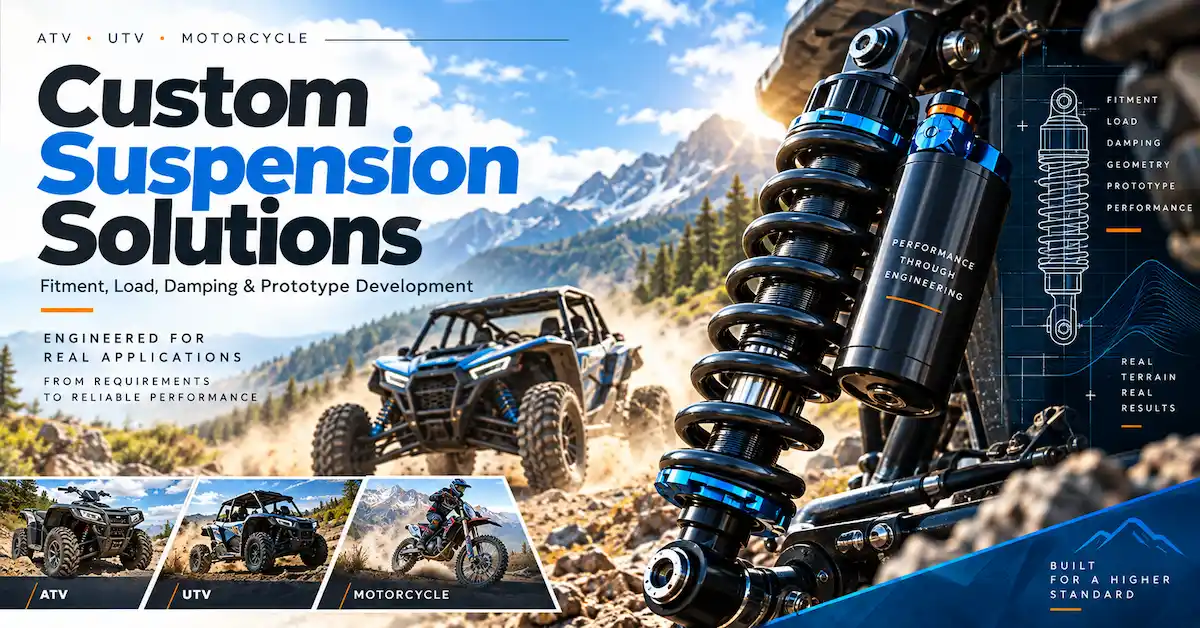
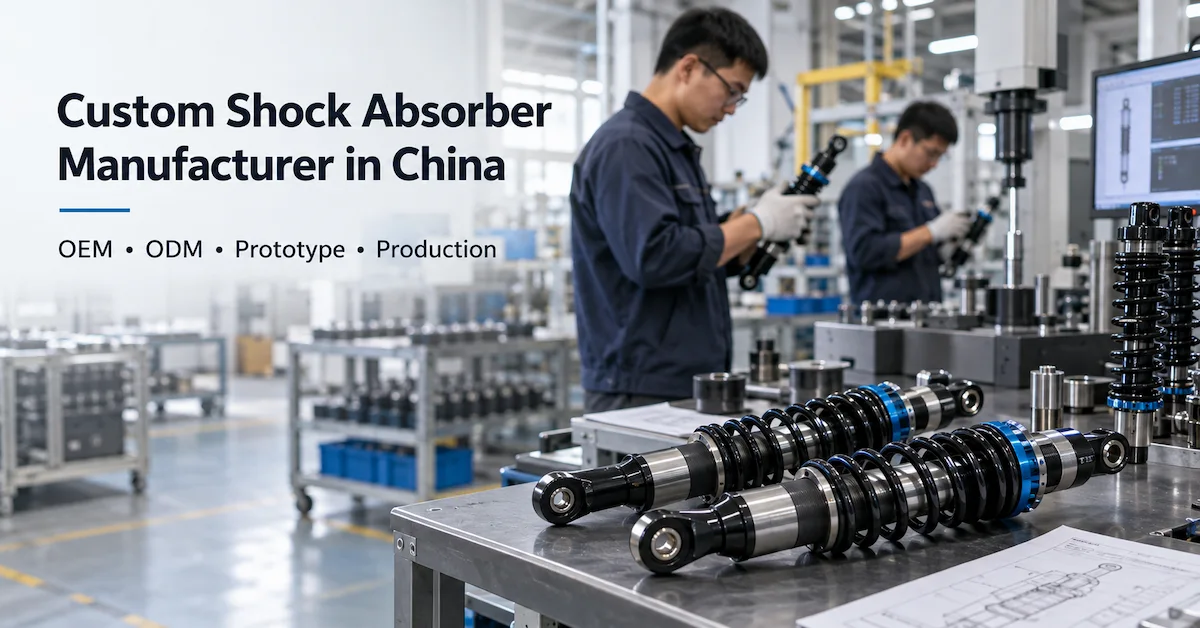
A Custom shock absorber manufacturer in China can provide very different levels of customization depending on the buyer, vehicle, product maturity, and engineering scope.
For one buyer, “custom shock absorber” may mean:
- a different spring color;
- a logo;
- branded packaging.
For another buyer, it may mean:
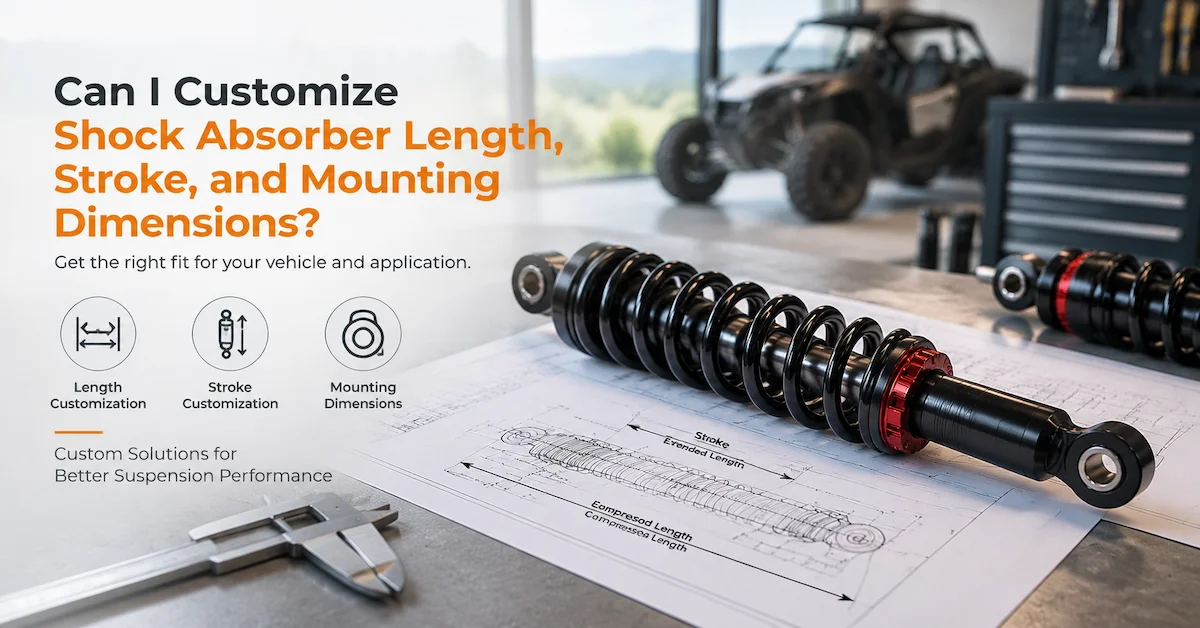
- new mounting dimensions;
- a different shock length;
- revised stroke;
- a new spring rate;
- customized compression damping;
- customized rebound damping;
- an external reservoir;
- prototype testing;
- small-batch validation;
- vehicle-specific development.
These two projects should not be treated as the same type of sourcing program.
The first is mainly commercial customization.
The second is engineering customization.
This distinction is one of the most important things an overseas buyer should clarify before asking Chinese manufacturers for quotations.
If the customization level is unclear, suppliers may quote completely different scopes while appearing to quote the same product.
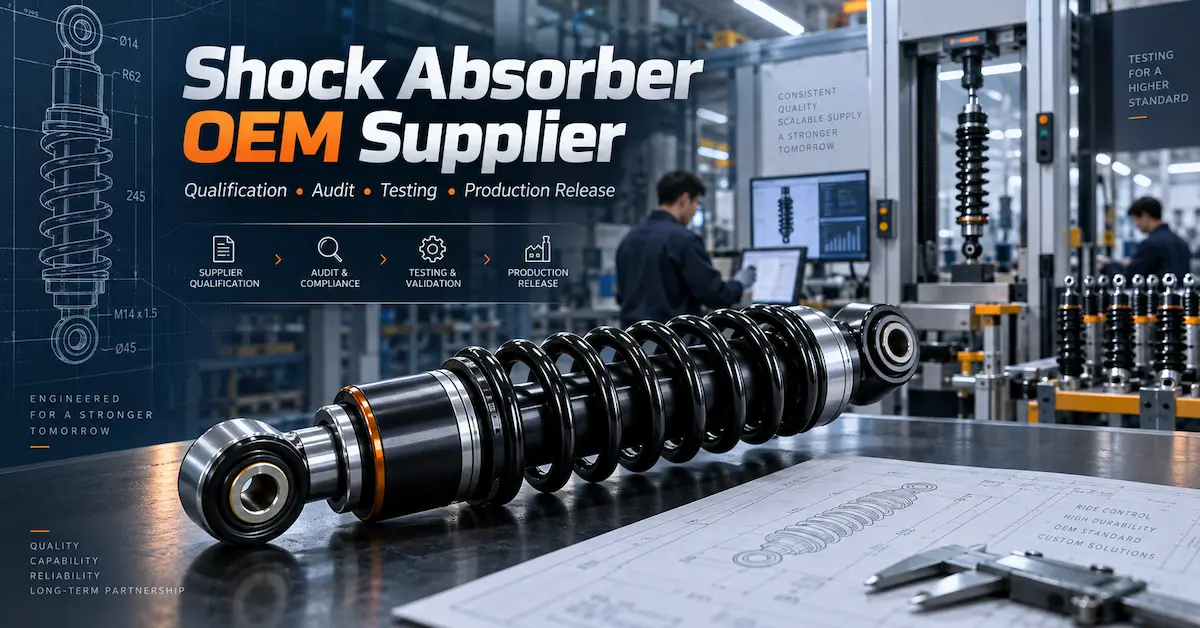
BEDO's current shock absorber and suspension product range provides a useful starting point for understanding existing ATV, UTV, motorcycle, and other off-road suspension configurations before deciding how far customization needs to go.
Why Buyers Search for Custom Shock Absorber Manufacturers in China
Global buyers typically approach Chinese suspension manufacturers for one or more of five reasons.
1. Existing Products Do Not Fit the Vehicle
The buyer may need different:
- mounting-hole diameters;
- mounting widths;
- extended length;
- compressed length;
- stroke;
- body dimensions.
This is primarily a fitment customization project.
2. Existing Suspension Does Not Support the Real Load
The vehicle may have:
- more passengers;
- higher cargo weight;
- a larger battery;
- accessories;
- larger tires;
- commercial equipment.
This may require revised:
- spring rate;
- preload;
- damping.
3. The Buyer Wants a Differentiated Aftermarket Product
An aftermarket brand may want to avoid selling the same generic shock as every competitor.
Differentiation may involve:
- application-specific setup;
- adjustable damping;
- reservoir configuration;
- spring color;
- body finish;
- branding;
- packaging.
4. A New Vehicle Is Being Developed
Vehicle OEMs and specialty-vehicle developers may have:
- CAD;
- suspension geometry;
- target wheel travel;
- vehicle weight;
- performance requirements;
but no final shock absorber specification yet.
This is closer to an engineering or ODM program.
5. The Buyer Needs a More Scalable Supply Chain
A company may already have an existing product but needs:
- repeat manufacturing;
- private label;
- lower development risk;
- wider model coverage;
- stable production;
- export supply.
The correct supplier strategy depends on which of these problems the buyer is actually trying to solve.
The Four Levels of Custom Shock Absorber Development
A practical way to compare Chinese manufacturers is to classify the project into four levels.
| Customization Level | Typical Scope | Engineering Depth | Suitable Buyers |
|---|---|---|---|
| Level 1 — Branding | Color, logo, label, packaging | Low | Private-label sellers |
| Level 2 — Dimensional | Length, mounts, stroke, interfaces | Medium | Replacement/fitment projects |
| Level 3 — Performance | Spring rate, compression, rebound | Medium–high | Performance/utility brands |
| Level 4 — Vehicle-Specific | Geometry, load, complete tuning | High | OEMs/new platforms |
A supplier capable of Level 1 customization is not automatically capable of Level 4.
This distinction should be made before supplier comparison begins.
Level 1: Private-Label Customization
Private-label customization is generally the easiest type of project.
It may include:
- shock-body color;
- spring color;
- laser marking;
- printed logo;
- labels;
- carton design;
- retail packaging.
This can be appropriate when:
- the existing shock specification already suits the target vehicle;
- the buyer does not need performance changes;
- product differentiation is mainly commercial.
What Buyers Should Still Control
Even simple private-label projects should define:
- exact product model;
- spring specification;
- damping version;
- finish;
- logo position;
- label content;
- packaging.
The technical product should be frozen before branding is approved.
A common mistake is spending significant time on package design while the underlying suspension specification remains unclear.
Level 2: Dimensional Customization
This type of project begins when the existing product is mechanically close but does not fully fit.
Typical changes include:
- extended length;
- compressed length;
- stroke;
- mounting-hole size;
- mounting width;
- upper/lower mount design;
- reservoir position.
At this level, customization becomes engineering-sensitive.
Changing one dimension may affect another.
For example, changing extended length may influence:
- suspension droop;
- joint angles;
- vehicle ride position.
Increasing stroke may create:
- bottoming conflicts;
- chassis interference;
- tire clearance problems.
A competent custom shock absorber manufacturer should therefore review the complete fitment envelope rather than adjust one number in isolation.
Level 3: Performance Customization
This level focuses on how the suspension behaves.
Common variables include:
- spring rate;
- preload;
- compression damping;
- rebound damping;
- fixed vs adjustable damping;
- reservoir architecture.
This kind of project normally requires clearer vehicle information.
The manufacturer may need:
- curb weight;
- typical operating weight;
- maximum load;
- passenger count;
- cargo;
- terrain;
- current suspension complaints.
A statement such as:
We want a stronger shock.
is not a useful engineering specification.
A better requirement is:
The rear suspension has excessive sag with two passengers and cargo, and the vehicle rebounds too quickly after larger compression events.
That provides a real technical problem to evaluate.
Level 4: Vehicle-Specific Suspension Development
This is the highest level of customization.
The manufacturer may need to work with:
- vehicle drawings;
- 3D CAD;
- suspension hard points;
- shock motion ratio;
- wheel travel;
- packaging limitations;
- axle load;
- tire/wheel configuration;
- operating terrain;
- target handling.
At this point, the buyer is not simply sourcing a shock absorber.
The buyer is developing part of the vehicle suspension system.
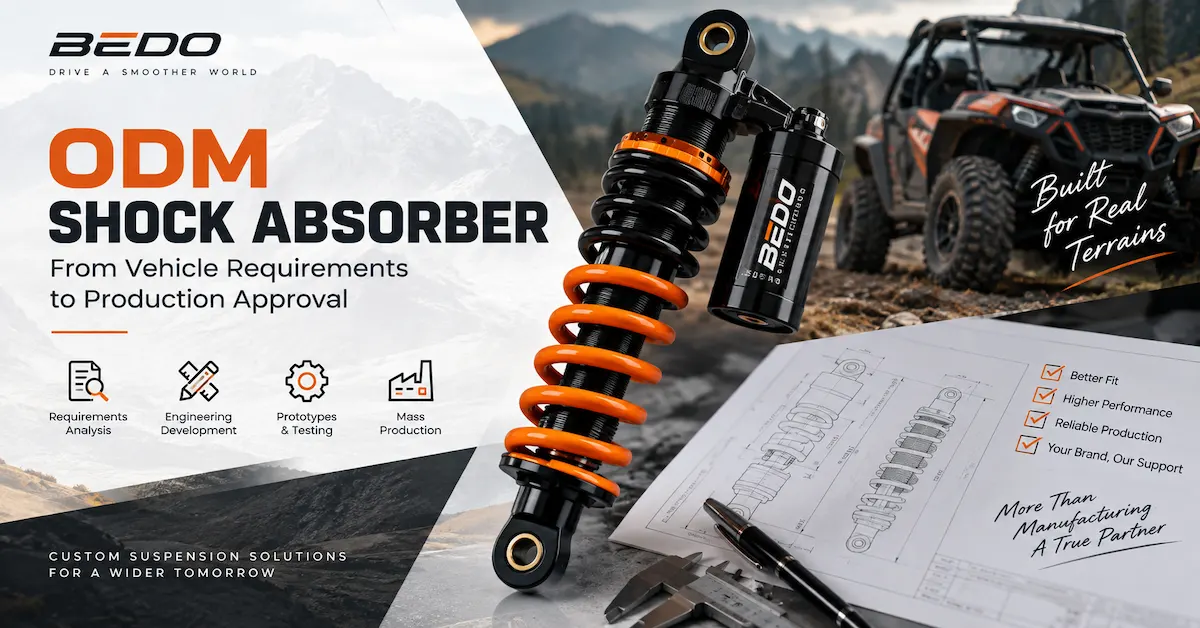
BEDO's ODM Shock Absorber Development Guide explains this progression from vehicle requirements to engineering specifications, prototypes, validation, and production approval.
Decide Which Development Path You Need
Another useful distinction is how the project starts.
There are four common entry points.
Sample-Based Development
The buyer already has an existing shock absorber.
The manufacturer can evaluate:
- physical dimensions;
- mounting;
- spring;
- structure;
- visible materials and finishes.
This route is useful when original drawings are unavailable.
However, a sample only shows what the current product is.
It does not automatically show:
- what should be improved;
- the target load;
- the desired damping behavior.
BEDO's sample-and-technical-parameter customization guide explains why physical samples should be combined with technical requirements.
Drawing-Based Manufacturing
The buyer already controls:
- dimensions;
- mounting;
- tolerances;
- product structure.
The project is more suitable for OEM manufacturing.
The supplier's job is to review manufacturability and reproduce the approved design consistently.
CAD-Based Development
CAD becomes useful when:
- packaging is tight;
- reservoir position matters;
- suspension geometry changes;
- a new chassis is being developed.
Requirement-Based Development
The buyer may only know:
- vehicle;
- load;
- current problem;
- target performance.
The supplier contributes more engineering work.
This is closer to ODM development.
What Information Should You Prepare Before Contacting a Chinese Factory?
A detailed project brief improves both quotations and engineering feedback.
At minimum, prepare the following.
Vehicle Information
- vehicle type;
- model or project code;
- front or rear position;
- model year where relevant.
Weight Information
- curb weight;
- operating weight;
- passenger load;
- cargo;
- accessories.
Fitment Information
- extended length;
- compressed length;
- stroke;
- upper mount;
- lower mount;
- hole diameter;
- mounting width.
Performance Information
- spring rate if known;
- preload;
- compression damping;
- rebound damping;
- current problem.
Application Information
- utility;
- recreation;
- performance;
- agriculture;
- sand;
- mud;
- rocky trail;
- snow;
- coastal.
Commercial Information
- sample quantity;
- first-order quantity;
- annual forecast;
- private-label requirements;
- packaging.
This information allows a manufacturer to determine whether the project requires a standard product, modification, or deeper engineering.
Do Not Send Only a Product Photo
One of the weakest RFQs a buyer can send is:
Can you make this?
with one product image attached.
A photo cannot reliably define:
- dimensions;
- stroke;
- internal damping;
- spring rate;
- mounting tolerance;
- loaded vehicle behavior.
Photos can help with visual identification.
They should not replace engineering data.
How to Evaluate Whether a Chinese Manufacturer Really Understands Customization
The quality of the supplier's questions is often more informative than the quality of its brochure.
A serious manufacturer may ask:
- Which vehicle is this for?
- What is the front/rear installation position?
- What load does the vehicle carry?
- What terrain is expected?
- Are you copying the current damping?
- What problem do you want to solve?
- Can you provide a sample?
- Is CAD available?
- Which dimensions are fixed?
These questions indicate that the supplier is trying to understand the application.
A factory that immediately sends a price without clarifying a complex custom requirement may be quoting assumptions.
Custom Shock Absorber Manufacturer vs Trading Company
Buyers often ask whether they should work directly with a factory.
The answer depends on the project.
Direct Manufacturer Advantages
Potential benefits include:
- faster technical communication;
- clearer engineering feedback;
- better revision control;
- easier manufacturing traceability.
Trading Company Advantages
A capable trading partner may provide:
- multi-product sourcing;
- export coordination;
- communication support;
- supplier consolidation.
Neither model is automatically better.
For engineering-heavy custom shock projects, however, the buyer should understand:
Who actually controls the technical specification and manufacturing process?
BEDO's Shock Absorber Factory RFQ Questions provides additional questions for verifying factory and technical capability.
How to Compare Chinese Custom Shock Absorber Manufacturers
Use a structured matrix instead of comparing websites.
| Evaluation Area | Supplier A | Supplier B | Supplier C |
|---|---|---|---|
| Relevant vehicle experience | |||
| Sample development | |||
| Drawing review | |||
| CAD capability | |||
| Spring customization | |||
| Damping development | |||
| Prototype support | |||
| Small-batch production | |||
| QC | |||
| Revision control | |||
| Private label | |||
| Repeat supply |
This makes differences visible.
What Should a Good Manufacturer Be Able to Customize?
For a serious project, customization may include several layers.
Dimensions
- shock length;
- stroke;
- eye-to-eye dimensions;
- mounting interfaces.
Spring
- spring rate;
- free length;
- preload configuration;
- coating;
- color.
Damping
- compression;
- rebound;
- fixed or adjustable characteristics.
Structure
- internal/external gas chamber;
- reservoir configuration;
- mounting arrangement.
Appearance
- body finish;
- spring color;
- logo.
Packaging
- label;
- carton;
- private label.
Not every project needs all of these.
The goal is to customize only what creates useful value.
How Much Does a Custom Shock Absorber Cost in China?
There is no responsible universal price.
Cost depends on the engineering scope.
Important cost drivers include:
- existing platform vs new design;
- shock size;
- materials;
- spring specification;
- damping complexity;
- adjustability;
- reservoir;
- machining;
- surface finish;
- prototype quantity;
- tooling;
- testing;
- packaging;
- production quantity.
A private-label color change is commercially different from developing a vehicle-specific adjustable reservoir shock.
Therefore, when comparing China quotations, normalize the scope first.
Why the Lowest Chinese Quote May Not Be the Lowest Project Cost
Suppose Supplier A has the lowest unit price.
But it requires:
- three extra prototype rounds;
- new freight for every revision;
- higher MOQ;
- more quality claims.
Supplier B has a higher unit price but better engineering alignment.
The total project cost may favor Supplier B.
A useful comparison is:
Unit Cost + Development Cost + Tooling + Testing + Freight + Quality Risk + Warranty Risk
This is especially important for OEM and branded aftermarket projects.
What Affects MOQ?
MOQ can depend on:
- component availability;
- spring customization;
- surface treatment;
- machining;
- packaging;
- production scheduling.
There may also be different quantities for:
- prototypes;
- pilot batch;
- first production;
- repeat orders.
Do not ask only:
What is your MOQ?
Ask:
What quantity applies at each stage of the project?
BEDO supports small-batch development for suitable customized suspension programs. The Small-Batch OEM/ODM Suspension Guide explains why buyers may validate a smaller batch before committing to larger production.
What Affects Development Lead Time?
Lead time should also be separated into stages.
Typical stages include:
- requirement review;
- drawing confirmation;
- sample manufacturing;
- buyer testing;
- revision;
- pilot production;
- mass production.
Incomplete data can extend development more than factory production time.
A project with a fully controlled drawing may move faster than a project beginning from:
- photographs;
- incomplete measurements;
- unclear performance requirements.
Prototype Development: What Should Be Checked?
A prototype should not be approved only because it looks correct.
Check:
Fitment
- extended length;
- compressed length;
- stroke;
- mounting interfaces;
- clearance.
Static Vehicle Setup
- ride height;
- sag;
- spring preload;
- load support.
Dynamic Behavior
- compression;
- rebound;
- bottoming;
- repeated-bump response.
Product Condition
- leakage;
- rod movement;
- assembly;
- coating;
- hardware.
Give the Factory Useful Test Feedback
Avoid:
Too soft.
Instead write:
With two passengers and 80 kg rear cargo, loaded ride height is lower than target and the suspension bottoms over repeated medium-size obstacles.
Avoid:
Damping is bad.
Instead write:
Rear rebound is too fast after large compression events at the normal operating load.
Specific feedback reduces unnecessary prototype iterations.
When Should You Use a Shock Dyno or Damping Evaluation?
Damping evaluation becomes more useful when:
- performance is a key sales point;
- buyer and supplier need objective comparison;
- several damping variants are being tested;
- batch consistency needs verification.
However, a dyno curve alone does not prove correct vehicle performance.
Vehicle behavior still depends on:
- spring;
- geometry;
- load;
- tire;
- terrain.
Testing data should support—not replace—vehicle validation.
BEDO discusses this process in its Compression and Rebound Damping Testing Guide.
Why Small-Batch Production Is Important
One successful sample proves one sample.
It does not prove the factory can repeat the result.
A pilot batch can help verify:
- dimensions;
- assembly;
- spring consistency;
- damping consistency;
- leakage;
- coating;
- packaging.
This is one of the most important steps between development and scale.
Sample-to-Mass Production Transfer Is a Critical Risk
The best prototype is useless if mass production does not match it.
Before mass production, freeze:
- drawing revision;
- spring specification;
- damping configuration;
- mounting parts;
- finish;
- branding;
- packaging.
The approved sample and documentation should point to the same revision.
Ask About Change Control
After approval, what happens if the supplier wants to change:
- a seal;
- spring;
- material;
- piston rod;
- coating;
- mounting part?
A custom shock absorber manufacturer should have a process for identifying significant changes.
The buyer should define which changes require:
- notification;
- approval;
- new samples.
This becomes more important in long-term programs.
What Quality Checks Matter?
A production QC plan may include:
- dimensions;
- mounting-hole diameter;
- mounting width;
- stroke;
- spring identification;
- assembly;
- rod movement;
- leakage;
- finish;
- labeling;
- packaging.
The exact plan should be based on project risk.
BEDO's Shock Absorber Testing Guide explains why development tests and production checks should not be treated as the same activity.
Corrosion and Environmental Protection
Custom suspension projects may operate in:
- mud;
- water;
- beach environments;
- coastal markets;
- snow.
In these cases, discuss:
- shock-body finish;
- spring coating;
- piston-rod protection;
- mounting hardware;
- reservoir finish.
Do not simply request “rust-proof.”
Define the environmental exposure.
Private Label: Control Product and Packaging Separately
Private-label buyers should approve two layers.
Technical Product
- dimensions;
- spring;
- damping;
- finish;
- hardware.
Brand Presentation
- logo;
- product label;
- carton;
- packaging.
A packaging revision should not accidentally change the technical product.
Likewise, a technical revision may require new labeling if product identity changes.
Intellectual Property and Project Files
Custom projects may involve:
- vehicle drawings;
- CAD;
- proprietary dimensions;
- new product concepts.
Before sending sensitive information, clarify:
- confidentiality;
- file use;
- ownership;
- subcontractor access.
Do not send an entire vehicle CAD package when only suspension interface data is required.
Share enough information to solve the engineering problem.
Export and Logistics Should Be Considered Early
International sourcing does not end at the factory gate.
Buyers should clarify:
- packaging;
- carton protection;
- labeling;
- shipping quantities;
- export documentation;
- spare parts or service requirements.
Shock absorbers are relatively dense products.
Packaging design therefore affects:
- protection;
- carton strength;
- freight efficiency.
A technically excellent product can still create commercial problems if packaging is poorly controlled.
Standard Product vs Custom Product: Which Is Better?
Custom is not automatically better.
Choose a Standard Product When
- fitment already works;
- target load is conventional;
- performance target is standard;
- speed to market is critical.
Choose Semi-Custom When
- only spring;
- finish;
- mounting;
- branding
needs revision.
Choose Full Custom Development When
- vehicle geometry is unique;
- existing shocks fail;
- load is non-standard;
- specific damping behavior is required;
- OEM differentiation matters.
The correct customization level should minimize unnecessary development.
Sample-Based vs Drawing-Based vs Vehicle-Based Development
| Development Method | Best When | Main Risk |
|---|---|---|
| Sample-based | No original drawing | Copying existing problems |
| Drawing-based | Specification is mature | Missing application context |
| CAD-based | Packaging/geometry matters | Incomplete vehicle assumptions |
| Vehicle-based ODM | New platform/performance target | More development time |
Strong buyers choose the method that fits project maturity.
Common Mistakes When Sourcing Custom Shock Absorbers From China
Mistake 1: Sending Only a Photo
Result: quotation based on assumptions.
Mistake 2: Asking Only for Price
Result: suppliers quote different technical scopes.
Mistake 3: Using “Heavy Duty” as a Specification
Result: unclear spring and damping target.
Mistake 4: Copying a Failed Sample Exactly
Result: original performance problem remains.
Mistake 5: Skipping Vehicle Load Data
Result: spring rate may be inappropriate.
Mistake 6: Skipping Prototype Testing
Result: fitment problem reaches production.
Mistake 7: Approving One Sample and Ordering Large Volume
Result: production variation is not verified.
Mistake 8: No Revision Control
Result: factory manufactures the wrong version.
Mistake 9: Comparing Unequal Quotations
Result: low-price supplier appears cheaper because scope is smaller.
Mistake 10: Treating Branding as Engineering
Result: attractive product without application advantage.
How to Structure a High-Quality RFQ
Instead of:
We need custom shock absorbers. Please quote.
Use a structured RFQ.
Include:
- Vehicle type
- Model/project code
- Front/rear position
- Current shock sample
- Extended length
- Compressed length
- Stroke
- Upper mount
- Lower mount
- Vehicle curb weight
- Operating load
- Passenger load
- Cargo
- Accessories
- Current spring information
- Current damping data
- Terrain
- Current problem
- Target improvement
- Drawing/CAD availability
- Prototype quantity
- Test requirements
- Pilot quantity
- Annual forecast
- Branding
- Packaging
BEDO's OEM Suspension RFQ Guide provides a more detailed framework for organizing a professional suspension RFQ.
How to Shortlist a Custom Shock Absorber Manufacturer in China
The shortlist should be based on project fit.
Ask whether the manufacturer can demonstrate capability in:
- relevant vehicle applications;
- sample development;
- drawings;
- CAD;
- spring customization;
- damping customization;
- prototyping;
- testing;
- small batches;
- OEM/ODM;
- production QC.
A manufacturer with fewer generic catalog products but stronger engineering alignment may be more useful than a supplier with hundreds of listings.
Questions to Ask Before Paying for a Prototype
Before committing development cost, ask:
- What information is still missing?
- Which dimensions are fixed?
- Which parameters are recommendations?
- Which existing platform will be used?
- Is tooling required?
- What will the prototype verify?
- What changes can be made after testing?
- How many sample units are recommended?
- Which documents will identify the prototype?
- What happens after approval?
These questions make the development path visible.
Questions to Ask Before Mass Production
Before production release, confirm:
- Which drawing revision is approved?
- Which spring is approved?
- Which damping configuration is approved?
- Is the approved sample clearly identified?
- What QC checks will continue?
- How will batches be traced?
- Which changes require buyer approval?
- What packaging revision is final?
- What is the repeat-order lead time?
- How will complaints be handled?
A good sourcing process becomes more controlled as volume increases.
How BEDO Supports Custom Shock Absorber Development in China
BEDO focuses on shock absorbers, suspension springs, and related suspension components for ATV, UTV, motorcycle, electric motorcycle, and other off-road or specialty-vehicle applications.
Depending on the project, buyers may begin with:
- a physical shock absorber sample;
- 2D drawings;
- 3D CAD;
- vehicle dimensions;
- vehicle load;
- suspension problems;
- target spring and damping behavior.
Custom projects can include:
- dimensional changes;
- spring specification;
- damping;
- surface finish;
- branding;
- packaging;
- prototypes;
- small-batch production.
You can review BEDO's Products and About Us pages before submitting project information.
A Practical Development Workflow
For many overseas buyers, a controlled China sourcing project can follow this sequence:
1. Application Definition
Identify vehicle, load, terrain, and target problem.
2. Development Path Selection
Choose sample, drawing, CAD, or ODM route.
3. Technical Review
Clarify dimensions, spring, damping, materials, and open questions.
4. Quotation
Compare equal technical scope.
5. Prototype Production
Build controlled samples.
6. Fitment Validation
Confirm dimensions and installation.
7. Performance Testing
Evaluate spring and damping under realistic conditions.
8. Revision
Correct confirmed problems.
9. Final Approval
Freeze technical configuration.
10. Pilot Batch
Confirm repeatability.
11. Packaging Approval
Freeze private-label presentation.
12. Mass Production
Release normal production.
13. Repeat Supply
Control revisions and batch consistency.
This process reduces the risk of moving directly from an initial quotation into a large order.
FAQ
What is a Custom shock absorber manufacturer in China?
A Custom shock absorber manufacturer in China develops or manufactures shock absorbers according to buyer requirements such as dimensions, mounting, spring rate, damping, surface finish, branding, packaging, or vehicle-specific performance targets.
What can be customized on a shock absorber?
Depending on the project, customization may include length, stroke, mounts, spring rate, preload, compression damping, rebound damping, reservoir design, color, logo, labels, and packaging.
Can a Chinese manufacturer copy my existing shock absorber?
A physical sample can be used as a development reference, but buyers should also provide the desired improvement. Copying an existing product exactly can reproduce its existing problems.
Can custom shocks be developed from drawings?
Yes. Drawing-based manufacturing is suitable when the buyer already controls dimensions and product requirements. The supplier should still review manufacturability and missing application information.
Do I need CAD for a custom shock project?
Not always. CAD is especially useful when suspension geometry, packaging, reservoir location, or new mounting positions are involved.
What is the typical MOQ for custom shock absorbers?
There is no universal MOQ. Sample, pilot, initial-production, and repeat-order quantities may differ depending on materials, springs, machining, finish, and manufacturing scope.
How much do custom shock absorbers cost in China?
Cost depends on structure, dimensions, materials, spring specification, damping complexity, adjustability, reservoir design, prototypes, tooling, testing, finish, packaging, and production volume.
Should I test samples before mass production?
Yes. Custom products should be validated for fitment and application performance before larger production quantities are approved.
Can Chinese factories provide private-label shock absorbers?
Depending on the supplier and project, private-label customization can include body finish, spring color, logo, labels, and packaging.
What should I send BEDO for a custom shock absorber quotation?
Provide vehicle application, front/rear position, existing sample or drawings, dimensions, vehicle/load data, spring and damping information, current suspension problem, target improvement, prototype quantity, and expected production volume.
Conclusion
Choosing a Custom shock absorber manufacturer in China starts with defining what “custom” actually means for your project. Fitment, spring rate, damping, vehicle data, prototype validation, production repeatability, and commercial requirements should be aligned before comparing quotations.
For ATV, UTV, motorcycle, electric motorcycle, or specialty-vehicle projects, submit your samples, drawings, CAD, vehicle information, and production requirements through the BEDO Contact Us page for technical review and custom development.