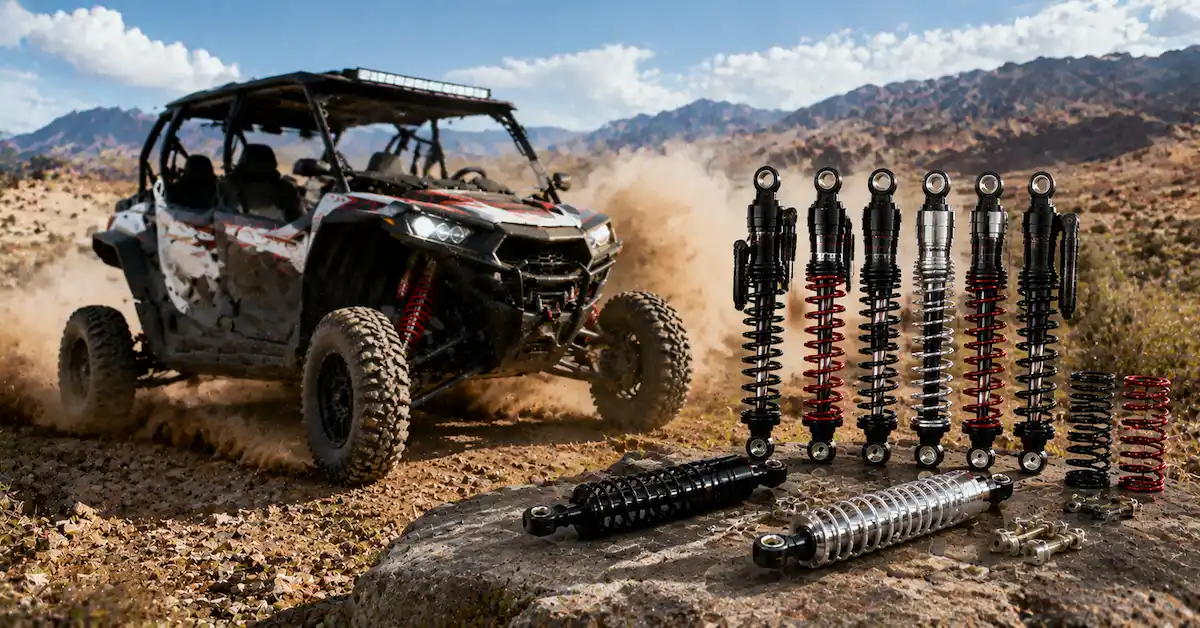

How should a buyer choose a battery vehicle suspension supplier?
Short answer: choose a battery vehicle suspension supplier that can convert the battery pack, axle loads, vehicle geometry, payload, duty cycle, and environment into a controlled spring and shock specification, then prove the specification through samples and vehicle testing. A vehicle that uses a battery is not automatically a special suspension application, but a battery change can alter mass, mass distribution, ride height, wheel load, and the way the vehicle responds to braking, acceleration, and rough ground.
The buying decision should therefore cover more than total shock length and unit price. Ask the supplier to review the interface, define load states, explain spring rate and damping targets, identify assumptions, provide a revision-controlled sample, and state which commercial and test records are available for the exact project.
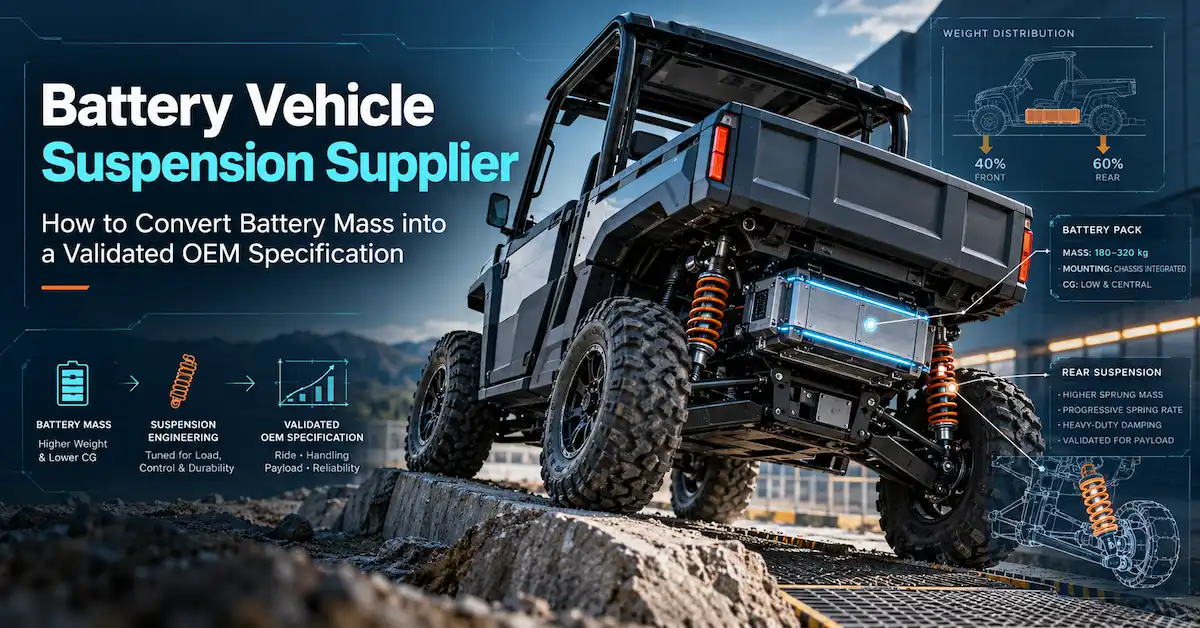
Why battery mass changes the suspension procurement question
Battery vehicles can be deceptively difficult to specify because the battery is both a major mass and a packaging constraint. A pack may sit low in the chassis, behind the rear axle, under a seat, between the frame rails, or in a location created by a conversion. The same nominal battery capacity can therefore create different front and rear axle loads. A new pack can also change the vehicle's center of gravity, ground clearance, pitch response, and the amount of reserve travel available at each corner.
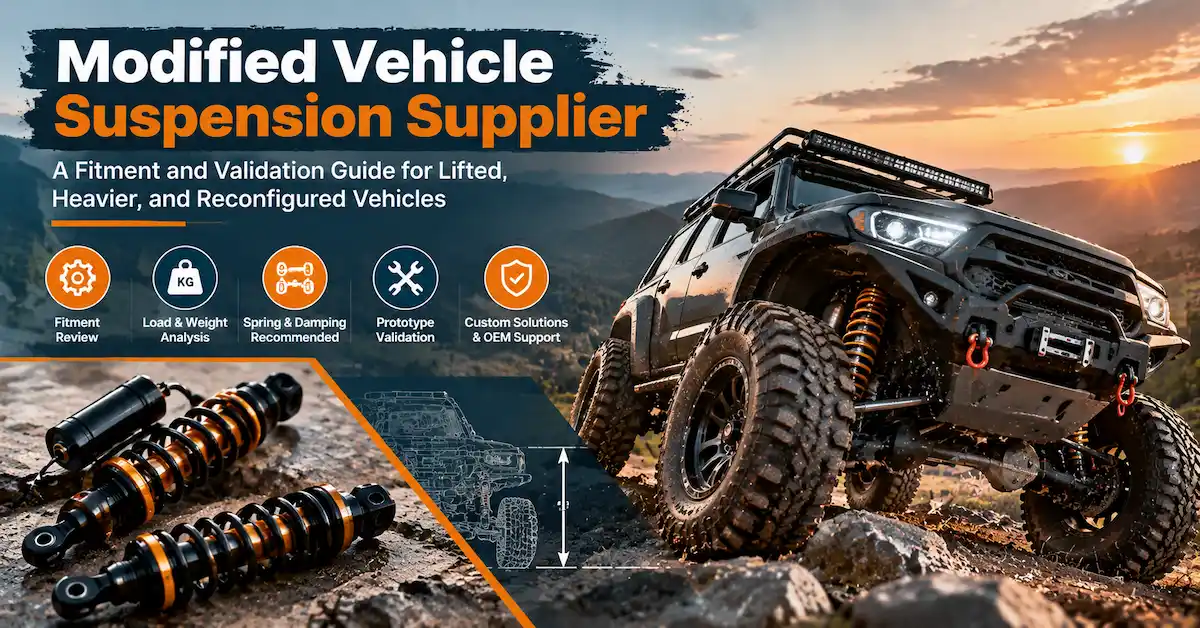
A buyer who sends only the old vehicle model and a request for a stronger shock is asking the supplier to guess. A battery vehicle suspension supplier needs to know which mass changed, where it was added or removed, which passengers and cargo are expected, and whether the vehicle's geometry has been altered. This is particularly important for conversions: the original shock may still bolt in while the original spring and damping assumptions are no longer valid.
| Battery vehicle variable | Suspension consequence | Information to provide |
|---|---|---|
| Battery mass | Changes static sag, spring compression, tire load, and available bump travel. | Old mass, new mass, pack tolerances, and mounting position. |
| Battery location | Changes front/rear load split and pitch response even when total vehicle mass is unchanged. | Axle distance, height, centerline, and a simple layout drawing. |
| Motor and controller layout | Can add concentrated mass, affect unsprung mass, or restrict shock and spring clearance. | Component weights, mounting points, and clearance envelope. |
| Payload and occupants | Creates multiple operating states rather than one design load. | Unloaded, normal, and maximum passenger/cargo conditions. |
| Regenerative braking or high torque | Can change pitch, traction, and repeated load transfer during low-speed operation. | Drive behavior, braking strategy, speed range, and surface. |
| Charging, washing, and outdoor storage | Raises the importance of sealing, corrosion review, cleaning, and inspection. | Water exposure, salt, chemicals, wash-down pressure, and storage. |
Define the battery vehicle before asking for a quotation
Start with a platform identity
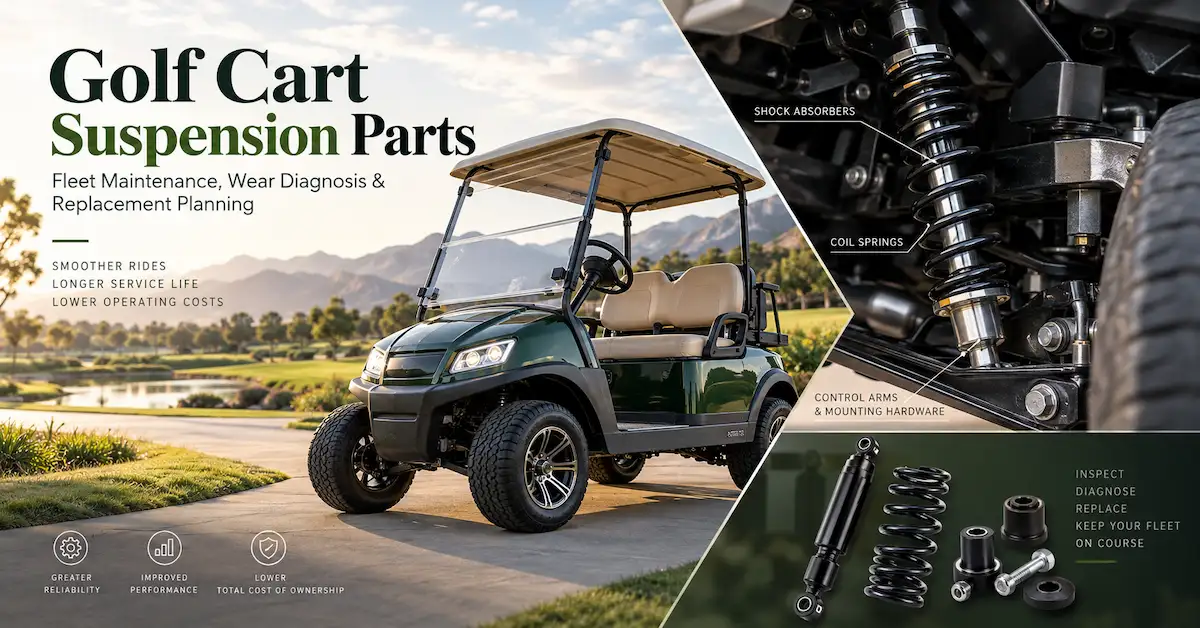
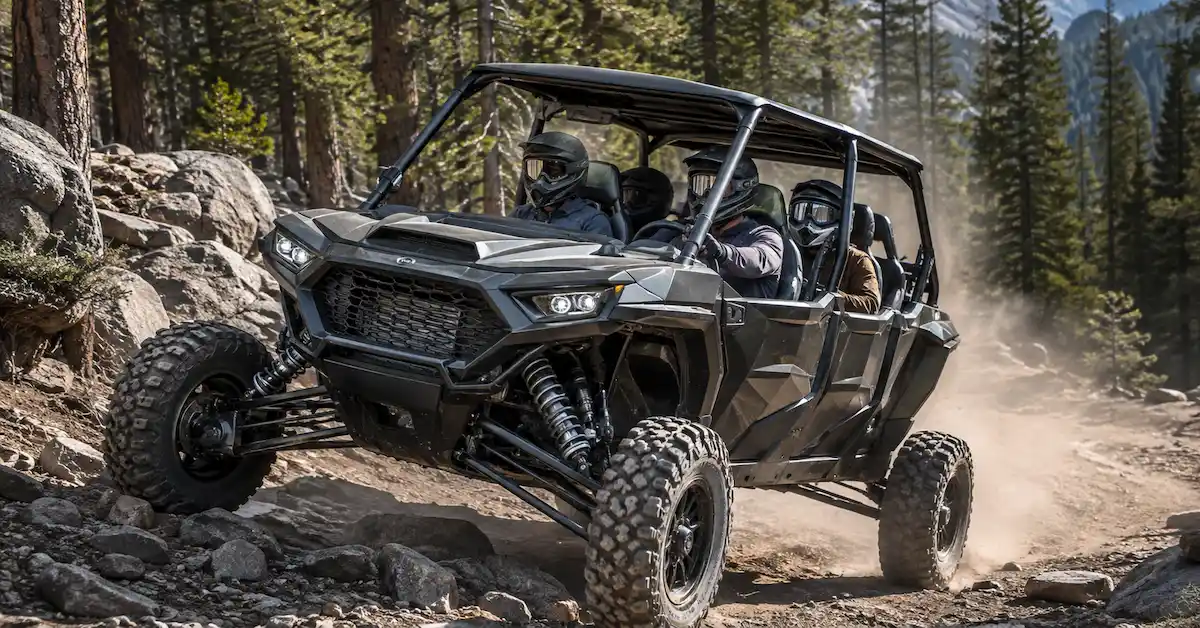
Give the supplier a project code, vehicle type, wheelbase, track width, tire size, drive layout, model year or prototype revision, and intended market. State whether the vehicle is a factory platform, a battery conversion, a new low-speed utility vehicle, an electric ATV or UTV, a golf cart derivative, or another special vehicle. The label matters because it sets expectations about speed, payload, terrain, ride comfort, and regulatory responsibility, but it cannot replace measured data.
Identify the shock position and the number of units. Record whether the shock mounts directly to the control arm or axle, works through a linkage, or is combined with a separate spring. Include the installation angle and any motion ratio information. If the supplier must infer a linkage ratio, mark that as an assumption in the RFQ and plan to verify it before the sample is released.
Use axle loads instead of a single total weight
Total curb weight is useful context, but corner loads and axle loads are more useful for suspension definition. Measure the vehicle in an unloaded state and at the normal operating state. If the vehicle will carry passengers, cargo, a tool box, a rear seat, or a battery accessory, record each state. A simple table with front axle, rear axle, total mass, and approximate load location is often enough to reveal why a current shock feels correct on one configuration and under-supported on another.
For an early concept, estimated loads can be used if they are labeled as estimates. Replace them with measured values before final validation. This distinction protects the project from a common failure: a prototype is tuned around a predicted battery mass, then the production pack, enclosure, cooling hardware, or wiring adds enough weight to change ride height and damping behavior.
Describe the duty cycle
“Electric” does not describe a duty cycle. A resort shuttle, warehouse cart, farm utility vehicle, neighborhood vehicle, delivery platform, and recreational ATV may all use a battery but impose different loads. State daily operating hours, distance, surface, average speed, obstacle frequency, passenger count, cargo pattern, charging schedule, and whether the vehicle is parked outdoors. Include the worst routine condition, not only a laboratory maximum that happens once per year.
Spring rate, damping, and geometry must be developed together
Spring rate protects the operating height
The spring carries the static load and determines how much the vehicle settles. If the battery conversion increases rear axle load, the original spring can place the vehicle too close to the bump stop. That reduces reserve travel and may make the shock appear to be the problem when the underlying issue is insufficient spring support. The opposite can also happen: a lighter battery can make an original spring feel too stiff, reducing tire contact and comfort.
Preload can change installed height and initial support, but it is not a substitute for the correct spring rate. Ask the battery vehicle suspension supplier to identify the target ride height, sag range, spring rate, preload range, and load state for the sample. If the proposal says “heavy duty” without a rate, test condition, or intended load, it is not yet a complete engineering answer.
Compression damping controls impact response
Compression damping influences how quickly the shock resists movement when the wheel moves upward. A battery vehicle with a heavier pack may carry more static load but still need compliance over small bumps. Too little compression control can produce bottoming on a loaded vehicle; too much can make the tire skip over broken surfaces. The correct choice depends on spring rate, motion ratio, shock velocity, tire, speed, and the buyer's comfort and control target.
Rebound damping controls recovery
Rebound damping manages the energy returned by the spring after compression. Too little rebound control can create repeated bouncing, especially when the vehicle is unloaded or when the spring is changed without changing the shock. Too much rebound control can prevent the wheel from returning quickly enough over successive bumps. A useful supplier response explains how the force is measured, at what speed, at what setting, and with what tolerance.
Geometry decides whether the part is safe to install
Measure extended length, compressed length, effective stroke, mounting-hole diameter, installation width, sleeve or bushing details, spring dimensions, and clearance at full bump and full droop. Review tire clearance, body clearance, brake lines, cable routing, battery enclosure, and any external reservoir. A shock can match eye-to-eye length and still be wrong if it reaches mechanical full compression before the vehicle's intended bump stop or if the spring coils bind.
For a linkage-mounted suspension, compare shock stroke with wheel travel rather than using them as interchangeable terms. Ask the supplier to review the motion ratio and mounting angle. For a conversion, also confirm that the battery enclosure does not become a new hard stop or contact point when the suspension moves.
Public BEDO references for a battery vehicle suspension discussion
The BEDO Auto website publicly lists an electric motorcycle rear hydraulic shock absorber as product reference EM_HSA_01. The published record gives a 290 mm total length, 70 mm effective stroke, 65 LBS spring rate, 25 adjustable damping levels, an external gas chamber, oil-gas separation, aluminum alloy and steel pipe construction, and 10 mm mounting holes with 20 mm mounting width at both ends. It also lists maximum rebound damping of 300 to 3000 N and compression damping of 250 to 2500 N at a stated inspection speed of 0.1 M/S.
These figures are useful because they show the fields that should appear in an RFQ. They are not a universal specification for electric ATVs, golf carts, utility vehicles, or any other battery platform. The battery vehicle suspension supplier must confirm whether the geometry, spring, damping range, mass, and environment match the target application.
| Public reference field | BEDO EM_HSA_01 listing | How an OEM buyer should use it |
|---|---|---|
| Application and position | Electric motorcycle rear shock absorber. | Use as a reference platform, not as automatic evidence of fitment for another vehicle. |
| Total length and stroke | 290 mm total length; 70 mm effective stroke. | Compare with the target vehicle's extended, compressed, and working dimensions. |
| Spring and damping | 65 LBS spring rate; 25 adjustable levels; 300-3000 N rebound; 250-2500 N compression. | Ask for the measurement convention, setting map, tolerance, and project-specific target. |
| Mounting | Upper and lower 10 mm holes; upper and lower 20 mm mounting width. | Check bolts, sleeves, brackets, installation angle, and clearance on the actual platform. |
| Construction | Aluminum alloy and steel pipe; external gas chamber; oil-gas separation. | Request the released material, finish, seal, service, and environmental evidence. |
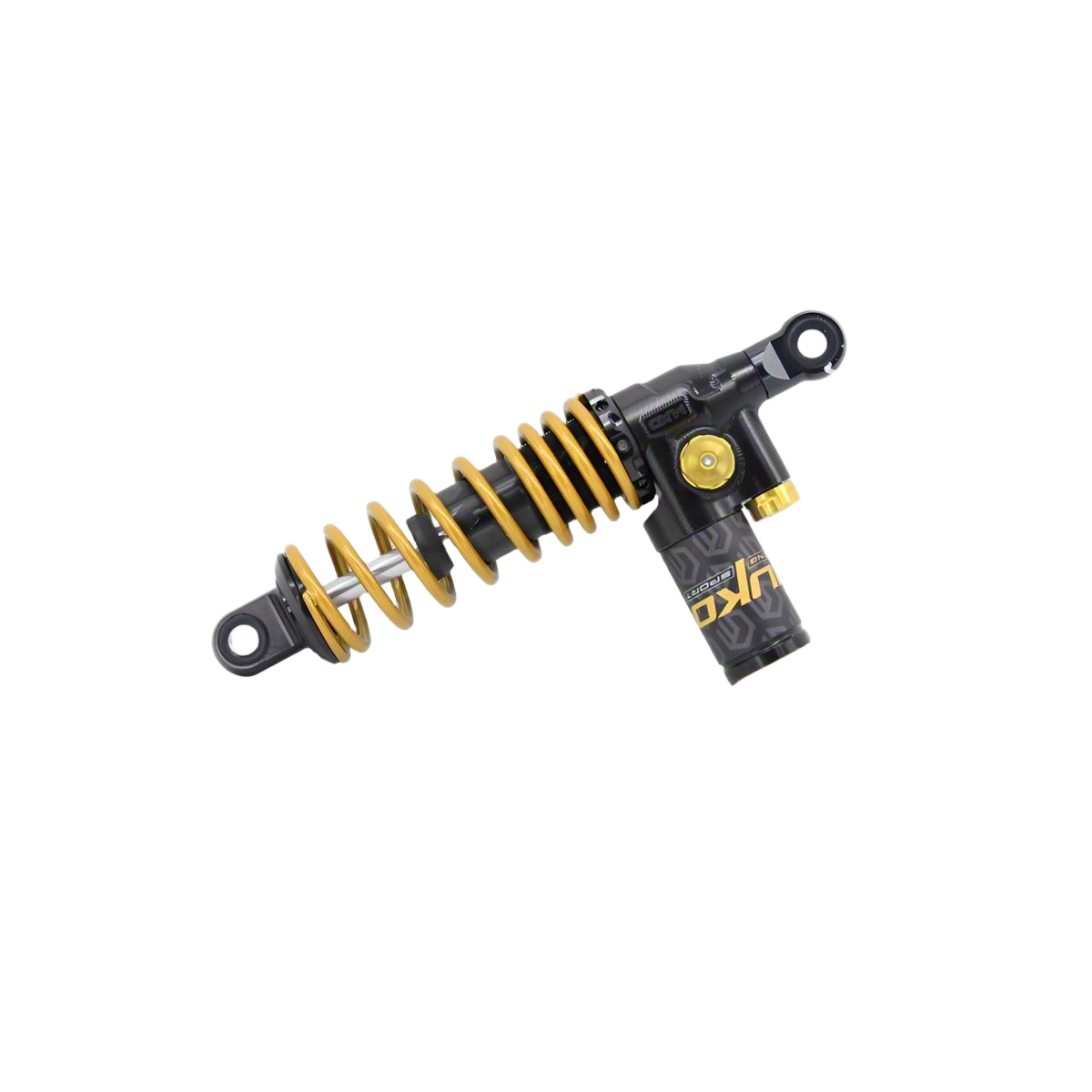
How to evaluate a battery vehicle suspension supplier
A supplier comparison should separate catalog availability from engineering capability. If the vehicle is unchanged and the original part number is known, an existing replacement can be efficient. If the battery, payload, geometry, or duty cycle changes, the buyer needs a supplier that can identify risk before quoting a final part. The following questions create a practical audit trail.
| Qualification question | Evidence to request | Why the answer matters |
|---|---|---|
| Can the supplier review a drawing or sample? | Dimensional review, marked drawing, assumption list, and proposed revision. | Shows whether fitment risk is being managed before tooling or production. |
| Can spring and damping be changed independently? | Spring-rate proposal, preload range, damping target, and test method. | Prevents a heavier battery from being treated only with extra preload. |
| Can the supplier support multiple load states? | Prototype test matrix for unloaded, normal, and maximum conditions. | Confirms that comfort and control are not judged from one static condition. |
| How is vehicle validation recorded? | Route, speed, load, temperature, observations, measurements, and sign-off. | Makes changes repeatable and reduces subjective tuning disputes. |
| How is production consistency controlled? | Incoming material checks, spring inspection, dimensions, leakage, damping, and traceability. | Protects the vehicle calibration after the first prototype. |
| What are the commercial boundaries? | MOQ, sample cost, lead time, packaging, labels, change control, and after-sales route. | Connects a technically feasible part to a workable launch plan. |
Use a gated development process
Gate 1: application definition
Freeze the platform identity, battery version, vehicle mass, axle loads, passengers, cargo, speed, surfaces, temperature, water exposure, and target ride height. Record unknowns. Do not let a supplier's first quotation silently turn estimates into approved specifications.
Gate 2: interface and packaging review
Confirm extended and compressed length, stroke, mounting interfaces, installation angle, bump-stop position, spring clearance, tire clearance, and battery enclosure clearance. If the vehicle uses a linkage, review motion ratio and mechanical limits. The output should be a short dimensional report with assumptions and open points.
Gate 3: preliminary spring and damping proposal
Ask for a proposed spring rate, preload, fixed or adjustable damping, and target acceptance conditions. Require the supplier to explain which change addresses which symptom. A heavier battery may require a spring change, a damping change, or both; the answer should be connected to measured axle loads and ride-height observations.
Gate 4: controlled prototype
Mark the prototype revision and record its total length, stroke, spring, preload, damping setting, mounting hardware, finish, and labels. Install it on a controlled vehicle configuration. Photograph the ride height and measure sag before subjective road evaluation.
Gate 5: bench and vehicle validation
Bench checks may include dimensions, spring rate, adjustment action, force at agreed velocities, leakage, and visual condition. Vehicle checks should include static sag, ride height, small-bump comfort, repeated-bump control, bottoming, topping out, braking pitch, acceleration squat, cornering, noise, and temperature-related change. The load cases should represent how the battery vehicle will actually be used.
Gate 6: production release
Freeze the drawing, part number, spring, damping target, adjustment map, materials, finish, inspection plan, packaging, labels, and change-notification process. Define the critical dimensions and acceptable ranges. A battery vehicle suspension supplier should be able to identify how a replacement unit is matched to the approved revision.
Prepare a supplier-ready battery vehicle RFQ
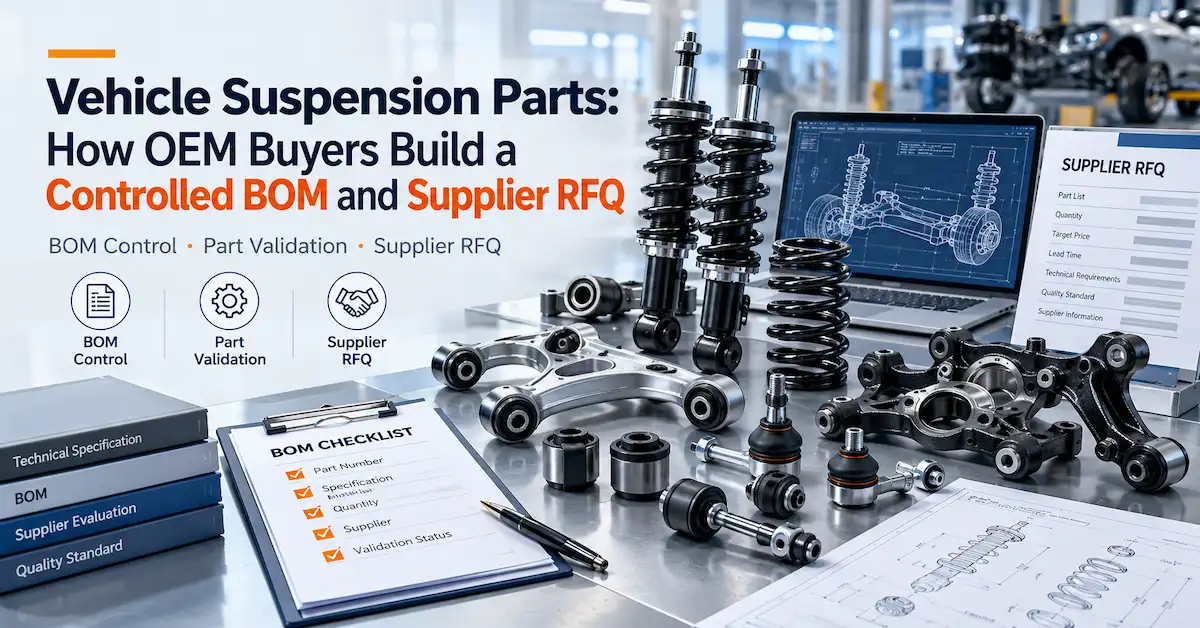
Send one organized package instead of a chain of disconnected messages. The following fields allow a supplier to determine whether the project needs a standard reference, a modified configuration, or a new development.
| RFQ section | Minimum information | Preferred evidence |
|---|---|---|
| Vehicle identity | Vehicle type, model, revision, wheelbase, track, tire, drive layout, target market. | Specification sheet, photographs, CAD, and project code. |
| Battery system | Old and new mass, location, enclosure, mounting, voltage platform, and accessory mass. | Battery drawing, mass table, and installation photographs. |
| Load cases | Unloaded, normal, maximum passenger, cargo, towing, and accessory conditions. | Front/rear axle measurements and load distribution table. |
| Suspension interface | Extended length, compressed length, stroke, holes, widths, sleeves, angle, linkage. | 2D drawing, 3D CAD, or measured sample. |
| Performance target | Ride height, sag, comfort, stability, bottoming limit, fixed or adjustable preference. | Test route, ride report, competitor sample, or field complaint. |
| Environment | Mud, water, salt, dust, wash-down, temperature, outdoor storage, daily hours. | Duty-cycle description and service conditions. |
| Commercial plan | Prototype quantity, pilot quantity, annual volume, launch date, private label, packaging. | Forecast, label artwork, carton requirements, and delivery assumptions. |
Ask the supplier to return a list of confirmed facts, assumptions, missing information, proposed configuration, sample timing, test plan, and commercial exclusions. This makes the answer easier to compare with another battery vehicle suspension supplier and helps the engineering team approve the next action.
Battery vehicle suspension supplier FAQ
Does every battery vehicle need a special shock absorber?
No. A vehicle that retains the original mass distribution, geometry, and operating conditions may use a suitable existing configuration. A battery replacement or conversion should trigger a suspension review when axle loads, ride height, comfort, handling, clearance, or duty cycle changes.
Is a heavier spring enough after adding a battery?
Not necessarily. The spring affects support and ride height, while the shock controls movement. A heavier spring with unchanged damping can create a different rebound and compression response. Check both parts against measured load cases.
Can I select a shock by total length alone?
No. Total length must be checked with compressed length, effective stroke, mounting holes, installation width, spring dimensions, motion ratio, bump stops, and clearances. A length match can still create a mechanical interference or incorrect wheel travel.
What is the most useful battery information for a supplier?
Provide old and new battery mass, location, enclosure, mounting, accessory mass, and front/rear axle measurements. The position of the battery can matter as much as the total mass.
Can the EM_HSA_01 product fit another battery vehicle?
It should be treated as a public reference configuration for an electric motorcycle rear shock. Its dimensions and listed forces are not proof of fitment for another vehicle. The supplier must confirm the new platform and load case.
What should be tested with passengers or cargo?
At minimum, measure unloaded, normal, and maximum intended conditions. Check ride height, sag, bottoming, rebound, comfort, braking pitch, acceleration squat, cornering, noise, and repeated-bump behavior on representative surfaces.
Should a battery vehicle project use adjustable damping?
Adjustment can help when load or terrain varies and the buyer can define a useful setting map. It also adds cost, setup, training, and quality-control requirements. A well-matched fixed configuration can be more practical for a fleet or simple aftermarket product.
What commercial information must be confirmed before ordering?
Confirm sample cost and quantity, MOQ, production lead time, packaging, labels, payment and shipping terms, revision control, warranty or replacement policy, and the documents provided with each production batch. The public website does not establish one universal value for every project.
What evidence is needed before publishing a supplier claim?
Use the official product record for public dimensions and descriptions. Add an identified author and technical reviewer, authorized factory or production photographs, current material and test records, project-specific MOQ and lead time, packaging evidence, and an approved customer case before making stronger original-evidence claims.
Conclusion
A battery vehicle suspension supplier should be selected through a traceable engineering and procurement process. Battery mass, location, payload, geometry, drive behavior, environment, and duty cycle must be translated into spring, damping, stroke, mounting, and validation requirements. The buyer should then move through interface review, controlled sampling, bench checks, vehicle testing, production release, and repeat-supply controls.
BEDO Auto's published electric motorcycle shock reference gives the discussion a concrete starting point, including 290 mm total length, 70 mm effective stroke, 65 LBS listed spring rate, 25 damping levels, and published mounting dimensions. The responsible next step is to send the actual battery vehicle data and ask BEDO to confirm which parameters transfer, which must change, and what evidence is available for the released configuration.