
Ningbo Bedo Auto Parts Co., Ltd.

+86 13123836189

How to Choose the Right Suspension System for Varying Payloads

Posted by NingboBEDO On Sep 01 2025

 ATV shock manufacturer bedo

How to Choose the Right Suspension System for Varying Payloads

Load Isn’t Just a Number—It’s a Suspension Factor

Whether you’re riding solo, hauling gear, or towing equipment, your ATV’s suspension doesn’t just absorb bumps—it carries everything that moves with you.
That’s why choosing the right ATV shock setup requires more than checking fitment or spring length—it means matching your system to real-world payload behavior.

As a trusted ATV shock manufacturer, we often see performance loss not from faulty components—but from underestimated loads.

What Payload Changes in a Suspension System

Varying payload impacts more than ride height. It affects:

  • Shock compression depth: heavier loads compress the spring more, reducing usable travel

  • Damping behavior: shocks cycle faster and harder, changing rebound timing

  • Vehicle geometry: load shifts center of gravity, affecting cornering and braking

  • Chassis fatigue: unbalanced or bottomed-out shocks cause frame stress and joint wear

If your shock system isn’t designed to adapt to changing payloads, you’ll lose both comfort and control.

Signs Your Suspension Isn’t Load-Ready

  • ATV sags when loaded, even before moving

  • Rear shocks bottom out over moderate bumps

  • Front-end lift under throttle with trailer

  • Tires wear unevenly or feel unstable under cargo

  • Suspension feels soft and unstable with no adjustment possible

These symptoms mean your suspension lacks the stiffness, damping profile, or tuning range to handle payload variation.

Key Features in Load-Ready Shock Systems

When selecting a suspension system for variable loads, look for:

  • Higher preload capacity: for adjusting ride height based on cargo

  • Progressive spring rates: adapt stiffness as compression increases

  • Compression-tuned damping: prevents bottom-out under sustained load

  • Rebound control: ensures fast return without spring kick

  • Heat-resistant oil: avoids fade under frequent heavy-cycle riding

All of these work together to maintain ride balance, safety, and long-term performance.

How Bedo Builds Shocks for Load Variation

At Bedo, we engineer suspension systems to support both working utility platforms and off-road recreation with unpredictable payloads. Our approach includes:

  • Platform-specific preload and damping calibration

  • Custom spring selection based on rider weight + cargo profiles

  • Validation on variable terrain under real-world weight conditions

  • Shock body materials chosen for heat resistance and structural reliability

  • Optional adjustable preload collars for field tuning

Whether you’re hauling tools or carrying a passenger, we make sure your ATV remains responsive, stable, and terrain-tuned.

Load Isn’t Optional—So Your Suspension Shouldn’t Be Generic

If your ATV carries more than a rider, your shocks need to do more than absorb bumps. They need to respond to payload, platform geometry, and terrain—all at once.

A properly chosen suspension system doesn’t just protect your vehicle—it protects your control.

At Bedo, we help riders and OEM platforms build cargo-capable ATV suspension that performs across conditions—not just under ideal weight.

See our load-ready ATV shock systems
Talk to our engineers about tuning for your payload profile
Featured Blogs
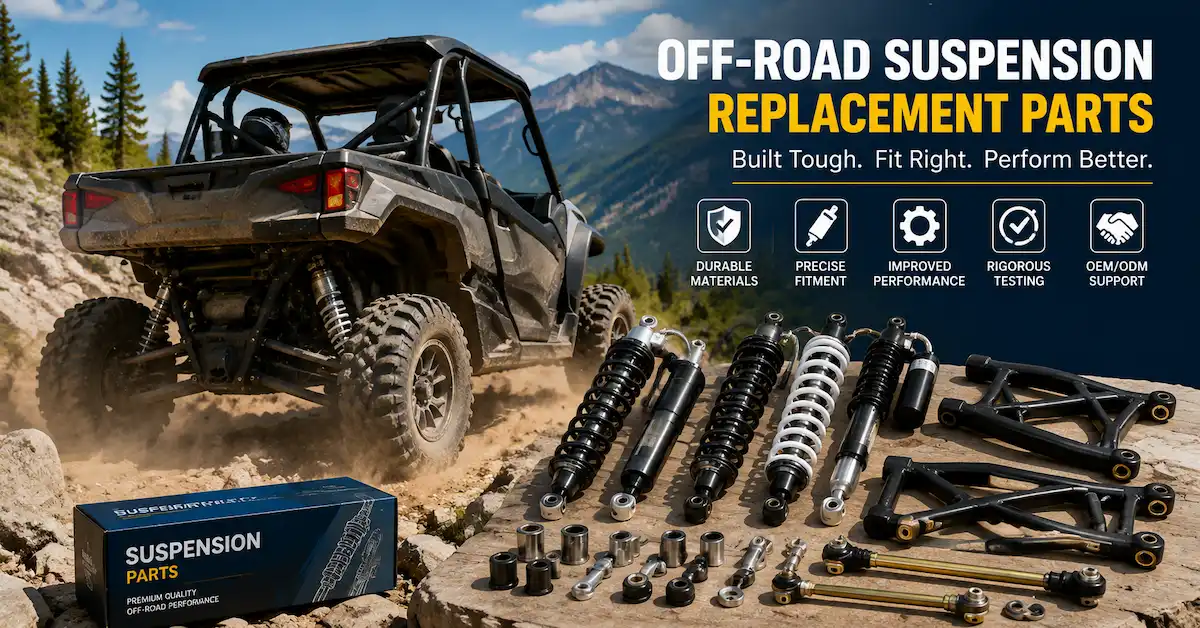
Off-Road Suspension Replacement Parts: B2B Sourcing Guide

Off-Road Suspension Replacement Parts: B2B Sourcing Guide

Off-road suspension replacement parts must restore correct fitment, load support, damping control, suspension travel, durability, and reliable vehicle handling. This guide helps importers, wholesalers, distributors, repair-parts brands, and aftermarket buyers evaluate shock absorbers, springs, bushings, mounts, materials, testing, customization, and supplier capabilities.

UTV Replacement Shock Absorber: B2B Sourcing Guide

UTV Replacement Shock Absorber: B2B Sourcing Guide

A reliable UTV replacement shock absorber must restore correct fitment, load support, damping control, suspension travel, and durability. This guide helps importers, wholesalers, distributors, repair-parts brands, and aftermarket buyers evaluate dimensions, spring rates, damping, materials, testing, customization, and supplier capabilities.

ATV Replacement Suspension Parts: B2B Sourcing Guide

ATV Replacement Suspension Parts: B2B Sourcing Guide

ATV replacement suspension parts must restore correct fitment, load support, damping control, durability, and stable suspension movement. This guide helps importers, wholesalers, distributors, repair-parts brands, and aftermarket buyers evaluate shock absorbers, springs, bushings, mounts, quality control, customization, and supplier capabilities.

How to Measure a Shock Absorber for OEM Development

How to Measure a Shock Absorber for OEM Development

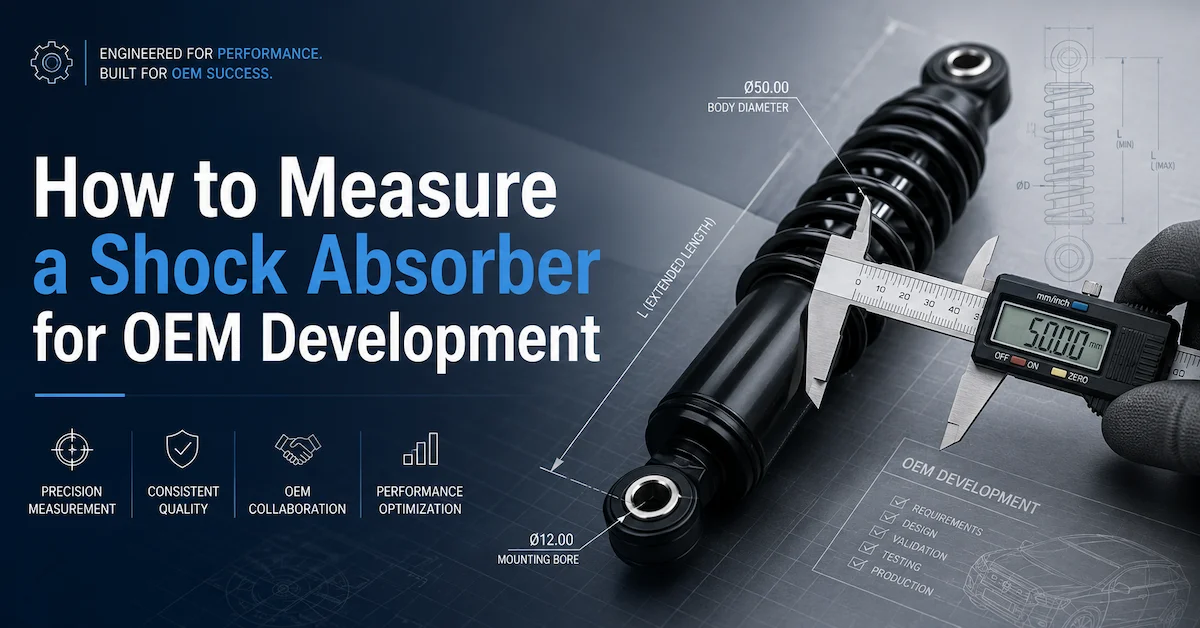
Accurate shock absorber measurements are essential for correct fitment, suspension travel, spring matching, and OEM product development. This guide explains how B2B buyers should measure extended length, compressed length, stroke, mounting dimensions, spring specifications, and installation geometry before requesting a customized shock absorber quotation.

Dirt Bike Suspension Supplier China: OEM Sourcing Guide for Global Buyers

Dirt Bike Suspension Supplier China: OEM Sourcing Guide for Global Buyers

A professional dirt bike suspension supplier China buyers can work with should provide more than standard replacement parts. The supplier must understand rider weight, suspension linkage, spring rate, damping, shock travel, terrain, sealing, heat management, prototype validation, and repeatable production. This guide explains how global manufacturers, importers, distributors, and aftermarket brands can evaluate a Chinese dirt bike suspension supplier for OEM and ODM projects.

Dirt Bike Shock Absorber OEM: Technical Sourcing Guide for Global Buyers

Dirt Bike Shock Absorber OEM: Technical Sourcing Guide for Global Buyers

A dirt bike shock absorber OEM project requires more than matching overall dimensions. Spring rate, damping force, stroke, linkage geometry, rider weight, terrain, heat management, sealing, and mounting strength must work together. This guide explains customization, prototype development, testing, quality control, and supplier evaluation for dirt bike manufacturers, importers, distributors, and aftermarket brands.