
Off-Road Vehicle Suspension System Manufacturer: How OEM Buyers Build a Production-Ready Specification
For an OEM buyer, an off-road vehicle suspension system is not simply a shock absorber with a spring attached. It is a controlled combination of vehicle load, suspension geometry, spring characteristics, damping behavior, mounting interfaces, operating environment, validation requirements, and production specifications.
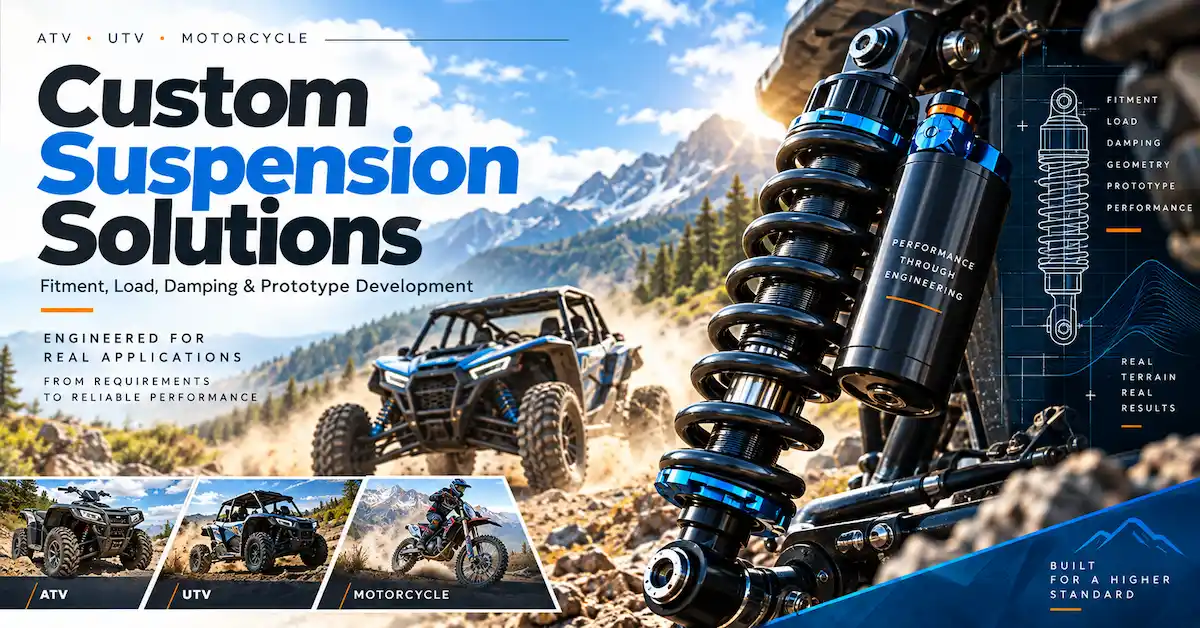
That distinction matters when developing ATV, UTV, motorcycle, electric motorcycle, beach buggy, snowmobile, golf cart, utility vehicle, or other specialty off-road platforms. A component can look correct and even fit at static ride height while still being unsuitable once the vehicle is loaded, compressed, extended, modified, or operated repeatedly on difficult terrain.
This guide explains how an off-road vehicle suspension system manufacturer and an OEM buyer can turn vehicle-level requirements into a controlled specification that can be prototyped, tested, approved, and reproduced in production.
1. What Does an Off-Road Vehicle Suspension System Manufacturer Actually Develop?
The phrase off-road vehicle suspension system manufacturer can describe two very different types of suppliers.
The first is primarily a component supplier. It provides existing shock absorbers, springs, or other suspension parts according to established product specifications.
The second is capable of participating in a vehicle-specific development process. Instead of starting with “Which product do you have?”, the discussion starts with “What does the vehicle need the suspension to do?”
For OEM and ODM projects, the second approach can be more useful because suspension performance depends on the relationship between components and the vehicle.
A system-level development project may involve:
- Shock absorber selection or customization
- Suspension spring selection or development
- Mounting interfaces
- Installation envelope
- Available shock stroke
- Suspension travel
- Spring support
- Compression damping
- Rebound damping
- Reservoir configuration where applicable
- Vehicle load conditions
- Terrain and duty cycle
- Prototype validation
- Production specification control
Not every vehicle requires every item. A simple replacement project may only need an existing configuration with confirmed fitment. A new UTV platform, modified ATV, or new electric motorcycle may require substantially more engineering work.
This is why a useful sourcing process separates component availability from system suitability.
2. Suspension System vs. Individual Suspension Component
One of the most useful distinctions for procurement teams is the difference between buying a component and developing a suspension system.
| Procurement Level | Typical Starting Point | Main Question | Development Depth |
|---|---|---|---|
| Standard replacement | Known part or vehicle application | Does it fit and perform as required? | Low |
| Component customization | Sample, drawing, or existing specification | Can the component be modified? | Medium |
| Vehicle-specific suspension | Vehicle data and performance requirement | What specification suits the application? | High |
| New platform development | CAD, hard points, load cases, target behavior | How should the suspension be developed around the vehicle? | High |
This distinction helps prevent one of the most common B2B sourcing errors: treating every suspension quotation as if it were a standard replacement-part quotation.
If a buyer simply needs a replacement for an unchanged vehicle, an existing product may be sufficient.
If the vehicle has gained larger tires, additional cargo, a battery pack, a new passenger configuration, a modified ride height, or different terrain requirements, the original specification may no longer represent the actual operating condition.
In that situation, the supplier needs more information before recommending a solution.
3. Start With the Vehicle Operating Envelope
A professional suspension specification begins by defining how the vehicle will actually be used.
For an ATV or UTV, “vehicle weight” is rarely enough. The same vehicle may operate empty, with one rider, with multiple passengers, with cargo, with accessories, or under a maximum working condition.
For an electric motorcycle, battery mass and its location can affect the overall load distribution. For a utility UTV, cargo and equipment may shift load toward one axle. For a modified off-road vehicle, larger tires and additional equipment may change both mass and clearance.
Build separate load cases instead of using one generic number.
| Load Case | What to Define | Why It Matters |
|---|---|---|
| Empty / light | Vehicle with normal unloaded configuration | Shows baseline ride height and compliance |
| Typical operating | Normal rider/passenger and accessory load | Represents the condition used most often |
| Maximum working | Maximum realistic passenger and cargo condition | Tests support, travel and bottoming risk |
| Special condition | Specific equipment or modified configuration | Prevents development around an incomplete vehicle |
For OEM projects, also consider where the additional weight is located.
A rear cargo box does not affect the vehicle in exactly the same way as a centrally mounted battery. A front winch does not create the same load distribution as a rear storage system.
The suspension specification should therefore record not only total vehicle mass but, where available, axle or corner load information.
4. Define the Suspension Geometry Before Choosing the Shock
One of the strongest technical lessons for an off-road vehicle suspension system manufacturer is that shock absorber length alone does not define fitment.
A complete geometric review may need to include:
- Published total length or defined measurement length
- Extended length
- Compressed length
- Effective shock stroke
- Upper mounting-hole diameter
- Lower mounting-hole diameter
- Upper mounting width
- Lower mounting width
- Bushing or sleeve arrangement
- Shock body diameter
- Spring envelope
- Reservoir location where applicable
- Installed shock angle
- Available clearance
- Suspension movement range
These dimensions should be evaluated together.
For example, two shock absorbers can have the same effective stroke and the same mounting-hole diameter while still having different total lengths or mounting widths. That difference can make them unsuitable as direct replacements for one another.
Important measurement rule: If a product page says “total length”, keep that terminology until a controlled engineering drawing defines the measurement reference. Do not automatically convert “total length” into “eye-to-eye length” or another dimensional definition.
This is especially important when purchasing from an off-road vehicle suspension system manufacturer because drawings, samples, CAD models, and catalog specifications may use different reference points.
For a custom project, a good drawing should make the measurement references clear enough that the buyer, engineer, prototype team, and production team are all working from the same definition.
Check the Shock Through the Full Movement Range
Static installation is only one part of fitment.
At full droop, verify that the shock does not become the unintended suspension travel limiter unless that condition is intentionally designed.
At ride height, check the installed angle, spring position, clearance, and adjuster access.
At full compression, inspect tire clearance, spring clearance, shock-body clearance, bump-stop behavior, reservoir clearance, and nearby chassis components.
If steering movement and suspension movement can interact, evaluate those movements together rather than checking them independently.
This system-level approach is more reliable than simply measuring an old shock and ordering another one with a similar length.
5. Spring Rate and Damping Must Be Treated as a Pair
A suspension system has several interacting variables, but the relationship between the spring and damper is particularly important.
The spring primarily provides load support and establishes the static operating condition of the suspension. The damper controls the speed and behavior of suspension movement.
That means increasing spring rate without reviewing damping can change vehicle behavior in ways that are not obvious from the catalog specification.
Spring Rate
Spring rate affects:
- Static ride height
- Sag
- Load support
- Available compression travel
- Ride response
- Vehicle behavior under changing load
A spring that is too soft for the actual load can allow excessive sag and reduce available compression travel. A spring that is too stiff can make the vehicle less compliant when lightly loaded.
The right specification therefore depends on the vehicle, the load, the suspension geometry, and the intended use.
For example, a utility UTV that frequently carries passengers and tools should not automatically use the same spring specification as a recreational vehicle with a lighter and more stable load profile.
Preload Is Not a Substitute for Spring Selection
Preload changes the installed condition of a spring, but it should not be treated as a universal way to compensate for an incorrect spring rate.
If a vehicle repeatedly operates above the load condition for which the original spring was developed, simply increasing preload may change ride height without solving the fundamental load-support problem.
For OEM development, the better approach is to define the actual load cases and then establish the required spring behavior.
Compression Damping
Compression damping influences how quickly the suspension moves into compression when the vehicle encounters an obstacle or load event.
Too little compression control can contribute to rapid suspension movement, excessive chassis movement, or frequent use of the available travel.
Too much compression damping can make the vehicle feel harsh and may prevent the suspension from responding efficiently to smaller terrain inputs.
The target is not “maximum damping.” The target is damping appropriate to the vehicle, spring, geometry, speed, terrain, and duty cycle.
Rebound Damping
Rebound damping controls the extension of the suspension after compression.
This becomes particularly important after a spring change because a stronger spring can store and release more energy.
If rebound control is insufficient, the suspension may extend too quickly and feel unsettled. If rebound damping is excessive, recovery can become too slow during repeated terrain inputs.
For this reason, an OEM project should avoid specifications such as “make the shock harder” or “increase damping” without defining the actual vehicle problem.
A better engineering requirement is measurable: “The rear suspension shows excessive sag under the typical cargo load and reaches the bump stop during repeated rough-road operation.” That description gives the manufacturer a development problem to investigate rather than a vague request for a stiffer part.
6. Fixed Damping vs. Adjustable Damping
An off-road vehicle suspension system manufacturer may offer both fixed and adjustable damping architectures. The correct choice depends on the application rather than on the number of adjustment positions.
| Configuration | Potential Value | Typical Development Consideration |
|---|---|---|
| Fixed damping | Simple and repeatable configuration | Best when vehicle and operating conditions are well defined |
| Adjustable damping | Allows tuning across defined conditions | Requires clear adjustment definition and validation |
| External gas chamber | Different packaging and damping architecture | Requires sufficient vehicle clearance |
| Internal gas chamber | Compact integrated configuration | Must be evaluated within the vehicle's packaging and duty cycle |
Adjustability should solve a real requirement.
If the vehicle operates under a stable load and terrain condition, a correctly developed fixed-damping configuration may be more practical than adding adjustment hardware that the end user does not understand or use.
If the vehicle operates across significantly different loads or terrain, adjustable damping may provide useful tuning flexibility, but the adjustment range still needs to be defined and validated.
More adjustment positions do not automatically mean better suspension.
7. Materials and Construction: What Should OEM Buyers Ask?
Material selection should be discussed in relation to the actual component and application rather than using broad claims such as “premium material.”
Current BEDO shock absorber product pages list aluminum alloy and steel pipe among the materials for several published models. They also describe oil-gas separation, internal or external gas-chamber configurations, and corrosion-resistant, waterproof and rust-resistant construction characteristics on relevant product pages.
For a procurement team, the important question is not only which material is used, but where it is used and what requirement it addresses.
For a custom suspension project, buyers may need to clarify:
- Shock body material
- Piston rod material
- Spring material
- Seal configuration
- Mounting component material
- Surface treatment
- Corrosion exposure
- Temperature exposure
- Water and mud exposure
- Expected duty cycle
These details should be frozen in the appropriate engineering documentation before mass production if they are critical to product performance.
It is also important to separate what the manufacturer publishes from what the buyer expects.
For example, a product page describing corrosion-resistant construction does not automatically establish a specific salt-spray duration or environmental certification. Those requirements should be discussed and validated separately if the project requires them.
8. A Suspension System Should Be Defined by the Vehicle, Not Only the Component
The same basic shock absorber architecture can behave differently when installed on different vehicles.
Suspension geometry changes the relationship between wheel movement and shock movement. Mounting position and angle can affect the effective behavior seen at the wheel. The vehicle mass, load distribution, spring specification, tire configuration, and terrain further change the operating condition.
For this reason, an OEM suspension specification should answer five questions:
- What vehicle is this for?
- What load must it support?
- How does the suspension move?
- What terrain and duty cycle will it experience?
- What performance behavior must be validated?
If one of these questions remains unanswered, the manufacturer may still be able to provide a preliminary assessment, but the quotation should not automatically be treated as a final production specification.
9. When Should the Project Include Springs, Ball Joints and Related Components?
BEDO's current product structure includes Shock Absorber, Suspension Springs and Ball Joints. For a system-level OEM project, these categories can be considered separately according to the vehicle architecture.
A shock absorber may be the main development focus, while the spring is a critical supporting element. Ball joints and other suspension interfaces may become important when changes to geometry, steering movement, or suspension articulation are part of the project.
However, OEM buyers should not assume that every suspension project requires a complete package from one supplier.
The right sourcing boundary depends on the buyer's own manufacturing and assembly capabilities.
| Sourcing Model | Suitable When | Main Buyer Responsibility |
|---|---|---|
| Shock absorber only | Spring and surrounding suspension are already controlled | System integration and final fitment |
| Shock + spring | Load support and damping need coordinated development | Vehicle-level validation |
| Multiple suspension components | Geometry or interfaces are changing together | System architecture and approval |
| Component program | Buyer operates its own assembly line | Incoming inspection and final assembly |
The important point is to define the scope before requesting the quotation.
10. Match the Suspension System to the Actual Terrain
“Off-road” is not one operating environment.
Sand, mud, rocky trails, forest roads, farm roads, snow, and mixed utility operation can create very different suspension demands.
| Environment | Typical Engineering Concern | What to Define |
|---|---|---|
| Rocky trails | Repeated impact and articulation | Travel, damping response, clearance |
| Sand / beach | Water, sand and corrosion exposure | Sealing, surface protection, terrain validation |
| Mud | Contamination and repeated movement | Protection, cleaning conditions, durability |
| Farm / utility roads | Changing load and long operating periods | Load cases, spring support, duty cycle |
| Snow | Cold and changing terrain conditions | Environmental requirements and validation |
| Mixed recreation | Wide range of speed and terrain | Damping behavior and tuning requirements |
The environment should be included in the RFQ because it helps the off-road vehicle suspension system manufacturer understand why a specification is required.
“Need durable shocks” is a weak requirement.
“The vehicle operates on wet forest trails and muddy farm roads for extended working periods and is exposed to water, mud and repeated vibration” is much more useful.
The second description creates a defined validation context.
11. How Vehicle Modifications Change the Suspension Specification
Aftermarket and specialty vehicle programs often change the vehicle after the original suspension has been designed.
Common changes include:
- Larger tires
- Different wheels
- Winches
- Heavy bumpers
- Cargo racks
- Toolboxes
- Passenger seats
- Protective structures
- Snow-plow equipment
- Battery packs
- Lift kits
These modifications can change more than total weight.
They may affect load distribution, unsprung mass, clearance, ride height, suspension geometry, component angles, and the available operating envelope.
Therefore, an aftermarket buyer should not automatically use the original shock specification for a modified vehicle.
For example, a heavier rear cargo system may primarily change the rear load case. A front-mounted winch may create a different front suspension requirement. A larger tire can introduce clearance and geometry questions even if the shock dimensions remain unchanged.
The correct engineering response is to review the complete modified configuration.
12. Use Published Product Data as a Starting Point, Not as Universal Fitment Approval
BEDO's current catalog provides several useful real-world reference configurations. These examples show why an OEM buyer should compare the entire specification rather than selecting a shock from one number.
| Model | Application / Position | Total Length | Effective Stroke | Cylinder OD | Spring Rate* | Damping Adjustment |
|---|---|---|---|---|---|---|
| AU_HSA_01 | ATV/UTV, Rear | 465 mm | 130 mm | 38 mm | 75 LBS | None |
| AU_HSA_02 | ATV/UTV, Rear | 395 mm | 80 mm | 38 mm | 250 LBS | None |
| AU_HSA_03 | ATV/UTV, Rear | 445 mm | 130 mm | 42 mm | 135 LBS | None |
| EM_HSA_01 | Electric Motorcycle, Rear | 290 mm | 70 mm | 43 mm | 65 LBS | 25 levels |
| M_HSA_01 | Motorcycle, Rear | 480 mm | 85 mm | 46 mm | 430 LBS | 25 levels |
| M_HSA_02 | Motorcycle, Rear | 460 mm | 100 mm | 60 mm | 350 LBS | 25 levels |
13. Electric Motorcycle Suspension Requires a Different System View
Electric motorcycles are a good example of why vehicle-level suspension development cannot rely on generic motorcycle specifications.
The battery pack adds mass and may change how that mass is distributed within the frame. Motor location, rider weight, passenger load, and intended use can further change the operating condition.
BEDO currently publishes the EM_HSA_01 rear electric-motorcycle shock absorber with a 290 mm total length, 70 mm effective stroke, 43 mm cylinder outer diameter, 65 LBS spring-rate field, 10 mm upper and lower mounting-hole diameters, 20 mm upper and lower mounting widths, an external gas chamber, oil-gas separation, and 25 adjustable damping levels.
Those figures are useful when screening the product against a project, but they do not by themselves establish compatibility with every electric motorcycle.
The buyer should still provide:
- Vehicle weight
- Battery weight
- Battery position
- Rider load
- Passenger load where applicable
- Rear suspension geometry
- Existing shock dimensions
- Target ride height
- Terrain
- Performance objective
This is a good example of how a catalog product becomes an engineering starting point rather than the final answer.
14. What Should the Validation Plan Include?
A production-ready suspension system should not be approved because one prototype “feels good.” Validation should be connected to the actual risks identified during development.
Stage 1: Dimensional Validation
Confirm all critical dimensions against the controlled drawing.
Depending on the project, these may include:
- Extended length
- Compressed length
- Effective stroke
- Mounting-hole diameter
- Mounting width
- Spring dimensions
- Shock-body dimensions
- Reservoir dimensions and position
Stage 2: Static Vehicle Validation
Install the prototype on the target vehicle and record unloaded and loaded conditions.
Check ride height, sag, clearance, mounting orientation, and suspension position.
Stage 3: Full-Movement Fitment
Cycle the suspension through the relevant movement range.
Inspect full droop and full compression conditions. Check whether the shock, spring, reservoir, tire, chassis, control arm, or other components create interference.
Stage 4: Dynamic Validation
Evaluate the behavior that the specification was designed to address.
This may include:
- Compression response
- Rebound recovery
- Ride stability
- Bottoming behavior
- Repeated obstacle response
- Loaded and unloaded behavior
- Terrain-specific performance
Stage 5: Environmental Validation
If the vehicle operates in mud, water, sand, snow, or other demanding environments, the validation plan should reflect those conditions.
Do not use a generic environmental statement as a substitute for a project-specific test requirement.
Stage 6: Production Validation
After the prototype is approved, a small production run can help verify whether the approved configuration can be reproduced consistently.
This is especially important when the buyer plans to sell the same product repeatedly under an OEM or private-label program.
15. Why Production Control Matters After Prototype Approval
The first approved prototype is not the final product. It is the reference against which future production should be controlled.
A production-ready specification should connect the approved sample with controlled documentation.
A useful control package may include:
| Control Item | Purpose |
|---|---|
| Product code | Identifies the approved configuration |
| Drawing revision | Controls engineering changes |
| Critical dimensions | Controls fitment and interfaces |
| Spring specification | Controls load-support characteristics |
| Damping specification | Controls shock behavior |
| Material requirements | Controls component definition |
| Finish requirements | Controls appearance and specified surface protection |
| Label / branding | Controls product identification |
| Packaging | Controls commercial presentation and shipment requirements |
| Inspection requirements | Defines production verification |
Revision control becomes especially important when a buyer develops several similar suspension SKUs.
A product can look nearly identical to another variant while having different spring, damping, mounting, or dimensional specifications.
Without clear identification, the wrong variant can enter production or shipment.
16. Quality Control Should Follow the Risk of the Suspension System
For an off-road vehicle suspension system manufacturer, quality control should not be limited to visual inspection.
The inspection plan should follow the actual risks in the product.
Incoming Components
Depending on the product structure, relevant incoming items may include steel components, springs, sealing components, machined parts, mounting components, and other purchased parts.
Dimensional Control
Critical dimensions should be measured using defined reference points.
This matters because a measurement without a defined reference can produce two different results from two different inspectors.
Assembly Control
Production controls may include cleanliness, seal installation, component assembly, oil filling, gas charging where applicable, tightening, alignment, and other controlled operations.
Functional and Final Checks
Depending on the product and project requirements, final inspection may address leakage, movement, adjustment function, dimensions, appearance, labeling, and other defined acceptance criteria.
The exact inspection plan should be agreed with the customer when the project requires customer-specific validation.
This is also why OEM buyers should avoid writing vague requirements such as “100% perfect quality.” A measurable requirement is more useful than a general quality statement.
17. How an OEM Development Project Moves From Concept to Production
A practical development process for a custom suspension project can be organized into the following stages:
| Stage | Main Output |
|---|---|
| 1. Application definition | Vehicle, load, terrain and duty-cycle requirements |
| 2. Technical review | Initial geometry and performance requirements |
| 3. Specification development | Controlled shock, spring and interface targets |
| 4. Drawing / CAD review | Defined interfaces and packaging |
| 5. Prototype | Physical development sample |
| 6. Vehicle validation | Fitment and performance feedback |
| 7. Engineering revision | Updated specification based on evidence |
| 8. Approval | Frozen production reference |
| 9. Pilot / small batch | Production repeatability check |
| 10. Production | Controlled repeat supply |
This process is valuable because it creates a clear separation between an early engineering concept and a final production specification.
For buyers, that reduces the risk of accidentally treating an early prototype dimension as a permanently approved production requirement.
18. What Affects the Cost of an Off-Road Suspension System?
There is no single meaningful price for a custom off-road suspension system without knowing what is being developed.
A quotation can change significantly depending on whether the buyer wants an existing product, a modified catalog product, or a new vehicle-specific design.
Important cost variables can include:
- Existing product vs. new development
- Shock dimensions
- Spring specification
- Mounting configuration
- Fixed or adjustable damping
- Gas-chamber architecture
- Prototype quantity
- Engineering revisions
- Testing scope
- Surface treatment
- Color requirements
- Logo and branding
- Packaging
- Production quantity
- Documentation requirements
For procurement teams, comparing unit price before aligning the technical specification can create a false price advantage.
Two suppliers may quote apparently similar shock absorbers while using different dimensions, spring specifications, damping configurations, testing scopes, or packaging requirements.
The better comparison is:
Equivalent technical scope → Equivalent validation scope → Equivalent commercial scope → Price comparison.
This approach makes the quotation process more transparent.
19. What Should OEM Buyers Put in the RFQ?
A strong RFQ gives an off-road vehicle suspension system manufacturer enough information to determine whether the project is a standard product opportunity, a modification, or a new development.
Recommended OEM Suspension RFQ Checklist
- Vehicle type
- Vehicle model or project code
- Model year or variant where relevant
- Front or rear installation position
- Vehicle curb weight
- Typical operating weight
- Maximum working weight
- Passenger load
- Cargo load
- Battery weight for electric vehicles
- Tire and wheel configuration
- Existing shock absorber sample
- Extended length
- Compressed length
- Effective stroke
- Upper mounting-hole diameter
- Lower mounting-hole diameter
- Upper mounting width
- Lower mounting width
- Spring information
- Current damping information if available
- Suspension CAD
- 2D drawings
- Installation photographs
- Current suspension problem
- Target performance improvement
- Typical terrain
- Duty cycle
- Environmental exposure
- Prototype quantity
- Expected production quantity
- Branding requirements
- Packaging requirements
- Validation requirements
If some data is unavailable, say so.
For example, it is better to tell the supplier:
“We do not currently have a confirmed damping target, but the vehicle rebounds too quickly after repeated rough-road impacts.”
That is more useful than inventing a damping number simply to make the RFQ appear complete.
A qualified manufacturer can then identify which parameters require engineering development.
20. Three RFQ Descriptions That Produce Very Different Results
Weak RFQ
“Need 1000 pieces of heavy-duty ATV shocks. Please quote your best price.”
This gives the supplier almost no engineering context.
Better RFQ
“Need rear ATV shocks for an existing vehicle. We have a sample and dimensional measurements. Please review whether you have a suitable standard configuration.”
This creates a basic fitment discussion.
Development-Level RFQ
“We are developing a rear suspension for a new utility ATV. The vehicle has defined empty and loaded conditions, a reference shock, CAD data, target suspension travel, and a specific terrain profile. The current prototype has excessive sag and poor rebound recovery under the maximum working load. We need engineering review, prototype development, validation and a repeat-production specification.”
The third RFQ gives an off-road vehicle suspension system manufacturer enough context to participate in the actual engineering problem.
21. How BEDO Fits Into the OEM Suspension Development Process
BEDO's official company information states that Ningbo Bedo Auto Parts Co., Ltd. specializes in manufacturing shock absorbers and springs and provides customized solutions with professional design support. The company states that it supports small-batch ordering and lists advanced manufacturing equipment, automated production lines, a comprehensive quality control system, an innovation laboratory, an expert technical team, continuous process improvement, and customization capabilities.
BEDO's published company history states that the company was founded in 2009 and obtained ISO9001 certification in 2013. The About page also states that it developed specialized suspension products and secured multiple patents in 2016, although specific patent numbers are not provided on that page.
For a buyer, the more useful question is how those capabilities translate into a project workflow.
BEDO's current published product structure includes:
- Shock Absorbers
- Suspension Springs
- Ball Joints
The company also publishes shock absorber configurations for ATV/UTV, motorcycles and electric motorcycles.
You can review the current shock absorber product range before sending a new development request.
For company background and published technical capabilities, see the BEDO About Us page.
22. When a Standard BEDO Product May Be the Better Starting Point
Custom development is not always necessary.
A standard product can be a sensible starting point when:
- The vehicle configuration is unchanged
- The mounting dimensions are already known
- The suspension position is confirmed
- The load condition is within the intended application
- The spring behavior is acceptable
- The damping behavior is acceptable
- No major geometry changes are required
- The buyer only needs a replacement or established product configuration
In these situations, the procurement process can be faster because the engineering uncertainty is lower.
For example, BEDO's AU_HSA_01, AU_HSA_02 and AU_HSA_03 provide different published dimensional and performance configurations that can be used as starting references.
But the buyer should still verify the final application rather than assuming that a product listed for ATV/UTV use fits every ATV or UTV.
23. When Custom Suspension Development Makes More Sense
Custom development becomes more valuable when the vehicle differs materially from the baseline product.
Examples include:
- New vehicle platform
- Changed suspension geometry
- Different mounting interface
- Significantly changed vehicle weight
- New battery configuration
- Higher passenger or cargo load
- Larger tires
- Changed ride height
- New terrain requirements
- Different spring requirements
- Different compression behavior
- Different rebound behavior
- Private-label performance product
- Specialty or limited-production vehicle
In these projects, trying to force the vehicle into an existing catalog specification may create more development risk than starting with a controlled engineering review.
BEDO's published content supports development from samples, drawings, CAD information and vehicle requirements. Buyers with incomplete engineering documentation can therefore start by organizing the information they already have rather than waiting until every parameter is known.
24. What Information Should Be Frozen Before Mass Production?
Before a custom suspension moves into repeat production, the buyer and manufacturer should agree on what defines the approved product.
At minimum, critical application dimensions should be controlled.
For many projects, the production baseline should also identify:
- Product model or code
- Drawing revision
- Mounting dimensions
- Stroke
- Spring specification
- Damping configuration
- Critical materials
- Surface finish
- Color
- Branding
- Packaging
- Inspection requirements
The approved physical sample is useful, but it should not be the only definition of the product.
A controlled drawing or specification can communicate details that a physical sample cannot communicate easily, especially revision history and tolerances.
This becomes increasingly important as the buyer adds more vehicle applications or more aftermarket SKUs.
25. A Practical System-Level Decision Framework
When deciding whether to use an existing product or begin custom development, use the following logic.
| Question | If YES | If NO |
|---|---|---|
| Is the vehicle configuration unchanged? | Existing product may be suitable | Review the changed load or geometry |
| Are mounting dimensions confirmed? | Continue fitment review | Measure or provide a drawing/sample |
| Is the load condition known? | Define spring requirement | Build realistic load cases |
| Is the current damping acceptable? | Existing damping may be a baseline | Define the actual performance problem |
| Has vehicle geometry changed? | Review suspension movement | Continue normal fitment analysis |
| Is this a new vehicle platform? | Consider engineering development | Evaluate existing configurations |
| Will the product be sold repeatedly? | Freeze a controlled production specification | Prototype-level scope may be sufficient |
This framework keeps the purchasing decision connected to engineering reality.
26. Why System-Level Thinking Improves B2B Procurement
A buyer may initially think the objective is simply to find an inexpensive shock absorber.
For an OEM program, the real objective is different.
The buyer needs a product that:
- Fits the vehicle
- Supports the intended load
- Provides appropriate suspension control
- Works in the intended environment
- Can be validated
- Can be manufactured consistently
- Can be identified correctly
- Can be reordered without specification drift
That is why a low unit price is not always the lowest total sourcing cost.
A technically unsuitable shock can create engineering revisions, additional samples, testing delays, inventory problems, returns, warranty claims, and customer dissatisfaction.
A better procurement strategy is to reduce uncertainty before placing the larger order.
27. How to Prepare Before Contacting an Off-Road Suspension Manufacturer
Before contacting a manufacturer, organize the information into four folders.
Folder A: Vehicle
- Vehicle model
- Vehicle year or variant
- Vehicle weight
- Passenger configuration
- Cargo configuration
- Tire and wheel information
- Accessories
Folder B: Suspension
- Current shock sample
- Extended length
- Compressed length
- Stroke
- Mounting-hole dimensions
- Mounting widths
- Spring information
- Current suspension problem
Folder C: Engineering
- 2D drawings
- 3D CAD
- Suspension hard points
- Installation envelope
- Performance targets
- Validation requirements
Folder D: Commercial
- Prototype quantity
- Expected production quantity
- Branding
- Packaging
- Target market
- Expected launch schedule
Organizing the project this way makes the first supplier conversation much more productive.
28. FAQ: Off-Road Vehicle Suspension System Manufacturer
1. What is an off-road vehicle suspension system manufacturer?
An off-road vehicle suspension system manufacturer develops or manufactures suspension components and, depending on its capabilities, supports vehicle-specific suspension development. For OEM projects, this may involve shock absorbers, springs, mounting interfaces, engineering review, prototypes, testing and production preparation.
2. Does a suspension system always mean a complete suspension kit?
No. In engineering terms, a suspension system describes the interaction of multiple components and vehicle conditions. A commercial project may involve only shock absorbers, shock absorbers plus springs, or a broader group of suspension components. The exact sourcing scope should be defined before quotation.
3. What information should I send to an off-road suspension manufacturer?
Start with vehicle type, installation position, vehicle weight, typical and maximum loads, tire configuration, current suspension dimensions, mounting interfaces, spring information, terrain, duty cycle, drawings, CAD files, reference samples and the performance problem you want to solve.
4. Can a manufacturer develop an off-road shock absorber from a physical sample?
A physical sample can provide a useful structural and dimensional reference. However, the sample alone may not explain the desired performance. For a better development process, combine the sample with vehicle data, load information, installation dimensions and the target performance change.
5. Why are stroke and total length both important?
Stroke describes damper movement, while total length describes a published dimensional reference on the product page. They answer different questions. A shock with the same stroke as another product may still have different installation dimensions and therefore may not be interchangeable.
6. Can two shocks with the same stroke be interchangeable?
Not necessarily. Mounting-hole diameter, mounting width, total length, compressed length, spring envelope, body diameter, reservoir position and vehicle geometry can all affect fitment. For example, current BEDO AU_HSA_01 and AU_HSA_03 products both publish a 130 mm effective stroke but have different published dimensions.
7. Is a higher spring rate always better for an off-road vehicle?
No. Spring selection depends on vehicle weight, load distribution, suspension geometry, terrain and intended use. A spring that is too soft can create excessive sag and bottoming, while a spring that is too stiff can reduce compliance when the vehicle is lightly loaded.
8. Are adjustable shock absorbers always better than fixed damping?
No. Adjustable damping provides tuning flexibility, but adjustment only adds value when the range is appropriate to the vehicle and the settings can be validated. A correctly specified fixed-damping shock can be a practical choice for a stable application.
9. What should be tested before mass production?
Testing should reflect the project risks. Depending on the application, this can include dimensional checks, static ride-height checks, full suspension movement, fitment, compression and rebound behavior, loaded and unloaded operation, representative terrain, environmental exposure, and production repeatability.
10. How can buyers reduce the risk of repeat-order inconsistency?
Use an approved sample together with a controlled drawing or specification, product code, revision information, spring and damping requirements, inspection criteria, labeling and packaging requirements. The goal is to make the approved product reproducible rather than relying on memory or a single physical sample.
Conclusion
Working with an off-road vehicle suspension system manufacturer should begin with the vehicle and its operating conditions, not simply with a catalog product.
A production-ready suspension specification connects vehicle weight, load distribution, geometry, mounting dimensions, shock stroke, spring characteristics, damping behavior, terrain, duty cycle, packaging, validation and production control. This system-level approach helps OEM buyers distinguish between a simple replacement requirement and a genuine custom suspension development project.
For ATV, UTV, motorcycle, electric motorcycle and specialty off-road applications, the most useful project inputs are often already available: an existing sample, vehicle measurements, CAD data, drawings, load information, terrain conditions and a clear description of the problem.
Turn Your Suspension Requirement Into a Clear OEM Project
If you already have a vehicle, sample, drawing, CAD file or even a suspension problem that has not yet been converted into a complete specification, BEDO can review the available information and discuss the next development step.
Start an OEM Suspension Inquiry → Learn About BEDO