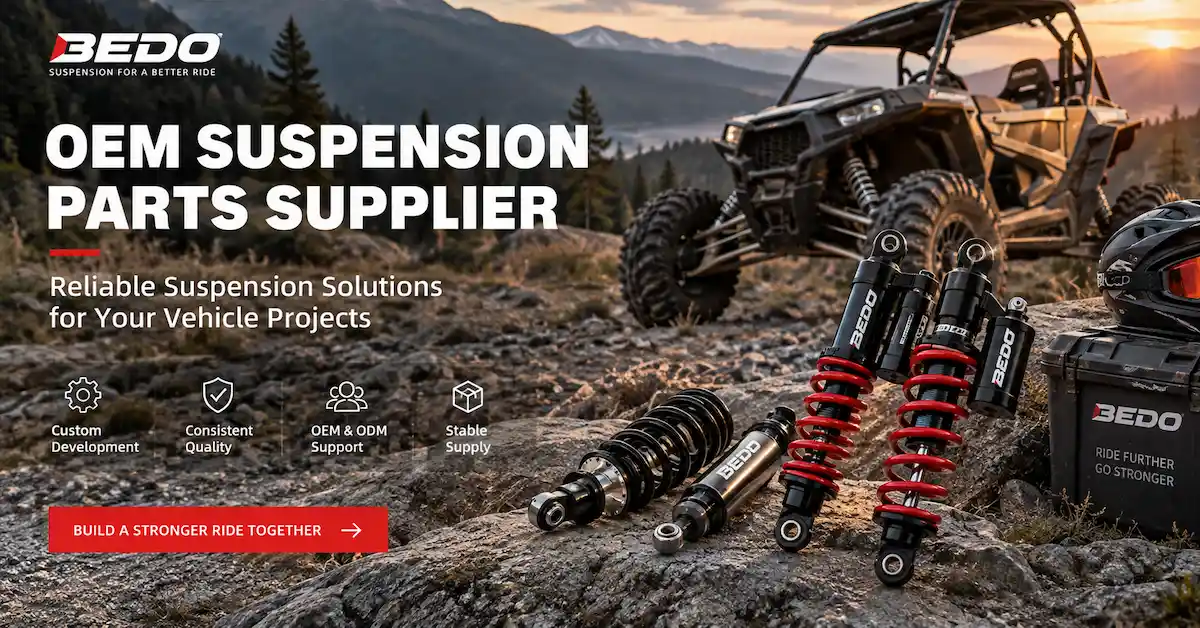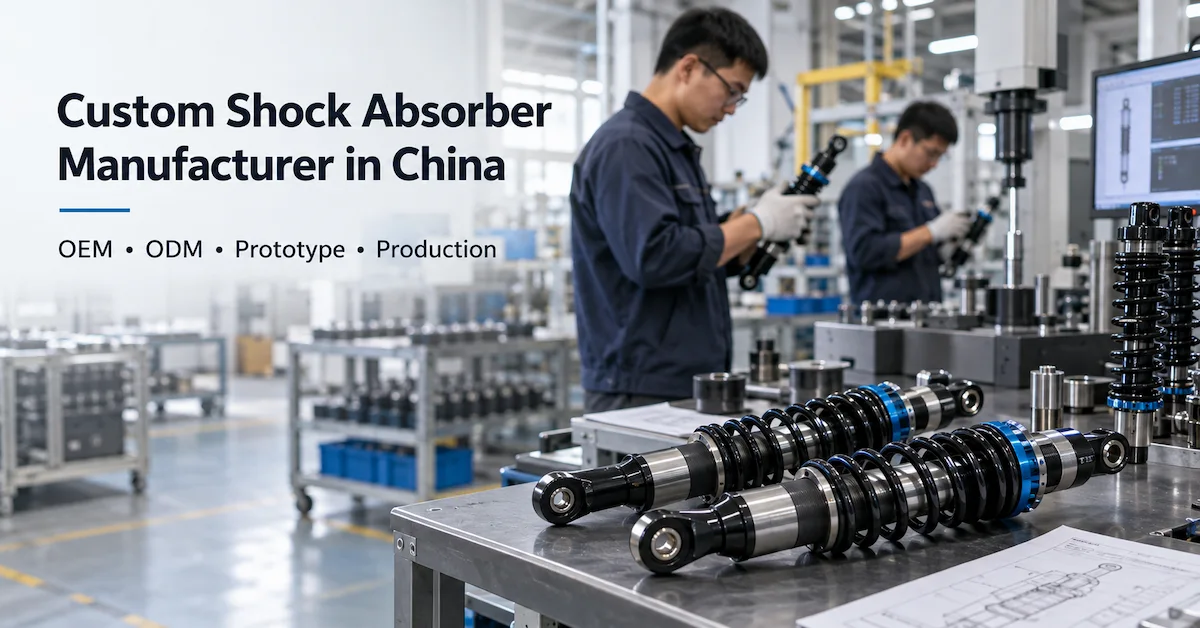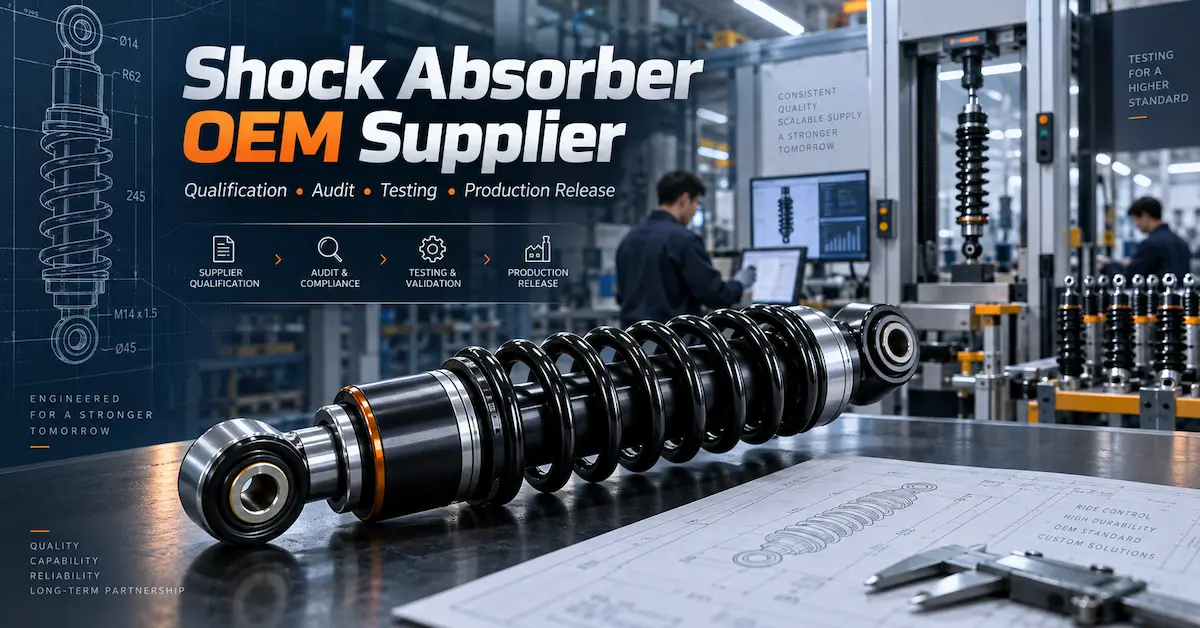

Yes. A capable UTV suspension supplier can develop custom UTV rear shocks for utility vehicles by evaluating the vehicle's rear load, suspension geometry, existing shock dimensions, spring requirements, damping targets, and actual operating conditions.
However, custom development should involve more than copying the dimensions of an existing rear shock.
Utility vehicles may operate with cargo, passengers, permanently installed equipment, or highly variable loads. These conditions can change rear suspension sag, remaining shock travel, ride height, rebound behavior, and vehicle stability.
A practical development process is:
Vehicle & Load Data → Existing Shock Review → Engineering Specification → Prototype → Loaded Vehicle Validation → Revision → Pilot Batch → Production
For OEM buyers, distributors, and utility vehicle brands, the objective is to develop a rear shock specification that performs correctly under the vehicle's real working conditions and can be reproduced consistently during production.
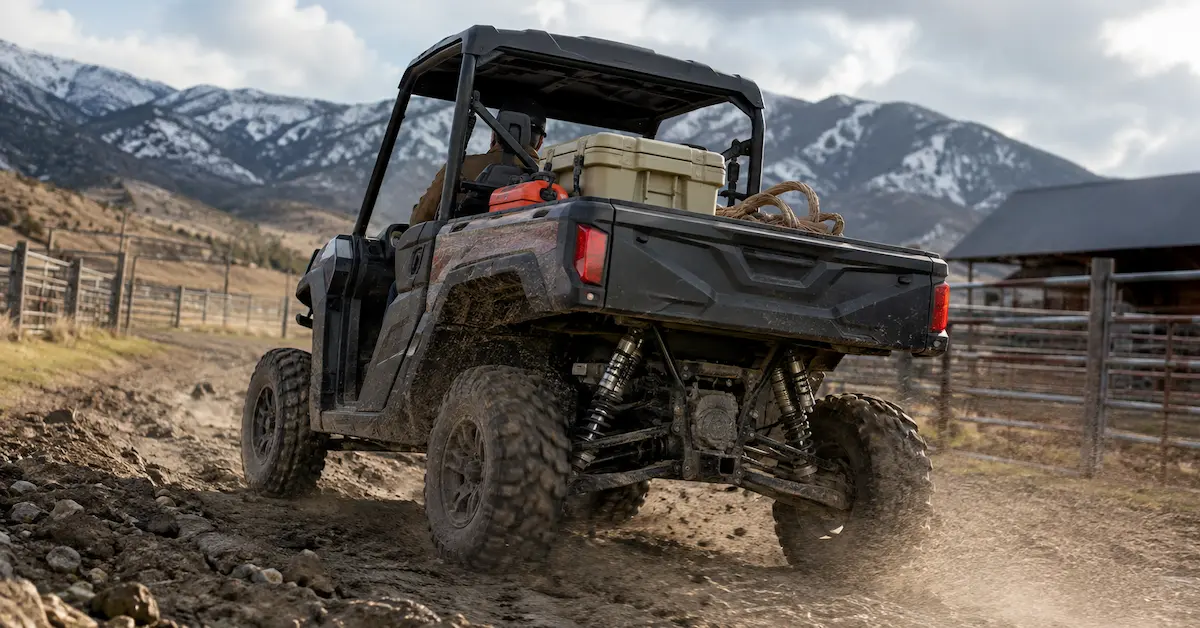
Why Do Utility Vehicles Often Need Different Rear Shocks?
Utility UTVs are commonly used for:
- Agriculture
- Property maintenance
- Construction sites
- Industrial transportation
- Tool carrying
- Cargo hauling
- Fleet operations
- Municipal and service applications
Many of these applications place significant or repeated loads toward the rear of the vehicle.
The original rear suspension may begin to show problems such as:
- Excessive rear sag
- Reduced ride height
- Frequent bottoming
- Limited remaining compression travel
- Poor rebound control
- Excessive body movement
- Reduced stability when loaded
This does not mean every utility UTV automatically needs heavy-duty or customized suspension.
Custom rear shocks become relevant when the existing suspension no longer matches the vehicle's actual load, geometry, duty cycle, or performance target.
Start With Rear Suspension Load, Not Cargo Capacity Alone
A statement such as:
"The UTV has a 500 kg cargo capacity."
is not enough to develop a rear shock specification.
Cargo capacity does not directly tell an engineer how much load reaches the rear suspension.
Important inputs include:
| Vehicle Data | Why It Matters |
|---|---|
| Base vehicle weight | Establishes the starting load |
| Front/rear weight distribution | Shows how vehicle mass is distributed |
| Typical cargo weight | Represents normal working conditions |
| Maximum intended cargo | Defines a demanding use condition |
| Cargo position | Changes rear axle loading |
| Passenger load | Influences total vehicle balance |
| Permanent accessories | Adds constant suspension load |
| Suspension geometry | Affects spring and shock behavior |
A useful principle is:
Cargo capacity tells you what the vehicle carries; rear suspension load tells you more directly what the rear shocks must manage.
For custom projects, actual loaded front and rear axle weights can be particularly useful when available.
Can an Existing Rear Shock Be Used as the Starting Point?
Yes.
Many custom suspension projects begin with an existing shock absorber rather than a completely new design.
The buyer can provide:
- Existing rear shock sample
- Product photographs
- 2D drawing
- 3D CAD file
- Dimensional measurements
Important measurements may include:
- Extended length
- Compressed length
- Shock stroke
- Upper mounting interface
- Lower mounting interface
- Mounting-hole dimensions
- Spring dimensions
- Existing spring specification if known
The existing shock provides useful geometry and packaging information.
However:
Copying the old shock geometry does not automatically solve the old suspension problem.
If the existing shock already allows excessive sag, repeated bottoming, or poor control under cargo load, reproducing the same specification may simply reproduce the same problem.
Can Rear Shock Dimensions Be Customized?
Depending on vehicle geometry and engineering feasibility, dimensions may be evaluated as part of a custom development project.
Possible parameters include:
- Extended length
- Compressed length
- Shock stroke
- Upper and lower mounts
- Eye width
- Mounting-hole diameter
- Spring dimensions
- Reservoir position where applicable
But changing shock dimensions must be done carefully.
For example, simply making a shock longer can affect:
- Suspension droop
- Compression position
- Wheel travel
- CV or drivetrain geometry
- Tire clearance
- Chassis clearance
- Mechanical bottoming points
For this reason, dimension changes should be reviewed as part of the suspension system rather than treated as isolated measurements.
Can Spring Rate Be Customized for Utility Vehicle Cargo Loads?
Yes, depending on the project.
Spring selection for custom UTV rear shocks should be based on the vehicle's actual rear suspension conditions rather than a general assumption that utility vehicles need the stiffest available spring.
Engineering inputs can include:
- Rear axle load
- Typical cargo weight
- Maximum intended cargo
- Suspension geometry
- Motion ratio where relevant
- Target ride height
- Available suspension travel
- Loaded versus unloaded operating time
If the Rear Spring Is Too Soft
Possible results include:
- Excessive sag
- Reduced ride height
- Frequent bottoming
- Poor cargo support
- Reduced usable travel
If the Rear Spring Is Too Stiff
Possible results include:
- Harsh unloaded ride
- Reduced suspension compliance
- Poor traction
- Limited wheel movement
- Unbalanced vehicle handling
The objective is therefore not maximum stiffness.
The correct rear spring provides enough support for the intended load while preserving the suspension movement required for the application.
Does Damping Need to Change When the Spring Changes?
It should be evaluated.
Spring rate and damping have different functions.
Spring Rate
The spring primarily determines:
- Load support
- Static suspension position
- Ride-height behavior
Shock Damping
The shock absorber controls how quickly the suspension moves.
Damping influences:
- Compression speed
- Rebound speed
- Body movement
- Wheel control
- Repeated-bump behavior
If a much stronger spring is installed without reviewing damping, the suspension may no longer be balanced.
A useful development rule is:
Spring Change → Damping Review
How Does Compression Damping Affect a Utility UTV?
Compression damping controls how quickly the rear suspension compresses when the wheel encounters a bump or when vehicle load shifts.
It can influence:
- Impact response
- Bottoming tendency
- Body control
- Loaded stability
A utility vehicle carrying substantial cargo may operate deeper in the suspension travel than the same vehicle when empty.
The damping target should therefore be considered under actual loaded conditions.
However, higher load does not mean compression damping should simply be increased as much as possible.
Too much damping can create poor compliance and a harsh ride.
How Does Rebound Damping Affect a Loaded Rear Suspension?
Rebound damping controls how quickly the suspension extends after compression.
It can affect:
- Wheel recovery
- Tire contact
- Vehicle body control
- Repeated-bump behavior
When spring rate changes, rebound behavior may also change.
A custom shock specification should therefore consider:
Vehicle Weight + Rear Load + Spring + Geometry + Terrain + Performance Target
rather than selecting damping independently.
Why Is Shock Stroke Important?
Load support is only one part of rear suspension performance.
The rear shock must also operate within an appropriate travel range.
Buyers should evaluate:
- Static loaded shock position
- Compression travel
- Droop
- Total shock stroke
- Mechanical clearance
A loaded UTV that sits too close to full shock compression may have little travel left for bumps.
Even if a stronger spring restores ride height, shock stroke and suspension geometry still need to be verified.
A rear suspension that holds the correct ride height but has insufficient usable travel is still poorly matched to the application.
Loaded and Unloaded Performance Should Both Be Considered
Utility vehicles often operate under very different conditions during the same working day.
For example:
Outbound: passengers + tools + cargo
Return: driver + little cargo
A suspension designed only for maximum cargo may become excessively stiff when unloaded.
A suspension optimized only for comfort when empty may sag excessively when working.
Ask:
What percentage of the vehicle's operating time is loaded versus unloaded?
| Operating Pattern | Main Engineering Priority |
|---|---|
| Mostly unloaded | Comfort with sufficient load reserve |
| Mostly loaded | Load support and control |
| Mixed duty | Balanced operating range |
| Permanent rear equipment | Support for constant added weight |
| Highly variable cargo | Broader adjustment range may help |
This operating pattern can influence spring selection, preload strategy, damping targets, and prototype validation.
Should Development Start From CAD or a Physical Sample?
Both can be useful.
Existing Shock Sample
A physical sample helps confirm:
- Packaging
- Mounts
- Overall dimensions
- Existing components
2D Drawing
A drawing is useful for:
- Critical dimensions
- Tolerances
- Mounting details
- Production references
3D CAD
CAD can help evaluate:
- Installation space
- Geometry
- Component clearance
- Vehicle integration
The strongest starting package is often:
Vehicle Data + Load Data + Existing Shock + Drawing/CAD + Current Performance Problem
This gives the engineering team both geometry and performance context.
What Is a Practical Custom Rear Shock Development Process?
A controlled project can follow nine stages.
1. Collect Vehicle Information
Confirm:
- Vehicle model or platform
- Utility application
- Vehicle weight
- Passenger and cargo conditions
2.Review the Existing Rear Suspension
Evaluate:
- Shock dimensions
- Mounting
- Spring
- Travel
- Current suspension problems
3. Analyze Rear Load and Geometry
Determine the conditions the suspension must manage.
4. Define the Proposed Shock Specification
The engineering discussion may cover:
- Dimensions
- Spring configuration
- Damping direction
- Mounting
- Other project-specific requirements
5. Produce a Prototype
Build an engineering sample for verification.
6.Test on the Vehicle
Evaluate the shock under actual operating conditions.
7. Revise the Engineering Specification
Use vehicle feedback to correct issues.
8. Produce a Pilot Batch
Confirm production repeatability before scaling.
9. Approve Production
The final order should reference an approved specification or engineering revision.
The overall path is:
Vehicle Data → Engineering → Prototype → Test → Revise → Pilot → Production
What Should Be Validated on a Rear Shock Prototype?
Prototype testing should focus on the actual application.
| Validation Item | What to Check |
|---|---|
| Mounting | Correct upper/lower interfaces |
| Dimensions | Extended and compressed length |
| Shock stroke | Usable travel |
| Ride height | Loaded and unloaded |
| Sag | Normal working load |
| Compression behavior | Bump and cargo response |
| Rebound behavior | Suspension recovery |
| Clearance | Full suspension movement |
| Basic function | Smooth operation and leakage |
| Vehicle behavior | Real utility use |
Vehicle-level testing is particularly important because a dimensionally correct shock can still produce poor performance if the spring or damping is not appropriate.
Why Should the UTV Be Tested With Cargo?
The vehicle should be evaluated under the load conditions it is expected to experience.
Unloaded or Light Load
Evaluate:
- Ride quality
- Ride height
- Compliance
Normal Working Load
This is often the most important test condition.
Evaluate:
- Sag
- Suspension travel
- Stability
- Compression behavior
- Rebound control
Maximum Intended Operating Load
Confirm:
- Remaining suspension travel
- Bottoming tendency
- Clearance
- Overall control
A suspension modification does not automatically increase the UTV manufacturer's rated payload or GVWR. Vehicle load limits should still be respected.
Custom Rear Shocks vs Standard Replacement Shocks
Custom development is not necessary for every vehicle.
| Factor | Standard Replacement Shock | Custom Rear Shock |
|---|---|---|
| Dimensions | Fixed | Project-based |
| Spring specification | Fixed | Can be evaluated |
| Damping | Fixed | Can be developed |
| Cargo application | General | Application-specific |
| Prototype | Usually unnecessary | Recommended |
| Loaded validation | Basic | Important |
| Engineering revision | Limited | Project-based |
| OEM branding | Often limited | Can be discussed |
A standard replacement shock may be sufficient when:
- Vehicle loading has not changed
- Existing suspension behavior is acceptable
- Fitment is already validated
- There is no significant sag or bottoming problem
- Standard specifications meet the intended use
Custom development becomes more valuable when the application requires a different technical target.
Can a Supplier Support Prototype and Pilot Orders?
A development-oriented suspension supplier may support prototypes and pilot quantities depending on:
- Shock architecture
- Spring requirements
- Custom components
- Tooling
- Surface finish
- Packaging
- Development scope
OEM buyers should ask separately about:
- Prototype quantity
- Pilot-order MOQ
- Production MOQ
- Engineering revision costs
- Tooling requirements
- Lead time for each stage
This is more useful than asking for one generic MOQ.
What Affects the Cost of Custom UTV Rear Shocks?
Several factors can influence the quotation.
These may include:
- Shock architecture
- Dimensions
- Spring specification
- Damping requirements
- Reservoir configuration
- Adjustment features
- Custom components
- Prototype quantity
- Engineering revisions
- Testing scope
- Surface finish
- Branding
- Packaging
- Production volume
When comparing suppliers:
Same Specification → Same Development Scope → Same Testing Scope → Same Packaging → Compare Price
A lower unit price has little meaning if the quotations cover different engineering or production requirements.
How Should Buyers Evaluate a UTV Suspension Supplier?
Before beginning a custom project, evaluate whether the supplier can answer technical questions clearly.
Suspension Engineering
Can the supplier discuss:
- Rear load
- Spring rate
- Shock stroke
- Damping
- Geometry?
Engineering Inputs
Can it work from:
- Existing samples
- Drawings
- CAD files?
Prototype Development
Can the supplier:
- Build a sample
- Receive vehicle feedback
- Revise the design?
Specification Control
Ask how production is linked to:
- Approved dimensions
- Approved spring configuration
- Approved damping
- Engineering revision
Quality Control
Ask how the supplier manages:
- Components
- Dimensions
- Assembly
- Functional checks
- Final inspection
Technical clarity is often a better indicator of development capability than generic claims such as "high quality."
What Should I Include in an RFQ for Custom UTV Rear Shocks?
A detailed RFQ can significantly improve the quality of the supplier's response.
Vehicle Information
Provide:
- UTV brand/model/platform
- Vehicle application
- Base vehicle weight
- Front/rear weight data if available
Load Information
Provide:
- Typical cargo
- Maximum intended cargo
- Cargo location
- Passenger load
- Permanent accessories
Existing Rear Shock
Provide:
- Photos
- Physical sample
- Extended length
- Compressed length
- Stroke
- Mounting dimensions
- Spring data if available
Current Suspension Problem
Examples include:
- Excessive rear sag
- Frequent bottoming
- Poor rebound control
- Harsh unloaded ride
- Insufficient usable travel
Engineering Information
Send when available:
- 2D drawings
- 3D CAD
- Vehicle suspension data
Commercial Requirements
Include:
- Prototype quantity
- Pilot quantity
- Expected production volume
- Target market
- Private-label requirements
- Packaging requirements
A useful RFQ statement could be:
The vehicle regularly carries tools and cargo in the rear bed, and the current rear suspension shows excessive sag and limited remaining travel under its normal working load.
That is much more useful than simply asking for a "stronger shock."
How Bedo Auto Supports Custom UTV Rear Shock Projects
Bedo Auto supports customized shock absorber and suspension development for UTV, ATV, off-road, and specialty vehicle applications.
Utility vehicle buyers can provide:
- Vehicle information
- Rear load data
- Existing rear shock samples
- Drawings
- 3D CAD files
- Current suspension problems
- Performance requirements
Depending on the project,development discussions may include:
- Rear shock dimensions
- Spring configuration
- Damping requirements
- Suspension travel
- Mounting conditions
- Prototype development
- Vehicle test feedback
- Engineering revisions
- Pilot-order evaluation
- OEM/private-label production preparation
For a more useful project evaluation, send your utility UTV model, rear load or cargo data, current rear shock sample or dimensions, suspension problem, prototype requirement, and expected production quantity.
FAQ
Can a UTV suspension supplier develop custom rear shocks?
Yes.A capable supplier can develop rear shocks around vehicle load, suspension geometry, shock dimensions, spring requirements, damping targets, and actual operating conditions.
What information is needed to develop custom UTV rear shocks?
Provide the vehicle model, load data, existing rear shock dimensions or sample, suspension information where available, current suspension problem, and intended use.
Can the rear spring rate be customized for cargo loads?
Yes, depending on engineering feasibility. Spring selection should consider rear suspension load, cargo weight, geometry, ride height, available travel, and loaded/unloaded operation.
Can damping be customized for a utility UTV?
Depending on supplier capability and project requirements, compression and rebound characteristics can be evaluated around the vehicle, spring, load, and performance target.
Can a supplier copy my existing rear shock?
An existing shock can be used as a dimensional reference, but simply copying it may not solve existing sag, bottoming, or damping problems.
Can custom UTV rear shocks be developed from CAD files?
Yes.Drawings and CAD files can support geometry and packaging review, but vehicle load and performance requirements are also needed.
Should rear shock prototypes be tested with cargo?
Yes. Normal working load should be included during validation, together with other important loaded and unloaded conditions.
Do custom rear shocks increase UTV payload capacity?
No. Suspension changes do not automatically increase the vehicle manufacturer's rated payload or GVWR.
Can I order a pilot batch before mass production?
Some development-oriented suppliers can support prototype or pilot quantities depending on components, tooling, and customization requirements.
What should I send for a custom rear shock quotation?
Send vehicle information, load data, existing shock specifications, drawings or CAD if available, current performance problems, quantities, and branding requirements.
Conclusion
A capable UTV suspension supplier can develop custom UTV rear shocks for utility vehicles, but successful development requires more than copying an existing shock or installing a stiffer spring.
The supplier should understand:
Rear Load + Suspension Geometry + Shock Travel + Spring Requirement + Damping Target + Actual Vehicle Use
A practical development path is:
Rear Load Data → Existing Shock Review → Engineering Specification → Prototype → Loaded Vehicle Validation → Revision → Pilot Batch → Production
For utility UTV manufacturers, distributors, and aftermarket brands, the right rear shock is the one that supports the intended working load while maintaining usable suspension travel and controlled vehicle behavior.
The most productive way to begin a project is to provide the supplier with actual vehicle data, rear load information, existing shock dimensions or samples, the current suspension problem, and realistic production requirements.